






Croatia has proven to be one of the best places to invest in terms of Southeastern Europe. Being part of the European Union, the Schengen area, and the Eurozone, this country provides companies easy access to one of the biggest economies in the world while keeping costs relatively low at the same time.
For those who are thinking about doing business in Croatia, it is important to consider both the strengths and weaknesses of this process. Though there are a number of advantages, including strategic location, talented workforce, and a developing tourism industry, an investor should be aware of bureaucracy, taxation, and a relatively small local market.
In this guide, we analyze the pros and cons of doing business in Croatia.
The Top Pros and Cons of Doing Business in Croatia
Strategic EU Market Access When Doing Business in Croatia
The foremost benefit of doing business in Croatia is free access to the European Union’s common market of around 450 million buyers.
After becoming an EU member in 2013, Croatia has managed to boost its legislative framework and attractiveness for investors. With the introduction of the euro in 2023, Croatian companies no longer face any exchange rate risks while conducting business in the Eurozone.
Advantages of doing business in Croatia include:
- Market access to the EU consumers without trade restrictions
- Uniform business legislation
- Increased investor trust
- Convenience of cross-border operations
- Legal clarity
Any foreign-owned company in Croatia will benefit greatly from Croatia’s EU membership.
Tourism Booms Driving Profits While Doing Business in Croatia
Tourism is still one of the leading economic sectors of Croatia.
According to the Croatian National Bank and the Croatian Bureau of Statistics, tourism accounts for about 20% of the country’s GDP, making it one of the most tourism-reliant countries in Europe.
Examples of tourist destinations include:
- Dubrovnik
- Split
- Zadar
- Rovinj
These places attract millions of tourists every year.
Businesses engaged in:
- Hospitals
- Real estate
- Food services
- Transport
- Digital services in the tourism industry
can take a huge advantage of the tourism demand.
Low Operational Costs Found When Doing Business in Croatia
As compared to Western European countries, Croatia maintains comparatively low business costs.
| Expense Category | Croatia | Germany | France |
| Average Office Rent | Lower | Higher | Higher |
| Average Salaries | Lower | Higher | Higher |
| Utility Costs | Moderate | Higher | Higher |
| Commercial Property | Competitive | Expensive | Expensive |
The cost-benefit structure allows the Croatian company or one owned by foreigners to have high operating margins that will allow it to be competitive in the EU market.
Hiring Skilled Local Talent for Doing Business in Croatia
The population in Croatia is well educated, particularly in:
- Information technology
- Engineering
- Economics
- Hospitality
- Medicine
This country provides graduates of such respected universities as the University of Zagreb.
Employees speak English and other European languages, which makes it possible to employ people in the domestic market.
As the Croatian startup ecosystem grows, it is becoming easier to find the right employees for your business in Croatia.
The Main Cons of Doing Business in Croatia
Bureaucracy Hurting Companies Doing Business in Croatia
However, despite all the reforms, bureaucracy continues to be an issue for investors.
The business can face:
- Delays in administration
- Time-consuming approvals
- Documentation difficulties
- Multiple government authorities
Although digital government has advanced, administrative effectiveness is still lagging behind leading European Union countries.
High Tax Rates Faced When Doing Business in Croatia
Croatia’s tax system is basically competitive as compared to other Western European countries; however, investors need to understand different obligations.
| Tax Type | Rate |
| Standard VAT | 25% |
| Reduced VAT | 13% / 5% |
| Corporate Income Tax | 10% or 18% (depending on revenue thresholds) |
| Dividend Tax | Generally 10% |
Companies must look for local tax advice prior to launching a Croatia company to make certain compliance and streamline their tax structure.
Small Local Market Limits for Doing Business in Croatia
The Croatian population comprises roughly 3.8 million individuals.
Although purchasing power has been improved, the domestic market is quite small compared to other EU countries’ markets.
Companies that target only local customers could experience growth constraints.
Effective investors consider Croatia to be:
- Entry gateway into the EU market
- Regional headquarters
- Logistics center
- Destination for tourism investments
Judicial Delays Disrupting Daily Doing Business in Croatia
Legal cases can sometimes be delayed more than anticipated.
Problems include:
- Delays in court
- Administrative appeals
- Delay in contract enforcement
Most international investors prefer contracts and alternative dispute resolution procedures.
Legal Realities of Doing Business in Croatia
Setup and Registration Steps for Doing Business in Croatia
Foreign investors can institute various legal entities, encompassing:
| Entity Type | Suitable For |
| d.o.o. (Limited Liability Company) | Most SMEs |
| j.d.o.o. (Simple LLC) | Startups |
| Branch Office | Foreign corporations |
| Representative Office | Market research activities |
The d.o.o. continues to be the most renowned structure for a foreign-owned Croatian company.
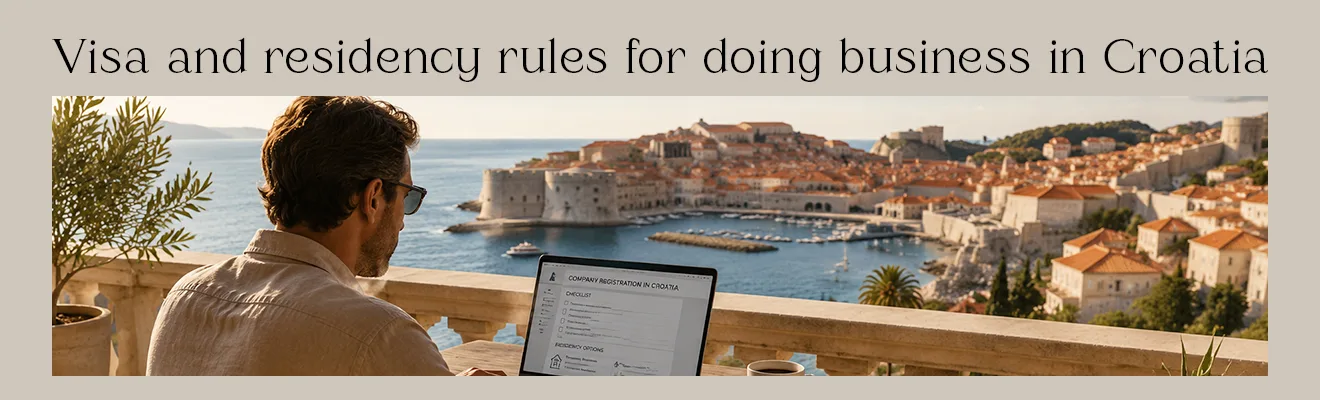
Visa and Residency Rules for Doing Business in Croatia
A non-EU entrepreneur may need:
- Visas for business
- Residence permits temporarily
- Work permits (depending on position)
Croatia also provides options for businessmen or entrepreneurs looking for residency through legitimate business.
This depends on nationality and business type.
Regional Insights on Doing Business in Croatia
Latest Economic Indicators Supporting Doing Business in Croatia
This further enhances Croatia’s ability to attract investors because, according to the recent statistics provided by the European Commission, Eurostat, and the World Bank:
| Economic Indicator | Latest Available Data |
| GDP Growth (2024) | Approximately 3.8% |
| Inflation Rate (2024) | Around 3% |
| Unemployment Rate | Below 6% |
| Foreign Direct Investment (FDI) Inflows | More than €4 billion annually |
| EU Membership | Since 2013 |
| Euro Adoption | Since 2023 |
| Schengen Membership | Since 2023 |
It can be seen from these statistics that Croatia is becoming more economically stable and attractive for international firms wishing to set up business in Croatia and in the whole European Union.
Croatia vs. Capital Dynamics for Doing Business in Croatia
Different regions provide diverse benefits.
| Region | Main Strength |
| Zagreb | Finance, technology, corporate services |
| Split | Tourism and maritime industries |
| Rijeka | Logistics and shipping |
| Osijek | Agriculture and manufacturing |
Zagreb is considered a major destination for investors looking for access to a talent pool and corporate infrastructure.
Infrastructure Strengths Supporting Your Doing Business in Croatia
Croatia has been able to invest substantially in its infrastructure in the last ten years.
The advantages include:
- Up-to-date highways
- Airports for international flights
- Ports for ships
- Increased broadband internet
- Infrastructure projects by the EU
This helps ensure that the running of any business in Croatia becomes efficient.
Strategic Tips for Doing Business in Croatia
Cultural Nuances to Master While Doing Business in Croatia
Having knowledge about business culture in Croatia may lead to more successful business relations.
Key elements are:
- Professionalism in communication
- Hierarchical approach
- Relationship-based negotiations
- Punctuality requirements
- Building trust before making big decisions
Foreign investors who adopt local traditions usually find their business development easier.
Finding Trusted Partners for Doing Business in Croatia
Local partnerships speed up market entry.
Advantages:
- Guidance on regulations
- Access to customers
- Distribution channels
- Local market knowledge
Due diligence is always necessary in choosing partners, suppliers or consultants.
Banking and Financing Realities of Doing Business in Croatia
The Croatian banking industry is stable and well-integrated into the European financial system.
Financing possibilities:
- Bank loans
- Funding programs by EU institutions
- Venture capital
- Private equity
- Subsidies
Euro currency use increases the predictability of financial transactions for foreign businesses.
Recent Statistics on Doing Business in Croatia
| Indicator | Latest Figure |
|---|---|
| Population | ~3.8 million |
| Currency | Euro (€) |
| EU Membership | Since 2013 |
| Schengen Membership | Since 2023 |
| Tourism Share of GDP | Approximately 20% |
| Corporate Income Tax | 10% or 18% |
| Standard VAT | 25% |
| GDP Growth (recent years) | Among the stronger performers in the EU region |
Sources:
- Croatian Bureau of Statistics
- Croatian National Bank
- Eurostat
- European Commission Economy and Finance
- World Bank Croatia Overview
How Insights Kolekr Helps Investors Understand Croatia
Insights Kolekr is an information website that allows entrepreneurs, investors, and foreign companies to gain insight into investment destinations like Croatia.
Insights Kolekr provides information through market intelligence, economic analysis, regulatory information, and investment-related information.
Information that readers may come across includes:
- Investment climate analysis
- Formation of companies
- Industry-specific market intelligence
- Regulatory news
- Regional economic trends
- Business across borders opportunities
For investors looking to operate in Croatia, getting access to the right market information can prove highly beneficial.
Final Verdict on Doing Business in Croatia
Is Risk Worth the Reward When Doing Business in Croatia?
In the case of many investors, the answer is affirmative.
The following are some of the benefits of having your company registered in Croatia. These include proximity to EU/Eurozone countries, tourist services, excellent manpower, and reduced costs. This combination of factors makes Croatia an appealing place for companies that want to establish their presence in Southeast Europe.
Nevertheless, there are some drawbacks – bureaucracy, legal issues, and a rather small domestic market can be a problem for inexperienced businesses.
Those enterprises that prepare carefully for doing business in Croatia and adapt to local laws and the business environment in Croatia have good chances to succeed.
With continuous improvements of infrastructure in Croatia, attracting investments from abroad, and integration into the European economy, opportunities for creating a successful Croatia company or Croatian company will remain quite promising in the future.
Frequently Asked Questions About Doing Business in Croatia
1. Can foreigners set up a company in Croatia?
Yes. Foreigners can register a Croatia company under the Croatian laws. Investors usually prefer the limited liability companies, which are known as d.o.o in the country.
2. How long does the process of company registration in Croatia last?
This depends on many factors, and the process can take some days or even weeks. Digitalization of processes has shortened the period considerably.
3. What are the main types of business taxes that one should be aware of in Croatia?
Corporate tax, VAT, payroll tax, and social contribution are common taxes. The corporate tax is at 10 or 18 per cent, and VAT is at 25 per cent.
4. Why is Croatia a good destination for foreign investments?
Croatia offers access to the EU market, membership in the eurozone, high demand in tourism, well-developed infrastructure, and favourable investment conditions.
5. In which industries are there opportunities in Croatia?
These are the following:
- Tourism and the hotel industry
- Information technologies
- Renewable energies
- Real estate
- Logistics and transportation
- Manufacturing