





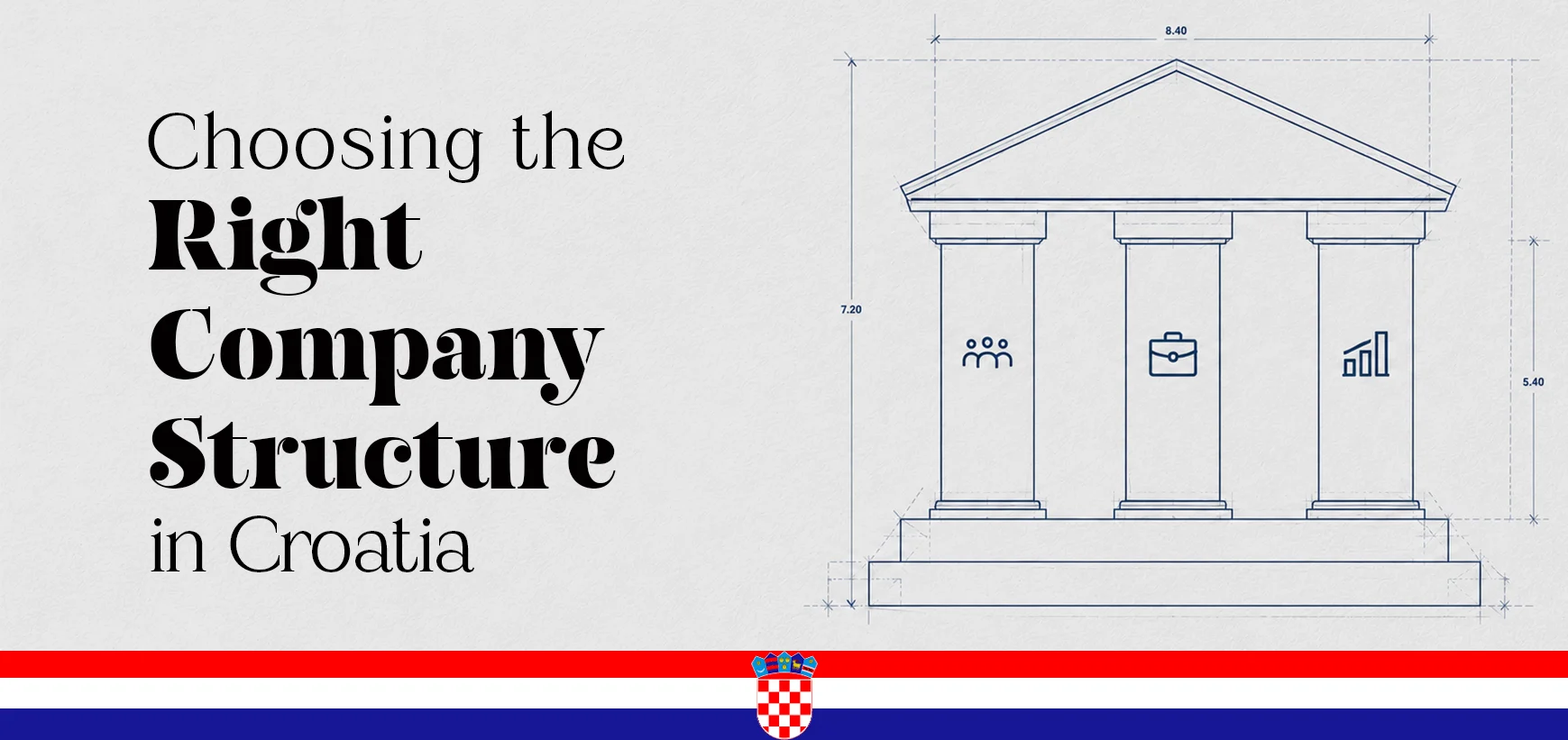
Company Formation in Croatia: Why Choosing the Right Entity Type Matters
Croatia has evolved into one of the most lucrative countries for entrepreneurs, startups, digital nomads, and foreign investors interested in entering the European Union market through its territory. Due to the country’s convenient position, business-friendly policies, highly skilled personnel, and strong economic growth, it represents an advantageous jurisdiction for the establishment of companies in Croatia.
Yet, prior to starting any business in Croatia, one of the main decisions that entrepreneurs need to make is determining their entity type. The selected type will influence the process of taxation, regulation, liabilities, and other matters related to the future development of the business.
If you plan to create your startup, open a subsidiary, or expand internationally by coming to Southeastern Europe, you should have basic knowledge about Croatian company structures.
How Company Formation in Croatia Affects Your Liability and Tax Burden
The structure of the firm affects the extent to which an individual is personally responsible as well as how the revenues will be taxed.
Limited liability firms, for instance, help create a distinction between the two. On the contrary, firms with a sole proprietorship structure could place more of a burden on entrepreneurs as far as their liability goes.
In addition to that, different forms of businesses have different tax liabilities. Some businesses enjoy a simpler process in terms of tax payment, while others make it easier to attract investors and expand globally.
A poor choice of firm structure might result in heavy administrative hassles and high tax rates.
Key Factors to Consider Before Company Formation in Croatia
When considering the type of business structure, one should pay attention to:
- Company size
- Opportunities for expansion in the future
- Capital
- Liability protection
- Desired tax benefits
- Number of shareholders
- Possibility of foreign investments
- Plans for business development
If one makes good plans from the very beginning, it will allow him or her to avoid problems in the future with the reorganization of his/her business.

Company Formation in Croatia: Major Business Structures Explained
There are a variety of business structures available in Croatia. Nevertheless, there are three types that are widely used: the simple liability company (j.d.o.o.), the limited liability company (d.o.o.), and the craft business (Obrt).
j.d.o.o.: A Smart Choice for Small Company Formation in Croatia
J.D.O.O. stands for Jednostavno Društvo s Ograničenom Odgovornošću. This type of business organization was created to stimulate entrepreneurship and simplify the creation process.
This form of the enterprise is especially popular among freelancers, entrepreneurs at the start of their business journey, digital services providers and start-up companies which seek to enter the Croatian market spending little money.
The main advantage of the business structure is that it guarantees limited liability while needing much less capital than a standard limited liability company.
Capital Requirements and Benefits of a j.d.o.o. for Company Formation in Croatia
Key features of a j.d.o.o. are:
- Minimal starting capital
- Quick registration
- Protection from liability
- Lower start-up cost
- Best for single owners or small groups
On the downside, there are some limitations imposed on j.d.o.o, such as the obligation to retain profits until capital reaches designated amounts. In time, most j.d.o.o. firms end up becoming d.o.o. Corporations.
d.o.o.: The Preferred Option for Company Formation in Croatia
The d.o.o. (Društvo s Ograničenom Odgovornošću) is among Croatia’s most common and widely appreciated corporate structures.
It fits well for companies which are seeking sustainable development, investments and flexibility. The d.o.o. is preferable for foreign investors because of its excellent reputation with banks and other clients and partners.
Such a company guarantees limited liability and allows for its further successful expansion in the international arena.
Why Foreign Investors Choose a d.o.o. for Company Formation in Croatia
Foreign entrepreneurs very often prefer d.o.o. as it delivers:
- Strong shareholder rights under the law
- Professional image of the corporation
- Easy access to banks and funding
- Flexibility in ownership structure
- Alignment with international business standards
- Increased appeal to investors and partners
In general, the d.o.o. is favoured among most international companies that enter the market in Croatia because of its combination of all these benefits.
Obrt or Company? Choosing the Right Structure for Company Formation in Croatia
An Obrt is a traditional Croatian company structure frequently leveraged by self-employed professionals, tradespeople, consultants, and service providers.
Not similar to a company structure, an Obrt is directly associated with its owner. However, this develops administrative simplicity; it may further lead to increased personal liability based on the particular type of craft registration.
With respect to freelancers and small-scale operators, an Obrt can offer a practical and cost-effective solution. While businesses planning substantial growth often transfer to a corporate structure later.
Why a Paušalni Obrt Can Be a Cost-Effective Option for Company Formation in Croatia
Paušalni Obrt has gained popularity with freelance professionals, remote workers, and online entrepreneurs in recent times.
Advantages of the form include:
- Easier accounting
- Cheaper accounting
- Predictable taxation
- Less bureaucracy
- Quick registration
A potential benefit for qualified entrepreneurs earning an average amount is tax efficiency when compared to standard companies.
Comparing Business Structures for Company Formation in Croatia
Choosing a J.D.O.O., a D.O.O., and Obrt depends on your plans concerning investments and income, as well as the purpose of the business. The Table mentioned below highlights the major differences:
| Feature | j.d.o.o. | d.o.o. | Obrt |
| Legal Entity | Yes | Yes | No (linked to owner) |
| Liability Protection | Limited | Limited | The owner may bear personal liability |
| Typical Use | Startups and small businesses | Growing businesses and foreign investors | Freelancers, tradespeople, consultants |
| Minimum Founders | 1 | 1 | 1 |
| Foreign Ownership Allowed | Yes | Yes | Generally, yes, subject to requirements |
| Accounting Requirements | Full accounting | Full accounting | Simplified options available |
| Investor-Friendly | Moderate | High | Low |
| Business Credibility | Good | Excellent | Moderate |
| Scalability | Moderate | High | Limited |
| Best For | Early-stage entrepreneurs | Long-term growth and expansion | Self-employed professionals |
Minimum Capital Requirements for Company Formation in Croatia
Though regulations might be upgraded periodically, entrepreneurs must expect the following capital requirements:
| Business Structure | Minimum Capital Requirement |
| j.d.o.o. | €1 |
| d.o.o. | €2,500 |
| Obrt | No minimum capital requirement |
Investors need to verify current legal prerequisites before incorporation, since regulatory frameworks can emerge.
Company Formation in Croatia for Foreign Entrepreneurs and Digital Nomads
Croatia’s emerging international appeal has been successful in attracting entrepreneurs across the world, specifically with the introduction of digital nomad-friendly policies and augmented foreign investment activity.
Choosing the right structure is predicated on the nature of your business activities, residency status, and long-term goals.
Can Non-EU Citizens Complete Company Formation in Croatia?
Yes. Non-EU residents can easily set up companies in Croatia, whether it is a d.o.o. structure or a j.d.o.o. structure.
Foreigners can be shareowners, directors, and even conduct operations within Croatia under appropriate legal guidelines.
Foreign companies in Croatia usually take advantage of setting up their businesses in Croatia because it provides an entry point into the whole European Union.
As the legal requirements may change from time to time, one should always consult professionals when setting up a company.
Branch Office or Subsidiary: Which Is Better for Company Formation in Croatia?
For international companies in Croatia, two options usually present themselves in the form of either forming a branch office or forming a subsidiary.
Branch Office:
- Acts as an extension of the firm’s operations abroad
- Does not form a new legal structure
- Can help make administrative tasks easier
Subsidiary:
- Forms a new legal structure in Croatia
- Gives better separation of liability
- Has more operational freedom
Ultimately, the choice depends on the purpose of doing business, as well as tax planning considerations and risk management strategies.
Tax Considerations for Company Formation in Croatia
Tax planning plays a significant role when choosing a business structure. Croatia has a transparent Croatia corporate tax framework aligned with European Union standards.
Knowing about the tax implications of each entity type can assist entrepreneurs in boosting efficiency and remaining compliant.
Business Tax Overview for Company Formation in Croatia
Croatia has a competitive tax framework that supports entrepreneurship, thereby being aligned with European Union standards.
Key taxes business owners need to consider include:
| Tax Type | Typical Rate |
| Corporate Income Tax (small businesses meeting revenue thresholds) | 10% |
| Corporate Income Tax (larger companies) | 18% |
| Standard VAT Rate | 25% |
| Reduced VAT Rates | 13% and 5% (certain goods and services) |
| Dividend Withholding Tax | Generally, 10% (subject to treaties and exemptions) |
The efficient tax burden is likely to depend on company size, revenue levels, industry sector, and international tax treaty applicability.
Tax Considerations for Foreign Companies During Company Formation in Croatia
Foreign enterprises should take into account:
- Benefits under the double taxation treaty
- Dividend distribution strategy
- Structure parent-subsidiary relations
- Need to register for VAT
- Requirements for cross-border payments
One may use professional consulting services in this matter in order to operate the company more efficiently.
Understanding Corporate Income Tax When Completing Company Formation in Croatia
Corporate Income Tax (Porez na Dobit) applies to Croatian companies.
Rates will vary according to different factors, including income levels or legislation changes. The tax rate can be reduced if you run a small company and increased if you run a large company.
There are other taxes related to the business besides corporate income tax, namely,
- VAT taxes
- Payroll taxes
- Social security taxes
- Other local taxes
It is recommended to keep track of any changes concerning the tax system.
Withholding Tax and Profit Distribution After Company Formation in Croatia
Foreign investors should also be made aware of dividend taxation issues.
Important issues include:
- Dividend withholding tax provisions
- Double taxation agreements
- Parent-subsidiary exemptions
- Cross-border payments regulations
- Taxation laws internationally
Good tax structuring can increase efficiency in international business ventures considerably.
Step-by-Step Guide to Company Formation in Croatia
Though the processes vary slightly based on the entity type, the basic registration process includes the following steps:
Step 1: Decide on Your Legal Entity Form
Choose which form will suit your purposes better – j.d.o.o., d.o.o., Obrt, Branch Office or Subsidiary.
Step 2: Find a Suitable Company Name
You should be able to choose a name for your company and ensure that the name corresponds with the laws regarding naming companies in Croatia.
Step 3: Gather All Necessary Documentation
You will need to have the following documents ready:
- Personal identification documents
- Articles of incorporation
- Shareholders’ details
- Registered office location
- Appointment of management
Step 4: Transfer of Share Capital
If you have to pay share capital, you will have to transfer money to the bank account of the country.
Step 5: Register a Business
Provide all necessary documents and register your company.
Step 6: Get Registered With Tax and VAT
Go to the tax office and register a business and VAT, if necessary.
Step 7: Establish Bank Accounts
Open corporate bank accounts to conduct transactions.
Step 8: Start Operating
After completing all the above steps, you are ready to operate legally.
Market Research Before Company Formation in Croatia
Before forming the business venture, it is necessary to do extensive market research and consider sector-related business opportunities in Croatia.
That is why Kolekr Insights may prove to be a great resource in this process. The website offers users such benefits as market intelligence, information about the latest business and economic trends, investment opportunities, and other related factors.
Those businessmen who want to expand their business in Croatia could benefit a lot from the services of Kolekr. In the first place, they will get information about different spheres, evaluate demands, monitor regulations and make decisions based on facts. Thus, they will be able to minimize possible risks and enter the Croatian market.
Conclusion: Making the Right Choice for Company Formation in Croatia
There are many opportunities to choose a business structure in Croatia. One may create a j.d.o.o., a d.o.o., or an Obrt. The choice of a company structure may prove to be one of the most important decisions you make as an entrepreneur.
The right choice can provide better tax savings, protection of assets, increased transparency, and more favourable conditions for the future development of your venture. Professional assistance coupled with market information available via online platforms like Kolekr Insights, can help make this process easier for investors.
Frequently Asked Questions About Company Formation in Croatia
1. Which company structure is best for foreigners in Croatia?
In general, the business form that is considered best in Croatia for many foreigners is d.o.o. (Limited Liability Company).
2. Can a foreigner start a business in Croatia?
Yes, both citizens from EU countries and other nations can set up businesses in Croatia following relevant regulations.
3. Is there a difference between j.d.o.o. and d.o.o.?
The j.d.o.o. is more preferable because it requires relatively little start-up capital.
4. Is it better to establish an Obrt than a company?
Obrt seems more suitable for individuals because of the lower bureaucracy associated with such a company.
5. What is the minimum capital requirement for registering a company in Croatia?
In the case of setting up a j.d.o.o., the minimum capital amount is only €1, while the initial capital for d.o.o. should be no less than €2,500.
6. What is the corporate tax rate in Croatia?
Depending on revenue, Corporate Income Tax rates range from 10% to 18%.
7. Can my company trade freely in the EU?
Due to being part of the EU, a Croatian company could do business throughout the region, provided that certain conditions are fulfilled.
8. How much time would it take to register my business in Croatia?
As long as all necessary documents are ready, the procedure could be finished within just a few days.