






Overview of Business Structure in Greece
Commencing a business in Greece puts forth access to the European Union Market, a pivotal location, and a rising entrepreneurial environment. Choosing the right legal structure is one of the most crucial aspects to consider while establishing a Greek company.
Why Choosing the Right Company Type Matters
The company structure decides your liability, taxation, operational feasibility, and compliance needs. The majority of startups concentrate on their capacity to adapt, which requires only a small amount of funds, whereas larger organizations depend on their reputation and their ability to secure funding.
Key Legal and Tax Differences Between Structures
All structures demonstrate their uniqueness through these factors:
- Liability: The first element requires courts to determine whether business owners possess liability for their company’s financial obligations.
- Taxation: The second element establishes two different tax systems which apply to businesses: corporate tax and personal income tax.
- Capital Needs: The third element defines the necessary funds which must be acquired before starting the business.
- Governance: The framework includes two types of management restrictions which control both operational processes and the reporting requirements.
The differences between Asian and Western business practices are essential for anyone who is considering doing business in Greece.
Public Limited Company (A.E) in Greece
Key Characteristics of A.E Companies
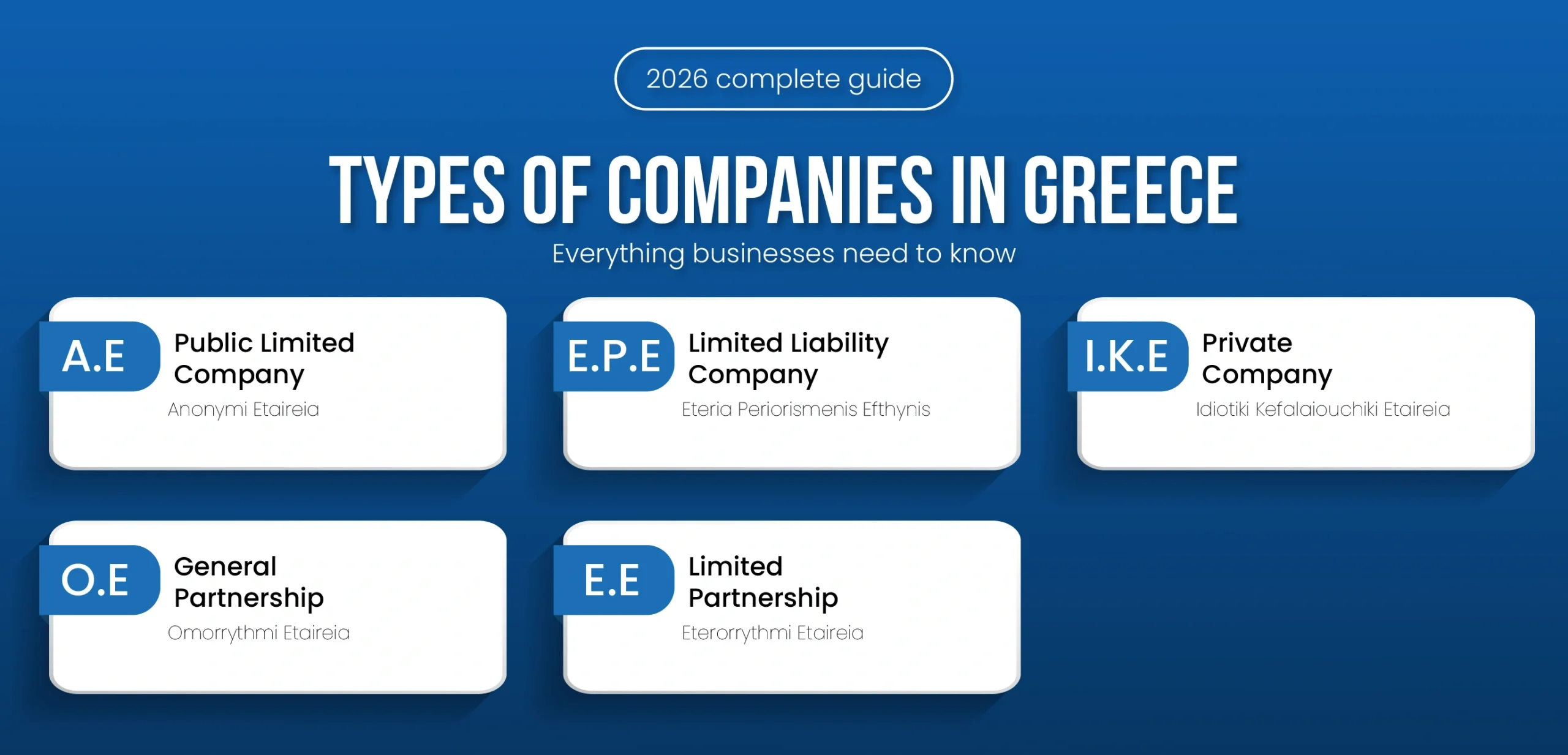
A Public Limited Company (Anonymi Etaireia – A.E) is basically leveraged by large entities. It is a separate legal entity with stakeholders, and its stakes can be publicly traded.
Minimum Capital Requirements
- The minimum required share capital amounts to: €25,000
- The capital must be fully paid or partially paid during the company incorporation process.
Advantages and Disadvantages
Advantages:
- Shareholders enjoy limited liability protection
- Companies can obtain funds through share sales
- A strong reputation provides them with corporate goodwill
Disadvantages:
- The system requires time-consuming setup work, which needs specialized operations to handle its complicated functions.
- The organization needs to meet more demanding reporting requirements because of its increased compliance obligations.
- The system requires costly upkeep expenses.
Limited Liability Company (E.P.E) Explained
How E.P.E Companies Work
The Eteria Periorismenis Efthynis (E. P. E) operates through the same frameworks which define private limited companies. It combines the fundamentals of partnerships and corporations.
Legal Obligations and Structure
- Needs notarized articles of association
- Handled by one or more directors
- Ownership is segmented into company shares (not publicly traded)
When to Choose an E.P.E
This particular structure is perfect for mid-sized businesses that require limited liability but do not require public fundraising alternatives.
Private Company (I.K.E): The Most Popular Option
The Idiotiki Kefalaiouchiki Etaireia (I.K.E) is one of the most flexible and immensely used structures in Greece, at present, particularly for startups and SMEs.
Benefits for Startups and Small Businesses
- No minimum capital prerequisite (can even start with €1)
- Supple management structure
- Limited liability for owners
- Quick and simple incorporation process
Cost and Setup Process
Incorporating an I.K.E is comparatively affordable and can be completed through the one-stop business service in a couple of days, making it suitable for entrepreneurs entering the Greek market.
General Partnership (O.E) in Greece
Key Features of O.E Partnerships
An Omorrythmi Etaireia (O.E) is a general partnership wherein all partners participate actively in the business.
Liability of Partners
All partners possess unlimited liability; that is, personal assets can be used to cover business debts.
Pros and Cons
Pros:
- Effortless to set up
- Lower operational costs
- Easy tax structure
Cons:
- Extreme personal risk
- Tough to attract investors
Limited Partnership (E.E) Structure
Difference Between General and Limited Partners
An Eterorrythmi Etaireia (E.E) consists of:
- General Partners: Look after the business and have unlimited liability
- Limited Partners: Have a share in capital and liability limited to their investment
Risk and Liability Considerations
This structure is ideal when investors need limited exposure while enabling experienced partners to manage operations.
Sole Proprietorship (Individual Business)
Who Should Choose this Structure
A sole proprietorship is perfect for freelancers, consultants, and small-scale entrepreneurs.
Taxation and Responsibilities
- All earnings which people receive as personal income face taxation
- All outstanding debts and financial commitments are the owner’s responsibility
Advantages and Limitations
Advantages:
- The process of registering for the service requires minimal effort
- The business owner possesses total authority to make decisions which affect the company
- The total expenses of the operation show a decrease
Limitations:
- The business requires people to take on all financial responsibilities
- The company experiences restricted development possibilities
- The business encounters challenges when trying to obtain financial resources
Branch Offices of Foreign Companies in Greece
How to Open a Branch in Greece
Foreign firms possess the ability to open international offices without the need to create new legal business entities. The parent company is responsible for operations.
Legal and Tax Implications
- The organization has to follow Greek corporate tax regulations
- The organization needs to appoint a legal representative who will work in Greece.
- The organization must keep its accounting records in the country where it operates.
When a Branch is the Best Option
A branch serves as an ideal solution for businesses that want to test the Greek market or expand their operations without establishing a new subsidiary.
Joint Ventures and Strategic Partnerships
How Joint Ventures Work in Greece
A joint venture is when two or more entities collaborate to work on a specific project or business endeavor. They can be organized contractually or through a different legal entity.
Legal Framework and Agreements
- Governed by contractual agreements
- Describe roles, profit sharing, and liabilities
- Often employed in construction, tourism, and energy sectors
Less Common Business Structures
Silent Partnerships Explained
Silent partnerships enable investors to contribute capital without active participation in management. The company does not disclose its identification details to the public.
Alternative Collaboration Models
Other respective models cover:
- Cooperative businesses
- Non-profit organizations
- Consortiums for mega infrastructure projects
These structures are not so common but quite useful in niche scenarios.
Comparison of Company Types in Greece
Liability Comparison
- Limited Liability: A.E, E.P.E, I.K.E
- Unlimited Liability: O.E, sole proprietorship
- Mixed Liability: E.E
Taxation Differences
- Corporate Entities (A. E, E. P. E, I. K. E) will be subject to corporate tax assessment.
- Individuals operating as partnerships or sole proprietors are taxed based on their personal income.
Setup Cost and Complexity
- A.E. organizations face high tax rates
- E.P.E. organizations maintain medium tax rates
- I.K.E. organizations have flexible tax rates which range from low to high
- Sole proprietorships and partnerships maintain extremely low tax rates
How to Choose the Right Company Type
Based on taxation and Risk
The I.K.E and A.E structures provide limited liability protection, which should be chosen by individuals who want to minimize their personal risk.
Common Mistakes to Avoid
- Choosing a structure solely based on its price
- Overlooking future growth initiatives and plans
- Failing to adequately assess compliance needs
- Does not constitute legal or tax advice
Final Thoughts on Choosing a Business Structure in Greece
Selecting an appropriate structure works as the essential starting point. Entrepreneurs can select from several company types, which range from flexible I.K.E companies to strict A.E. corporations to meet their specific business needs.
The I.K.E structure represents the best operational solution for modern businesses, which include startups and international investors. The appropriate structure for you needs to be selected according to three factors, which include your project’s size, your funding requirements and your capacity to handle potential dangers.
The company should consult with both legal and financial professionals before making decisions because they need to check Greek legal compliance and verify that business goals will be achieved.
The company guide, which covers all aspects of doing business in Greece, constitutes a complete resource that Insights Kolekr developed. The content is pedestal on in-depth research, current legal frameworks, and business expansion coupled with market entry. Insights Kolekr’s expertise helps entrepreneurs make informed decisions when doing business in Greece. For more such expert-driven business guides, you can count on Insights Kolekr.