By closing Russia’s Azov route to Crimea and battering refineries deep inside Russian territory, Ukraine’s drone campaign is forcing Moscow to rethink how it moves fuel and troops across nearly every front of the war.
 Roman Pataj



Every day, the Ukraine Battlefield update newsletter offers a clear look at how the war is unfolding on the ground. Subscribe for free here to get the full text delivered to your inbox.
Russia is losing another sea, its maritime route to Crimea is closing. A literal hunt for Russian tankers has begun in the Sea of Azov. The commander of drone forces, Robert Brovdi, better known under the nickname Magyar, wrote about the destruction of enemy ships on an industrial scale, and it is hard to accuse him of exaggeration.
The operation began in the night from Monday to Tuesday and continued into last night. On Wednesday before noon, Brovdi announced that they had managed to hit as many as 21 ships. Reportedly, 19 of them were tankers of the so‑called shadow fleet, one was a cargo ship and a ferry in Kerch was also hit.
Such massive attacks in the Sea of Azov are a novelty. They are undoubtedly part of an effort to disrupt Russian logistics, including in Crimea. In Russia, people have already become used to the fact that their fleet in the area is powerless, but videos showing Ukrainian drones setting one ship after another on fire without resistance have triggered a new wave of criticism of the navy.
“If this goes on, we will have our own little Strait of Hormuz, with Ukraine in the role of Iran and us in the role of the United States – ships will simply not be able to reach Crimea and sail back without being hit by drones,” the Russian Telegram channel Military Correspondent with 600,000 followers wrote on Wednesday.
The strong words were explained by two compilations. The first was published by Magyar’s Birds on Tuesday morning:
USF Birds played Battleship with the shadow fleet tankers today:
The shadow fleet is leaving the chat.
The battle for fuel supplies to Crimea in the Sea of Azov: 8 shadow-fleet tankers of the rf were hunted down and lit up by pilots of “Kairos” from the 414th Brigade “Magyar’s… pic.twitter.com/QLFHDsuVlW
— 414 Magyar’s Birds (@414magyarbirds) July 7, 2026
On Wednesday before noon, another followed:
Magyar’s update: the tanker hunt continues.
🔥 The USF Birds struck 9 more russian shadow fleet tankers during the night of July 8 in the Sea of Azov.
🌶️ 21 vessels were hit over the past 72 hours: 19 shadow fleet tankers, 1 cargo ship, and 1 ferry in Kerch.
The operation was… pic.twitter.com/nWhJTU8vtQ
— 414 Magyar’s Birds (@414magyarbirds) July 8, 2026
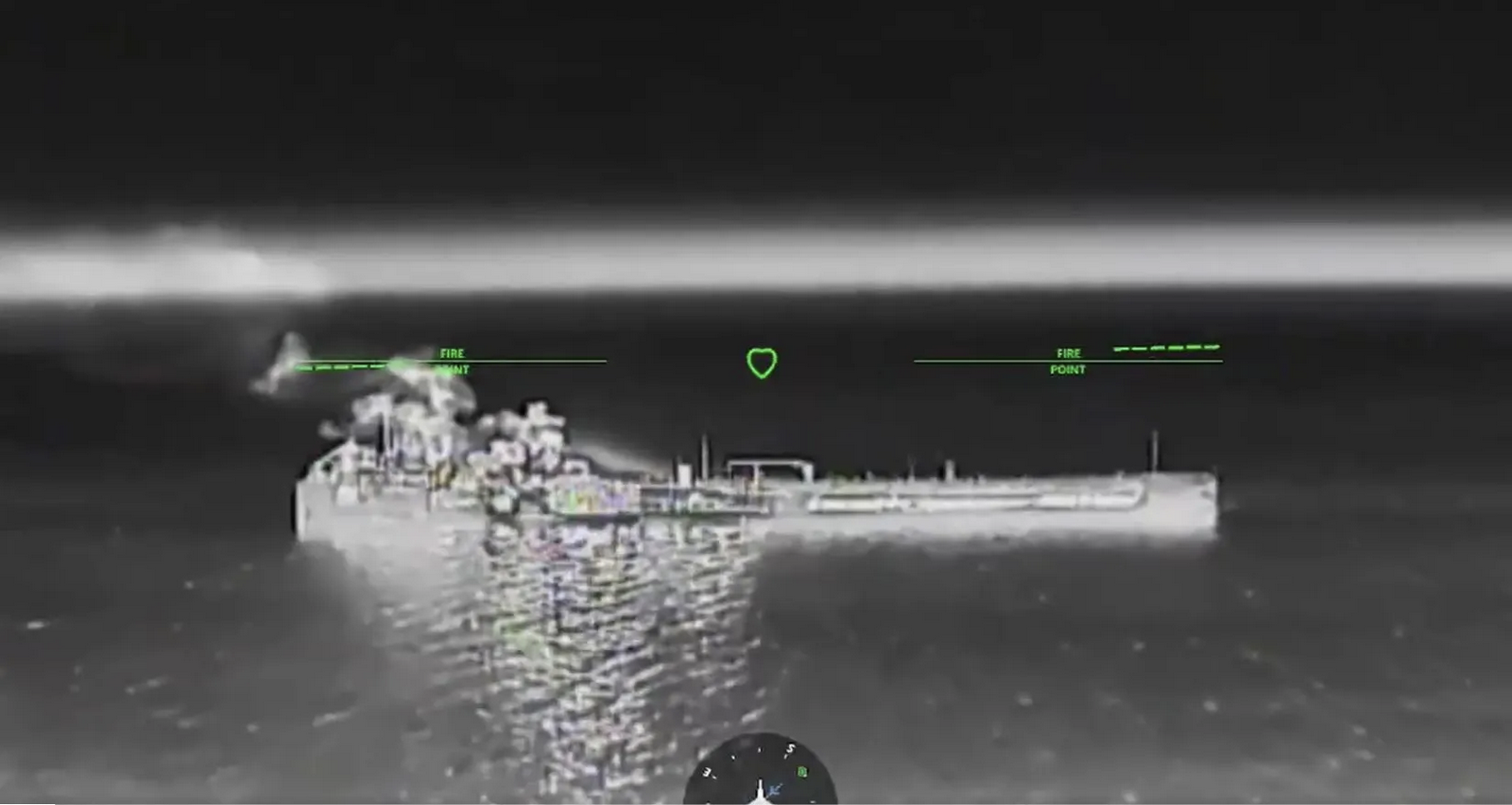
Several ships ended up in flames like this one:
Footage of Russian oil tankers burning in the Sea of Azov last night after a series of Ukrainian drone strikes.
Ukrainian attack drones continue to hunt down Russian vessels in the area. pic.twitter.com/JRD37YWaT2
— OSINTtechnical (@Osinttechnical) July 7, 2026
The attacks took place to the north of Kerch. The footage shows dozens of ships. Some were clearly underway, but several were probably lying at anchor without moving.
🛳️💥 To understand where SBS attacked the tankers: the anchorage is located in the Kerch Strait area and north of the Kerch (Crimean) Bridge, – Falcon Insight pic.twitter.com/CVQCcbi5fo
— MAKS 26 🇺🇦👀 (@Maks_NAFO_FELLA) July 7, 2026
“They were reportedly carrying fuel for Crimea and were hit in the Sea of Azov,” the Russian channel Two Majors wrote on Tuesday, which had already described the operation after the first wave as a “reckless attack on civilian targets”.
The Military Correspondent channel at the same time also confirmed that the tankers were transporting fuel to Crimea. It criticised the way it was being moved. It noted that the ships were sailing in a tight formation, “which for Ukrainian FP‑2 drone operators is literally a shooting range. There is no protection at all by ships of the Black Sea Fleet, which has long barely been able to defend itself.” It also pointed out the fact that there were no weapons on the tankers for their protection.
This is what the convoy looked like on satellite images before the attack:
🛳️💥 Yesterday’s pictures of Russian tankers, which were attacked in the Sea of Azov today.
The photo shows 38 vessels heading to the Kerch port. pic.twitter.com/k1oO6Np18O
— MAKS 26 🇺🇦👀 (@Maks_NAFO_FELLA) July 7, 2026
The Russian retaliation continues – Ukraine has already lost dozens of petrol stations. Azerbaijan is protesting. The French analyst Clément Molin counted 52 destroyed petrol stations in Ukraine’s frontline regions since the beginning of June. He estimates that together with those lacking visual confirmation, the figure may be 70. For comparison, according to data from the Slovak Association of the Petroleum Industry and Trade, there were 674 petrol stations in Slovakia last year.
Such a loss would in our conditions represent roughly a ten percent reduction. Ukraine, however, is much larger and its petrol-station network is very dense. So for now this does not amount to fatal consequences, but it is certainly a potentially very serious problem.
Russia is at the same time trying to strike Ukrainian fuel tankers as well, but it is lagging behind in the number of vehicles hit.
Molin’s map of the hit petrol stations:

It is noteworthy that Azerbaijan has entered the picture, having summoned the Russian ambassador because some of the attacks hit a station of the Azerbaijani network SOCAR. Since this was not the first such case, Azerbaijani diplomacy expressed the conviction that it was deliberate.
Kostyantynivka may be “captured”, but there is still intense fighting and many Ukrainian soldiers in the town – on Russian contradictions in their claims about controlling the city. “Kostyantynivka is liberated,” begins the analysis of the situation by the Russian Telegram channel Archangel Spetsnaza. It has one million readers and is among the largest and most influential. The rest of the message is an attempt not to write directly that Vladimir Putin lied when he announced the capture of the town last week, while smuggling between the lines information about the real situation.
The author is careful to stress that the report came from the Ministry of Defence, not from him. This is what his map looks like:
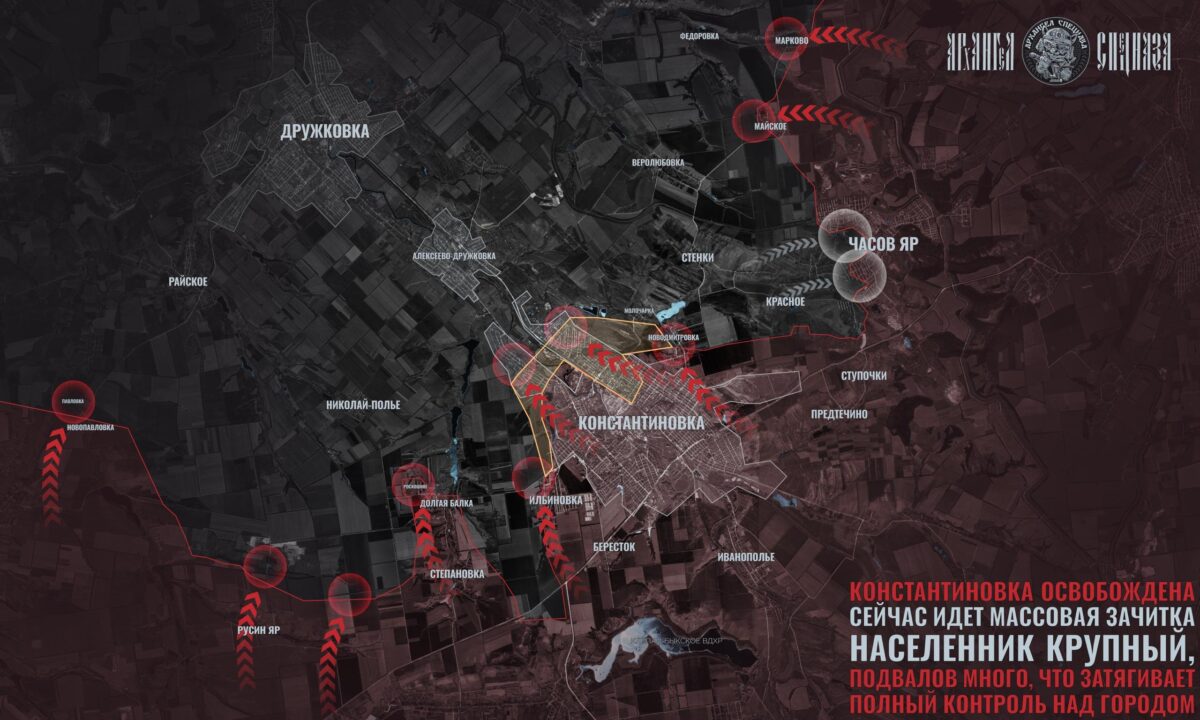
Then, however, a different story follows:
“The town has indeed come under our control, but there is still a lot of work to do in it, which our units are currently engaged in. Kostyantynivka is very large, it has an extensive network of communications and dense urban development, including a large number of basements. The enemy has settled in many such facilities and is hiding in houses. Soldiers of the Russian army are currently busy searching for and clearing the area of the remnants of Ukrainian units.”
So the town is “liberated”, but there are still many Ukrainian soldiers in it, and there will be a lot of work with them because they are in many houses. In other words, where else but in houses should soldiers in urban fighting be, and what has actually changed to allow it to be described as captured?
Archangel Spetsnaza claimed that the south and the centre of the town were under the full control of the Russian army, “but the north‑western part is still being cleared”. So this too directly contradicts Putin’s statement about the capture of Kostyantynivka.
The town will indeed fall definitively in a short time, but this has not yet happened, and Russian propagandists have a problem with how to play along with Putin and at the same time not repeat his claims, which they otherwise describe as the cause of heavy losses.
What is happening in Sumy region – Russia is advancing, but less than it claims. This is one of the few places where Russia constantly reports that it is making gains. The latest version was published by the military channel Rybar. The main part of the map focuses on the area into which Russian forces pushed at the beginning of 2025, after they drove Ukrainian units out of Kursk region. If his map were accurate, in a year and a half of fighting the Russian army here would have advanced 14 to 15 km deep into Ukrainian territory, furthest near the village of Kyyanytsia, which lies just under 13 km from Sumy.
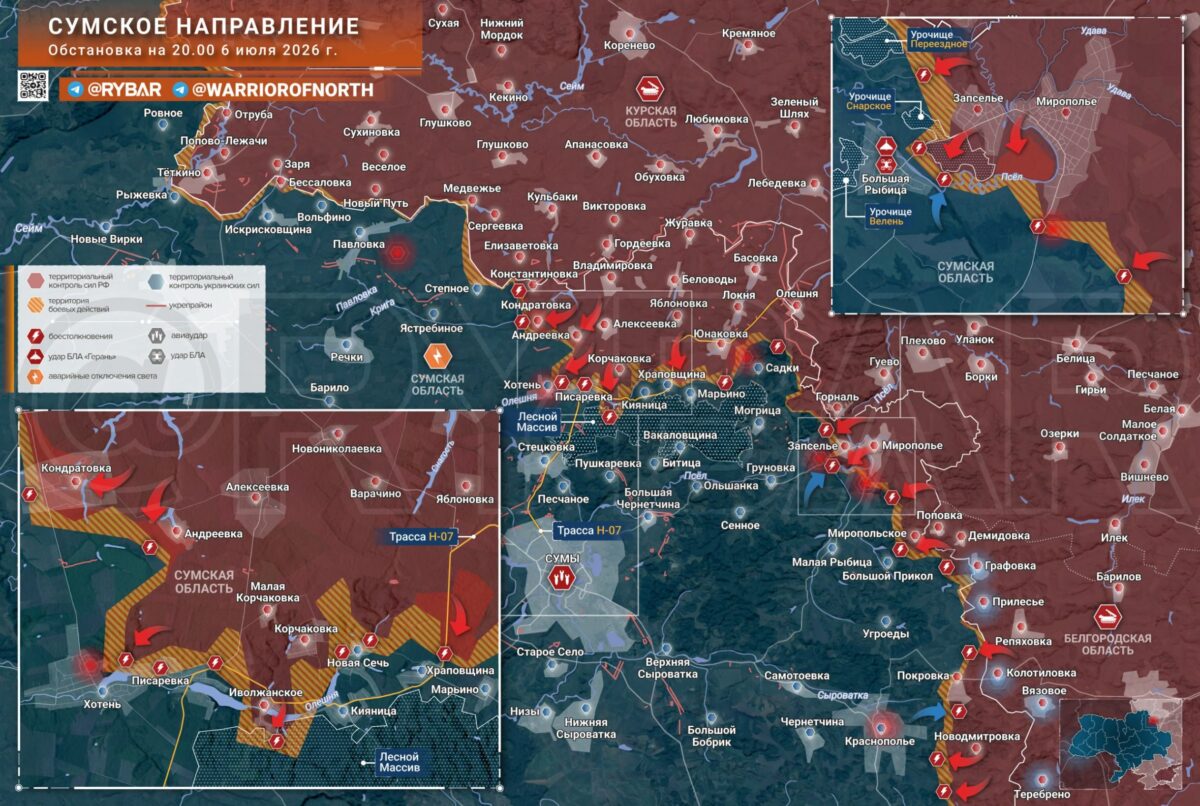
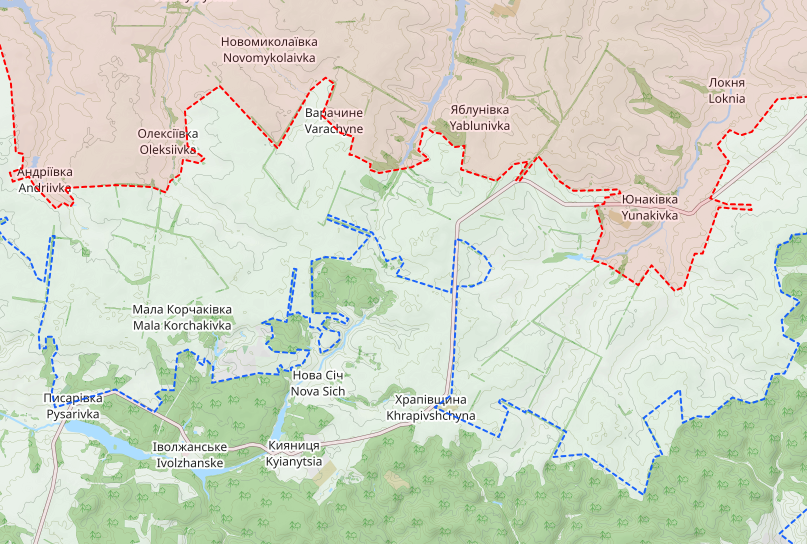
As we will show a bit further down, Rybar is among the more trustworthy Russian sources, but its maps are notoriously inaccurate and plot Russian positions significantly farther forward than they are in reality. In this case, they are two to three km farther south than, for example, the Ukrainian account Petrenko:
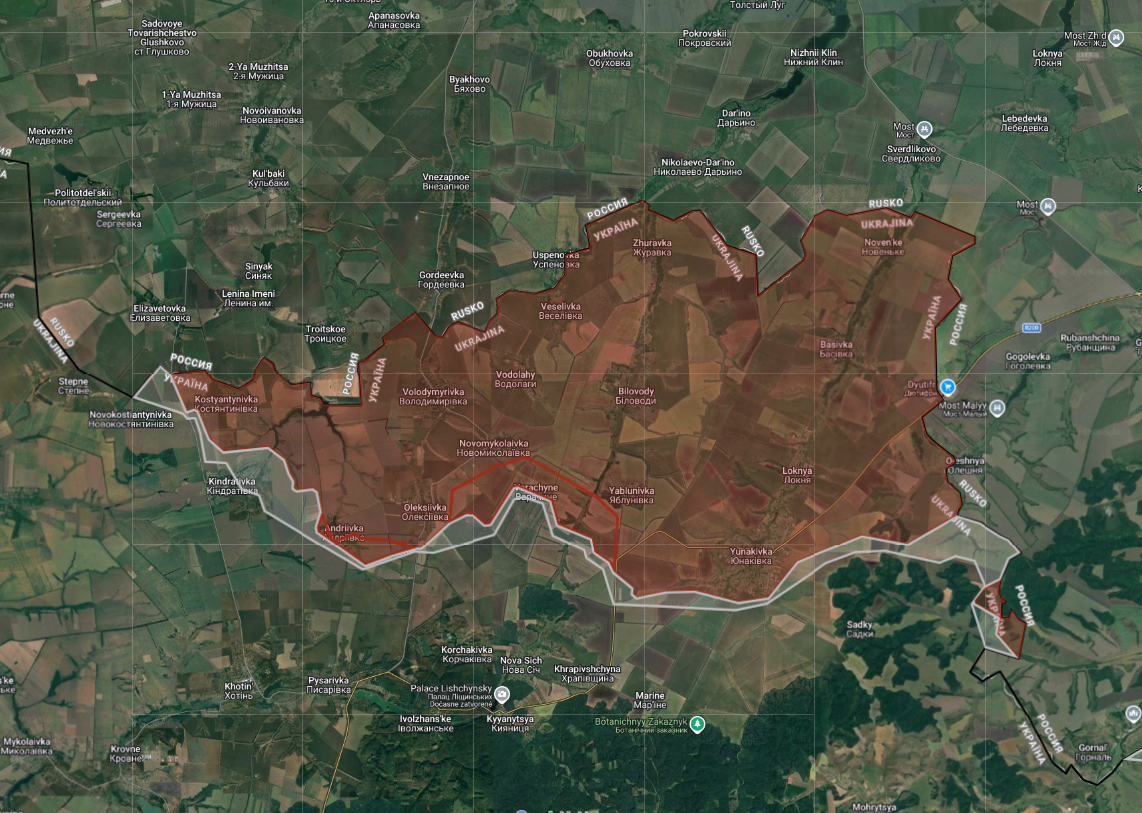
Compared with the Finnish analysts from the Black Bird Group, the difference is in places as much as eight km:
Russia complains that the “spirit of Anchorage” was betrayed. Pro‑war Rybar explains to Russians why they should not deceive themselves. This is one of the cases when this Russian Telegram channel explains reality rationally. Recently, for example, it even debunked Putin’s claim that in the spring of 2022 he had been deceived and withdrew from Kyiv and northern Ukraine for humanitarian reasons because it was part of peace talks. Rybar explained matter‑of‑factly that the Russian army retreated from northern Ukraine because it was defeated.
At the moment, the Kremlin and many Z‑channels keep repeating the phrase about the violation of the “spirit of Anchorage”. They refer to the well‑known meeting between the American and Russian presidents in Alaska in August 2025. At that time, Trump, without Ukraine’s consent, negotiated unacceptable concessions. It was also the period when he claimed that Zelensky “had no cards in his hand” and so on. A year later, Trump and his vice‑president are publicly speaking about Russia’s problems, and it is clear that the “spirit of Anchorage”, as they interpret it, is really nothing more than a ghost.
Russia interprets the year‑old talks as meaning that Trump promised it the whole of Luhansk and Donetsk regions (it has still not managed to capture either of them in full), as well as the occupied parts of other regions where it has troops.
Not only that, this spirit allegedly caused a lack of measures to protect refineries. Supposedly, there was no motivation to focus on their defence because negotiations about ending the war were under way, and so on.
Rybar described such claims as absurd, because air raids on refineries had begun at least two years before the Alaska summit. It also reminded readers that blaming ongoing negotiations for various failures is a broader phenomenon.
“It is not unusual to find claims suggesting that the army defeated everyone and was rushing forward, but then the ‘spirits of Anchorage’ intervened, forced it to halt its rapid advance, which the enemy exploited. However, there is a small nuance here: since 2022 the Russian armed forces have never stopped military operations during negotiations. Not once,” Rybar wrote.
According to it, the opposite was true, because after the talks in Istanbul, Riyadh and also in Anchorage, “there were sometimes intensifications of offensives”.
Moreover, after the meetings in Istanbul, Riyadh or Anchorage there were in some cases, on the contrary, escalations of offensive operations. One example is last year’s events near Pokrovsk.
“Kyiv and Sloviansk were not failed to be captured because of negotiations. Rather, negotiations began because Kyiv and Sloviansk could not be captured,” Rybar concluded its post, in which, in the case of Kyiv, it again returned to March 2022.
Videos of the day
In the night from Tuesday to Wednesday, drones attacked Russian refineries in Saratov and Nizhnekamsk. At the latter site, employees watched like this as drones bombed their workplace. These are FP‑1 types; note the manoeuvres they perform before impact.
🔥🛢️Workers at Russia’s oil refinery in Nizhnekamsk watch as a Ukrainian drone attack unfolds over their plant in real time, with FP-1 drones flying directly above them. pic.twitter.com/OyVXzGy4cA
— Special Kherson Cat 🐈🇺🇦 (@bayraktar_1love) July 8, 2026
This is not even a video, rather just a few photographs, but they show a logistical disaster at one of the bridges in occupied Ukraine. From the images it is not clear whether the drones destroyed the bridge itself or only a lorry driving across it, but the result is five burning or damaged trucks and traffic brought to a halt.
What are the losses
No update on Wednesday.
By Tuesday (7 July), Russia had verifiably lost 23,806 pieces of heavy equipment (on Tuesday (23 June) it was 23,668). Of that, 18,785 (18,686) pieces were destroyed by Ukrainians, 992 (988) were damaged, 1,199 (1,199) were abandoned by their crews and 2,830 (2,830) were captured by the Ukrainian army. This includes 4,424 (4,404) tanks, of which 3,327 (3,310) were destroyed in combat.
Ukraine has lost 11,683 (11,546) pieces of equipment, of which 9,068 (9,011) were destroyed, 687 (687) damaged, 683 (677) abandoned and 1,191 (1,189) captured. This includes 1,440 (1,437) tanks, of which 1,101 (1,099) were destroyed in combat.
Note: Neither side regularly reports on its dead or on destroyed equipment. Ukraine publishes daily figures for Russian casualties and destroyed equipment, which cannot be independently verified. In this overview we use data from the Oryx project, which since the beginning of the war has compiled a list exclusively of visually documented equipment losses.