Republika Srpska’s law changes introducing prison terms for displaying symbols of the Bosniak-led 1990s wartime army – or of the World War II-era fascist Croatian state – are likely to be challenged in court.
 Azem Kurtic



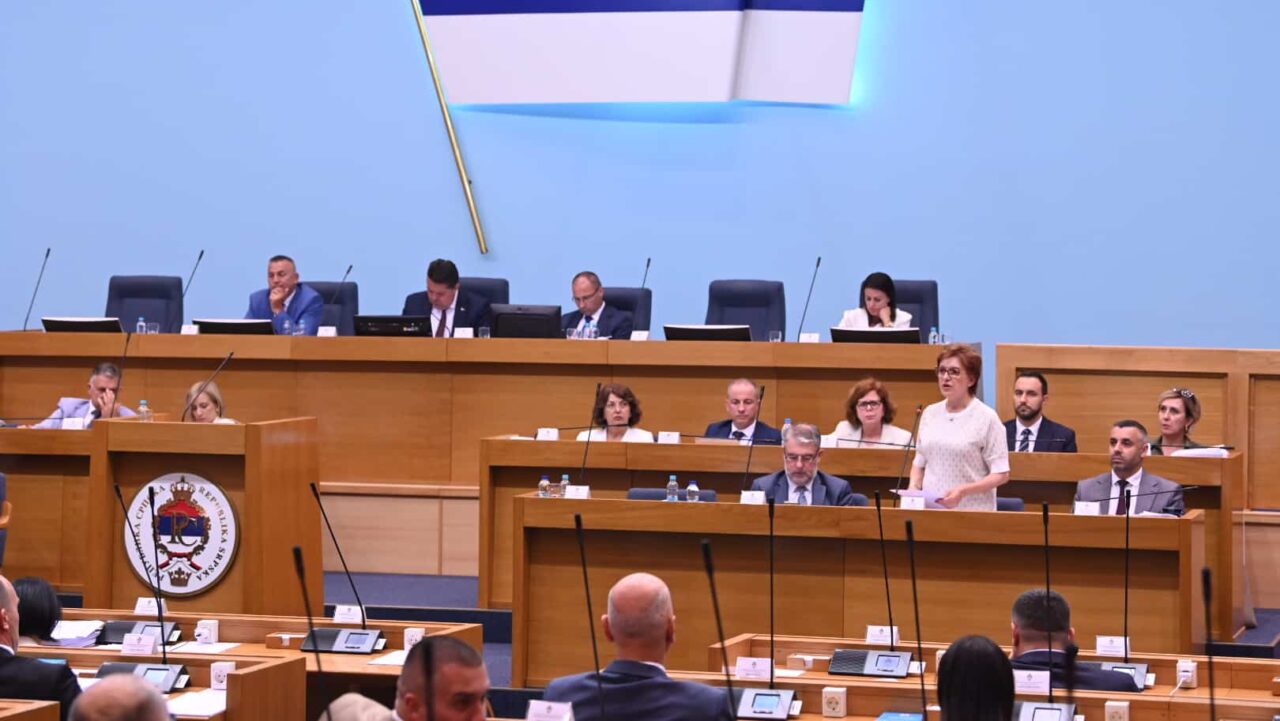
Members of the National Assembly of Republika Srpska discussing the legal amendments. Photo: NSRS.
The parliament of Bosnia’s Serb-led entity, the National Assembly of Republika Srpska, amended the entity’s criminal code on Thursday, introducing prison terms of up to five years for displaying or promoting flags and symbols of the Army of the Republic of Bosnia and Herzegovina – the now-defunct Bosniak-led force that fought in the 1992-95 war.
The National Assembly of Republika Srpska also criminalised displaying or promoting flags and symbols of the Independent State of Croatia, a World War II-era fascist state allied with Nazi Germany.
The new provision states that anyone who “publicly displays, shows, wears, produces, reproduces or otherwise puts into circulation flags, symbols, insignia, greetings, slogans or other markings that promote or glorify the Army of the Republic of Bosnia and Herzegovina” can be punished with up to three years in prison.
A harsher penalty of between two and five years in prison is foreseen if such acts result in unrest, violence, or other serious consequences for relations among peoples and other communities living in Republika Srpska.
The law also provides for the confiscation and destruction of objects used in committing the offence, at the perpetrator’s expense.
The same amendments ban the promotion and glorification of the Independent State of Croatia. Under the new provisions, anyone who uses print media, radio, television, computer systems, social networks or other platforms to promote its ideology faces up to three years in prison, rising to five years if the offence leads to unrest, violence or public disturbance.
The amendments need the approval from the Republika Srpska Council of Peoples and must be signed by the entity’s president before entering into force. They become applicable once published in the Official Gazette of Republika Srpska. Out of 58 present members of the assembly, only two voted against the amendments.
However, the legal changes are expected to face a legal challenge before Bosnia and Herzegovina’s Constitutional Court after coming into force.
After the Washington Agreement was signed in 1994, ending the armed conflict between Bosniak and Croat forces, the Army of the Republic of Bosnia and Herzegovina and the Croatian Defence Council were merged into the Army of Federation of Bosnia and Herzegovina. This army was then integrated into the Armed Forces of Bosnia and Herzegovina, alongside the Army of Republika Srpska, during the 2006 military reform.