As Beijing exploits Europe’s economic dependence and political splits, this summit’s cautious language risks signalling weakness just as the EU’s leverage over its biggest trading rival is being tested.
 Elena Sánchez Nicolás



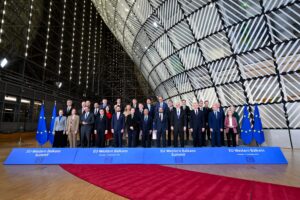
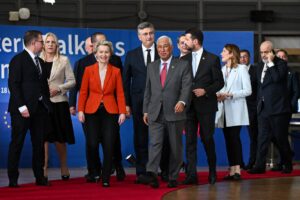
The EU has spent years using bureaucratic, coded language to address China without directly provoking it — often avoiding even naming it. That dynamic has become significantly clear in briefings ahead of the EU leaders’ summit in Brussels on Thursday and Friday (18-19 June).
While trade with China will be one of the main topics on the summit agenda, it has been hidden under the polite euphemism of “the issue of global macroeconomic imbalances” in the Council conclusions (the main outcome of the EU leaders’ debate).
“We all know the imbalances discussion is about China,” one senior EU diplomat said ahead of the summit.
This was also the case in May, when a paper put forward by France, Italy, Spain, the Netherlands and Lithuania, later supported by Poland, avoided mentioning China by name, instead talking about “some of the European Union’s (EU) main trading partners … imposing new trade barriers or contributing to systemic and structural industrial overcapacity.”
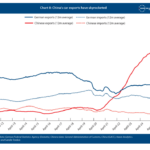
The EU has run a trade deficit with China for years. So while everyone agrees there is a major problem, and EU officials say there is an appetite to take action, nobody seems willing to name the issue as such.
28 competing China policies
The reality behind these dynamics is that there is no single China policy in Europe – at least not in practice.
As a European leader recently observed during a private background briefing with journalists some months ago: In Europe, there are de facto 28 policies on China – “one from the European Commission, and 27 national ones.”
But how did we arrive here?
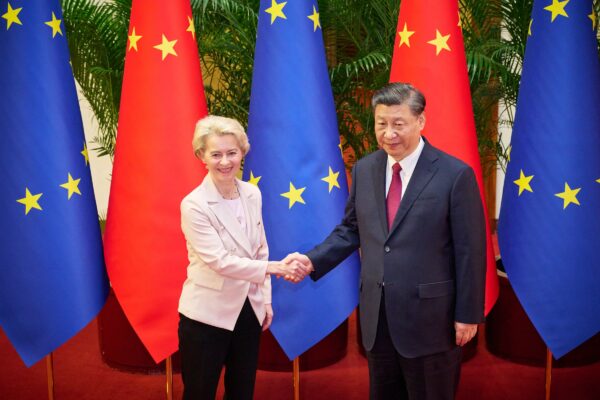
In 2023, during the World Economic Forum in Davos, EU commission president Ursula von der Leyen said for the first time that the EU needed to focus on “de-risking rather than decoupling” when it comes to China. The term was nevertheless years in the making.
Previously, in 2019, the EU had officially defined China as a partner, economic competitor and systemic rival. A good motto for an economic superpower on which some key European industries depend massively.
The “de-risking strategy” materialised in 2023 with the first-ever European Economic Security Strategy and the adoption of the Anti-Coercion Instrument (also known as the EU’s trade bazooka).
Back then, the EU was dealing with trade disputes involving the US administration during the first term of Trump and economic pressure exerted on Lithuania by China.
The trade bazooka however was never fired, and some EU diplomats admit it is “too complicated” to address current challenges, prompting heads of state and government to urge the commission to come forward with alternatives (well explained in this piece).
And in parallel, work is ongoing on the so-called ‘Made in Europe‘ proposals, aimed at reducing dependencies on critical sectors from China.
At the end, Europe is willing to discuss the consequences of China’s economic model and address them through different policies – but it still struggles to speak with one voice about China itself.
Divide and conquer
Export-driven economies with massive automotive or industrial footprints, like Germany, have traditionally tried to soften Brussels’ rhetoric, fearing retaliation.
In the East, China has used Hungary and the government of former prime minister Viktor Orbán as an economic Trojan Horse, with a multi-billion-euro investment into an EV factory and battery manufacturers.
And if we look at recent events, the moment Europe named-and-shamed Chinese industries with heavy tariffs (like in October 2024 with EVs), Beijing responded with what some have described as “surgical retaliation”. And it triggered targeted investigations into European exports, like French cognac, Spanish pork, or German luxury cars.
Facing a catastrophic blow to its agricultural sector after China targeted its pork exports (worth over €1.1bn annually), Spain went into survival mode. To appease Beijing, Madrid began aggressively courting Chinese automotive investment to show they were open to Chinese business. Today, it is estimated that 10 percent of new car registrations in the country are Chinese.
Greece is another good example. China owns most of the Port of Piraeus, Greece’s largest and primary maritime gateway. You cannot afford to align with Brussels’ ‘systemic rival’ label when that rival controls your most important trade hub.
Many say that the single market is Europe’s best leverage on trade policy, but one can argue that China has also proven it to be its vulnerability – turning a macro-economic trade dispute with the EU into economic pressure inside European capitals.
The classic divide and conquer.
Against this backdrop, there is little expectation this European Council summit can produce a major breakthrough on China. The most likely outcome is another carefully-worded compromise, calling on the commission to put forward options to act. The challenge lies in finding the political will and unity to actually do something at EU level.