The European trade deficit with China amounted to €360bn in 2025, or roughly €1bn a day. The commission and a growing group of member states want to take stronger measures to save European industries.
 Wester van Gaal



When EU leaders sit down to dinner at the European Council on Thursday evening (18 June), the item on the agenda will be listed as “global macroeconomic imbalances.”
But everyone in the room is aware that can only mean one thing. “We all know the imbalances discussion is about China,” one senior EU diplomat said in a background briefing ahead of the summit.
Europe’s trade deficit with China amounted to €360bn in 2025, or roughly €1bn a day. The commission and a growing group of member states want to take stronger measures to save European industries.
“It amounts to the destruction of our industrial base,” said a diplomat from a major EU country.
But so far, member states have not been able to agree on a coherent response, with some governments with deep commercial ties, including Germany, Spain and Greece, remaining reluctant to antagonise Beijing.
Thursday’s aim, according to one EU official, therefore, is to give the commission “very powerful political guidance” on whether to take a tougher stance on China, and in what way.
Cheap high tech
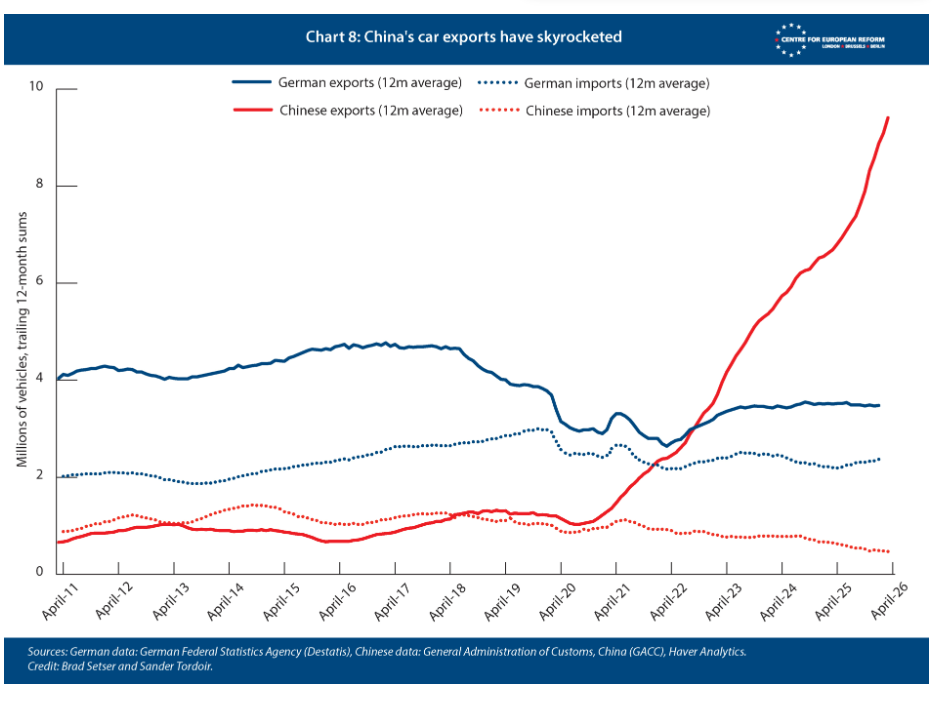
For years, the standard concern about China was that it flooded European markets with cheap goods. But since the pandemic, this has changed.
China now increasingly sells high-tech products in European markets that are both cheaper and of higher quality than domestic options. And for the first time, every single EU member state had a trade deficit with Beijing in 2025.
According to a widely-shared policy brief by the Berlin-based think tank Centre for European Reform (CER), China now accounts for roughly 30 percent of global manufacturing output while consuming only 13 percent of global output.
This is now threatening the survival of European industries. Last year, Chinese electric vehicle (EV) exports to Europe rose by 26 percent compared to the year before, despite EU tariffs introduced a year before.
And experts warn this could just be the beginning.
China can produce at least 25 million EVs a year but only sells around half that domestically, leaving a vast surplus to flood global markets.
According to CER, 55 percent of European manufacturing is exposed to Chinese market-share gains in the coming years, driven in part by what it estimates is a 30 percent undervaluation of China’s currency, the renminbi, offering an unfair advantage over foreign competitors.
European Commission president Ursula von der Leyen will open Thursday’s dinner with a presentation on macroeconomic imbalances, nearly a year after she warned China’s Xi Jinping that EU-China trade relations had reached an “inflexion point.”
But while the commission has proposed various measures since, member states have so far not agreed on a coherent China strategy. Thursday’s dinner is intended to generate a political mandate from the member states for the EU to finally move forward — although fears of Chinese retaliation are likely to weigh heavily on their minds.
Those concerns stem in part from October 2024, when the commission imposed tariffs on Chinese electric vehicles, prompting Beijing to launch investigations into several European exports, including French cognac, Spanish pork, and German luxury cars.
EU countermeasures