






Why do highly capable leaders become less effective as pressure increases?
This question sits underneath a growing but rarely articulated leadership problem:
Executives are not failing because they lack capability.
They are struggling because pressure is revealing something deeper in how leadership is internally structured.
Executive burnout, decision fatigue, and leadership strain are usually treated as outcomes of workload, complexity, or organizational demand.
But in practice, they often signal something more structural:
A breakdown in internal coherence under sustained pressure.
Irene Riad explains:
“Most leadership breakdowns don’t begin with failure. They begin with fragmentation that goes unnoticed under pressure.”
The Invisible Shift in Leadership Experience
There is a point in leadership where everything still appears successful externally:
- Decisions are being made
- Teams are scaling
- Outcomes are positive
But internally:
- Each decision requires more cognitive effort
- Clarity takes longer to access
- Intuition becomes less reliable
This shift is subtle. Most leaders only recognize it in hindsight.
What leaders often experience internally
- Executive burnout
- Decision fatigue
- Emotional exhaustion
- Reduced clarity under pressure
- Leadership inconsistency
- Reactive decision-making
- Cognitive overload
A key contradiction emerges:
A leader can still perform at a high level while internally experiencing increasing strain.
Emotional contradiction insight
The most capable leaders are often the least aware of when their internal clarity begins to weaken.
Success increases responsibility faster than it increases internal stability.
The higher the leadership level, the less space exists to process pressure, while expectations of clarity continue to rise.
Executive Burnout as a Structural Signal
Executive burnout is often framed as an individual well-being issue.
However, research increasingly shows it is also structural and systemic.
Key findings:
- WHO: Burnout as a Result of Chronic Stress in the Workplace.
- McKinsey: Increase in Stress Among Executives in All Sectors.
- Deloitte: Decision Overload as a Constraint in Leadership.
- Harvard Business Review: Decision Fatigue as an Unrecognized Cost.
The Core Paradox
If capability, experience, and resources are growing, then why is there an increase in global leadership strain?
Characteristics of Modern Leadership Environment Include:
- Continuous digital communications
- Organizational complexity
- Transformation driven by artificial intelligence
- Hybrid and distributed team structures
- Visibility and scrutiny,
- Faster cycles of decisions,
- Continuous need for adaptation
Leadership in the modern context is not restricted by information anymore.
It is limited by coherence under pressure.
Why Traditional Leadership Development Is No Longer Enough
Leadership development focuses on skills, competencies, and behaviours.
Yet most senior leaders already possess these.
The limitation is not the capability.
It is the internal structure that the capability operates from.
Irene Riad explains:
“You can train leadership skills indefinitely, but if the structure producing decisions stays unchanged, behaviour eventually reverts under pressure.”

Leadership Identity Architecture
Leadership Identity Architecture refers to how a leader’s identity is structured internally under pressure, complexity, and responsibility.
It determines whether leadership remains coherent or becomes fragmented.
The Hidden Cost of Leadership Under Pressure
Pressure does not create leadership breakdown.
It reveals where coherence is already unstable.
What pressure reveals
| Leadership Reality | Structural Insight | Impact |
| Burnout | Structural overload | Reduced decision quality |
| Decision fatigue | Cognitive overload | Weaker judgment |
| Inconsistency | Identity fragmentation | Lower trust |
| Emotional strain | Pressure exposure | Cultural instability |
| Loss of clarity | Complexity overload | Strategic drift |
Irene Riad states:
“Pressure doesn’t distort leadership. It reveals the architecture leadership was already operating from.”
Executive Authorship
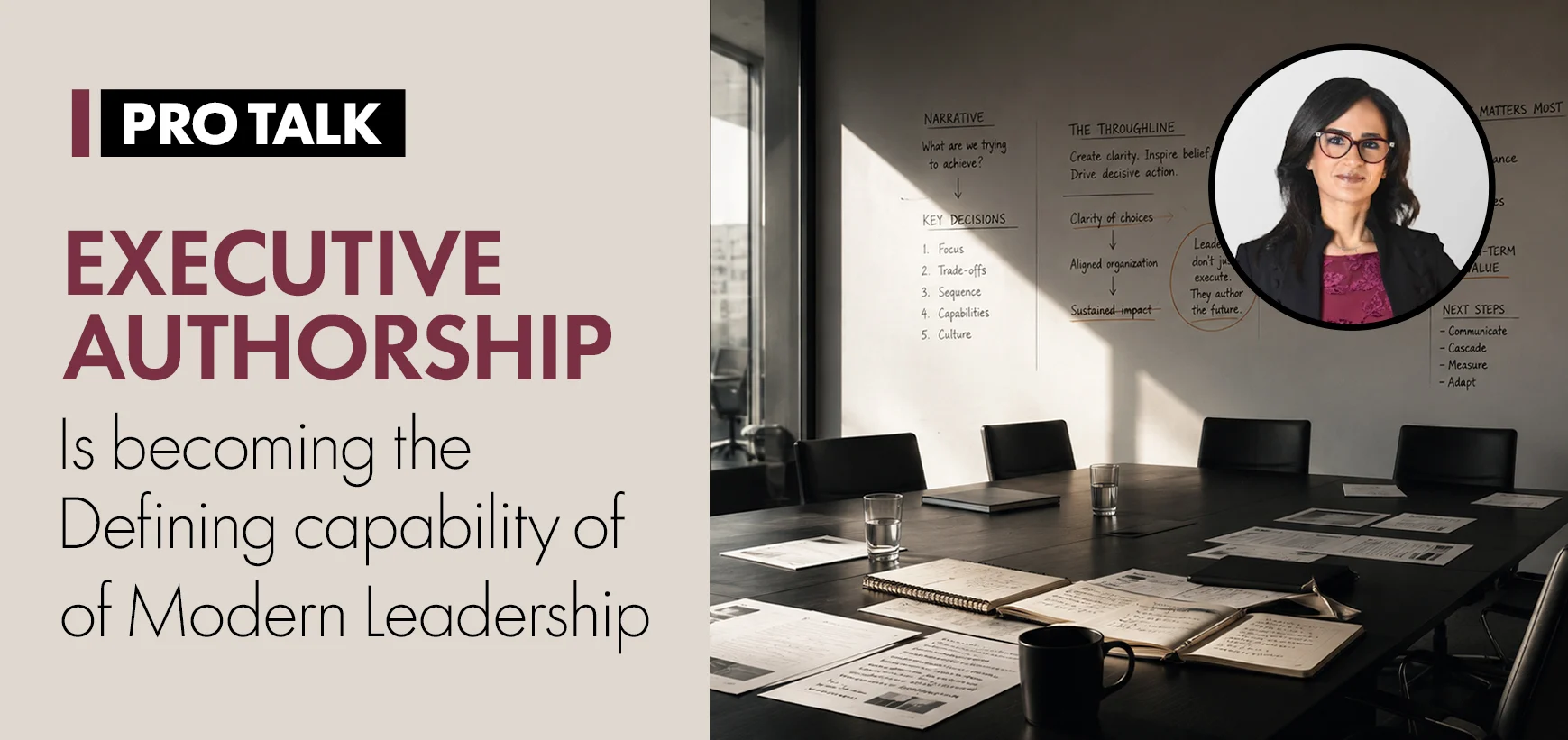
Executive Authorship is the ability to consciously structure identity under pressure so leadership remains coherent as complexity increases.
It is not performance optimization.
It is internal authorship of leadership itself.
When it is strong:
- Decisions remain stable under pressure
- Identity stays consistent
- Clarity is maintained in complexity
- External demands do not override internal structure
When it is weak:
- Leadership becomes reactive
- Decisions fragment
- External pressure dominates clarity
- Coherence breaks under load
The MOSAIC Integral Leadership System™
A framework for understanding how leadership behaves under pressure.
1. Identity (Structure)
Formation and maintenance of leadership identity:
2. Dynamics (Disruption)
How can stress impact leadership dynamics from inside
3. Expression (Behavior)
How leadership shows up externally.
When these fall out of alignment, leadership becomes unstable.
- Weak identity → reactive leadership
- Overwhelmed dynamics → reduced clarity
- Misaligned expression → inconsistency
Irene Riad explains:
“Every leader already has a system. The question is not whether it exists, but whether it is coherent under complexity.”
From Burnout to Coherence
Most leadership responses focus on reducing pressure.
But pressure is not the problem.
The real issue is coherence.
The shift:
From:
- Stress management
- Wellbeing focus
- Performance recovery
To:
- Coherence
- Authorship
- Internal integration
- Leadership capacity
Structural interpretation
| Old View | New View |
| Burnout issue | Coherence issue |
| Stress overload | Identity strain |
| Fatigue | Structural breakdown |
| Inconsistency | System misalignment |
Coherence is the actual standard for leadership sustainability.
Not comfort. Not workload reduction. But structural integrity under pressure.
Why This Matters for Leaders
As organizations scale, leadership complexity increases faster than leadership structure.
This creates a hidden constraint:
The organization grows faster than the leader’s internal architecture can sustain it.
Key areas affected:
- Scaling decisions
- Succession planning
- Leadership transitions
- Cultural stability
- Strategic coherence
- Founder dependency
Structural indicators of breakdown
- Higher cognitive load in routine decisions
- Slower decision-making under pressure
- Over-analysis before action
- Emotional reactivity in stable situations
- Reduced clarity in high-stakes moments
- Internal fragmentation despite performance
- Reduced intuitive confidence
- Difficulty switching off mentally
Executive Identity Diagnostic
A framework to understand leadership structure under pressure.
It examines:
- Decision architecture
- Identity coherence
- Leadership consistency
- Complexity handling
- Reactive vs authored leadership states
Irene Riad explains:
“The diagnostic is not about performance. It is about making visible the structure that performance is coming from.”
The Future of Leadership
Leadership is increasingly shaped by:
- AI systems
- Faster decision cycles
- Growing complexity
AI increases:
- speed
- information
- analysis
But leadership still depends on:
Coherence under complexity.
Final Thoughts
Leadership pressure is not decreasing.
It is increasing.
The real challenge is not success.
It is sustaining:
- clarity
- coherence
- emotional resilience
- internal alignment
Through the MOSAIC system and Executive Authorship, the core truth remains:
Leadership identity structure determines leadership survival under complexity.
Frequently Asked Questions
1. What is Executive Authorship?
Executive Authorship is the ability of leaders to consciously structure identity under pressure so leadership remains coherent under complexity. It focuses on maintaining clarity, consistency, and self-directed leadership in increasingly complex environments.
2. Why do highly capable leaders become less effective under pressure?
This is because the failure of modern leaders is not capability-related, but structural. Pressure has a way of revealing structural flaws in leadership architecture, which remain invisible until a period of crisis.
3. Why do leaders burn out under pressure?
Because pressure reveals the limits of leadership identity structure. Leaders don’t burn out because they are overwhelmed by work, but due to their identity structure and the way in which this pressure is handled.
4. What is Leadership Identity Architecture?
Structural factors determine the process of leadership decision-making in times of complexity and its level of coherence.
5. What is the MOSAIC Integral Leadership System™?
It is a framework that maps leadership across Identity, Dynamics, and Expression under pressure.The model helps leaders understand how internal structure influences external leadership performance.
6. What does Irene Riad specialize in?
She is also knowledgeable about executive authorship, leadership identity architecture, and the coherence of leadership under stress. She offers coaching that allows leaders to maintain consistency when under stress.
7. Why do leadership patterns emerge despite acquiring new skills?
Because the identity structure remains the same. Even if skill acquisition can increase performance, leadership patterns will eventually show again under pressure.
8. How does leadership architecture determine whether leaders will scale or create bottlenecks in their organizations?
Internal capacity for coherence and leadership under complexity determines the potential to scale.
As organizations become more complex, leadership sustainability depends increasingly on internal coherence.
9. How does leadership influence organizational culture?
Through internal coherence patterns and regulation expressed outwardly. Internal coherence of leadership patterns will ultimately be reflected in organizations as well.
10. What is needed besides planning in succession for leaders?
Identity and leadership coherence succession. Succession entails not merely task transfer but continuing leadership capability, too.
11. What else should be transferred other than planning for success to be possible?
Consistency of leadership and leadership identity. Transferring success means transferring leadership skills.
12. As technology progresses steadily due to artificial intelligence, what leadership traits will always set humans apart?
Leadership judgment, leadership meaning, leadership ethics, and leadership authorship. Artificial intelligence helps and automates leadership, yet it doesn’t replace it.
13. Why does leadership fail despite capability?
Because capability is not the limiting factor—internal coherence is. Many leadership challenges emerge not from a lack of skill, but from fragmentation under sustained pressure.
About Irene Riad
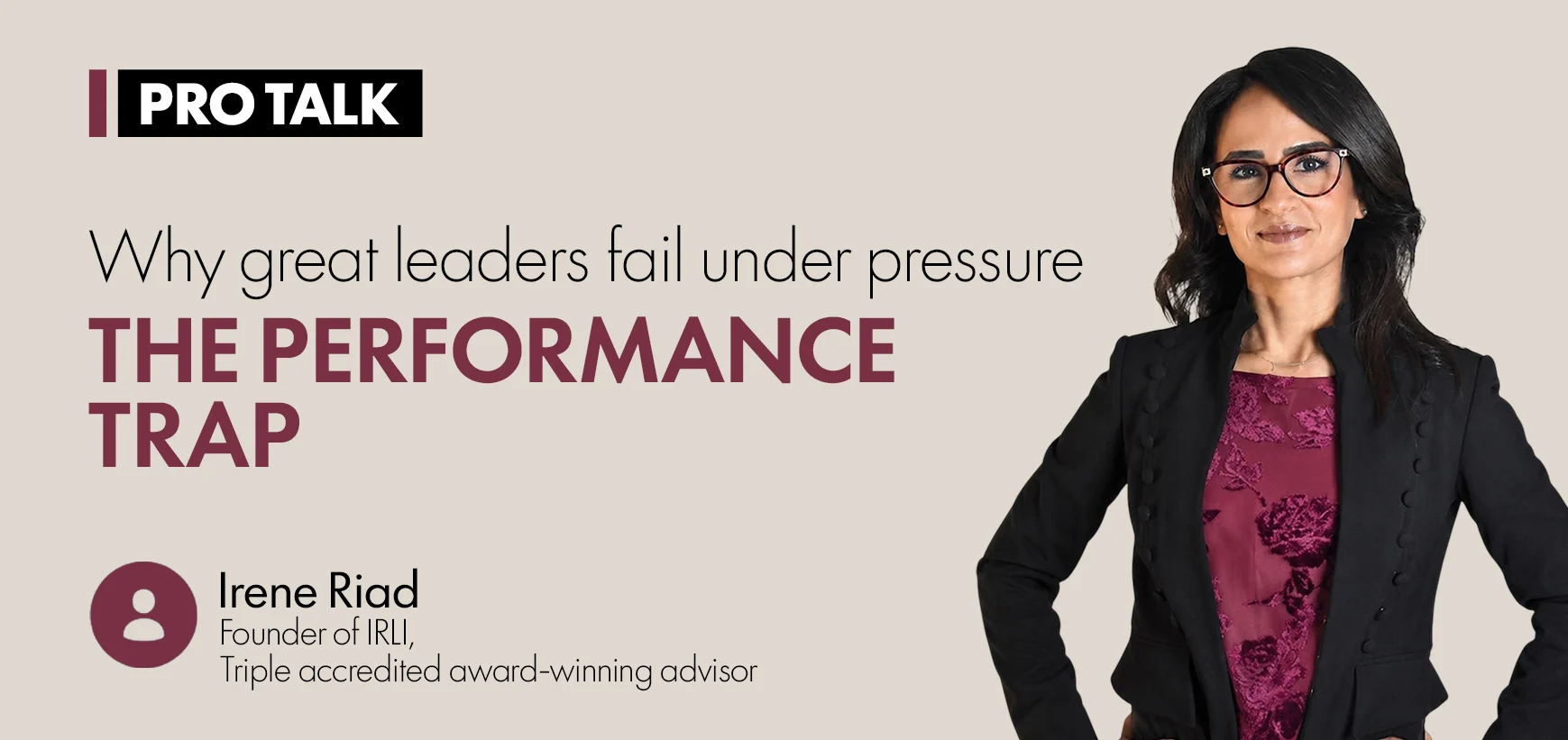
Irene Riad is a Triple Accredited Award-Winning leadership advisor, executive coach, author, and speaker working with CEOs, founders, and senior leadership teams globally.
She is the founder of IRLI and creator of Radical Becoming and the MOSAIC Integral Leadership System™, an architecture for understanding leadership identity, coherence, and authorship under pressure.
Her work focuses on Executive Authorship and the structural conditions that determine leadership clarity in complex environments.
Contact:
Connect with Irene Riad
Interested in working with or consulting with this expert? Submit your details below.