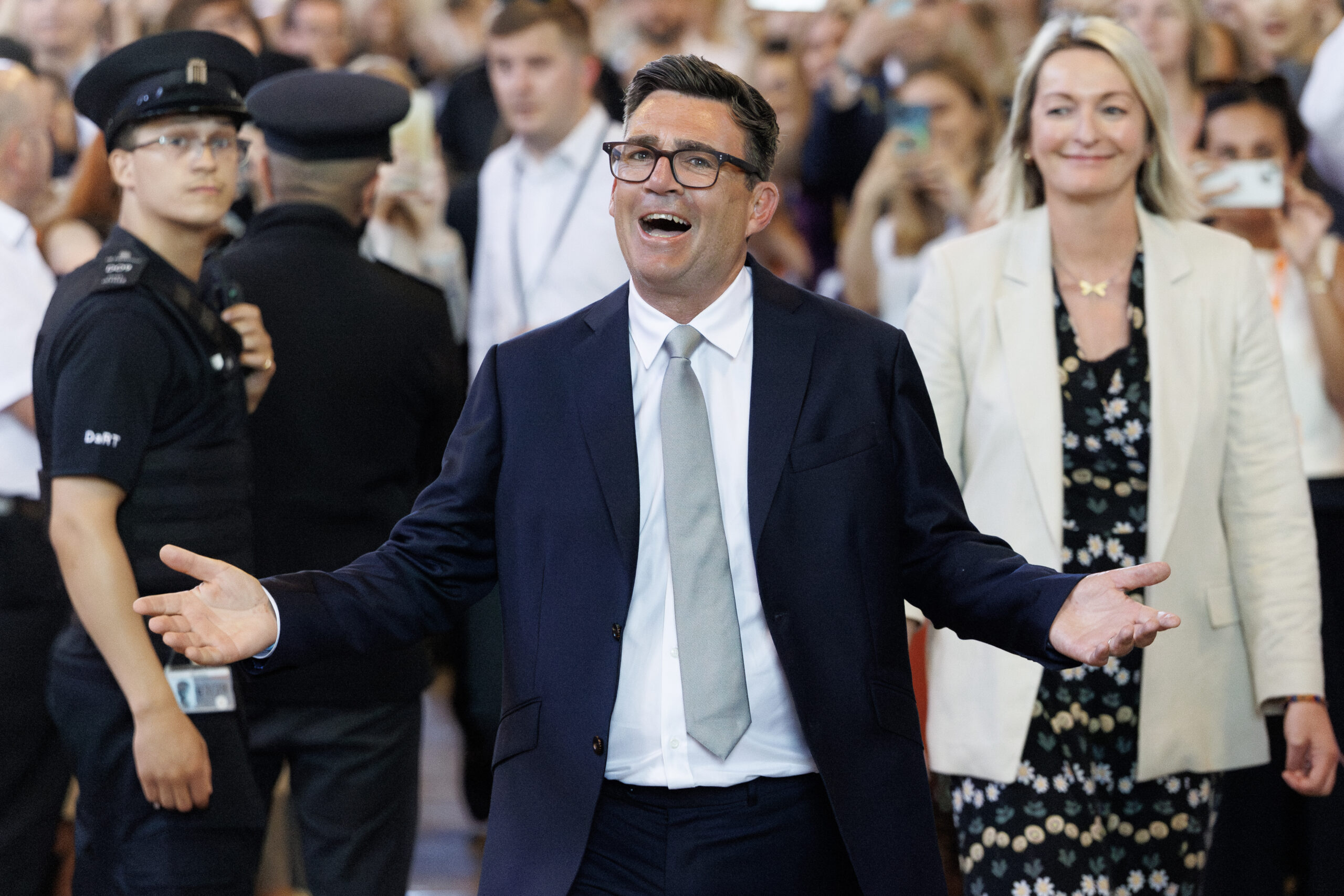
Andy Burnham is set to be the first ever English Literature graduate to serve as Prime Minister. James Ford is very concerned I have a problem with Andy Burnham. It isn’t his litany of U-turns and policy flip flops. It isn’t that he wears a t-shirt with a suit (a
 James Ford



Tuesday 30 June 2026 5:34 am | Updated: Monday 29 June 2026 10:53 am
Andy Burnham is set to be the first ever English Literature graduate to serve as Prime Minister. James Ford is very concerned
I have a problem with Andy Burnham. It isn’t his litany of U-turns and policy flip flops. It isn’t that he wears a t-shirt with a suit (a bad look on anyone, but unforgivable in a man in his 50s). It isn’t even his whole ‘King of the North’, professional Mancunian schtick (though it is certainly grating). No, my problem is more fundamental. When he inevitably takes his place at Number 10 next month, he will become our first Prime Minister to have an English Literature degree. Let that sink in. An English Literature degree. Heaven help us all.
I know, I know – I am probably the last person who should call out anyone for their degree. I have a degree in War Studies from King’s College London. It’s a choice that has raised many a quizzical eyebrow at job interviews. People assume my education consisted of three years playing the popular board game Risk and watching the film Zulu (I wish!). But, despite being a rather niche choice (and one whose credibility is not helped by the inclusion of the word ‘studies’ in its title), it could be argued that it is a better, more relevant preparation for public office than an English degree. Afterall, one of the things I learned during my degree was that military theorist Carl Von Clauswitz said that “War is the continuation of politics by other means” – so, essentially, I took a politics degree by any other name. And, thankfully, I am not about to become Prime Minister any time soon.
Frivolous
Admittedly, Burnham’s English degree is from Cambridge, which we must assume is pretty much as good as English degrees get. But it is still an English degree. I’m sure Andy Burnham can quote you some excellent poetry. He probably knows his Dickens from his Dostoevsky. And I’m sure he can conjugate a mean verb. But, let’s face it, as humanities degrees go, English is one of the more frivolous ones. Not as bad as media studies (a degree in Netflix) or art history (a degree for posh girls too thick to do real history), but pretty lightweight nonetheless.
Am I alone in thinking there is something to be said for our political leaders spending three years at university studying, you know, politics? Wouldn’t that be helpful, useful and relevant? And, if that doesn’t appeal there are plenty of other useful humanities courses to choose from: economics (politics with added maths), history (past politics), and classics (very old politics with a side serving of dead languages). Studying law makes sense if you plan on making the nation’s laws. Even geography has its place (a good PM should, at the very least, be able to point to Great Britain on a map…and find their constituency). But to have chosen reading fiction over facts, does not seem to augur well for someone wanting to hold the highest office in the land.
#mc_embed_signup { background: #fff; clear: left; font: 14px Helvetica, Arial,sans-serif; width: 100%; max-width: 600px; margin: 20px 0; } #mc-embedded-subscribe-form { margin: 20px 0 !important; } .newsletter-form-flex { display: flex; gap: 0; align-items: center; margin-top: -10px; } .newsletter-form-flex input[type=”email”] { flex: 1; padding: 2px 10px; border: 1px solid rgb(18, 22, 23) !important; border-radius: 12px 0 0 12px !important; } .newsletter-form-flex input[type=”submit”] { padding: 4px 10px !important; margin: 0 !important; background-color: rgb(18, 22, 23) !important; color: rgb(255, 255, 255) !important; border: 1px solid rgb(18, 22, 23) !important; border-radius: 0 12px 12px 0 !important; } .newsletter-banner-content { margin-bottom: 15px; } .newsletter-banner-content h2 { margin: 0 0 10px 0; font-size: 18px; font-weight: 600; } .newsletter-banner-content p { margin: 0 0 10px 0; line-height: 1.5; } .newsletter-banner-content ul, .newsletter-banner-content ol { margin: 0 0 10px 20px; } .newsletter-banner-content a { color: #0073aa; text-decoration: none; } .newsletter-banner-content a:hover { text-decoration: underline; } .newsletter-banner-content img { max-width: 100%; height: auto; margin: 10px 0; } #mc_embed_signup #mce-success-response { color: #0356a5; display: none; margin: 0 0 10px; width: 100%; } #mc_embed_signup div#mce-responses { float: left; top: -1.4em; padding: 0; overflow: hidden; width: 100%; margin: 0; clear: both; }
To have chosen reading fiction over facts, does not seem to augur well for someone wanting to hold the highest office in the land
Everybody knows that our Prime Ministers are supposed to follow a relatively standard academic trajectory. They go to Oxford (31 out of 58 holders of the office to date, including 13 of the 18 postwar occupants of Downing Street). And they study politics, philosophy and economics (Wilson, Heath, Cameron, Truss and Sunak), classics (Gladstone, Asquith, Macmillan and Johnson) or modern history (Attlee and Douglas-Home). That is, pretty much, the rule. Sure, there are one or two exceptions to that rule: Thatcher read chemistry (therefore becoming the first PM with a science degree as well as the first PM with a uterus!), Blair read law and Eden read oriental languages (which may explain why he was a great Foreign Secretary but a disaster as PM). There are some of our postwar Prime Ministers who didn’t attend Oxbridge – looking at you Brown (Edinburgh) and Starmer (Leeds) – but at least they studied for proper, serious degrees at respectable (Russell Group) universities.
Now, I know there will be readers out there who argue that it doesn’t really matter. But, like it or not, how we choose to spend our time at university says a lot about who we are. And Burnham didn’t choose to spend his university days grappling with the rigours of comparative politics, economic theory or historiography. He chose Plath, Hardy and Milton over Plato, Hobbes and Machiavelli. He even picked Middlemarch over Marx. I’m very concerned that the Labour Party is poised to choose a dilletante to be Prime Minister. And that worries me a great deal.
James Ford was an advisor to former Mayor of London Boris Johnson
Read more Burnham warns Labour of ‘final chance’ after Makerfield win
Similarly tagged content: Sections Categories People & Organisations