
Vladimir Putin’s envoy to the EU had a strange career path, a spy-linked uncle, spy friends, and allegedly played a role in pre-Brexit dirty tricks in the UK.
 Andrew Rettman



Karen Malayan speaks to Europe on behalf of Russian president Vladimir Putin, but his irregular CV invites the question: Is the acting head of Russia’s embassy to the EU another spy sent to recruit assets, steal secrets, and direct sabotage attacks?
You can spot Malayan on official photos by his receding hairline, frameless glasses, and Mona Lisa smile.
The avuncular 55-year-old, who is married with one son, arrived at Russia’s EU embassy in Brussels in 2015 and became “chargé d’affaires ad interim [temporary head]” in 2024.
He was still active on Facebook, Instagram, LinkedIn, OK.ru [a Russian social media platform], X, and his embassy website, where he dutifully repeated Kremlin talking points.
He used to meet with EU officials and diplomats, Russia–friendly MEPs, and European business executives.
But Malayan did little by way of face-to-face EU diplomacy nowadays, due to a cordon sanitaire imposed on Russia after Putin’s full invasion of Ukraine in 2022.
EU cold shoulder
Russian diplomats were now all-but banned from the European Commission and never visited the EU Council, European Parliament [EP], or the 27 member states’ EU missions, as well as being shunned by think-tanks and lobby firms in Brussels.
“All commission services have suspended any bilateral engagement with Russian state representatives,” said EU foreign service spokeswoman Anitta Hipper.
“In practice, a number of meetings have taken place in the EEAS [European External Action Service] since 2022 with representatives of the Russian mission to the EU, aimed at communicating EU positions [complaints], or discussing matters of operational engagement … among others, staff matters of the EU delegation in Moscow,” she said.
The EU Council said: “There is a suspension of access to the council premises for Russian diplomats.”
EU ambassadors in the ‘Coreper II’ club could, in theory, invite a Russian diplomat to attend one of their meetings, or to lower-level ‘working group’ talks, the way they used to pre-2022, a Council spokesman said, but they have never done so since Putin went fully on the rampage, while inviting Russian dissidents, such as Yulia Navalnaya, instead.
The 27 member states’ EU embassies had the same approach.
“We don’t meet with Russian diplomats, don’t invite them to our events, and don’t attend theirs,” said a Czech diplomat, echoing Austria, the Baltic states, Denmark, Finland, the Netherlands, Poland, and Spain.
Even Slovakia, which was led by the EU’s most pro-Russian prime minister, Robert Fico, was not breaking ranks.
“In line with the political approach agreed by all EU member states in 2022, the permanent representation of the Slovak Republic to the EU does not invite representatives of the Russian federation to events it organises, nor does it hold bilateral meetings with individual Russian diplomats,” the Slovak foreign ministry told EUobserver.
The EU Parliament said: “Since March 2022, diplomatic and government staff of Russia and Belarus are banned from entering the premises … as well as EP liaison offices inside and outside the EU.”
MEPs were, in theory, free to meet Russians off-campus.
But the centre-right European Peoples’ Party and rightwing European Conservatives and Reformists, the Socialists & Democrats and The Left, liberal Renew Europe, and the Green groups, which together had 577 out of parliament’s 720 MEPs, told EUobserver their members did not do so.
The two far-right, pro-Russian groups – Patriots for Europe (PfE) and Europe of Sovereign Nations (ESN), with 122 MEPs – did not reply.
But if their declarations in the EP’s transparency register were to be believed, they also avoided Malayan.
MEPs from the PfE and ESN’s most fawningly pro-Kremlin delegations (Germany’s Alternative für Deutschland, Hungary’s Fidesz, and France’s Rassemblement national ) declared dozens of meetings with Chinese, US, and Israeli diplomats, as well as Big Tobacco lobbyists, both in and out of parliament buildings in 2024 and 2025, but no Russians.
MEPs from Fico’s unattached Smer party also declared zero Russians.
Mainstream think-tanks in Brussels, such as the European Policy Centre or Friends of Europe, said they would not invite Malayan.
Even the hard-right MCC Corvinus think-tank, which had links to Fidesz, told EUobserver: “We [at] MCC Brussels have no relations with Russian diplomats.”
And EU lobby firms were legally banned from doing business with Russia in June 2022.

Malayan’s Brussels friends
The EU cold shoulder did not mean that Malayan and his staff had no one to talk to, however.
The EU, Nato, and Belgian national capital hosted 187 embassies, 94 permanent representations, and 131 international organisations in total, said the Belgian foreign ministry.
There were 13,099 people with diplomatic status in Belgium, composed of 5,983 diplomats and 7,116 family members.
And in a sign of how many of these might welcome Putin’s men and women for cocktails, 39 UN states either backed Russia or abstained in the last vote on the Ukraine war at the UN General Assembly, including China, India, Iran, Pakistan, and South Africa, as well as Belarus and Central Asian states.
Malayan and his squad were free to meet any of the 1,700 international firms which had offices in Brussels.
Russian embassies organised events with the Russian diaspora of some 30,000 people in Belgium (who prevailingly backed Putin) and the 18 Russian Orthodox churches there.
And Russian diplomats accredited in Belgium were free to travel to any of the 25 EU states, as well as Iceland, Liechtenstein, Norway, and Switzerland, in the ‘Schengen Area’, albeit not as freely as before.
Belgium declined to say how many Russian diplomats it hosted these days, citing EU data-privacy law.
But there were about 210 of them back in 2022, it previously said, if you counted Russia’s embassies to Belgium and the EU and its consulates in Brussels and Antwerp.
And Malayan’s EU mission still had some 45 diplomatic posts and 15 technical staff in July 2026, a Western intelligence contact said.
ussia’s real estate in Belgium also gave away the size of its presence.
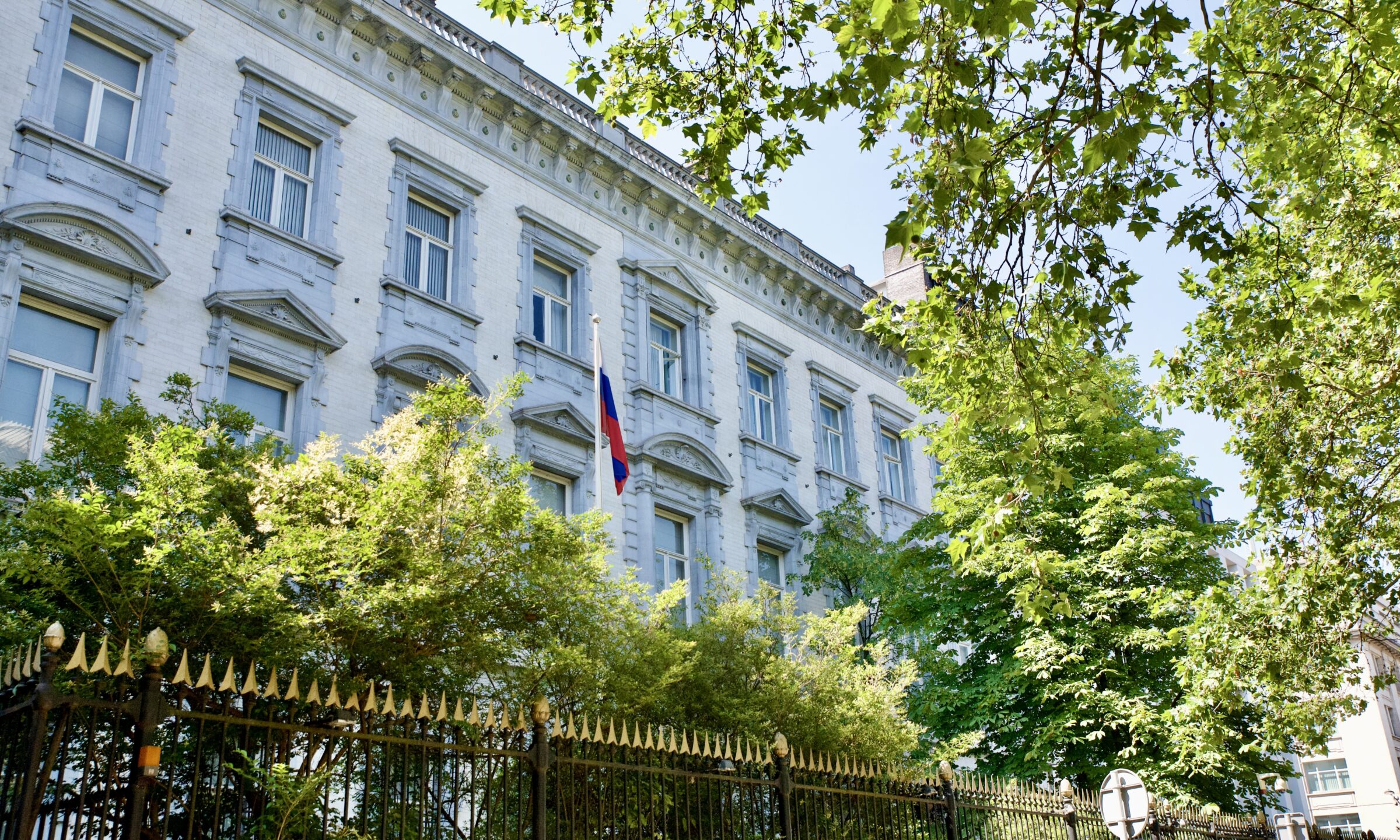
This included Malayan’s EU embassy – ‘Hôtel Brugmann’, a 2,200 square-metre mansion from the 1890s, which used to belong to a Belgian baron, and was situated next door to the US embassy, in the heart of the EU diplomatic quarter.
Russia had a 46,000 square-metre secure compound at 66 Avenue de Fré, in the leafy Uccle suburb in Brussels, which housed Russia’s bilateral embassy to Belgium, the Russian ambassador to Belgium’s residence, and its (closed in 2021) embassy to Nato.
Its Brussels consulate was situated at 78 Rue Robert Jones, also in Uccle, a district of the EU capital in which many Russian diplomats and their families lived, while its second consulate was in the city centre of Antwerp (160 Jan van Rijswijcklaan), Belgium’s economic hub.
And the Hôtel Brugmann, Avenue de Fré, and Jan van Rijswijcklaan addresses were all storied nests of Russian spies.
Belgium has expelled 68 Russian diplomats from these three locations since 2022 on grounds of espionage, Belgium’s intelligence service, the Veiligheid van de Staat / Sûreté de l’État (VSSE), previously said.
And Russia had also weaponised its buildings, by putting 17 signals-intelligence antennas on the rooftops of its Avenue de Fré complex, Belgian daily De Tijd reported in 2023.
When Belgium expelled spies in the past, Russia sent back new ones to fill the old diplomatic posts, the VSSE has also said.
But Europe has now started taking a different approach.
EU foreign affairs chief Kaja Kallas said in February that Malayan had to slash his number of posts by a third, citing security concerns: “We will not tolerate abuse of diplomatic power”, she said at the time.
The EU also cited the need for “closer parity” with its smaller embassy in Moscow, under Article 11 of the Vienna Convention on Diplomatic Relations, which empowers accrediting entities to unilaterally reduce foreign embassies to a “reasonable and normal” size, in relation to “the needs of the particular mission”.
“The Russian mission to the EU was notified it should cap its size at 40 staff, starting from 1 September 2026,” Hipper, Kallas’ spokeswoman, told EUobserver.
But “this number does not include the head of the mission [Malayan],” Hipper said.
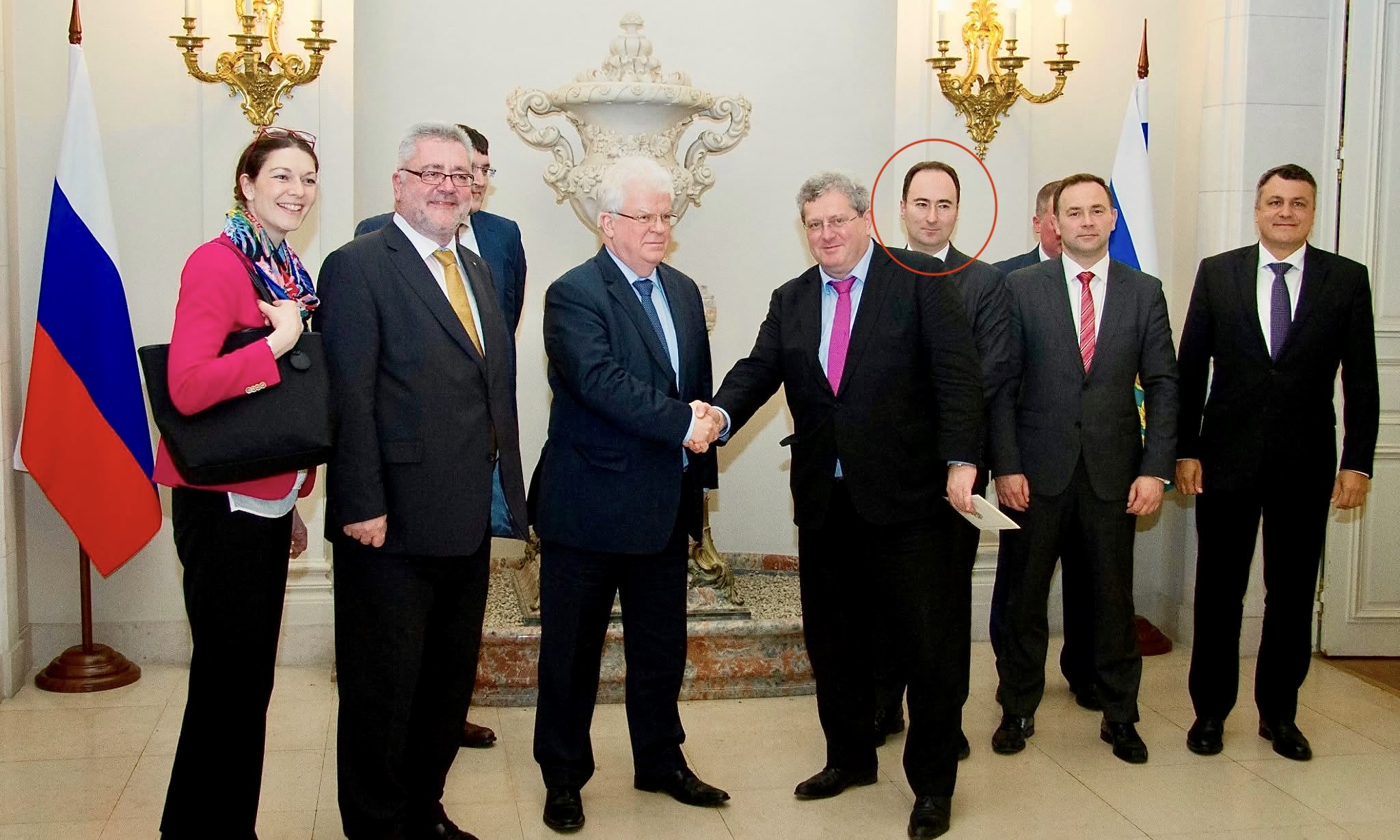 Malayan (circled) at meeting with European businessmen at the Russian embassy in 2018 (Source: Russian embassy)
CV red flags
And given the Kremlin’s spooky track record in Brussels, it naturally posed the natural question if Malayan was just shaking hands with Chinese diplomats and going to church fairs in his ample free time, or if he was also doing more sinister things on the side?
The first place to look for answers was his CV – to check if it looked kosher or if it contained holes, which might indicate that it was a cover story for yet another spy.