2026 has been a year of new beginnings. In March, we joined the Slovak independent publishing house Dennik N, and many things have changed since.
 Elena Sánchez Nicolás



Dear reader,
We’ve always tried to be transparent over the past 26 years. When things got tough, we didn’t hide it; we told you what we were dealing with. We want to keep being just as open today.
2026 has been a year of new beginnings. In March, we joined the Slovak independent publishing house Dennik N, and many things have changed since, so here are a few things I’d like you to know:
An editorial strategy focused on quality
We’re putting a greater focus on foreign affairs, be it the US, the Middle East, Russia, or China. This goes hand in hand with the core policies and topics that have made EUobserver what it is today: migration, human rights, corporate lobbying, rule of law, gender equality, consumer rights and anything that would fall under the European affairs umbrella.
EUobserver will keep covering the daily Brussels Bubble, but there is renewed attention on analyses, explainers, interviews, and investigations. We aim to better explain the EU’s decision-making machinery (and its consequences). This means that you, the reader, will be offered more exclusive and quality content, investigative reporting, in-depth analysis, and opinions — rather than gossip and breaking news available everywhere else.
We are also going (a bit) longer. In the era of the 30-second videos on social media, we believe that there are still those who enjoy a deep dive. Our longer formats allow us to provide context, reflect on history and connect the dots.
We take a less hand-in-glove approach to coverage, don’t take handouts from any political party or industry and rely on editorial judgement (instead of dominant discourse) on how and what we cover.
In other words, we might not be the publication you read to decide what your business needs to do today, but rather what EU policy decisions mean for people and society.
If you have any tips, ideas, or suggestions for stories or investigations, you can contact each reporter or me individually by email (see here), or if you prefer, you can also reach us at euobserver@proton.me. For opinion articles, please write directly to comment editor Matt Tempest (mt@euobserver.com)
More central, eastern Europe, and Ukraine
EU affairs coverage has traditionally focused on the Brussels machinery and the big players in Western Europe. But Poland, Hungary, the Baltic states, and others along the EU’s eastern flank today play a much bigger role in shaping debates on security, energy, enlargement, and relations with Russia. That’s why we’re bringing voices from central and eastern Europe to a wider European audience — and into the Brussels bubble, which has long been dominated by German, French, Dutch, Italian and Spanish perspectives (prove me wrong).
This change is already underway, and numbers indicate it is the right call.
Our weekly update on Hungarian politics to help readers prepare for the election in April 2026 was the perfect example. Veronika Munk’s digests are the most detailed analyses in town, with a combination of internal politics and wider implications, so we have decided to keep publishing (for the moment).
And as you probably noticed, there are also more articles about Ukraine, alongside our daily update on the latest military developments on the frontlines — which we heard is of great value to the European Commission External Action Service, EU delegations and diplomats.
🤝 This is all thanks to the editorial ties we have now, republishing and co-producing content with Denník N (Slovakia), Deník N (Czech Republic), Napunk (Hungary) and the investigative magazine Respekt (Czech Republic). In exchange, more articles from EUobserver are also featured by these media, bringing Europe closer to those in the region. A two-way exchange of journalism that strengthens both reach and relevance.
More newsletters — unlimited access
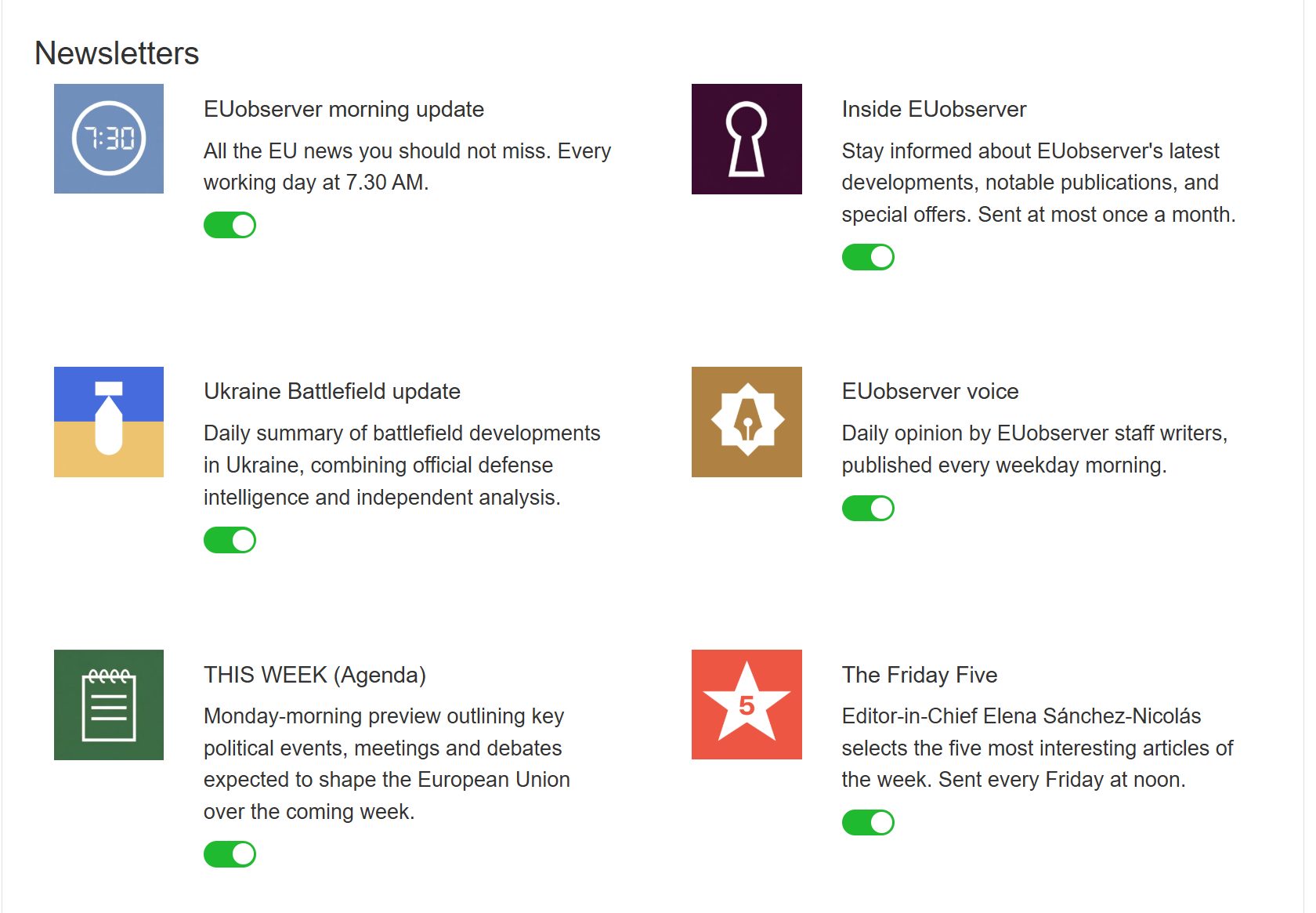
We are thrilled to celebrate a major milestone: 40,000 newsletter subscribers and counting! What started as a single morning update with an exclusive editorial (a quite novel idea for EUobserver we introduced quite recently) has grown with our readers. Today, we’ve expanded our coverage to six distinct newsletters, each tailored to different needs and interests.
EUobserver Morning Update: The essential “start your day” briefing. All the stories you shouldn’t miss, delivered every working day at 7:30 AM. (Subscribe here or see sample) Ukraine Battlefield Update: Expert-driven defence intelligence and independent analysis of the developments in Ukraine. Delivered every weekday afternoon for those tracking what’s happening on the ground (Subscribe here or see sample) THIS WEEK (Agenda): Your Monday morning “look-ahead.” We outline the key political events, meetings, and debates that will shape the EU in the coming week. Every Monday at 6:10 AM. (Subscribe here or see sample) EUobserver Voice: For those who value perspective. A daily opinion piece written by our staff writers, published every weekday morning. (Subscribe here or see sample) The Friday Five: My personal curation. A selection of the five most interesting and impactful articles of the week, sent every Friday around noon. (Subscribe here or see sample) Inside EUobserver: Our “behind-the-scenes” update. Stay informed about our latest developments, special offers, and notable publications (sent maximum once a month). (Subscribe here)
🔔 Tailor your subscription in a few clicks. Go to Newsletters where you can toggle each newsletter on or off, or hit “Subscribe all” to ensure you never miss a beat.
Follow reporters and specific topics:
Using a more robust metadata system, subscribers can now follow specific topics (e.g., digital or defence) or sections (e.g., investigations) we often cover, such as Migration, Rule of Law, Trade, Hungary or Israel, and receive push notifications via email tailored to those interests. If you value a specific reporter’s style, you can now follow an author and their “beat” directly.
Follow our reporters here:
Andrew Rettman, who covers foreign affairs and security Nikolaj Nielsen, who covers migration, lobbying and transparency Benjamin Fox, who covers geopolitics, trade and Africa Wester van Gaal, who covers economic and energy Petra Pavlovičová, who covers EU politics Gaia Neiman, who covers EU politics Matthew Tempest, opinion editor This editor-in-chief, who also writes on a range of topics
Follow our columnist here:
More collaborations
By working with trusted media partners across Europe, we can pool resources, share investigations, and amplify stories that matter beyond one country’s borders. Examples of these partnerships include collaborations with Europod, Project Syndicate, Investigate Europe, Follow the Money, DeSmog, and Pulse Network, among many others. We will continue to expand this network of collaboration with the goal to reach new audiences and reinforce the role of independent media.
EUobserver is partially funded by sharing our reach and trust among readers. We aim to work with partners to communicate in a way that not only benefits themselves, but also provides value to readers. If you’re interested in working with our commercial team, have a look at our media kit or get in touch with publisher Alejandro Tauber (at@euobserver.com) for more bespoke campaigns.
We’re always happy to hear from you, whether it’s feedback, comments, or criticism. So please don’t hesitate to reach out (esn@euobserver.com) — I also like calls and in-person chats over coffee.
And if it’s tough love or criticism you’d like to share, you can always send it directly to the new boss (tb@euobserver.com).
Yours,
Elena
editor-in-chief