While Russian officials boast of flags planted deep behind enemy lines, maps, videos and leaked frontline accounts reveal a very different picture.
 Tomáš Vasilko



Every day, the Ukraine Battlefield update newsletter offers a clear look at how the war is unfolding on the ground. Subscribe for free here to get the full text delivered to your inbox.
The Ukrainian defence minister pledged another 5bn hryvnias (€100m) for drones that will destroy Russian logistics. Ukrainians are attacking not only the main road to Crimea, but also the roads leading to the front. Russian politicians said Ukrainians wanted to cut Crimea off from water, food, and fuel, as the Nazis did to Leningrad. The main target, however, is the Russian army. The situation for Ukrainians in Kostyantynivka is deteriorating. Map of the day: where Russians have waved the flag and how far it is from their positions. Chart of the day: since January Russians have basically stalled, according to a Polish analyst. Videos of the day: attacks on convoys, Pantsir system put on a skyscraper in Moscow, destroyed Lyman
Attacks on Russian logistics in southern Ukraine have continued. Ukrainian defence minister Mykhailo Fedorov on Wednesday published a post announcing the launch of a so‑called “logistics lockdown” for the Russian army. They want to achieve this with medium‑range drones that threaten an area from 20 to 200 km (the figures vary, but it is roughly in this range).
“We are scaling up medium‑range operations to systematically destroy enemy logistics and supply routes, thereby depriving the enemy of the ability to conduct offensive operations. We have allocated an additional 5bn hryvnias (around €100m, editor’s note) for direct procurement for our most effective units on the front, and at the same time we have launched large‑scale public tenders. The enemy rear is no longer a safe haven. We are taking the initiative – using technology and the cold mathematics of war to paralyse their operations,” Fedorov wrote.
We are launching a “logistics lockdown” for the Russian army. We are scaling middle-strike operations to systematically destroy enemy logistics and supply lines, stripping them of their capacity to mount offensive actions. We’ve allocated an additional 5 billion UAH for direct… pic.twitter.com/g8h45T5woh
— Mykhailo Fedorov (@FedorovMykhailo) May 27, 2026
The Ukrainian military website Militarnyj wrote that this should take place in two phases. In the first, drones will be purchased for the most effective units with the allocated funds. “The first units have already received funding and direct purchases have already begun,” Fedorov said.
In the second phase, drones will be purchased through tenders. “Open tenders are not just about speed and expanding production. They are also about competition between manufacturers,” Mykhailo Fedorov noted.
So far, the attacks on Russian logistics in southern Ukraine have relied mainly on US‑made Hornet drones with AI assistance.
On Tuesday, the Russian account Two Majors published a video of Ukrainians hitting vehicles near Berdiansk. “Intensive enemy attacks on our logistics units have also affected the coast of the Azov Sea … The direct distance to Orikhiv is about 95 km, so operators of the Ukrainian armed forces have no major problems covering this distance, as the maximum range of these drones is up to 145 km,” the account wrote.
The channel added that the situation was “critical” and was already affecting the logistics of the Russian army. “For almost a month now, logistics has been facing problems, which affects the delivery of materiel not only to the rear, but also to the front line. This problem can only be solved by strengthening ‘small air defence’. The technical means exist – but they require more active deployment, training and equipping of personnel. At the same time, we must not forget to search for and destroy enemy positions,” the Russian account wrote.
Overall, it is estimated that Russia may have lost some two hundred trucks in recent weeks. Ukrainians said that the Russian command and occupation authorities had restricted the movement of heavy equipment.
“Even Russia’s attempts to bypass this route via field and unpaved roads have proved futile – Ukrainian drones successfully search for and destroy targets in any terrain,” Ukrainian analyst and former interior minister’s adviser Anton Herashchenko wrote.
Official Russian representatives have been downplaying the situation in the south, and are trying instead to frame it as a Ukrainian attempt to terrorise the civilian population. Dmitry Rogozin, a Russian nationalist politician and senator for the occupied Zaporizhzhia region, wrote on Telegram that the aim of the Ukrainians was to “strangle Novorossiya”, which is the Russian name for the mostly occupied southern Ukraine.
“The task of Fedorov and the Ukrainian armed forces is to make life in Crimea and the Novorossiya regions unbearable – without fuel at petrol stations, without electricity, water supply, sewage and, finally, without food,” he wrote. He compared it to the siege of Leningrad by Nazi Germany during the Second World War.
More and more videos have indeed appeared showing problems with refuelling cars in Crimea or in Melitopol in the occupied Zaporizhzhia region. But there is no evidence that Ukraine’s goal was to cause the level of civilian suffering in Crimea or Donbas that Rogozin described. From the point of view of the law and of Kyiv, these are still Ukrainian citizens.
The Ukrainian defence minister said that the aim was primarily to halt military logistics.
Occupied Melitopol is reportedly experiencing fuel issues, which is likely a knock-on effect of strikes targeting Russia’s logistics routes. pic.twitter.com/W2bnoeY5oy
— WarTranslated (@wartranslated) May 27, 2026
Meanwhile, more videos have appeared of Ukrainians hitting Russian trucks on roads in occupied Ukraine. It appears that they are now attacking vehicle convoys as well, as several burnt‑out vehicles can be seen in one place.
These are not only vehicles heading along the main route Taganrog–Mariupol–Melitopol–Simferopol to Crimea, but also those on the roads Russian vehicles use to go to the front.
For example, this footage comes from the road between Debaltseve and Luhansk, about 55 km from the front. “This is what the roads look like today. You can’t get to Luhansk,” an unidentified man commented on several burnt‑out vehicles, according to journalist Yuriy Butusov, who posted the video.
Ukrainian 🇺🇦 forces hit a Russian 🇷🇺 artillery convoy at the entrance of Debaltseve in Luhansk oblast, hitting 2 trucks, 2 cars and an ambulance.
This is another exemple of Ukraine’s middle strike campaign.
Geoloc : 48.353206, 38.471319 ⬇️proof under : pic.twitter.com/HK9VK3GaTz
— Clément Molin (@clement_molin) May 27, 2026
The video also shows a destroyed car. “The civilian driver who had the misfortune to be nearby was killed in the explosion of ammunition in a truck belonging to the Russian armed forces,” Butusov wrote.
According to French analyst Clément Molin, two trucks, a Buchanka van, a civilian car and probably an ambulance burnt out. On his map, this attack is marked with a white rectangle. The red dots are geolocated attacks.
As can be seen, the drones are targeting not only the road towards Crimea, but all roads in occupied southern Ukraine, including those leading to the front.
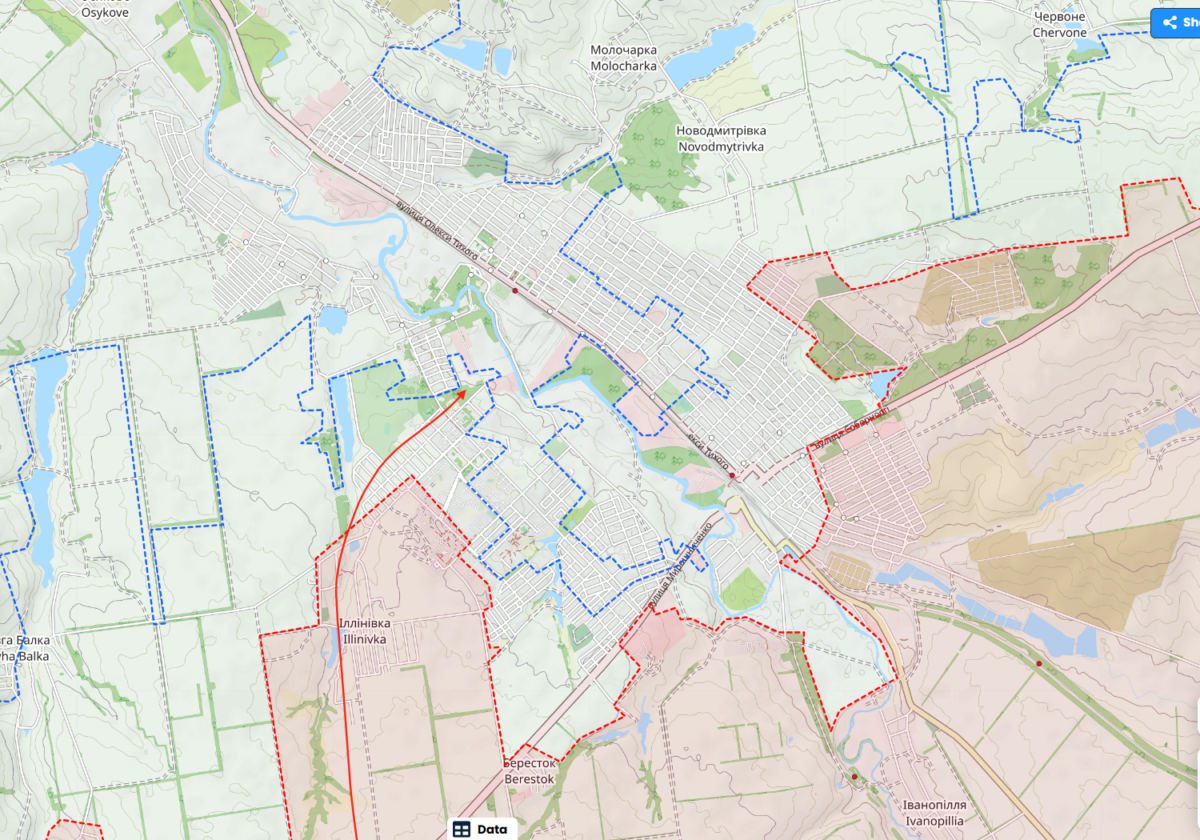
From the Ukrainian point of view, the situation is deteriorating in Kostyantynivka. Russia has been repeatedly sending infiltration groups into the town, while also trying to bypass it through the surrounding villages on both sides.
“The enemy is tightening its grip over the area around the town, infiltrating surrounding villages where it is massing forces, and from there trying to break into the town itself and entrench positions in different places,” the DeepState UA account wrote. Kostyantynivka is also being massively bombed.
Source – Black Bird Group
Source – DeepState UA
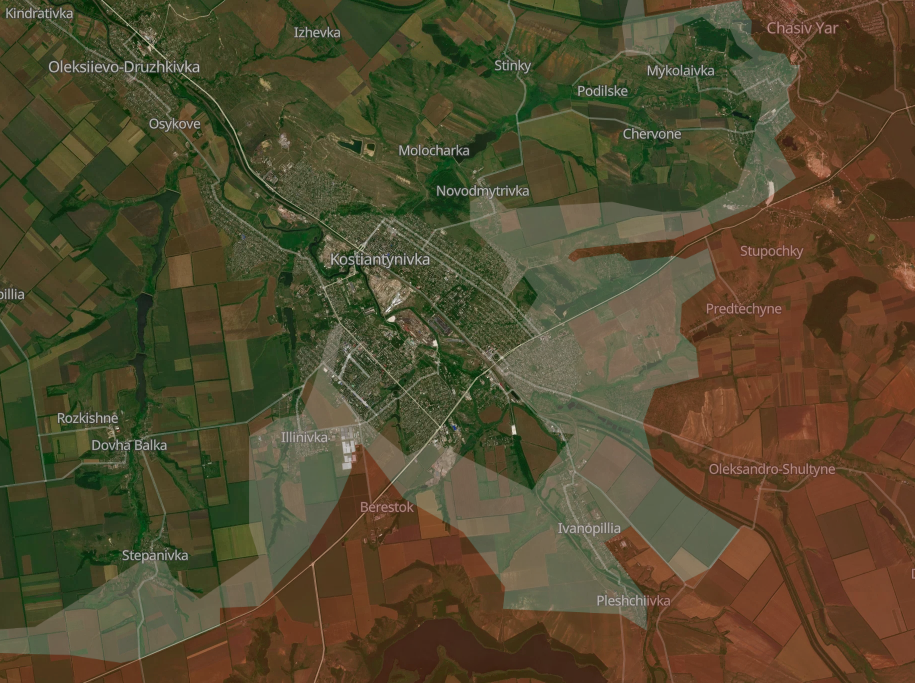
Russian troops have already appeared in the town centre and have been seen in high‑rise buildings. “Despite confirmed Ukrainian presence in the southern part of Kostyantynivka and in surrounding villages such as Illinivka and Novodmytrivka, Russian forces have managed to bypass these positions and infiltrate high‑rise and industrial areas in the town centre, where they have been targeted,” the Ukraine Daily Update account wrote earlier this week.
As it added, not every Russian infiltration was destroyed, but it was not possible to speak of a stable Russian presence. “This area remains a patchwork of territory under Ukrainian control and grey zones,” it said.
The Russian channel Rybar wrote this week that Russia’s systematic advance was bearing fruit. “Small assault groups are clearing out fortified positions in built‑up areas, with the greatest progress observed on the southern and southwestern outskirts,” it added.
Ukraine will certainly not abandon this pre‑war town of 60,000 without a fight, but of all the threatened towns it is currently the closest to being captured by Russia this year.
Map of the day
Russia continues to announce captured territory based on where its soldiers manage to unfurl the Russian flag. This is regardless of how long these groups stayed there and whether their positions were secured.
On Wednesday, it announced in this way that it had captured Vozdvyzhivka, north‑west of Huliaipole, which is about 8 km from Russian positions.
Several independent accounts, however, refuted this claim. “Two to three weeks ago, Russians sneaked into the village. Those who were not detected and killed in time managed to hang a few flags. A swift sweep was carried out immediately. These perverts were captured or eliminated. The Russian flags were destroyed,” the DeepState UA account wrote.
“Ukrainian unmanned ground vehicles regularly drive through this area, which does not happen in areas controlled by Russian forces or in grey zones,” the Playfra account wrote.
The French OSINT analyst Molin published a map showing the current front lines and the places where Russian infiltration groups have displayed the Russian flag. It shows that they often operate far from their positions; at the same time, this does not mean that Russia controls this territory.
“For example, in January several Russian soldiers entered Ternuvate. They never achieved control of the town and were all killed; the town was eventually fully cleared a few days later,” Molin wrote.
We can imagine, however, that Russian generals have it marked somewhat differently on their maps. They consider the territory with red dots to be Russian, even though the reality is different.
Source – Clément Molin
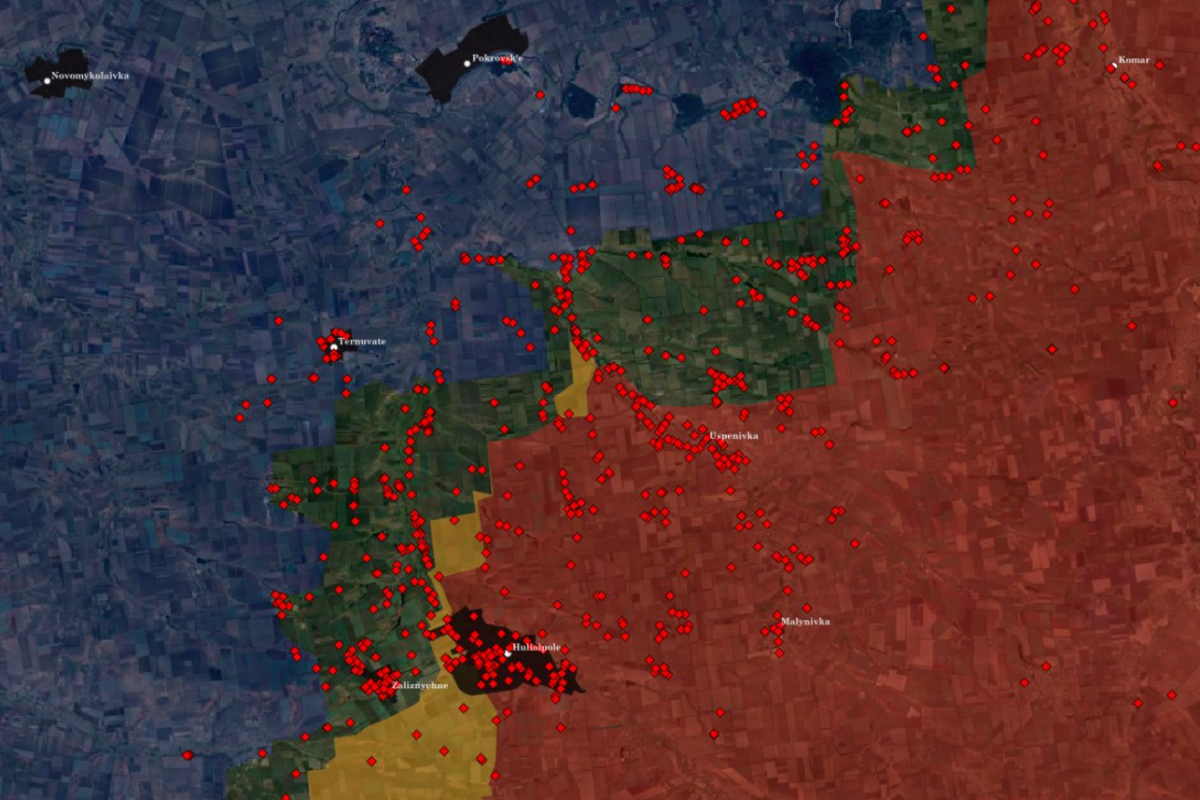
Chart of the day
According to the Oko Hora account, Russia advanced a net 14 square kms last week. It looks like May will see the slowest advance in the monitored period.
Russian advance by weeks
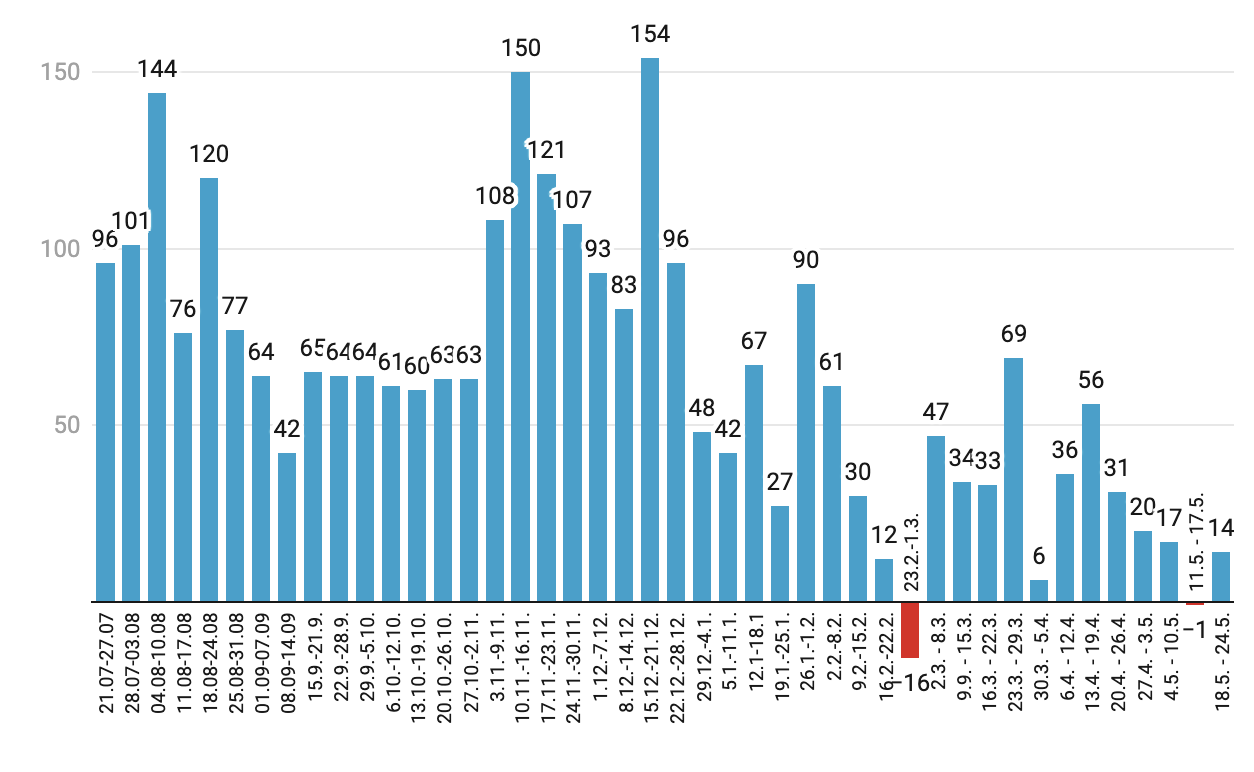 Amount of territory occupied by Russians per week. Data is in square kilometers. Source: Oko Hora, Download data, Created with Datawrapper/ Dennik N
Movements on the front are also being tracked by Polish analyst Konrad Muzyka, who this week published a chart of Russian progress since September 2025. The total amount of territory occupied since that month is shown by the red line in his chart. At present, this is 2,070 square kms captured since last September.
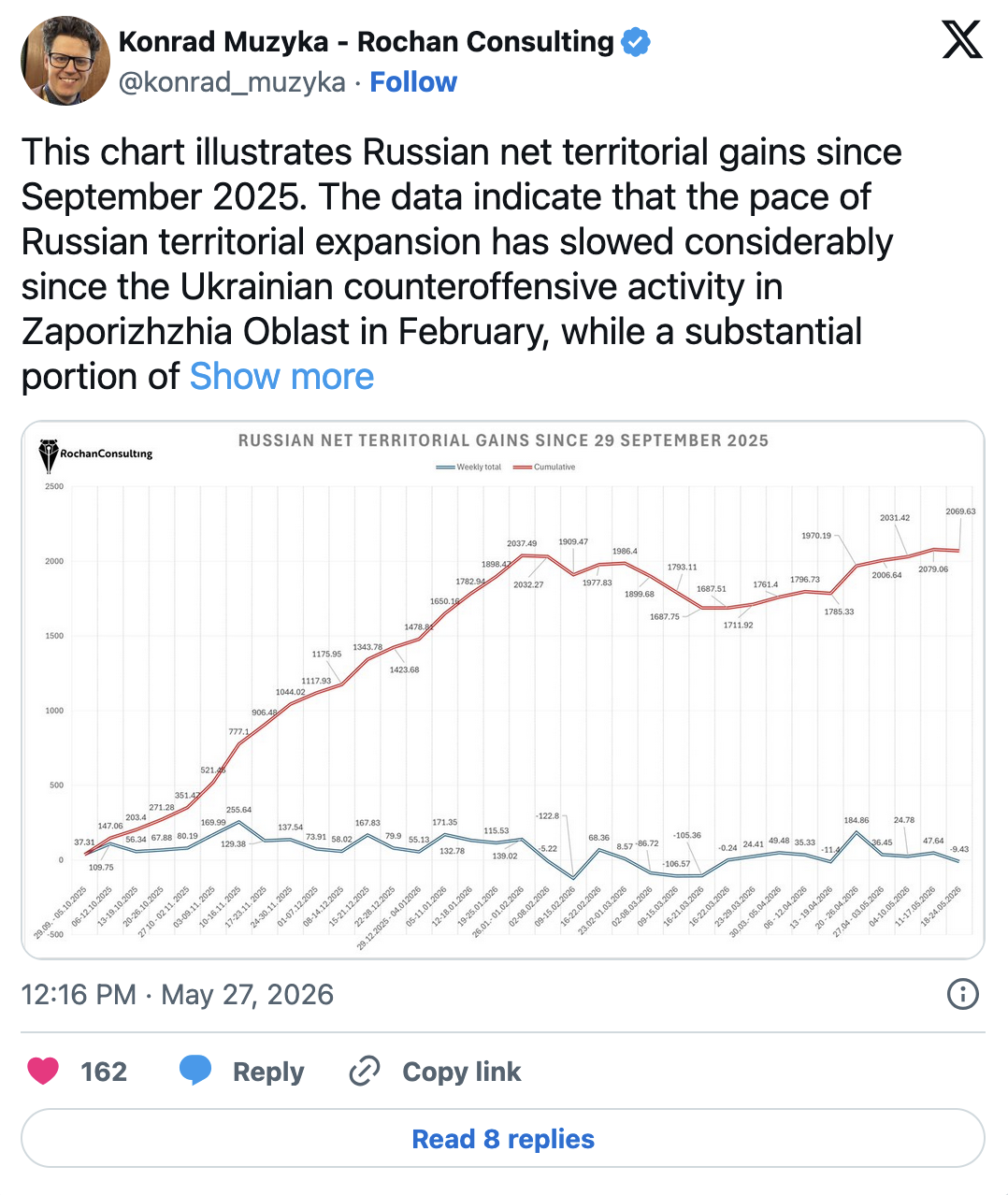
His chart shows that since January Russia has expanded its territory by only 32 square kms. In many weeks Ukrainians liberated more territory than they lost (the blue line).
“The data suggest that the pace of Russian territorial expansion has slowed considerably since the February Ukrainian counter‑offensive in Zaporizhzhia region, with a substantial portion of Russian gains since the beginning of 2026 achieved in relatively lightly defended areas of Sumy region,” he wrote.
Videos of the day
Russia is placing a Pantsir air‑defence system by helicopter on a high‑rise building in Moscow.
This is what part of the destroyed town of Lyman looks like.
The town of Liman in the Donetsk region. All the buildings were destroyed by Russian air strikes and artillery shelling. Almost no people remain – everyone was killed by the Russians or left.
Putin calls this “help for the people of Donbas.” pic.twitter.com/ifSLqzd8SN
— Денис Казанський (@den_kazansky) May 27, 2026
What are the losses
In May, some types of equipment were removed from the list, so the total figures dropped significantly compared with previous weeks. No update since Monday (11 May).
By Monday (11 May), Russia had demonstrably lost 23,439 pieces of heavy equipment (on Tuesday (5 May) it was 23,650). Of these, 18,444 (18,618) pieces were destroyed by Ukrainians, 971 (976) were damaged, 1,197 (1,206) were abandoned by the crew and 2,827 (3,182) were captured by the Ukrainian army. This includes 4,390 (4,394) tanks, of which 3,293 (3,292) were destroyed in combat. Ukraine lost 11,253 (11,219) pieces of equipment, of which 8,737 (8,708) were destroyed, 666 (661) damaged, 665 (666) abandoned and 1,185 (1,184) captured. This includes 1,422 (1,420) tanks, of which 1,087 (1,085) were destroyed in combat.
Note: Neither side regularly reports its dead or destroyed equipment. Ukraine publishes daily figures on Russian casualties and destroyed equipment, but these cannot be independently verified. This overview uses data from the Oryx project, which since the beginning of the war has compiled a list exclusively of visually documented equipment losses.