As Luxembourg’s elite judges at the Court of Justice of the European Union quietly juggle share portfolios and politically-sensitive cases, critics warn their ties (often undisclosed) to Big Pharma, banks and Big Tech raise concerns over possible conflicts of interest and transparency.
 Pascal Hansens



Operating from tiny Luxembourg, fewer than 100 individuals are invested with unique power to shape the rules governing half a billion people.
Members of the Court of Justice of the European Union (CJEU) can compel governments to rewrite laws, force corporations to shell out billions and have the last word on laws of the world’s largest trade bloc.
These revered experts are held to exacting standards to avoid anything casting a shadow of doubt over their decisions. The court’s code of conduct states jurists must avoid all situations “which may give rise to a conflict of interest… or may be perceived as such”.
Yet a surprising number of CJEU jurists have ties to the very companies the court can effectively regulate, Investigate Europe can reveal.
More than 40 per cent of current judges and advocates-general have declared private financial interests, exclusive analysis of transparency documents shows.
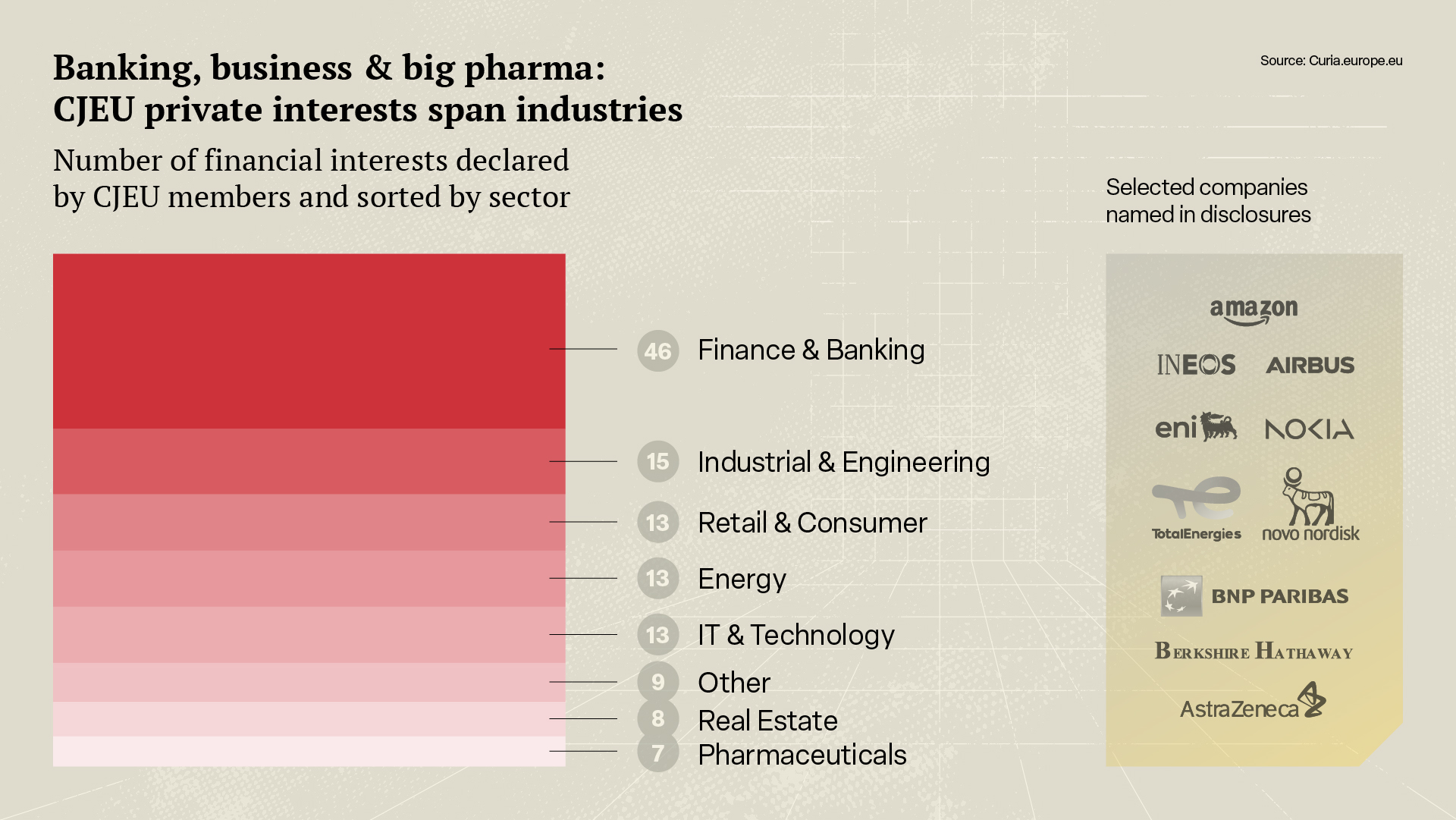
Jurists’ holdings include stakes in oil giants Eni and Total, sprawling real estate and infrastructure operations, and household names like AstraZeneca, Airbus, Amazon and Boeing.
In some instances, jurists worked on cases involving companies or competitors where they had registered a financial interest, Investigate Europe found, raising questions about perceived potential conflicts and the court’s system to safeguard against such risks. Many more sat on cases concerning industries where they also have declared financial interests.
In a six-month investigation, reporters found striking gaps in jurists’ public disclosures, a system where cases at both CJEU courts – the higher Court of Justice and the lower General Court – are assigned without external scrutiny, and impartiality risks around judges’ links to their national governments.
The president of the General Court told Investigate Europe that an internal committee would review the findings.
The European Ombudsman, meanwhile, announced they would open an inquiry after Investigate Europe filed a complaint with the EU administrative body over the court’s failure to make public judges’ historical declarations.
“The Court of Justice of the European Union still falls short of the transparency standards now expected of high supreme courts,” said Alberto Alemanno, a professor of EU law and EUobserver columnist, who has written on judicial openness and public integrity for more than a decade.
Big Pharma shares, big pharma cases
German advocate general Juliane Kokott is a prominent face at the Court of Justice and an authority on competition law. She also has a varied share portfolio, which according to her latest public declaration, includes a German rail infrastructure firm, a physical gold investment fund and three major pharmaceutical companies: AstraZeneca, BioNTech and Merck.
This is not against court rules. The code of conduct simply requires justices to declare financial interests when taking office and update disclosures once every three years or whenever changes occur. They must flag any potential conflict when assigned a case, and if necessary, recuse themselves.
The CJEU offers no definitions for conflict of interest in its policies, but the Organization for Economic Cooperation and Development (OECD) defines it as when a public official’s private interests “could improperly influence” their responsibilities. A perceived conflict, the OECD states, is when such interests could influence their duties but ultimately do not.
In 2019, Kokott was assigned a case pitting French drugmaker Servier against the European Commission, concerning a treatment for hypertension.
Two years later, she acquired shares in the three pharmaceutical firms. Kokott did so, she said, to “contribute – to a very limited extent” to the development of Covid-19 vaccines. In 2022, the advocate general gave her legal opinion in the Servier case.
Since 2016, Kokott has been called to give opinions on at least eight cases involving the pharmaceutical sector and delivered four. The opinions of advocate generals carry weight, and are followed roughly 80 percent of the time by judges in their final rulings.
In response to Investigate Europe, Kokott said she “strictly followed all relevant rules… in particular those on impartiality and conflicts of interest.”
In the Servier case, Kokott said her opinion was ultimately not favourable to the company. “I pleaded that agreements concluded by the Servier group with generic pharmaceutical companies constituted restrictions of competition,” she said. “This is in no way beneficial to another brand-name manufacturer, such as AstraZeneca, and thus does not increase its share values.”
Kokott told reporters she holds only five shares in AstraZeneca, five in Merck and seven in BioNTech. Asked whether owning shares in an industry she also worked on could raise conflict of interest questions, Kokott said she did “not share that impression.” She did not respond to questions about whether a perceived conflict had been reviewed by the court.
“The fact that a jurist is supportive of the pharmaceutical sector generally is problematic, even if the value of shares is somewhat symbolic,” said a senior legal figure familiar with how the CJEU operates, who asked to remain anonymous. “It is about the perception that such cases give, and that is where the issue lies.”
There is no indication that Kokott derived material benefits from any of the cases. She is not the only jurist, however, whose private interests stray close to their work.
Banking connections
In 2023, Geert de Baere, a Belgian judge at the CJEU’s General Court, sat as one of five judges on a panel ruling a case involving BNP Paribas, despite having publicly declared an interest in BNP Paribas Fortis, the French bank’s Belgian subsidiary.
General Court president Marc van der Woude told Investigate Europe that De Baere was not a shareholder in BNP. Rather, he held a current and savings account there, as well as an investment “portfolio of shares and stocks of third parties” managed on his behalf.
De Baere had been assigned the case, which concerned BNP’s bill to an EU banking agency and which it ultimately won, as part of a group of cases concerning more than 40 banks. His inclusion was necessary to “preserve the consistency of the judgments,” van der Woude said.
The General Court president conceded he hadn’t examined the interest when De Baere was assigned the case, but said he would still have signed off the judge’s inclusion in the case.
While De Baere holds no shares in BNP itself, he still has a relationship with the bank and this “from the perspective of perception is problematic”, said the legal figure with knowledge of CJEU proceedings.
“Judicial impartiality must remain beyond doubt,” said Shari Hinds, senior policy officer at Transparency International EU. “Yet some of these cases leave open questions on whether the consequences of perceived conflicts of interest were fully considered when cases were assigned.”
‘System relies on self-assessment’
There is no indication any of these cases amount to an actual conflict of interest. But the findings do raise questions about what checks the court carries out when cases are assigned. The court did not answer when asked whether any of the members had raised the matter for examination when they were assigned to the case.
“The system relies almost entirely on self-assessment,” professor Alemanno said. “A member identifies a possible conflict and notifies the president of the court, who takes the declaration ‘into due account’ when allocating cases. There is no external verification on this, no published reasoning.”
The court argues such secrecy is necessary to shield judges from external interference. For the same reason, judges sit on panels rather than individually.
During the investigation, the court refused multiple requests for information from Investigate Europe relating to judges’ interests and decision-making around case allocation, citing the need for privacy in internal deliberations.
It also declined to hand over past versions of declarations of interest, despite those being public documents.
In the days before publication, European Ombudswoman Teresa Anjinho told Investigate Europe that she would open an inquiry into the decision not to publish past declarations, adding that she would meet with the court to discuss the issue by mid-September. However, reporters were able to obtain several previous versions via internet-archive websites.
Wide range of shareholdings
Using openly-available documents, Investigate Europe found overall that 36 justices declared interests in 124 entities, according to their latest disclosures. Notable companies include fossil fuel heavyweights Eni, Total and Repsol, weight-loss drug maker Novo Nordisk, aviation titans Boeing and Airbus and US tech giant Amazon.
Interests in the finance sector were by far the most common, spanning European institutions such as Erste Bank, Swedbank and Bank of Valletta to US conglomerate Berkshire Hathaway.
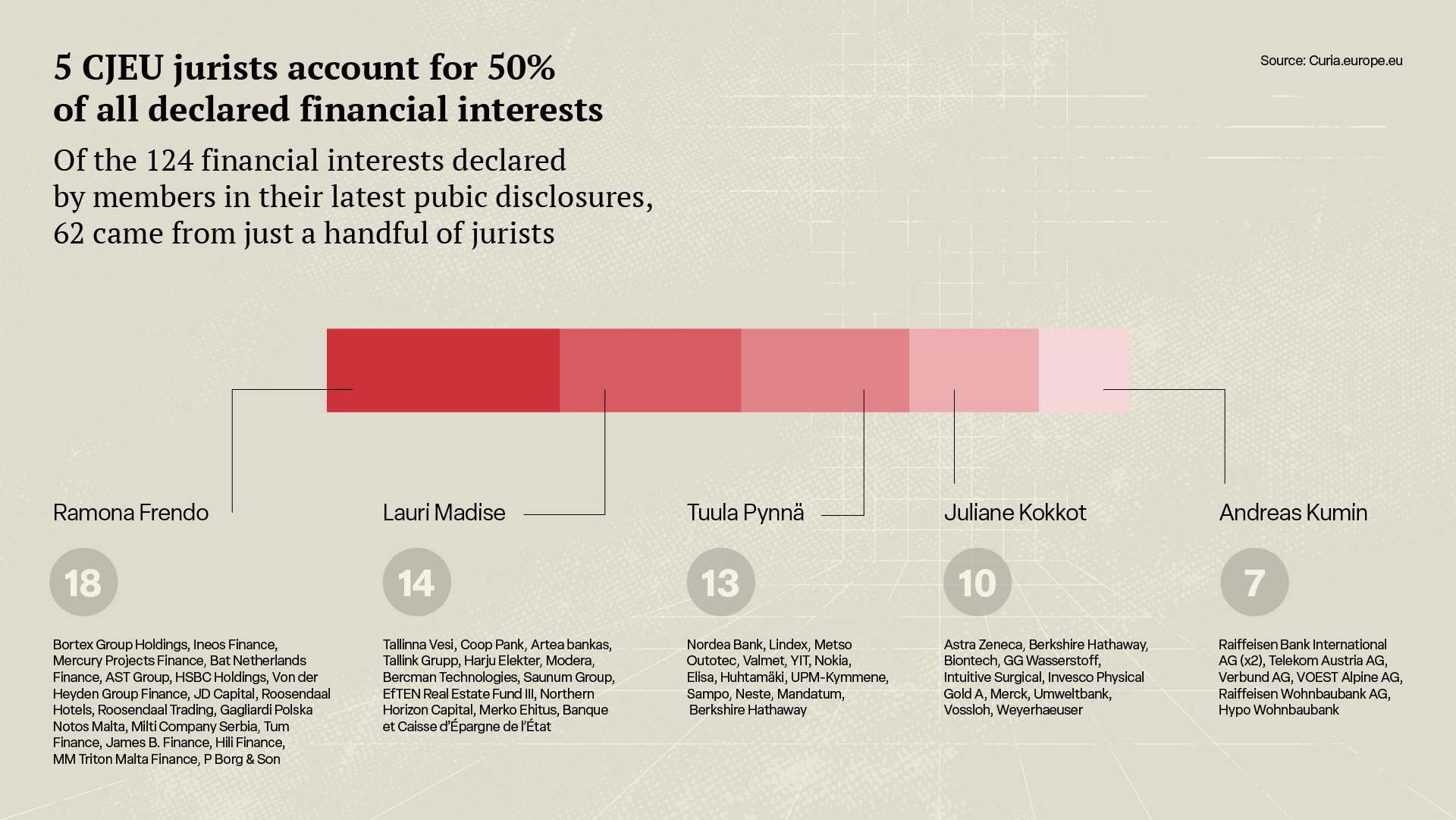
Five jurists accounted for half of all declared interests: Malta’s Ramona Frendo, Estonian Lauri Madise, Finland’s Tuula Pynnä, followed by Juliane Kokott and Austria’s Andreas Kumin.
Details on the size and nature of the holdings, however, are almost always excluded from published declarations.
Almost a third of declarations were uploaded more than three years ago —seemingly at odds with the court’s own transparency policy.
However, soon after Investigate Europe contacted the CJEU for comment in the days before publication, more than 35 jurists’ public disclosures, most of which were outdated, were re-uploaded to the court website with new versions.
At least three, though, still included no date at all at the time of publication, and one had no declaration published at all.
According to the court’s code of conduct, a separate, more detailed version is circulated internally, but kept out of public view.
For Silje Hermansen, an assistant professor specialised in judicial politics at the University of Copenhagen, allowing judges to have any kind of shareholdings is an unnecessary risk to the court’s perceived integrity.
“Bear in mind that when a publicly-traded company wins in court, this often has an immediate effect on its stock market value,” she said. “The court should consider a reform where judges sell their shares before taking office. You will never find anyone in the EU institutions who is paid more than these people.”
General Court president van der Woude told Investigate Europe that in his previous job at a private law firm, he and his colleagues were barred from owning direct shares. “It was absolutely clear and there was no ambiguity.”
A spokesperson for the CJEU said “judges and advocate generals of the Court of Justice are citizens who have private lives and, therefore, decide themselves on how they wish to manage their possessions.”
Asked about this wide range of shareholdings, they said there was “nothing wrong with owning shares/interests insofar as it does not affect the good administration of justice.”
Recusal had to date never been necessary, they added.
Cases close to home
In addition, Investigate Europe found that many judges, who are nominated by their home countries for renewable six-year terms, previously held national political office, which some experts believe could pose potential impartiality risks for cases.
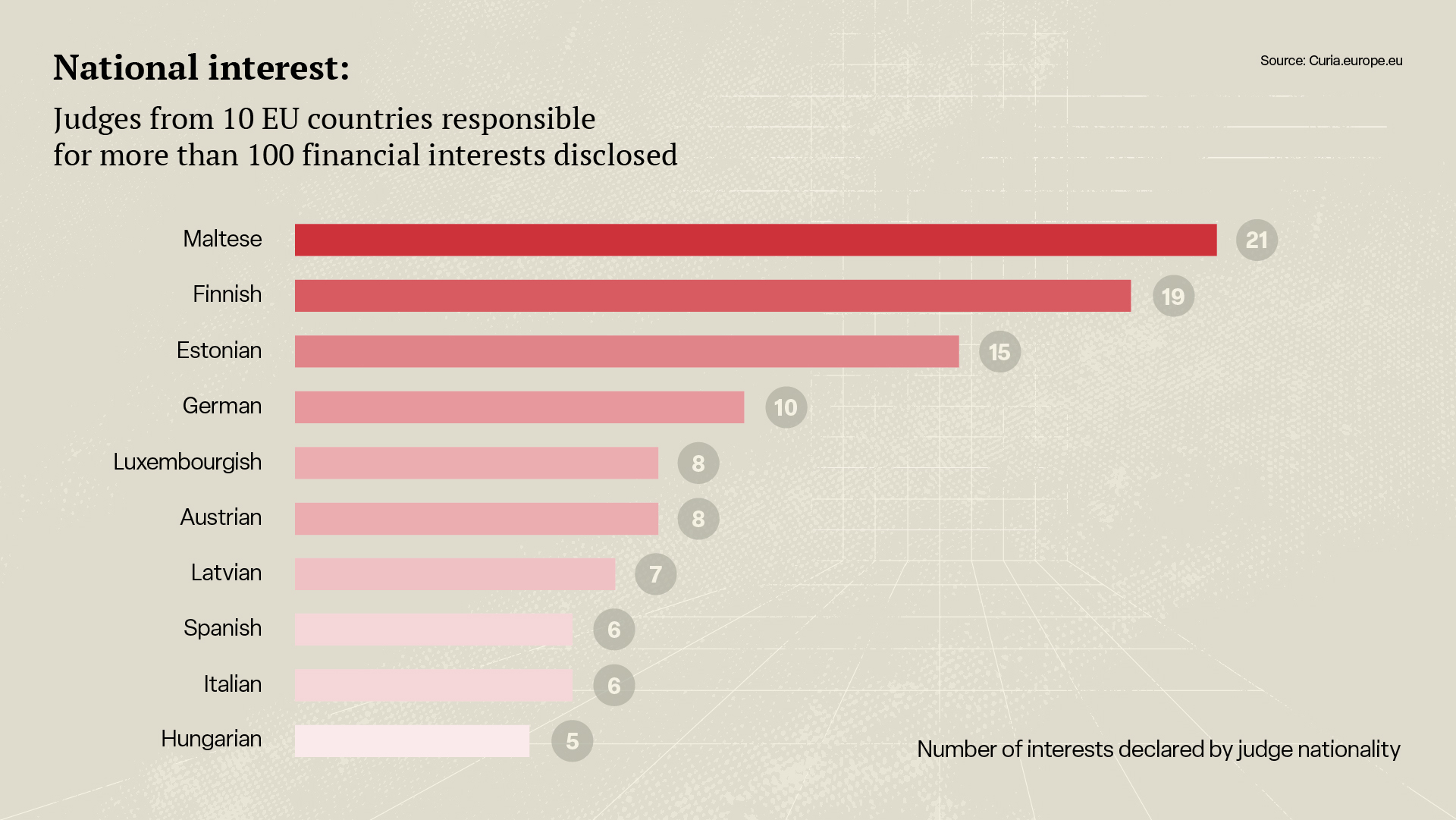
They include Luxembourg’s Francois Biltgen, who served as a government minister for 14 years and was a close ally of long-time prime minister (and former EU Commission president) Jean-Claude Juncker.
In 2023, he sat as one of five judges on a high-stakes case concerning Amazon’s tax bill in the Grand Duchy. The European Commission wanted Luxembourg to recoup €250m from the US giant, arguing it had set itself at a competitive advantage with tax administration decisions dating from when Biltgen sat in government. The court ultimately sided with Amazon and Luxembourg.
Biltgen told Investigate Europe that his involvement in no way constituted a conflict of interest: “There can therefore be no appearance of a conflict of interest here, unless the notion of conflict of interest is – unduly – extended.” The contested decision was made by Luxembourg tax authorities and not the government itself, he noted.
“Since becoming a CJEU judge, I do not have any official contacts with the Christian Social Party,” he added. “Moreover, I have never been submitted to political pressure by any political entity, governmental or other.”
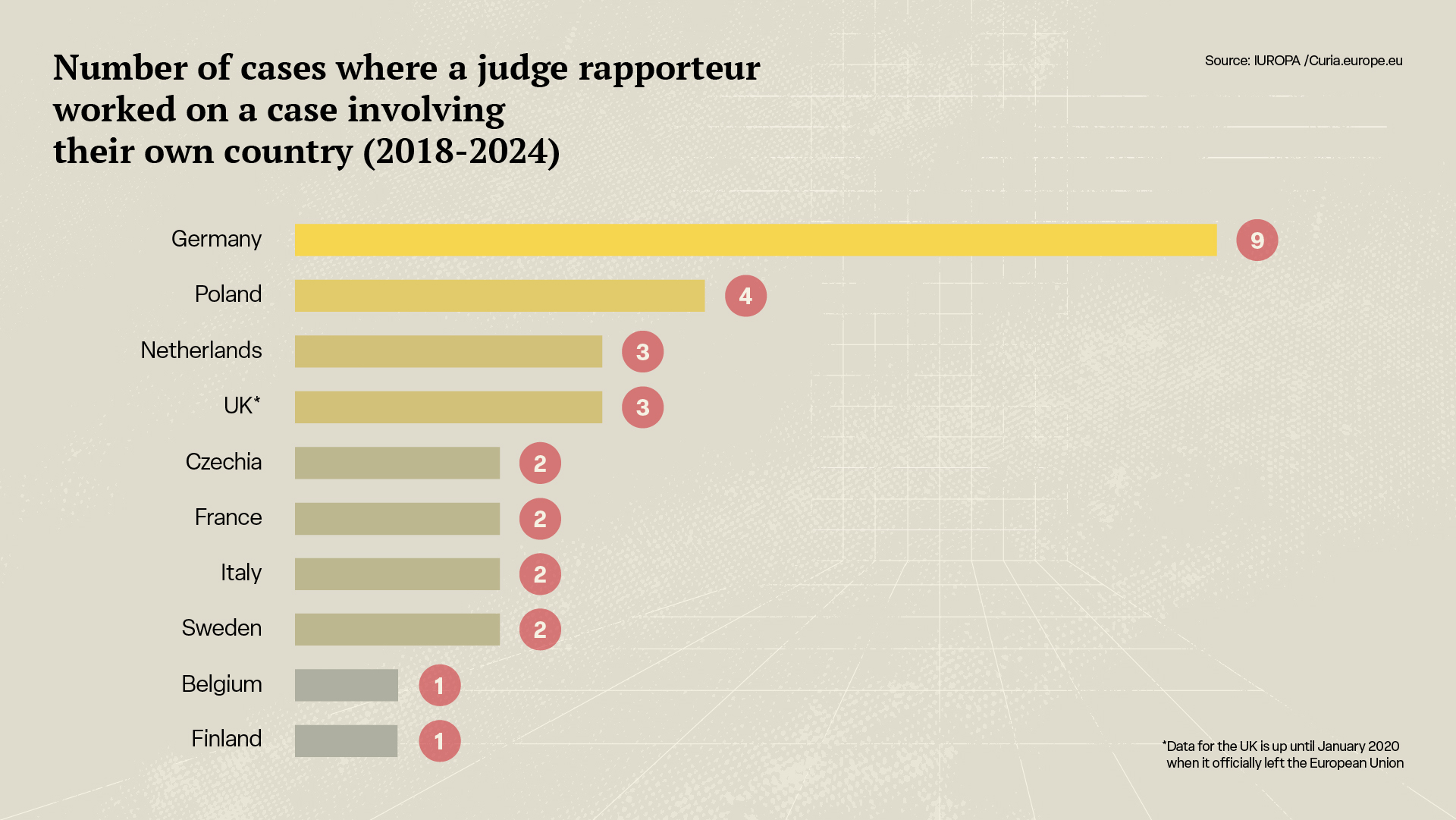
According to Silje Hermansen, it is not uncommon or against the rules for judges to sit on a panel ruling involving their home country, or for former politicians to serve. But to avoid any risk of national bias, the court tries to ensure judges do not serve as rapporteurs. In this crucial role, a judge prepares a draft ruling for their colleagues to deliberate on.
Investigate Europe found that judges served as rapporteurs around 30 times in cases directly involving their home country between 2018 and 2024, analysis of a database compiled by IUROPA, a research project tracking CJEU cases, showed.
‘Duty of loyalty’
CJEU justices have “a duty of loyalty to the state that appointed them, and it is these same states that have the power to renew their terms,” said Yale University researcher Carles Aulés-Blancher, who has studied perceived bias at the court.
For him, six-year renewal terms are a sort of “sword of Damocles hanging over the judges’ heads that should be abolished in favour of longer terms.”
In 2010, the European Court of Human Rights changed its own rules of nomination for this precise reason, introducing nine-year non-renewable mandates for judges.
“You will not find a single constitutional or supreme court across Europe where judges have renewable mandates,” said the senior legal figure, who asked to remain anonymous. “I can tell you, there is anxiety among judges a year before the end of their mandate. And the number of trips they have to do to see ministers, or anybody they have to, because they want to carry on.”
Campaigners have long criticised the way judges are selected, with candidates confirmed behind closed doors by an obscure panel called the 255 Committee, made up of seven European jurists, often previous CJEU members. In 2024, Politico reported that a high-ranking FIFA official was part of the 225 Committee despite the court handling multiple cases concerning the world’s football governing body.
As Koen Lenaerts, president of the CJEU, said in an interview back in 2020, a judge must not have “the slightest personal interest” in a case. “That equal distance is also a matter of perception: none of the parties should entertain any reasonable doubt as to the judge’s impartiality.”
Editor: Chris Matthews (IE) and Matthew Tempest (EUObserver). Additional reporting: Lisa Pace, Nico Schmidt
This investigation is led and coordinated by Investigate Europe, a cross-border journalism collective. It is published with media partners including EUobserver, Follow The Money, Le Monde, Publico.pt, Publico.es, Le Soir and Taz.