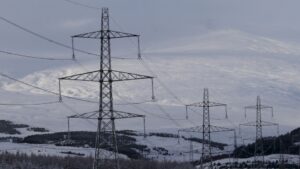

Russia’s scramble to plug holes in its air defences is now exposing key bases, as Ukraine claws back ground in the south and steps up drone and naval strikes.
 Roman Pataj




Every day, the Ukraine Battlefield update newsletter offers a clear look at how the war is unfolding on the ground. Subscribe for free here to get the full text delivered to your inbox.
The process of exhausting Russian air defences has been under way for years, with units from the Arctic bleeding out also in Crimea. How ATACMS in 2024 killed a lieutenant colonel from Severodvinsk. Russian forces are approaching Sloviansk from the east, the situation of the defenders is deteriorating. The Ukrainian army advanced in the south on the boundary between three regions. The war against ships has shifted from the Sea of Azov to the Black Sea. Ukrainians sank a Russian vessel that in 2018 was a star of Russian propaganda. The victims of the revenge of the commander of the 155th brigade of the Ukrainian army had 15 and eight bullets in their bodies; they were buried at the unit’s training ground. Maps of the day – Sloviansk axis; Ukrainian advance in the south Videos of the day – a drone hit a Russian Mi‑28 helicopter over Belgorod region; the offensive against maritime shipping continues; heavy fighting is under way in Kostyantynivka, which Russia claims to have captured; a perfect battle from the Ukrainian army’s point of view – ground and flying drones clear a position without the direct presence of people; a three‑tonne bomb hits Orikhiv
The process of exhausting Russian air defences has been under way for years, with units from the Arctic bleeding out also in Crimea. The problems of Ukraine’s air defences are well known. It lacks missiles capable of shooting down Russian ballistic missiles, which Russia exploits for increasingly frequent attacks on Kyiv with Iskander missiles.
Ukrainians are therefore trying to disrupt the production chain of these weapons and, since March, have already attacked six different factories where their components are produced.
However, Ukrainian unmanned aircraft are at the same time conducting a long‑term campaign to weaken Russian air defences, which is bringing results. These are visible in the increasingly frequent and increasingly successful attacks on refineries. On the Russian internet, especially around 9 May, criticism appeared that Putin’s regime was pulling air‑defence assets back towards the capital and leaving the periphery without protection.
Russia is also disadvantaged by the sheer size of its territory, which it is unable to defend in its entirety against hundreds of drones attacking every night, a problem that is further aggravated by the destruction of more and more batteries, with fresh evidence of this emerging constantly. How far this can go can be seen in Crimea, where Ukrainian drones have already triggered an energy state of emergency.
Norwegian journalists from The Barents Observer have now analysed a series of satellite images and concluded that the shortage of surface‑to‑air missile batteries is so serious that the Kremlin has had to resort to a step which, before the invasion began in 2022, would have seemed unthinkable.
Norwegian analysts calculated that since 2024 at least 20 launchers of S‑300 and S‑400 systems have disappeared from two air‑defence positions around the city of Severodvinsk.
“The systems were most likely moved to southern Russia, the Moscow region or the occupied parts of Ukraine to reinforce air defences after repeated Ukrainian attacks,” the Norwegians wrote.
Severodvinsk and its surroundings were protected by the 1528th Anti‑Aircraft Missile Regiment. Near the city are the Sevmash and Zvezdochka shipyards. The former is the only yard in Russia capable of building nuclear submarines, the latter is the largest port for their maintenance and modernisation.
Thanks to the TopCargo200 website, The Barents Observer has identified one of the probable locations to which the regiment from Severodvinsk was transferred. One of its members was Lieutenant Colonel Vladimir Spiridonov, who died on 30 April 2024 in Crimea. At that time, he was probably the commander of a battalion armed with the S‑400 system and was killed by a US ATACMS missile during a coordinated strike on targets in Crimea. The Ukrainians attacked four different targets on the peninsula, including Spiridonov’s unit.
It is not known at which of the above‑mentioned sites it was stationed, but on 2 May 2024 we published these satellite images from Dzhankoi, which show S‑300 or S‑400 launchers in combat positions before the strike. They are missing in the second image. It cannot be ruled out that this was the place where Lieutenant Colonel Spiridonov was killed and where the unit from Severodvinsk was deployed.
🛰️З’явились супутникові знімки наслідків ударів по військовому аеродрому у Джанкої в окупованому Криму
👀@KOvsianyi pic.twitter.com/pvBj9zjXLw
— Схеми (@cxemu) May 2, 2024
“In an effort to repel Ukrainian drone and missile attacks on strategic infrastructure deep inside Russian territory, Russia is expending its stocks of surface‑to‑air missiles faster than its arms industry can replenish them. This has apparently forced the Kremlin to move many of its air‑defence assets from lower‑priority regions to higher‑priority areas such as Moscow, St Petersburg and operational zones closer to the Ukrainian front, including Crimea,” Norwegian expert Kristian Åtland said for The Barents Observer. He did not think, however, that Severodvinsk had been left completely unprotected. Part of its air defences may have been dispersed and part moved only temporarily.
The weakening of Severodvinsk’s defences, in addition to the overall depletion of Russian air defences, is also a clear indication that the Kremlin is lying when it speaks of Nato’s aggressive intentions. If Russia really believed in such intentions, it would not be moving air‑defence systems away from a target which, in a war of that scale, would be one of the enemy’s priorities.
Russian forces are approaching Sloviansk from the east, the situation of the defenders is deteriorating. On the map from the Russian Telegram channel Rybar, in addition to its own version of the front line, the locations of successful attacks by Russian FPV drones on Ukrainian military equipment and supply vehicles are also marked.
If Rybar’s map accurately reflected reality, Russian forces would be succeeding in straightening the front and would in effect have only one last major obstacle to overcome before breaking through directly to the eastern boundary of Sloviansk, in the form of the small town of Mykolaivka on the north‑eastern edge of Sloviansk.
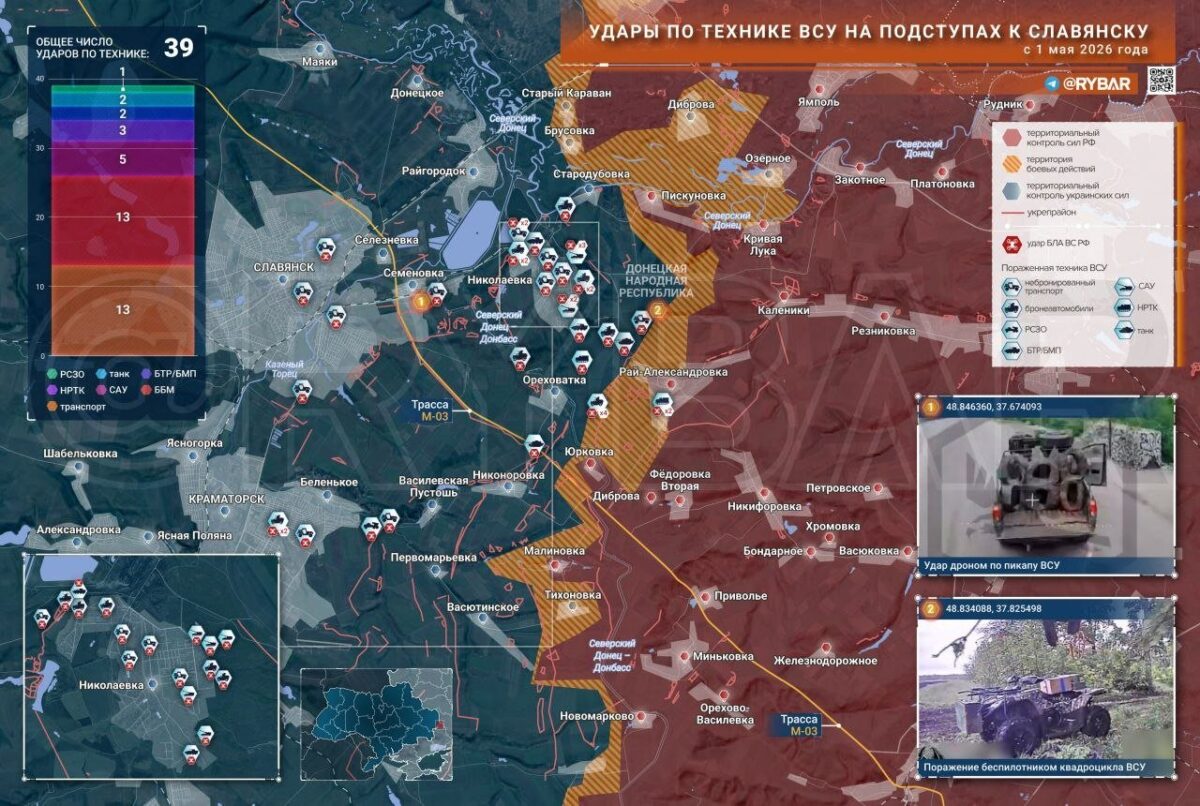
The map by French analyst Clément Molin looks somewhat less ominous, but it confirms that Russian forces are already operating west of the Siverskyi Donets–Donbas canal, as well as the degradation of Ukrainian logistics throughout the area caused by constant Russian strikes now also hitting Kramatorsk and Sloviansk.
If the situation in the south recently improved, it continues to worsen in the Donbas, especially on the Sloviansk front.
Russian 🇷🇺 forces continue to push west after they took Siversk (7 months ago) and have down nearly half of the path leading to Siversk. The current… pic.twitter.com/tbV2TlHpTH
— Clément Molin (@clement_molin) July 15, 2026
The Ukrainian army advanced in the south on the boundary between three regions. Specifically, this is the area where the Donetsk, Dnipropetrovsk and Zaporizhzhia regions meet. It has long been known that a local Ukrainian counter‑attack has been under way there. Ukrainian analysts from DeepStateUA have only now, after a longer interval, updated their map to show that the Ukrainian army has made gains near the villages of Maliivka, Sichneve, Novohiorhiyivka, and Zaporizke.
In the map below, the situation before and after the update is compared. The new version does not show anything dramatic, and even the authors did not mark the change in green, but only by expanding the grey zone that is not fully controlled by either army. It is therefore good news, but accounts that whip up unwarranted euphoria around it with claims of a major counter‑offensive should not be believed.
СОУ звільняють декілька сіл
Очікування: більше синього
Реальність: менше червоного pic.twitter.com/JdNpRarGFm
— Vitaly (@M0nstas) July 14, 2026
The war against ships has shifted from the Sea of Azov to the Black Sea. Russia is trying to strike back, but the number of attacks on its vessels remains significantly higher. Russian strikes are aimed partly at ships, but mainly at ports around Odesa.
The pro‑war Russian blogger Yuriy Podolyaka quoted claims by the Russian ministry of defence according to which “our drones hit another two cargo ships that were sailing from the port of Chornomorsk to the port of Odesa. The number of vessels hit over the past three days has thus risen to eleven.”
The frequency of Ukrainian attacks is several times greater. On Tuesday, Ukraine’s unmanned‑systems forces announced that units subordinated to them had managed, in nine days in the Sea of Azov, to hit 116 Russian naval vessels.
USF Operation “MoLoCHKa” in action: 116:0 in nine days.
We will stand.
Moscow will fall.
Crimea will be fed back up and rebuilt.
Follow the Unmanned Systems Forces’ results live:
Online dashboard “PIDRAKHUIKA”https://t.co/nOV6cIalfS
MAGYAR 🇺🇦
14.07.26 pic.twitter.com/EOnI8bzfUa
— 414 Magyar’s Birds (@414magyarbirds) July 14, 2026
On Wednesday, the drone offensive against maritime traffic moved into the Black Sea, and within 24 hours there were 20 new hits, mostly on tankers, which is twelve times more than the number of ships hit by Russia over the same period.
The extent of the damage and the success rate of the attacks cannot be independently verified, but the published compilation shows that at least two tankers ended up in flames.
⚓️ Magyar’s Admiral Update
Black Sea: Unpacking 2.0
🔥⚓️Operation “MoLoChKa” by the Unmanned Systems Forces
The first 20 tankers in the Black Sea were hunted during the very first night.
The overall naval battle score during the operation from 6 to 15 July reached 136 units of… pic.twitter.com/LqmM06KdlO
— 414 Magyar’s Birds (@414magyarbirds) July 15, 2026
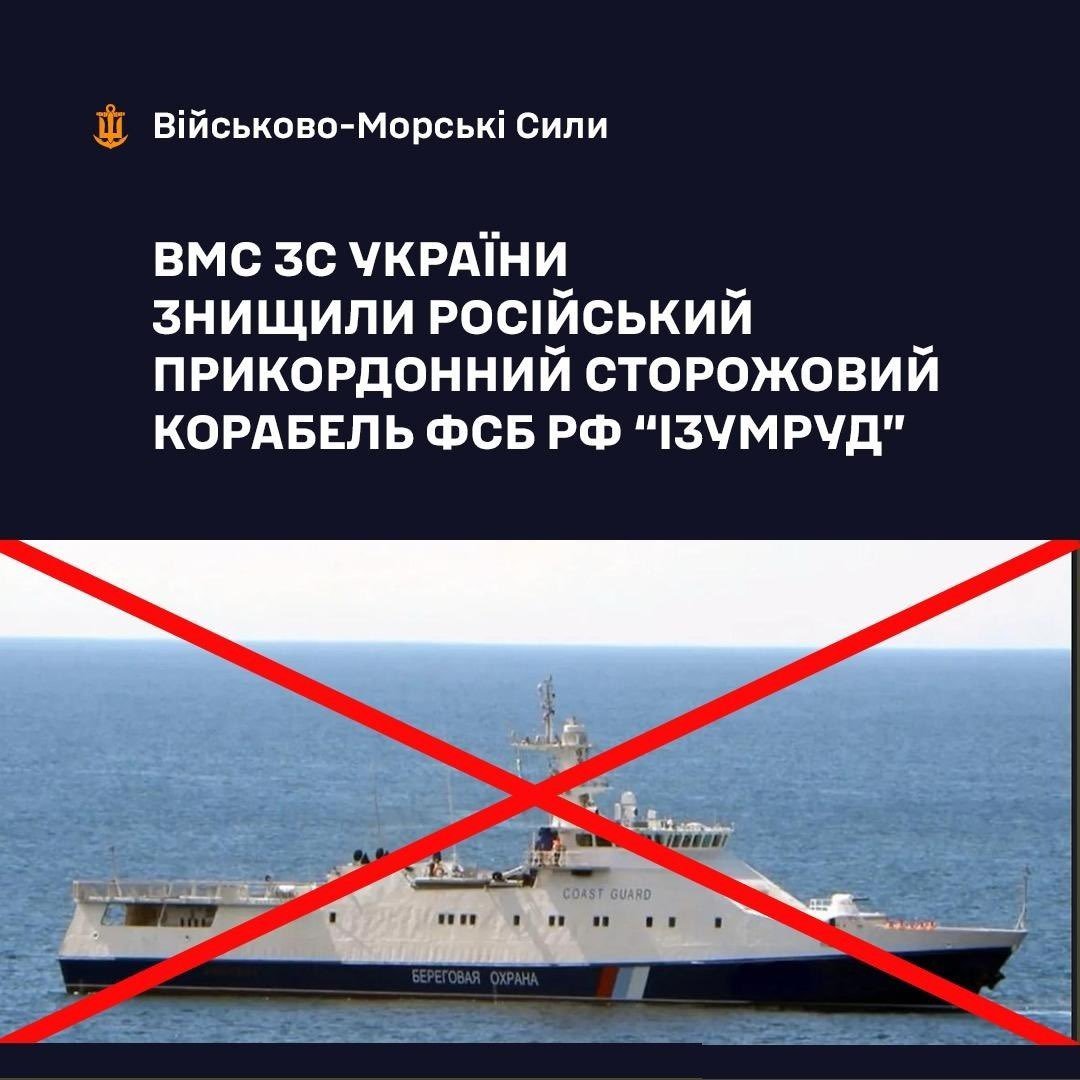
Ukrainians sank a Russian vessel that in 2018 was a star of Russian propaganda. The video below shows the unlawful actions of Russian navy vessels which, in November 2018, prevented a Ukrainian ship from passing through the Kerch Strait between the Sea of Azov and the Black Sea.
🚢🔥 SAR-3000 maritime drone sank the 2nd-rank border patrol ship Izumrud in the Novorossiysk area.
📹 Izumrud previously participated in the attack on Ukrainian ships in the Kerch Strait on November 25, 2018, when Russia captured 24 Ukrainian sailors. pic.twitter.com/Zxjf7PfjPV
— MAKS 26 🇺🇦👀 (@Maks_NAFO_FELLA) July 14, 2026
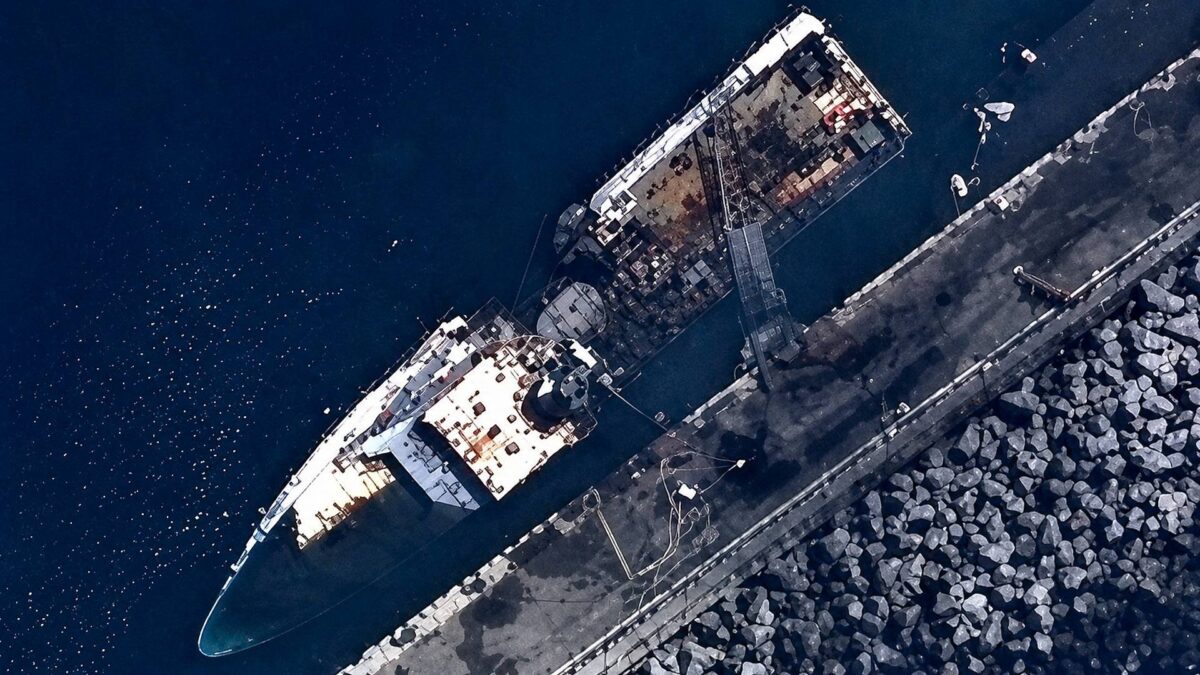
At that time, the Russian navy’s arbitrariness generated satisfaction in Russia and was taken as confirmation that the Russians had closed the Sea of Azov to Ukrainians. One of the ships in the footage is the Izumrud. On Tuesday, the Ukrainian navy announced that it had managed to destroy this vessel right in the port of Novorossiysk.
Satellite images are now available that confirm this. While moored alongside the pier, the Izumrud was hit on its starboard side by a Ukrainian SAR‑3000 naval drone. The ship sank after the explosion, and a large hole is clearly visible in the hull where the drone struck.
The victims of the revenge of the commander of the 155th brigade of the Ukrainian army had 15 and eight bullets in their bodies; they were buried at the unit’s training ground. As recently as the weekend, Stanislav Luchanov was in command of his unit; today he is already in custody and faces a possible life sentence. On his orders, his subordinates first kidnapped and then murdered two men from the village of Kalynivka in Kyiv region on 28 June.
A reporter from the Censor.net website, Violetta Kirtoka, visited the village after the scandal broke, and the details she learned from residents of the community of not even 500 inhabitants are even more bizarre than the original version, according to which the crime was sparked by an insult to Luchanov’s wife. Witnesses claim that the reason was allegedly the noise caused by motorbikes.
The victims were brothers Maksym and Roman Moyseichuk. They were abducted directly from their home by seven armed men in black, who had already walked through the village the day before with a list of names they were looking for. Locals found them suspicious and refused to tell them anything. A drone was, however, flying suspiciously low over the village, and people believe it was part of the search for future victims.
A photograph of the car in which the perpetrators came to Kalynivka helped track them down. It was taken by the murdered men’s brother Vasyl, who had originally planned to spend the evening with them but changed his plans, which probably saved his life. He was on the list as well.
His brothers were found buried at the unit’s training ground. One had 15 bullets in his body, the other eight. Today, the houses of the commander’s relatives are daubed with the words “murderers” and “executioners”. The gate of the house belonging to the family of the commander’s wife has been painted red.
As we have already written, Luchanov became commander of the 155th Mechanised Brigade of Anna of Kyiv after serving as chief of staff of the 425th Assault Regiment Skala. He in turn obtained that position after commanding one of the battalions of the regiment, which is known for its high casualties.
Videos of the day
After several months, a Russian combat helicopter has once again been destroyed by a drone. There is still no formal confirmation, but the drone operator hit the helicopter in such a way that its subsequent crash can be assumed with certainty. Whereas the last time the Ka‑52 was attacked directly from the front, this time the drone struck from above and behind. This was possible thanks to the helicopter’s low speed.
A Ukrainian FPV attack drone successfully chased down and hit a Russian Mi-28N attack helicopter over Belgorod this morning. pic.twitter.com/OTCZmwgAg4
— OSINTtechnical (@Osinttechnical) July 15, 2026
According to the Russian general staff and President Putin, Kostyantynivka has been captured. This is what it really looks like there.
An ideal way the Ukrainian army would like to fight all the time, and the future of warfare – ground and aerial drones work together to clear a position occupied by Russian troops. Not a single Ukrainian soldier took part directly in the fighting, which saves the lives of an army suffering from a shortage of manpower.
Orikhiv is an important stronghold of Ukrainian defence on the axis towards Zaporizhzhia. On the maps prepared for the Russian president, his troops are shown on the city limits; in reality, they are eight or more kms away. This does not change the fact that it faces the same fate as all the towns and villages in the path of Russian offensives – Russia is shelling and bombing them until nothing remains but ruins. In this case, you are watching the effect of a three‑tonne aerial bomb.
🔴 Russian forces have published footage showing them dropping a 3-ton aerial bomb on the Ukrainian town of Orikhiv in the Zaporizhzhia region. pic.twitter.com/osVkHH6J3K
— UNITED24 Media (@United24media) July 13, 2026
What are the losses
No change on Wednesday.
Russia has demonstrably lost 23,837 pieces of heavy equipment (on Tuesday (7 July) it was 23,806). Of these, 18,815 (18,785) pieces were destroyed by Ukrainians, 993 (992) were damaged, 1,199 (1,199) were abandoned by their crews and 2,830 (2,830) were captured by the Ukrainian army. This includes 4,427 (4,424) tanks, of which 3,329 (3,327) were destroyed in combat.
Ukraine has lost 11,690 (11,683) pieces of equipment, of which 9,123 (9,068) were destroyed, 689 (687) damaged, 687 (683) abandoned and 1,191 (1,191) captured. This includes 1,443 (1,440) tanks, of which 1,104 (1,101) were destroyed in combat.
Note: Neither side regularly reports its own dead or its destroyed equipment. Ukraine publishes daily figures for Russian casualties and destroyed equipment, which cannot be independently verified. In this overview we use data from the Oryx project, which since the beginning of the war has compiled a list of equipment losses documented exclusively by photographic evidence.