Moscow pushes ahead with a huge post‑election mobilisation to offset losses and stalled gains in Donbas. Europe could face a newly swollen Russian army whose strain on Russia’s economy and stability is impossible to predict.
 Roman Pataj



Every day, the Ukraine Battlefield update newsletter offers a clear look at how the war is unfolding on the ground. Subscribe for free here to get the full text delivered to your inbox.
Mobilisation to test Russian society’s determination to continue the war.
“The fools willing to fight for money have run out.”
Do not succumb to excessive optimism, the situation at the front is serious – Ukrainian soldiers write about the current state on the battlefields.
The end of one “flag operation” in the village of Kopani on the Zaporizhzhia front. Russian flags have appeared in many other places as well. Maps of the day – the flag operation in Kopani and the real situation; locations where Russians showed their flags on Thursday. Videos of the day – a drone crashed through the roof of a swimming pool in Zaporizhzhia directly onto swimmers; the downing of a ballistic missile over Kyiv; a comparison of the size of craters in Moscow and Kyiv; one more video from Voronezh with an angry commentary by a local resident.
Recruitment of new soldiers has again fallen sharply; mobilisation tests Russian society’s determination to continue the war. “Mobilisation. October. 1.2 million people,” was the message published on Wednesday by the Russian pro-war source Romanov Lajt. He did not claim it would definitely happen, only that “something like this is circulating online.”
Does it even make sense to pay attention to rumours on the Russian internet? In this case, yes, because the signs are multiplying.
The Russian Telegram channel Spirit of Novorossiya also believes that it certainly does:
“Discussions about the likelihood of renewed mobilisation have long since gone beyond mere speculation. It is a quite clear and stable expectation, expressed in a sense of looming major changes and possible upheavals as a result of, to put it mildly, the unfavourable development of combat operations.”
The author was convinced that the question was not whether there would be mobilisation, but when. As one of the three main reasons, he said reyling on volunteers motivated by money no longer “meets the needs of the front for several reasons. From the loss ratio to the need to have more manpower than is currently available.” Another reason is exhausted resources from the 2022 mobilisation. Third, is the need to build a several-times larger air-defence system.
Putin’s regime had so far tried by all possible means to avoid mobilisation. The unwritten agreement with society was that the war would not affect those who did not want to fight. On the contrary, until quite recently they were earning money from wartime production. Today, however, Russia is shaken by a fuel crisis that is increasingly turning into an economic one. Many different Russian sources were convinced that in autumn the second part of the deal would also fall. Why only in October? Because there will be parliamentary elections in September. They will be as manipulated as all elections have been for at least the past ten years, but even so, Putin does not want problems.
If mobilisation really takes place, and if it is indeed as large as Romanov suggested, the Russian army will call up four times as many men as in autumn 2022. At that time, there were 300,000 of them and they had to plug a collapsing front in a hurry. It served its purpose, but according to some estimates from last year, only about ten percent of the soldiers from that batch were still combat-capable.
Of course, a mass of 1.2 million new soldiers would be a huge challenge for the Ukrainian army, but also for the Russian economy and society as a whole. The economy is already suffering from a shortage of labour, and the war is becoming increasingly unpopular.
Why would Putin take that risk? Because he may have no choice. His armies are still advancing slowly, but the capture of the whole of Donbas is a long way off, and in some places Ukraine is even managing to liberate small patches of territory.
Money is no longer sufficient motivation. As the independent Russian website Verstka wrote, “the fools willing to fight for money have run out.” In the fourth quarter of 2025, the number of applicants to serve in Ukraine fell by half compared with the same period in 2024.
Their number then rose sharply at a time when it seemed that the fighting would end. “Many believed that the war would end any day and saw it as a chance to earn money,” a source from Moscow city hall told Verstka; there, the inflow of recruits fell by one third in spring, and reportedly it is similar in the regions.
“In April, Moscow sent 1,708 contract soldiers to the front, in May 1,378. That is a thousand fewer than last year and comparable to the figures for 2024,” Verstka wrote. In 2024, the system of high recruitment bonuses was not yet in force in Moscow. As we can see, even those are no longer sufficient.
Verstka provided very important information in the second half of the article. A large share of today’s recruits are people under criminal prosecution, whose charges are dropped if they sign a contract with the army, as well as the sick and those with addictions. And by all accounts, the rate of desertion in the Russian army is comparable to that in the Ukrainian one. Despite the fact that they join the Russian army voluntarily and for money, according to the estimate of an employee of a recruitment office, as many as half of the recruits may immediately flee from the front.
“It is as if we have run out of people,” an unnamed soldier told Verstka, and continued: “In our regiment it is very visible; units are at 30 percent, at best 40.”
Another soldier, who was fighting on the Kharkiv axis, from where Russian Z‑bloggers were sending daily reports of advances by hundreds of metres, complained that since January his unit had been fighting “for 300 square metres”.
“We are barely holding on to this area. We lack everything. People, equipment, drones. We eat animal feed,” said the soldier, introduced as Anton.
Do not succumb to excessive optimism, the situation at the front is serious – Ukrainian soldiers write about the current state on the battlefields. “Against the backdrop of a successful series of medium‑range strikes, deep rear strikes and the total destruction of the enemy’s deep logistics, some kind of unhealthy, excessively euphoric wave of enthusiasm is sweeping through society. I feel as if I have gone back to the first half of 2023, when everyone was arguing about when we would end the war and how much territory we would still manage to liberate,” the Ukrainian Telegram account Officer, run by an active‑duty soldier, wrote.
He did not question the successes at the operational and strategic level, but reminded readers that the fate of the war depended on what was happening on the front line. “The situation there is tense and there is not a trace of any excessive euphoria,” Officer warned. He therefore recommended against hoping for an early victory, “so that we do not end up disappointed again.”
Stanislav Bunyatov, who runs the Telegram account Sniper Speaks, offered the same views. He also reminded readers that at the tactical level the situation is difficult on almost all sections of the front.
He focused in particular on the role of the Russian air force during fighting in built‑up areas. In urban combat, Ukrainian strategy is most vulnerable when the army faces Russia’s numerical superiority in drones. Because of the abundance of cover in cities – once Russians get into them – they manage to infiltrate most effectively there, since drone operators have less time to stop them. At the same time, Russians bomb their positions, forcing them to operate further from the front line, which further shortens the time during which the infiltrating Russians can be attacked.
“As a result, a chain is created that contributes to the accumulation of enemy forces and to their subsequent advance,” Bunyatov wrote.
The end of one “flag operation” in the village of Kopani on the Zaporizhzhia front. One of the places where the Russian flag appeared is the village of Kopani in Zaporizhzhia region (do not confuse it with the village of the same name south of Orikhiv, over which heavy fighting took place in summer 2023 and which Russians have occupied since 2022). It lies on a secondary road between already‑occupied Hulyaipole and Orikhiv, which is another Russian objective in its southern offensive. On the orientation map without the front line drawn in, the village is at the top in the middle, Hulyaipole is in the upper right, and Orikhiv in the lower left.
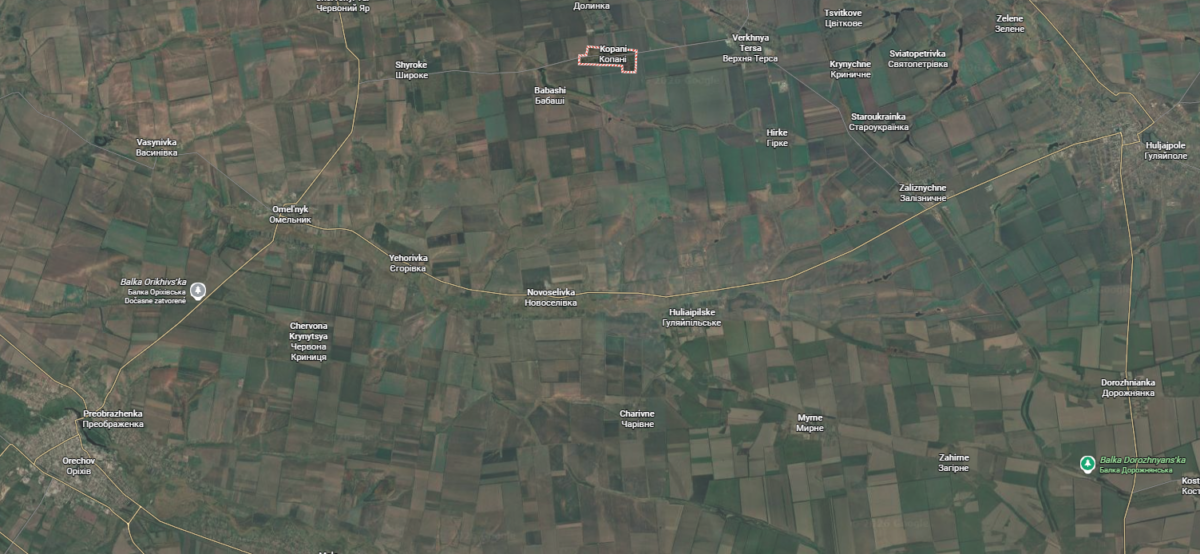
When the Russian side published a video with its soldier, the 225th Separate Assault Regiment sent its own troops into the village, who found the Russian and captured him. On camera, he told them that his commander had sent him into the village with the flag and that he then gladly surrendered.
After the Russians recorded their usual propaganda flag videos in Kopani, Huljajpole direction, the Ukrainians entered it and recorded a video with their presence instead, then showing the captured Russian flagger.
It’s always like this: the flaggers enters a territory often not… pic.twitter.com/O7gUdkOjIJ
— Playfra (@Playfra0) July 2, 2026
And this is what the front in this sector looks like according to Petrenko. Note on his map, for example, Novoselivka, where a similar story to Kopani took place. Russians draw it as captured and today reported that fighting is already taking place to the west of it.
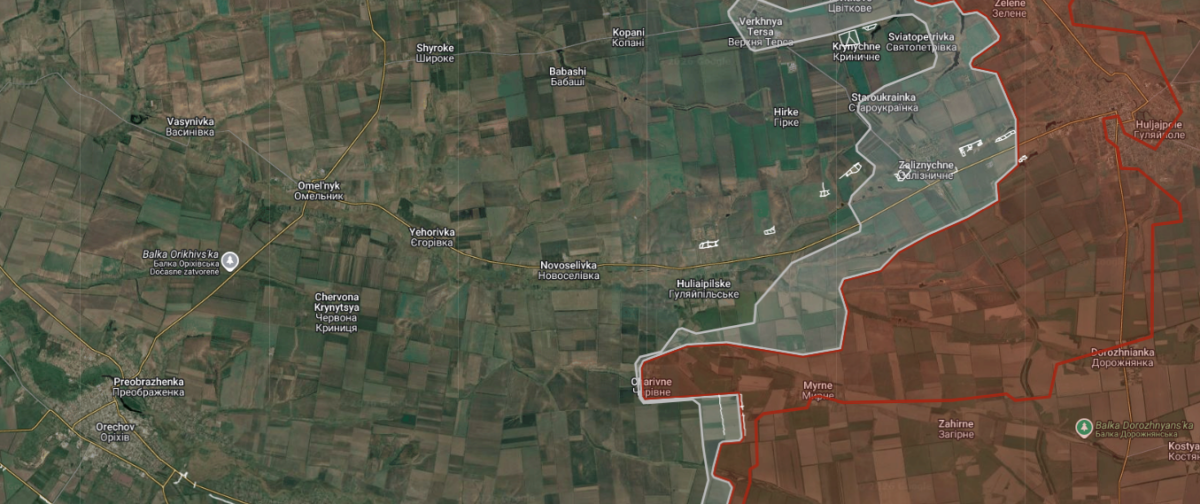
Of course, Petrenko is Ukrainian and therefore a biased source, but his information has long been serious; he reports systematically on Russian advances and regularly updates his maps. Combined with the video from the 225th Regiment in Kopani, this makes it possible to state with almost one hundred percent certainty that Russians are simply lying about the situation on this axis. To illustrate how much, a report from the fronts by the Russian Telegram channel Dvayka majory, which is regularly shared by the much larger Rybar and many other Z‑channels, serves very well. Specifically about this area, it said the following:
“In the eastern part of Zaporizhzhia region, units of the Vostok group of forces continued to advance into the depth of the enemy’s defences west of the villages of Novoselivka, Kopani, Rovne and Lesne. After the liberation of Kopani, our forces continue to break through the defences of the Ukrainian armed forces in a westerly direction.”
So the situation is as follows – Russians sent a single soldier into the village, where he showed the flag. Ukrainians then captured him and proved on video that they were standing in exactly the same spot where he had appeared and which Russians use as proof that they are in Kopani. They were not bothered by this debunking and on Friday morning claimed that they were already fighting west of the village and breaking through Ukrainian defences.
Finally, here is a map of the same area by Andrew Perpetua:
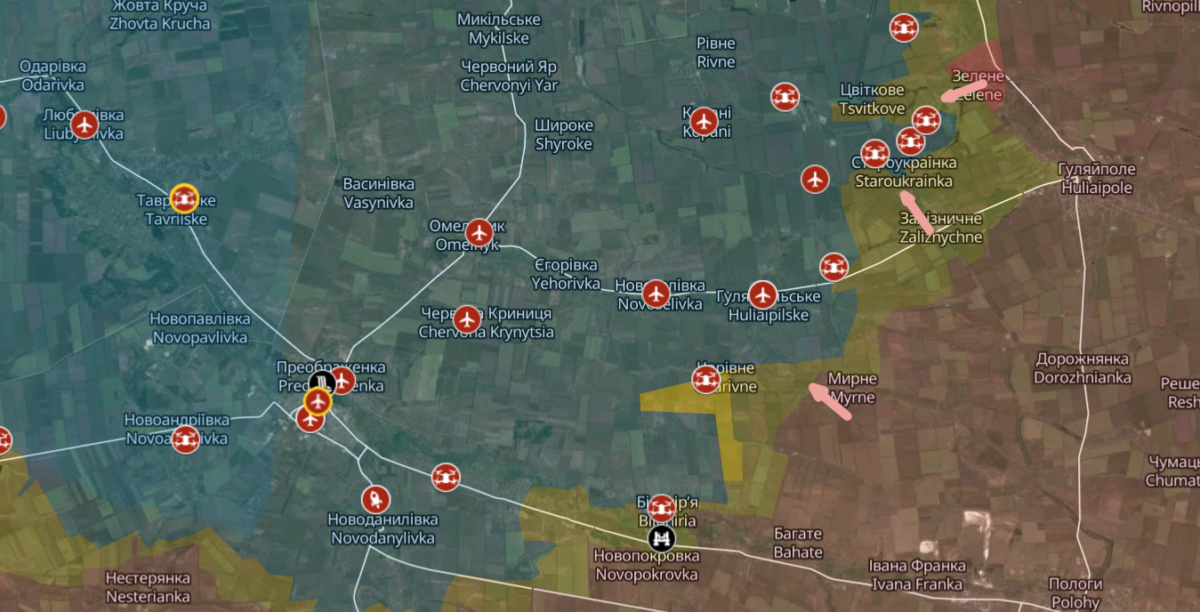
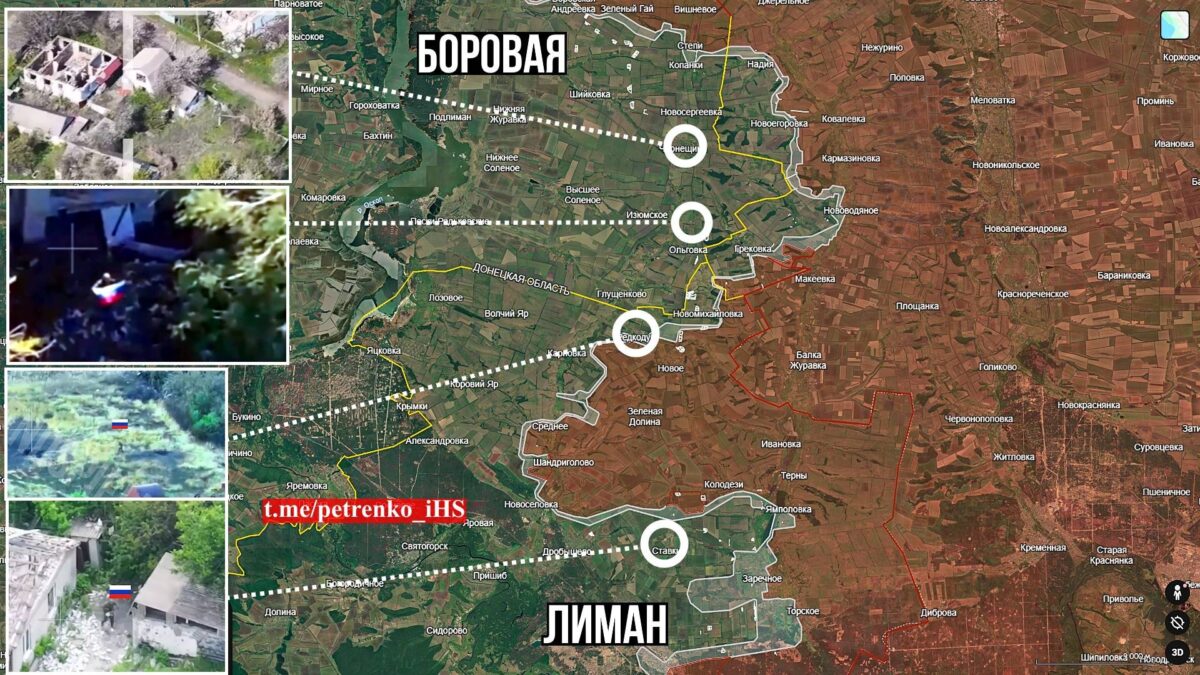
Russian flags have appeared in many other places as well. This happened on several different sectors and in most cases it is very likely that the “flag‑bearers” ended up at best like the one from Kopani, and at worst were killed. The overview of places where Russian flags appeared, and where it is still impossible to determine whether this reflects real advances or fake successes, again comes from Ukrainian analyst Petrenko, who bases his maps on Russian and Ukrainian drone videos:
The first map is from the north, specifically from the fighting around Lyman and Borova. Petrenko wrote about them:
“The enemy also showed videos of flags being raised on the Borova and Lyman axes – in the areas of Cherneshchyna, Druzhelyubivka, Ridkodub and Stavky. In the first two cases, it was an infiltration carried out solely for ‘propaganda flag‑raising’, whereas in Ridkodub and Stavky the enemy really controls positions. It is noteworthy that the Russian ministry of defence already reported the capture of Ridkodub a year ago – on 4 June 2025.”
The next two maps are from the Sloviansk axis. The first is from the village of Pyskunivka. It lies to the north‑east of the much larger Mykolayivka, which is already a direct gateway from Sloviansk. The author recorded eight different locations across practically the entire village. He reminded readers that the Russian flag first appeared there as early as 18 June, but at that time there was only one and only in the eastern part of the village.

The Polish OSINT account Thorkill clearly claimed that Pyskunivka was lost:
Sytuacja w rejonie Rai-Oleksandriwki (Słowiańsk), część III. Rozpoczęcie walk o Mykołajiwkę.
Każdego dnia pogarsza się sytuacja GT “Soledar” broniącej w ramach XI Korpusu wsch dalekiego przedpola Słowiańska. Na lewym skrzydle grupy w ostatnim tygodniu rus 7 Brygada Strzelców… pic.twitter.com/cceBRS2zS2
— Thorkill (@Thorkill65) July 3, 2026
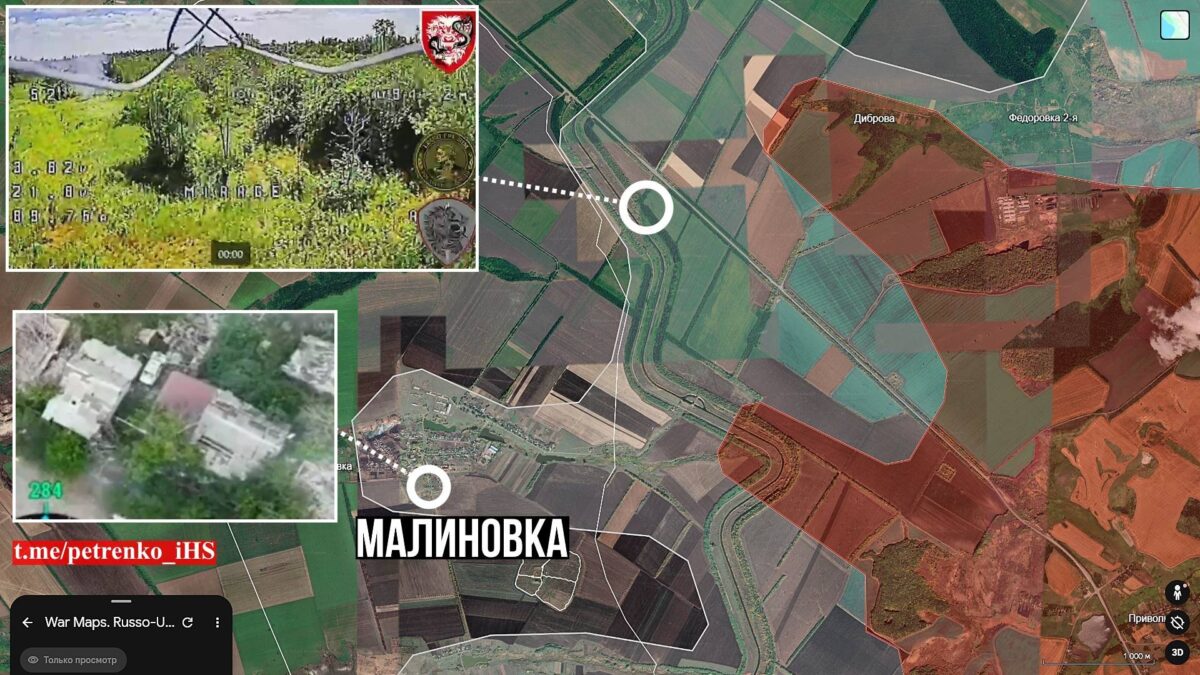
The last map is from Malynivka, 16 km further south. We already wrote this week about the presence of Russians there.
Videos of the day
A Russian drone hit the roof of a swimming pool in Zaporizhzhia and fell directly onto the swimmers. It is not known whether this was intentional or whether the drone fell on a civilian target after it had been shot down.
These were the consequences.
Один из российских ударов. Бассейн в Запорожье. Напишут, что это база разработки морских дронов? pic.twitter.com/Iu31Ji4ELi
— IanMatveev (@ian_matveev) July 2, 2026
A view through an infrared sensor of the moment a Russian missile was shot down over Kyiv.
Rare IR footage of a Ukrainian Patriot PAC-3 interceptor destroying an incoming Russian ballistic missile over Kyiv last night. pic.twitter.com/RRPBwM7VwA
— OSINTtechnical (@Osinttechnical) July 2, 2026
One of the Russian missiles landed directly among residential buildings. A large crater was created, whose dimensions can be estimated thanks to the people in the shot providing a scale.
It is still not certain whether Moscow saw the first use of a Ukrainian ballistic missile, but the crater – although somewhat smaller than the one in Kyiv – suggests that this is a real possibility.
The video is in Russian, but it is quite understandable even without knowing the language. It comes from Voronezh, where Ukrainian missiles destroyed a factory producing electronic components, among other things for Iskander ballistic missiles. The man in it complained that Russian cities were not protected by air defence because all of it had been moved to Moscow, and said that although the authorities admitted to six victims, in reality there were 300. A discussion by alleged residents of the city did indeed appear on Telegram, in which they posted figures like this, but their accuracy cannot be verified.
«Всьо ПВО в Москвє, Москву защіщаєт, а здєсь как скот пускай уміраєт».
росіянин з Воронєжа говорить, що під час удару по заводу з виробництва електроніки для Іскандерів загинули 300 співробітників.
Офіційно влада повідомила про шістьох. pic.twitter.com/zEk2iX0qSs
— Toronto Television / Телебачення Торонто (@tvtoront) June 30, 2026
What are the losses
No update on Thursday.
By Monday (29 June), Russia had demonstrably lost 23,703 pieces of heavy equipment (on Tuesday (23 June) it was 23,668). Of this, 18,686 (18,652) pieces were destroyed by Ukrainians, 988 (987) were damaged, 1,199 (1,199) were abandoned by their crews, and 2,830 (2,830) were captured by the Ukrainian army. This includes 4,407 (4,404) tanks, of which 3,310 (3,307) were destroyed in combat.
Ukraine has lost 11,629 (11,546) pieces of equipment, of which 9,068 (9,011) were destroyed, 687 (687) damaged, 683 (677) abandoned and 1,191 (1,189) captured. This includes 1,437 (1,433) tanks, of which 1,099 (1,097) were destroyed in combat.
Note: Neither side regularly reports on its dead or on destroyed equipment. Ukraine publishes daily figures for Russian casualties and destroyed equipment, which cannot be independently verified. In this overview we use data from the Oryx project, which since the beginning of the war has compiled a list of equipment losses documented exclusively by photographs.