


The NATO peacekeeping mission will reduce troop numbers as a result of improved security conditions in Kosovo’s north – after sending more soldiers in 2023 amid repeated unrest in Serb-majority areas.
 Xhorxhina Bami



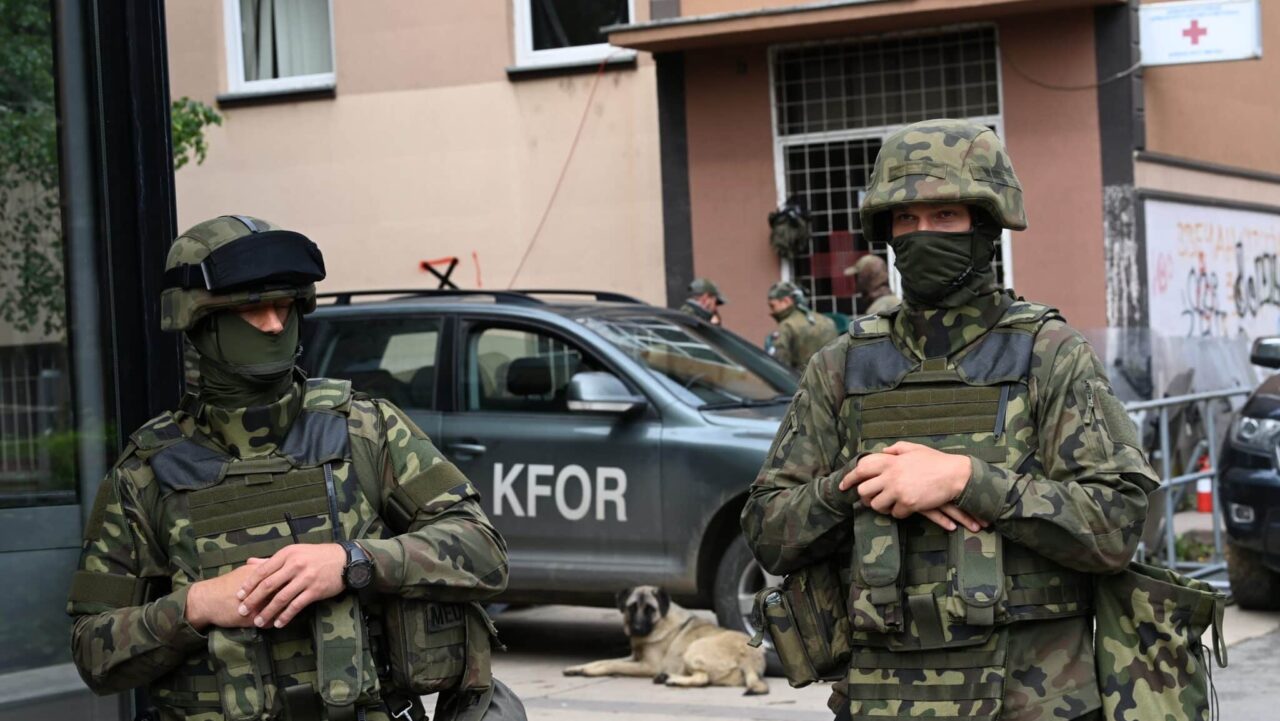
Peacekeepers from the NATO-led mission in front of the municipality building in Zvecan, June 2023. Photo: EPA/Georgi Licovski.
NATO Secretary General Mark Rutte announced on Wednesday at a press conference in Brussels that the Western alliance will considerably reduce peacekeeping troops in Kosovo as a result of the improved security situation in the country’s Serb-majority north compared to 2023.
“NATO ceased in January the deployment of reserve forces to the Kosovo Force and this is after two years of continuous rotation,” Rutte told the media, explaining that the security situation has been continuously improving over the past two years in Kosovo.
“At this moment KFOR [Kosovo Force] has an overall size of 4,700 troops and what we will do is go back to 2023 levels. Depending on the circumstances you will see a KFOR going forward between 3,000 and 3,500 troops,” Rutte said.
NATO reinforced its troops significantly in 2023 amid increased tensions and violence. In May 2023, violent protests sparked by the elections of ethnic Albanian mayors in four Serb-majority municipalities in northern Kosovo left 93 KFOR soldiers injured.
There were also attacks on KFOR peacekeepers in June 2023 by Serb protesters in the town of Zvecan, and an armed attack in September by Serb gunmen in the village of Banjska that left one Kosovo police officer and three Serb gunmen dead.
NATO deployed nearly 1,000 additional troops to Kosovo in 2023, which it said was its largest reinforcement in over a decade.
The situation has since calmed, and in April this year, KFOR commander Ozkan Ulutas told NATO ambassadors in Brussels that “we have not seen a recurrence of violence, as we saw in 2023”. Ulutas cautioned however that “the situation remains fragile, with the potential for new tensions, particularly in northern Kosovo”.
The EU also took action over the unrest in 2023, announcing a package of punitive measures against Kosovo, citing its failure to restore calm in the Serb-majority north.
European Commission President Ursula von der Leyen announced in December 2025, after Serb mayors were sworn into office in the four Serb-majority municipalities that the EU’s measures would be lifted “following the smooth and orderly transition of local governance in the north”
The measures were fully lifted in March 2026.