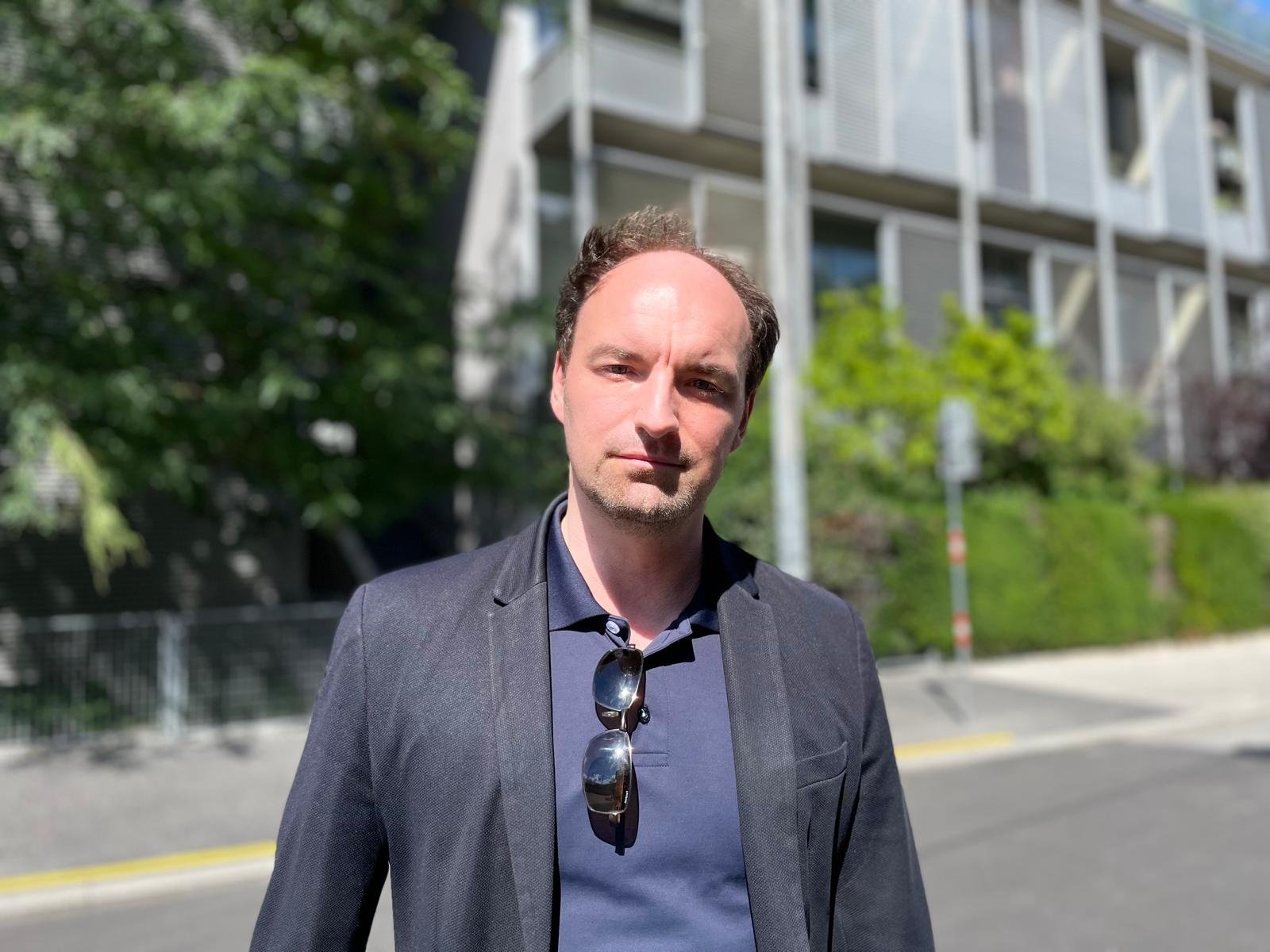
Austrian expert on Russian hybrid warfare Pichler warns that Austria’s cult‑like neutrality and apathetic middle class have turned the country into a playground for Kremlin spin.
 Soňa Weissová



Last month, the largest espionage trial in decades concluded at the Vienna regional court in Austria. Former agent of the Austrian intelligence service Egist Ott was, for now non‑finally, sentenced to an unconditional four years and one month in prison.
According to the charges, Ott was a Russian spy and also cooperated with the most wanted man in Europe, former Wirecard executive Jan Marsalek, who is currently hiding in Russia.
Interestingly, one of the most important verdicts in the history of a country known as a hub for spies was handed down by a lay jury.
The case has reminded the public of the role of Vienna and Austria in Russian espionage activities, of how the country wants to come to terms with this dark side, and of how dangerous the populist far‑right Freedom Party (FPÖ) can be. The spy worked at the interior ministry at a time when it was headed by the party’s leader Herbert Kickl as minister.
Austrian expert on Russian hybrid warfare Dietmar Pichler has long been warning about Russian activities in Austria. He said Austrian society is permeated by people who spread pro‑Russian narratives. “The problem is that we have hundreds of cases here that I call Karin Kneissl light, and nobody cares about them,” he said for Denník N, referring to the former Austrian foreign minister who invited the Russian president to her wedding.
He said there were many people in the country who did not see Russian hybrid operations as a risk. “We have a huge grey mass of people who do not care at all – they are essentially neutralised or somehow zombified,” he added.
In his view, compared with Austria there are more people in Slovakia who understand why this is a problem.
In this interview you will learn:
determined civil society than the apathetic grey mass in Austria; whether Austrian politicians would rent out state premises to the Russian embassy; how Russian hybrid operations work in Austria and whether the Austrian government responds to them adequately; why Austrian neutrality functions as an almost sacred “religion” and why this is problematic.
Denník N: Austria, especially Vienna, is regarded as one of the most prominent centres of Russian espionage activities in Europe. The Austrian intelligence service DSN acknowledged this in its annual reports as well. What role does Austria play in Russia’s hybrid war in Europe?
Dietmar Pichler: Austria still plays a very important role in it. We have several examples. Let us recall, for instance, the espionage case targeting Austrian journalists or the surveillance of investigative journalist Christo Grozev, who had to leave Austria because he feared for his life. Then there is another very interesting phenomenon: the stories of so‑called one‑time agents, or low‑profile agents. These are people recruited via the internet, usually to carry out small tasks – for example, to spray something on a wall. These can be false‑flag operations: you spray something that appears to be a pro‑Ukrainian far‑right message linked to fascist ideology, but in reality it is a fabrication. The aim is to portray Ukraine in a negative light and to help Russia. We have had such operations here and they were linked to people from Austria. There is a transcript of their communication that clearly shows how these people talked to each other, how radical their language was and that they had no inhibitions whatsoever. In Austria we have people who are sincerely convinced that this kind of activity is the right thing to do. They use Vienna as a base and logistical hub, sometimes as a planning headquarters and at other times as a hideout.
We must understand that when we talk about people working for the Russians or for the Chinese, we should not speak only about espionage. We tend to see espionage exclusively as the problem. Yet we must admit that it is also dangerous to feed harmful information into our country, to lobby or to spread propaganda in favour of authoritarian regimes. These are agents of influence. In Austria this is not illegal, but it represents a serious problem for our democracy and our freedom.
Do the Russians or other powers use Vienna as a hub for spreading disinformation?
Austria is an espionage and logistical hub, which they use for potential money transfers or as a safe base. However, I am not aware that we have actual “troll farms” in Austria. That would not be very smart, because employing Austrians is expensive. If you need real people, other countries are more useful. The Russians use, for example, the global South, where wages are lower and where they can afford such workers. What we have here – and, frankly, this is not specific to Austria, it happens to a much greater extent in Germany, since Germany is a more important player – is another kind of infiltration. The Russians have infiltrated the whole of society in Germany and Austria through people who are under their influence. I would not call all of them agents, but some of them are. They are not official agents on the embassy payroll, but people who have business interests in the matter, receive some form of support and live a very comfortable life thanks to spreading Russian or Chinese narratives.
Dietmar Pichler is an expert on disinformation and hybrid operations of authoritarian regimes in Austria.
He is co‑founder of the Austrian think tank Institut zur Verteidigung der Europäischen Demokratien (Inved), which focuses on protecting democratic systems in Europe from hybrid threats.
He also founded the Disinfo Resilience Network, which brings together experts in political science, history, security, journalism and cyber security with the aim of combating disinformation and strengthening resilience.
What is Russia’s objective in Austria? Whom is it targeting?
There are two target groups. The Austrian public is more important than it might seem, because Austria is a member of the European Union. The example of Orbán’s regime in Hungary shows how the weakest link has repeatedly managed to block important decisions, for instance on support for Ukraine. So Austria does matter, of course, even if it is not a big country. Then there is the second angle: the international organisations based here. We have the UN office, the OSCE, OPEC … Austria hosts a large number of diplomats, many activities take place here and diplomatic events offer a huge number of opportunities. To some extent, these are also used to shape public opinion, because public opinion matters.
And does this work, in your view, on the Austrian public?
When we add everything up – people who knowingly or unknowingly spread Russian narratives, official Russian diplomats and agents, Russian citizens, and then add the international campaign in English and German via troll farms and bots – we see two main outcomes in Austria. First, we have a group of people who are pro‑Russian, genuinely consider this war justified and think it only started in 2022. They refuse to admit that the Russians unleashed it back in 2014.
What worries me even more is the fact that there is a much larger group in society who do not openly support the invasion but say: “I condemn the invasion, but …”. And after that “but” comes a whole range of Russian narratives. For example, that the reason for the invasion is Nato enlargement or that Ukrainians banned the Russian language. These are all old hoaxes from 2014 that keep being repeated. In Austria they are deeply rooted, even in the academic community. You really hear the Nato argument very often. We also have peace movements that shift a substantial part of the blame onto Ukraine and the West and away from Russia. We are witnessing a distortion of reality, and this phenomenon is far more widespread than just on the far right or the far left.
In your view, is this also reflected in Austrian politics? In the fact that Austria supports Ukraine only in humanitarian terms and provides no military aid?
We live in a country where neutrality has almost the status of a religion, even though many Austrians do not even know what our neutrality actually means. In a world where neutrality is your “religion” and prevents you from sending weapons to a country that is defending itself, you also need an alternative reality to feel good about it, or even superior because of it. This alternative reality includes, for example, blaming Ukraine for wanting Nato protection from an imperialist and expansionist neighbour. Neutrality creates huge scope for blaming the victims and distorting reality.
Can neutrality also be an excuse for not doing more?
Yes, exactly. First of all, there is the practical dimension – we do nothing. We do not have many weapons and we do not take a position on anything. There is no military aid, we send helmets and that is it. Another problem, however, is that our neutrality is not and never has been political neutrality. It was not even during the Cold War. Back then we were part of the democratic West; we were only neutral in terms of military alliances. Many Austrians have never heard this in their lives, because they have no knowledge of what neutrality actually means.
The way neutrality works in the minds of most Austrians is problematic because it weakens our democratic resilience. It does not give us the feeling that we are part of the European democracies; people think we stand somewhere in the middle, that we are simply neutral. That is really a problem, because we lack firm pro‑European positions. As a result, we do not see strong support for membership of the European Union, which is directly linked to this neutrality. If neutrality is your main ideology, you have a very complicated relationship with reality.
Does Russian propaganda not also exploit the fact that Austria is still a neutral country? It can point out that Nato is in fact neither necessary nor attractive, because look at Austria, they manage without it, they are neutral and they prosper.
Of course. First, we are surrounded by Nato countries. Second, we enjoy protection arising from our membership of the European Union, which is a key factor that did not exist during the Cold War. However, Russian propaganda also uses our supposed neutrality to attack us directly. Even Medvedev tried this – I do not know if you noticed. He declared that Austria was not neutral, that it was behaving in a hostile way and that it was now also a target. He told us not to think we were neutral. So the Russians are openly playing with this neutrality narrative through their former president. [In May 2025 Dmitry Medvedev threatened Austria that if it joined Nato, the Austrian army could become part of Russia’s operational plans.]
All right, so they no longer consider Austria neutral?
No, not any more. Because we have taken a clear political stance, which I find absurd, since we are still not a Nato member. Our neutrality essentially has only two basic pillars: first, not to be part of any military alliance, and second, not to have foreign military bases on our territory. We also cannot participate directly in wars, although there are exceptions for peace forces protecting borders.
Although Medvedev may no longer consider Austria neutral, you still have a huge amount of Russian staff. Even under the current pro‑Western government, more than 200 employees work at various Russian embassies, in institutions and in the Russian district. Why, in your view, does the Austrian government not act on this?
I think today they are doing more than in the past. By Austrian standards we currently have a fairly pro‑Western government, with some exceptions. The practical aspect of the problem, however, is linked to the international organisations based here, and the Russians justify the presence of their people precisely with this argument. We also need to understand that Vienna has deeply rooted structures of infiltration – spies, diplomats, agents of influence and pro‑Russian peace organisations. This is a long tradition that goes back to the Cold War period. Everything the Soviet Union did in the early 80s, Moscow is still doing today. And when I say the same, I mean exactly the same. Social media and cyberspace are just the icing on the cake that makes it all more effective.
I still do not understand why the Austrian government does nothing about it. For example, about the problem of Russian satellite dishes in so‑called Russencity.
Yes, if it were up to me, this entire infrastructure would have ceased to exist long ago and I would take a much tougher line against it.
It seems to me that the Austrian government has no real interest in stopping all this.
I cannot answer on behalf of the Austrian government. I can only assume it is a combination of various reasons.
For example, MEP Helmut Brandstätter from the NEOS party, which is in government and controls the foreign ministry, said the reason is fear of reciprocal expulsion of diplomats from Moscow.
Basically, we have far fewer staff there, so we would end up in the red.
A disinformation expert recently pointed out that the Russian embassy in Slovakia organised a celebration at the state‑owned Hotel Bôrik – that is, in accommodation owned by Slovakia. Could you imagine something similar happening in Austria?
No. If something like that happened in Austria, it would be a red line that would trigger a huge media storm. Since 2014 I have been closely following and monitoring the discourse on Russia and Ukraine in Austria. There are things that resonate in the media and cause outrage, but at the same time there are many things nobody talks about, because they seem too inconspicuous, people are not interested in them or simply do not see them. That is the moment when I step in, at least to draw attention to it or write a post about it. But what you have just described would not be possible in Austria – at least not without consequences. And that would apply even if we had a different government.
For example with the Freedom Party (FPÖ), which is known for its pro‑Russian positions and won the last elections but did not form a government?
You said it for me. Theoretically, if comparable things were happening, it would trigger a reaction and they would know in advance that it would only cause them trouble.
So there are still certain limits or boundaries in Austria that politicians are afraid to cross?