With hundreds of pro-Fidesz journalists laid off and state propaganda cash drying up, Hungarians could soon see a radically different media landscape—if independent outlets survive the coming financial squeeze.
 Zoltan Szalay



No single political party will be able to completely control Hungary’s public-service media, only part of Fidesz’s media empire will survive, and serious challenges await independent newsrooms.
An earthquake – that is how the new media law, approved by parliament on 23 June, is being described in Hungary. It fundamentally reforms the public-service media, which became one of the symbols of Fidesz prime minister Viktor Orbán’s system. The law entered into force on Friday, and on Saturday the mandates of all existing directors of public-service media came to an end.
The law includes safeguards designed to prevent public-service media from being hijacked by government. European regulation will also be incorporated into the Hungarian legal order, bringing further guarantees.
The system of state advertising, which in recent years distorted the media market, will also change.
Media expert and lawyer Gábor Polyák, a professor at the Institute of Media Studies at ELTE University in Budapest, pointed out that a difficult period awaits not only Fidesz-aligned media, but also independent newsrooms: after the elections, readers will spend less money on maintaining independent media.
What is happening to the public-service media?
Although new prime minister Péter Magyar promised during the campaign that one of his first steps after an election victory on 12 April would be to “switch off the factory of lies”, by which he meant the public-service media, this did not happen. Three days after the elections he was in the studio of Kossuth Radio and M1 television, where he got into a heated exchange with the presenters.
“What Tisza promised will also happen. After the government is formed, one of the first steps will be that we suspend the news coverage of these propaganda media,” he repeated. However, Tisza is yet to fulfil this promise.
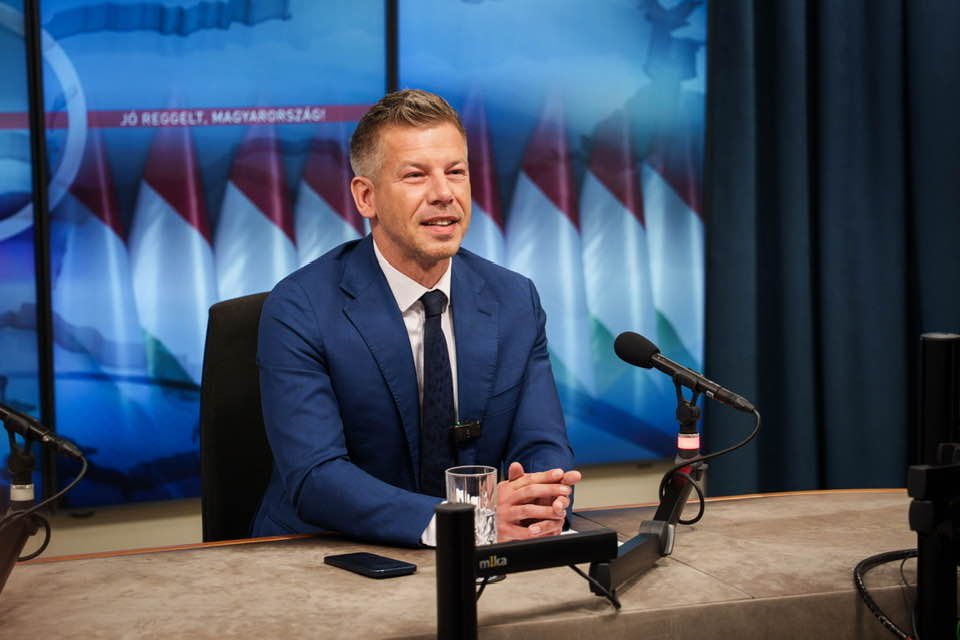 Péter Magyar on Kossuth Radio on 15 April 2026. Source: MP/Facebook.
The director general of MTVA, which operates the public-service media, Dániel Papp, resigned in early June, explaining that the government was preparing a reform of the public-service media.
The adoption of the detailed amendment to the media law was swift. Tisza submitted it on 12 June and parliament approved it on 23 June. It significantly changes the structure of the public-service media and the management will also be replaced. After the law entered into force on 26 June, the mandates of all heads of public-service media ended the following day.
The law will separate public-service media from the state news agency MTI, create new companies that will act as founders of the public-service media, and new bodies will be set up to monitor their independence.
What does this law guarantee?
This law is a guarantee that decisions concerning the public-service media will not be taken by a single party, Gábor Polyák told Napunk. The law has also established the institutional framework for selecting the director general of the public-service media and their ongoing oversight.
The newly created body gives the opposition the same number of members as the governing parties, with professional organisations also receiving three seats. The nominees from political parties have a four year mandate, while nominees of professional organisations have a five-year term.
“The intention is unambiguous: to create a framework for diverse and impartial public-service media, which precisely because they are impartial are clearly no longer usable as a propaganda tool,” Polyák said.
An important new element is that the selection procedures for the position of director general will be public, and even before the tenders are announced there will be a quick public consultation on what experts and the audience expect from the public-service media. The conditions of the selection procedure for the director general will then be adapted to this consultation, Polyák added.
“Among the applicants there will certainly be those who have a realistic vision of running the public-service media and the right qualifications to do so. That is an important safeguard,” he said.
What will the new public-service media look like?
“What the public-service media will actually do does not, of course, follow from the law. There is a list of tasks, but it is roughly in line with the existing definition of the mission of public-service media. We have seen that this did not in fact guarantee anything at all,” Gábor Polyák continued.
The law also does not specify how many channels there will be or what their budget will be. “There are still a great many unclear questions, and deciding on them will inevitably require another legislative step,” Polyák said. The government is communicating that this is only the first law for now, and that in the autumn a comprehensive review of media legislation will begin, preceded by expert and public debate.