As Alexander Lukashenko ties his political future to Vladimir Putin and Russia’s wartime economy, Sviatlana Tsikhanouskaya argues that many Belarusians are waiting for a Ukrainian victory to challenge his grip on power.
 Ondřej Kundra



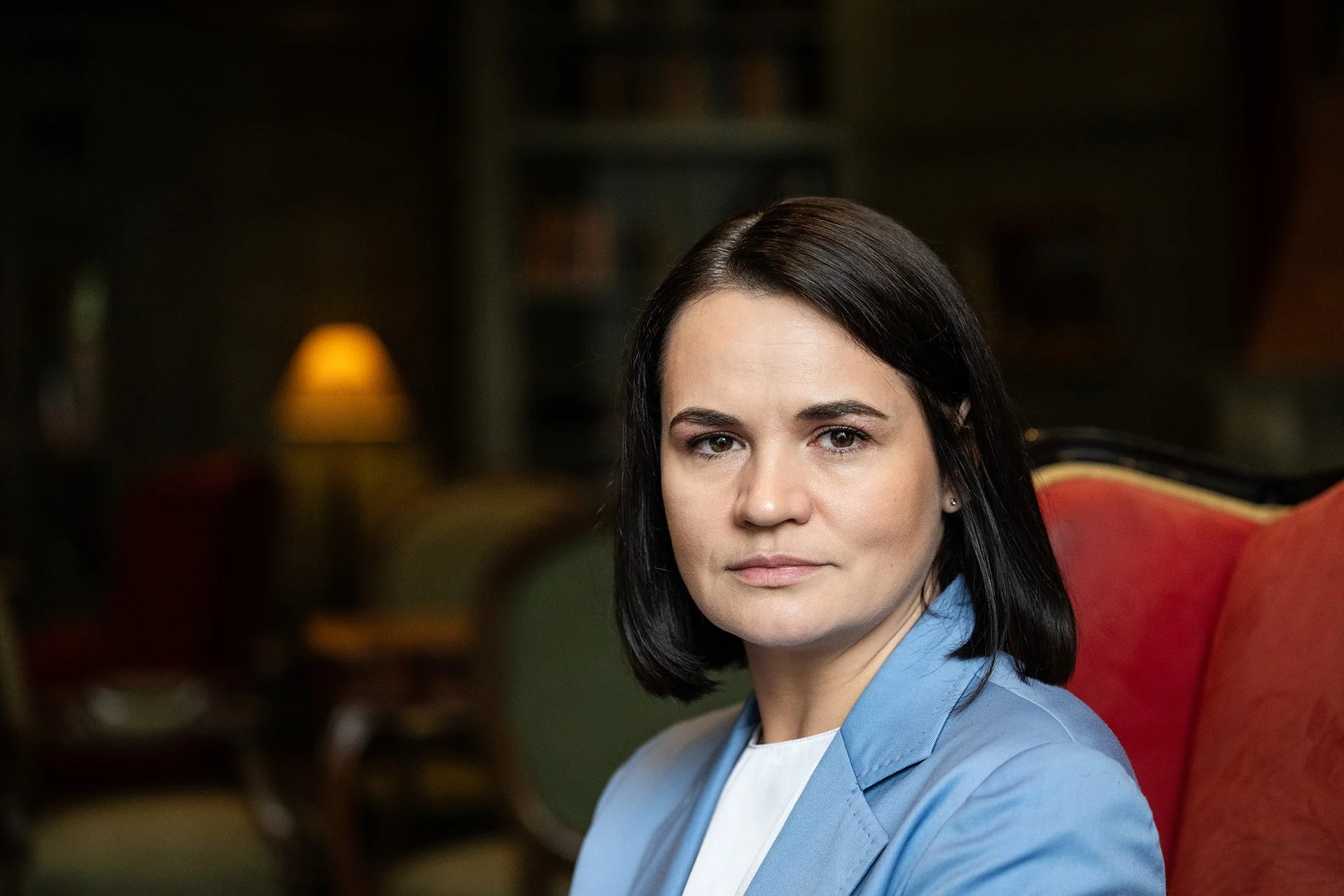
An interview with Belarusian opposition leader Sviatlana Tsikhanouskaya on what could bring about the end of president Alexander Lukashenko’s regime
At the beginning of the year you moved from Vilnius in Lithuania to Warsaw in Poland. Has that proved to be a good move?
I spent five years in Lithuania and it became my second home. I was grateful to the Lithuanian government for its political and diplomatic support for our efforts for a democratic Belarus. The move to Warsaw was connected with changes in our security protocol. In hindsight, I would say it was a change for the better, many more Belarusians live in Poland and we can work even more intensively with various NGOs and initiatives.
Sviatlana Tsikhanouskaya
A Belarusian politician and activist, the main opposition candidate for president of Belarus in the 2020 election. She claimed to have decisively won the election, but president Lukashenko rigged the result and forced Tsikhanouskaya into exile in Lithuania. From there and, since this year, from Poland, she has been leading her mission for a free Belarus, with her main political goals being to call new free elections and secure the release of all political prisoners.
The Lithuanian government cut the budget for your bodyguards and security – is that what you mean by changes in the security protocol?
Yes, when the new government took office, it made this decision. Our office in Vilnius has remained, it has diplomatic status. And thanks to the fact that I am now in Warsaw, we are expanding our presence in the region.
Are you learning Polish?
When I was still in Lithuania, I did not learn the language fluently, I did not have enough time. With Polish it will be easier, it is much closer to Belarusian.
The Belarusian dictator Alexander Lukashenko has said he would not allow Belarusians to become fodder for Ukrainian guns, despite growing reports that Belarus might indeed enter the war in Ukraine on Russia’s side. What is he aiming at with this statement? Do you believe him?
Look, on the eve of the Russian attack on Ukraine he said that not a single missile would be launched from Belarus – and the full-scale invasion started from this territory. So, first of all, it is very important that everyone understand that Lukashenko has long been at war. How else can we see the fact that he provided Belarusian territory to the Russian army and repeatedly helped Putin in his aggression? In the same way, he is ready to provide Belarusian infrastructure if Russia needs it for further escalation. He serves Russian interests because Putin guarantees his political survival.
It is also true, however, that most Belarusians definitely do not want to take part in the war against Ukraine, and if Lukashenko issued such an order, the army might refuse to carry it out. That could be his end. Lukashenko is trying to move within these confines, and you can see that every moment he says something different. One time he claims that Nato wants to attack Belarus, another time that he does not want to attack his neighbours, a third time that the neighbours are a threat to Belarus. He creates the image of an external enemy and constantly dodges and manoeuvres. He is a cunning politician who has always played the role of a kind of seesaw between Russia and Europe. He wants to be loyal to Putin, but at the same time he tries to send signals inside Belarusian society that he wants to save it from war.
How could Lukashenko continue to help Russia wage war, while not sending the Belarusian army into it?
There are various scenarios for possible escalation. The most likely is the deployment of additional Russian weapons on Belarusian territory, and providing support for that. We already see tests of the Oreshnik missile and other similar things. Lukashenko knows that, despite all the difficulties, this war is a blessing for him. Under his leadership Belarus was economically stagnating; the war machine is making him money, he produces various military goods for the Russians. But again I must stress that he does not have the support of either the Belarusian people or the democratic world.
The protests against Lukashenko that followed the rigged elections have stopped. How does resistance in Belarus continue?
At the moment it is impossible to go out into the streets and protest. In the West I often hear the question of why people are not on the streets, but it is not simple. Belarus saw long-term mass protests against the rigged presidential election in 2020, protesters were subjected to enormous violence and repression, people were beaten and arrested, they received draconian prison sentences. The regime spreads an atmosphere of absolute fear. When I speak every week via Zoom and other applications with my fellow citizens in Belarus, they tell me to tell our Western partners that they have not gone anywhere, that because of the repression they have only moved into a sort of emergency mode. And that they are ready, when a new impulse comes, to do whatever they can for the freedom of our country. So the mood and desire for change have not evaporated from people at home, and we in exile are also doing our utmost – we are building institutions, relations with the democratic world, we support political prisoners and their families.
What could be that new impulse for an uprising against Lukashenko?