Replacing combustion engines with electric cars and switching industrial heat from fossil fuels to electricity are among the most impactful ways to decarbonise. Yet, in exactly in these areas Europe is weakening its policies.
 Wester van Gaal



European environment ministers met in Luxembourg on Thursday to prepare for the next UN climate summit and discuss how to shield the bloc from a warming planet, as a record-breaking heatwave pushed temperatures across western Europe above 40C, killing dozens of people and causing mass poultry deaths.
“Look at the weather, look at what is happening in Europe. It is crystal clear: we need more mitigation, but certainly also more in the domain of resilience and making sure we get our people out of harm’s way,” EU climate commissioner Wopke Hoekstra told reporters on arrival on Thursday (25 June).
Yet much of the busy agenda was taken up by proposed climate rollbacks, including the replacement of the 2035 combustion-engine phase-out with weaker CO2 standards for new cars and weakening its carbon-pricing system for industries and power production.
Hoekstra also signalled that the EU would push for electrification rather than fossil fuel phase-out at the next UN climate summit in the Turkish coastal city of Antalya in November.
“Let’s focus on electrification,”said Hoekstra. “That works for the climate, it works for competitiveness, and in reality it’s the same as transitioning away from fossil fuels, but it’s less controversial so I think it also works politically.”
After several summits widely seen as failures, the next one, he added, “needs to be more execution-focused, less high-drama, and more linked to delivery.”
Europe’s own electrification stalling
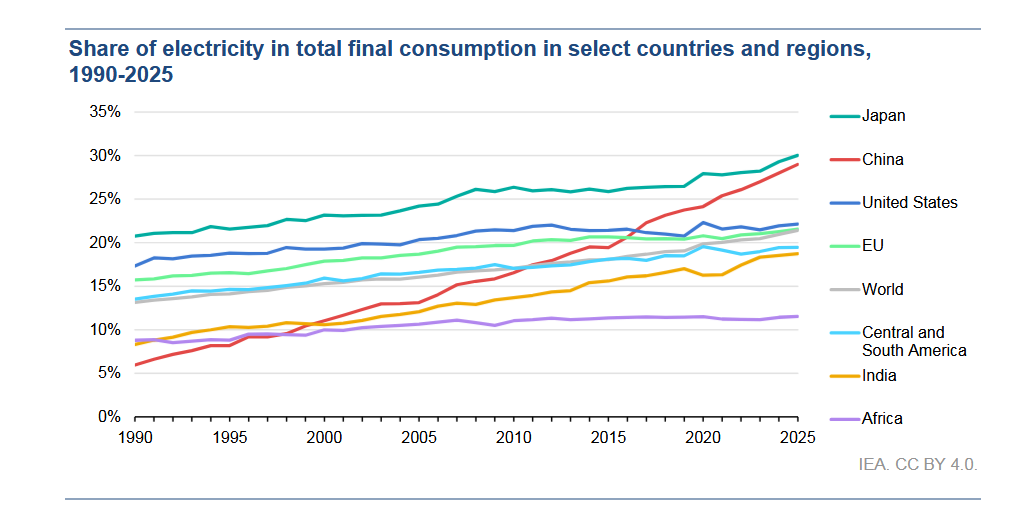
Europe’s own electrification path has been slow compared to some other large economies, rising only about five percent since 1990. During this time, China went from six percent to almost 30 percent.
Replacing combustion engines with electric cars and switching industrial heat from fossil fuels to electricity are among the most impactful ways to decarbonise.
Yet, in these areas Europe is weakening its policies.
Battery electric vehicle registrations in Europe were up almost 40 percent compared to last year, data from the European Automobile Manufacturers’ Association (ACEA) showed earlier this week.
“It’s truly very impressive,” said Hoekstra. But he admitted it could easily be a temporary effect related to the Iran crisis.
Sweden’s climate minister Romina Pourmokhtari urged her colleagues to stop rolling back Europe’s climate policies.
“Our vulnerability to oil price spikes and imported fossil fuels will only increase when we slow down our electrification,” she said, vowing to “put pressure” on colleagues to rethink their opposition to the 2035 phase-out of petrol car sales.
Backtracking on carbon pricing would only make it “more risky and expensive for European industries” to transition, she warned.
Earlier this month, twelve advisory councils on climate and sustainable development warned that “weakening the ETS would jeopardise global climate action and, with it, the wellbeing of current and future generations.”
The commission’s own estimates show emissions covered by Europe’s carbon pricing system have fallen by 50 percent since its launch in 2005, including a 24-percent drop in 2023 and a further 11 percent in 2024.
But Cefic, Europe’s powerful chemical lobby, has campaigned relentlessly to weaken the system, with eleven governments now pushing the commission to water it down.
Too expensive
Poland’s environment minister Krzysztof Bolesta was among those pushing for weaker rules.
He said he would spend the day coordinating with allies to water down carbon pricing, widen free pollution allowances, and delay the extension of carbon pricing to buildings and road transport, due in 2028.
“If we do not cater for what people need and the costs coming from ETS, we would lose support for wider climate policies,” he said, adding that the focus should shift to measures that reduce the impact of climate change rather than prevent it.
Gesturing at the heat, he noted that the building where ministers were meeting was “relatively new, but already hot.”
“This is something we should not ignore anymore,” he said.
When asked whether watering down climate policies would help Europe’s electrification ambitions, Hoekstra, who has previously called the ETS “the smartest policy tool we have in the EU, full stop,” said revisions may be necessary “to keep the family together.”