He’s a life insurance salesman who dines at Claridge’s thrice daily. Anna Moloney meets the breakfast king of Mayfair.
 Anna Moloney



Monday 29 June 2026 4:17 am | Updated: Friday 26 June 2026 5:24 pm
He’s a life insurance salesman who dines at Claridge’s thrice daily. He’s racked up more than 10,000 portions of eggs and bacon. Anna Moloney meets the breakfast king of Mayfair
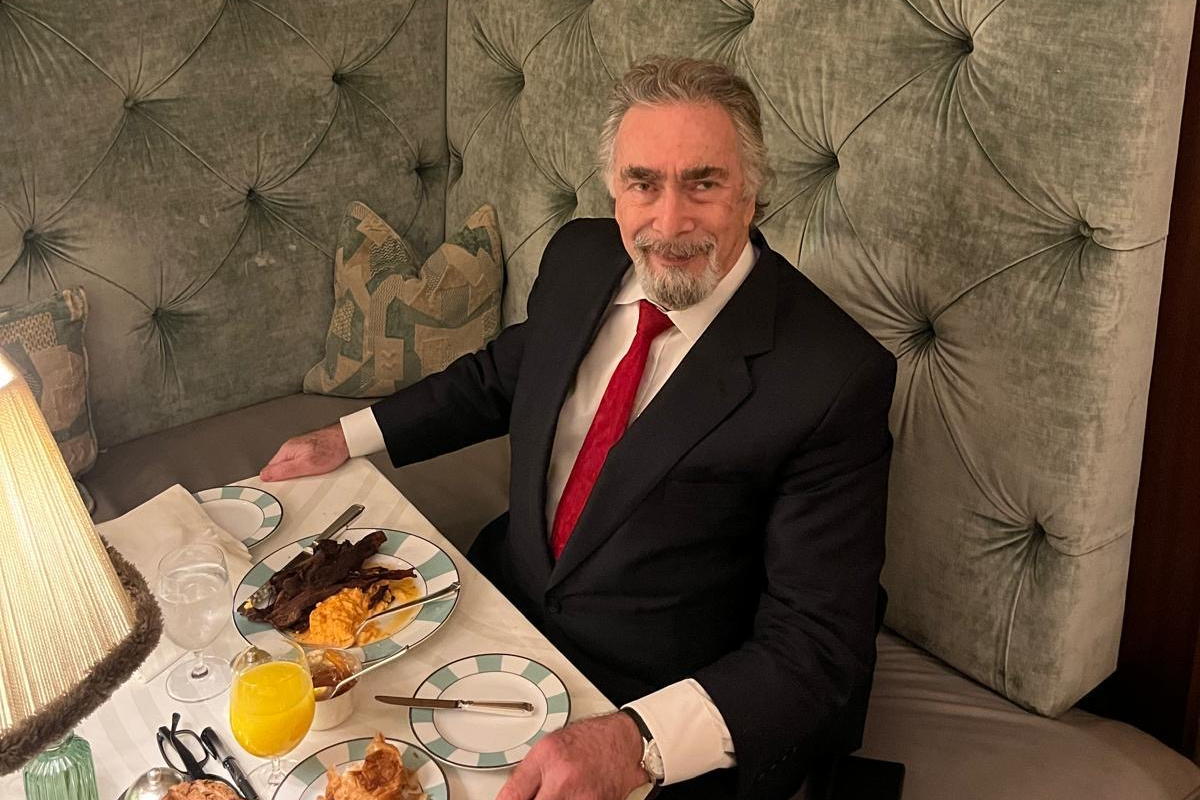
Peter Rosengard takes his breakfast at Claridge’s three times a day: at 7:30am, 8:30am and 9:30am. For each, he invites someone different to join him and attempts to sell them life insurance. He says it’s the only brilliant idea he’s ever had – nobody says no to Claridge’s – and that’s he’s booked out ‘his table’ (a corner banquette in the Reading Room, where he’s had 10,367 breakfasts and counting) for every day until his 100th birthday.
When I arrange to meet him at 11:30am on a Friday (usually his day for booking in the following week’s appointments), he graciously agrees to notch up his breakfast count for that week.
I don’t know what exactly I expected when I agreed to dine with Mr Rosengard to interview him about his new book They Only Call Me When They’re Dead, but what I got was one of the strangest experiences of my life. And definitely the strangest breakfast.
Burnt bacon
The first thing that struck me was the voice. Hurrying down Davis Street a couple minutes late, I picked up the phone to Mr Rosengard at 11:34. He boomed down the line: “Anna. Where are you?” I was just one minute away, I assured him, and he seemed settled. “Okay. Ask for my table.” Timekeeping is important. After all, he typically has three breakfasts to get through by 10:30am. It’s one of the reasons he doesn’t let you look at the menu. That, he deems, is a waste of time. Instead, you will be ordered scrambled eggs and bacon, and encouraged to eat it with your hands. Rosengard says it’s rare he faces objections.
#mc_embed_signup { background: #fff; clear: left; font: 14px Helvetica, Arial,sans-serif; width: 100%; max-width: 600px; margin: 20px 0; } #mc-embedded-subscribe-form { margin: 20px 0 !important; } .newsletter-form-flex { display: flex; gap: 0; align-items: center; margin-top: -10px; } .newsletter-form-flex input[type=”email”] { flex: 1; padding: 2px 10px; border: 1px solid rgb(18, 22, 23) !important; border-radius: 12px 0 0 12px !important; } .newsletter-form-flex input[type=”submit”] { padding: 4px 10px !important; margin: 0 !important; background-color: rgb(18, 22, 23) !important; color: rgb(255, 255, 255) !important; border: 1px solid rgb(18, 22, 23) !important; border-radius: 0 12px 12px 0 !important; } .newsletter-banner-content { margin-bottom: 15px; } .newsletter-banner-content h2 { margin: 0 0 10px 0; font-size: 18px; font-weight: 600; } .newsletter-banner-content p { margin: 0 0 10px 0; line-height: 1.5; } .newsletter-banner-content ul, .newsletter-banner-content ol { margin: 0 0 10px 20px; } .newsletter-banner-content a { color: #0073aa; text-decoration: none; } .newsletter-banner-content a:hover { text-decoration: underline; } .newsletter-banner-content img { max-width: 100%; height: auto; margin: 10px 0; } #mc_embed_signup #mce-success-response { color: #0356a5; display: none; margin: 0 0 10px; width: 100%; } #mc_embed_signup div#mce-responses { float: left; top: -1.4em; padding: 0; overflow: hidden; width: 100%; margin: 0; clear: both; }
When our breakfast arrives, however, all is not well. Rosengard beckons back the waiter, who looks like he knows what’s coming. “FLOPPY,” he pronounces, holding up the bacon which, encountering the undefeatable force of gravity, tilts to a slight bend. It’ll need to be done again, he tells the waiter. In its current form it lacks the structural integrity to be used, as he prefers, as a spoon with which to shovel up the eggs. The next batch that arrives, blackened to a crisp, is considered good. This, he says, shuffling the eggs onto the end of the brittle rasher, is how the late Queen ate, though I have been unable to find any evidence supporting this. I ask Rosengard if he ever met the Queen. He says not – but he did once gift King Charles a fully functioning, antique Victorian lavatory as a birthday present after hearing the monarch collected toilets (there are pictures of Rosengard, clad in a shiny silver dinner jacket and bowtie, personally delivering said toilet to Buckingham Palace).
Anecdotes like this are a key part of Rosengard’s armoury, and he regales me with many during our 90 minute chat. His father grew up in Walton, a deeply deprived part of Liverpool, but had his life changed by an inspirational teacher who encouraged him to become a doctor. Duly, Peter’s mother encouraged him in turn to become a dentist, but he lasted one week at dentistry school before dropping out (“I didn’t like teeth”) and became a salesman instead. He has had an eclectic career: as well as once holding the Guinness World Record for selling the biggest ever life insurance deal (£100m to David Geffen), he founded The Comedy Store in 1979 and later discovered and managed the pop band Curiosity Killed the Cat.
When Rosengard tells you these tales he likes to make sure you’re listening, and reacting, correctly. When he tells a joke, he quizzes me afterwards to make sure I got the punchline. Likewise, when he tells me he’s 79 years old and I don’t gasp, he insists I must have known that already. “I usually get a wow,” he says with a hint of disappointment. To be fair, he does look good for almost 80, especially for someone who’s eaten quite so much bacon. “I feel like I’m 10,” he enthuses. “I still jump in puddles!” It’s an unlikely image, but one I believe. When requesting pictures of Rosengard for this feature, I am sent one of him standing in an igloo. “He’s not one for press images,” his PR explains for context.
A chance encounter with Rosengard
This is surprising to me: in almost every other aspect, Rosengard seems more than keen to mould his own image. That he sells life insurance to everyone from “binmen to billionaires” is a key part of his schtick. He likes to recount the first life insurance deal he ever struck – to the taxi driver taking him to the office – and has been known to pick up some of his breakfast companions from chance encounters. “I didn’t know salesmen generally only signed three policies a month. It didn’t strike me as unusual I was selling 30. One month, I sold 100. Within a year, I was driving an E-Type. If it moved, I signed it. I tried to sell to anyone,” he told the Mail on Sunday in 1998.
When I recounted my story to a friend, it turned out he had already heard tell of this strange man eating eggs and bacon with his bare hands in Claridge’s. He put me in touch with his friend, a young comic who had, by chance, once come across Rosengard at an Italian cafe in Little Venice, and duly been lured to one of his Claridge’s meets. He tells me he has remained haunted by the experience ever since; was so rattled, in fact, that he wrote a screenplay based on the encounter, in which Peter Rosengard eats him.
Read more KSI on buying a football club, the manosphere and quitting alcohol
He didn’t end up buying life insurance, but says he was close to, out of fear. “When there’s blood in the water, he gets kinda frenzied.”
At one point, he says Rosengard grabbed a piece of scrap paper with “£1,000,000” written on it and asked him what it said. “One million pounds,” he replied. “I paid that out to someone yesterday – sounds good, right?” Later, he handed the comic a piece of paper with the numbers one to three written down the side, and told him to list people who would give him a million pounds if he got cancer. He wrote down “Peter Rosengard, Peter Rosengard, Peter Rosengard”, to which Peter Rosengard said he was only the second person to have got that right, the first being the CEO of a Big Four bank.
‘I want to die running at full tilt’
Judging by his Claridge’s habit alone, Rosengard has done well for himself. At a quick estimate, he should have now spent £663,488 on eggs and bacon (before anyone has even thought about coffee), though he may be privy to a three-breakfasts-a-day discount. Richard Branson, as advertised prominently on the front cover of Rosengard’s book, called him the greatest life insurance salesman in the world. It’s easy to assume Rosengard may be prone to exaggeration – he is, after all, a salesman – but he’s clearly well connected. During my own breakfast with him, a man came over from the opposite table to say hello. Rosengard introduces him as William Lauder, the grandson of Estee.
While life insurance has made Rosengard his fortune, he’s refreshingly unsentimental about it. “From early childhood all I ever wanted to be was a life insurance salesman. I never gave any other profession a second thought. And, as Robin Williams once said, ‘If you believe that, you’ll buy this watch!’,” he writes in his book. He adds that if you had asked him at 21 what he wanted to be, life insurance salesman would have been 1,001 on his list. Nonetheless, by sheer force of will he’s managed to turn it into an adventure, moulding his own celebrity along the way.
He tells me he was born with the “enthusiasm gene” and intends to live until he’s 130, when he wants to die “running at full tilt and fully burnt out”. Most people, he says, die only 10-30 per cent used; he intends to wring out every drop. When I tell him a lot of my generation are quite caught up with the idea of ‘work-life balance’ he looks confused. “I’ve never gone to work. People say, how’s work? I say, ‘sorry I don’t know’. I’ve never worked for anybody.”
A portrait of Peter Rosengard
When speaking to Rosengard, it is hard to discern who he is beyond the Peter Rosengards who star in his well-worn anecdotes. I arrived at the breakfast with a list of questions and left realising I had asked almost none. As soon as you sit at that table, it becomes clear this is his ship, and you must cling on until he lets you off.
The closest glimpse I got of the man underneath it all was towards the end of our breakfast, when he flipped open his book to show me his author picture on the inside cover. There, instead of a photo, was a self-portrait: red, black and yellow streaks made with a palette knife on canvas. He hadn’t intended it to be a self-portrait, but had just got the cans of paint and decided to go at it. When he came downstairs and saw it again the following morning he says he was astonished. He painted in two black stripes for eyebrows and added a smile. “I can see me,” he said. I could see him, too. A man full of colour, vigour and conviction, determined to paint his own image.
They Only Call Me When They’re Dead is available now for £24.99 published by Coptic
• Tap here for more stories from The Magazine
Read more People named Mark called upon to raise money at London charity golf day
Similarly tagged content: Sections Categories People & Organisations