If the EU insists on imposing economic and trade restrictions on China, China will have no choice but to take corresponding countermeasures.
 H. E. Ambassador Cai Run



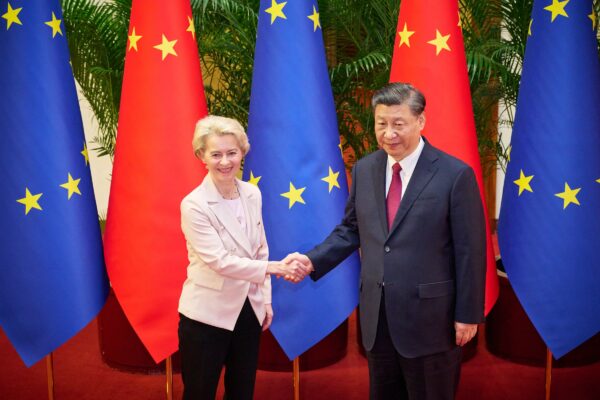
Economic and trade cooperation is an important component of China-EU relations, serving as both a ‘ballast stone’ and a ‘booster’ for the development of bilateral ties.
Through the joint efforts of both sides, China-EU economic and trade cooperation has delivered fruitful outcomes, benefiting not only the peoples of both sides but also the world at large. According to Chinese statistics, China-EU trade reached $828.1bn (€707bn) in 2025. Today, the trade volume between China and the EU in a single day is roughly equivalent to the total trade volume of an entire year during our early period of diplomatic relations.
These achievements in cooperation have not come easily and should be all the more cherished.
At the same time, we are fully aware of the EU side’s strong concerns regarding the trade imbalance between the two sides. In this regard, I would like to share several observations for exchange with you, in the hope that they may help enhance understanding among friends from various sectors on this issue, so that we can jointly address the differences and frictions through dialogue and consultation, and jointly promote deeper and more substantive economic and trade cooperation.
The Chinese side has never deliberately pursued a trade surplus. China takes a positive and open attitude toward addressing the trade imbalance issue and has adopted a series of concrete measures to this end.
China has made strong efforts to expand imports from the EU, including actively broadening market access for EU agricultural products. For example, pork products from 15 EU member states and poultry products from 7 member states have now been granted access to the Chinese market.
At the same time, China has also strengthened regulation and oversight of exports. For example, beginning on 1 April this year, China removed export VAT rebates for products such as photovoltaic products and reduced the export VAT rebate rate for battery products from nine percent to six percent.
China has also strengthened export controls on key products by introducing export licensing requirements for products including battery electric passenger vehicles and certain steel products. It should be emphasised that although trade imbalances are shaped by factors such as the international division of labor, market supply and demand, and consumer needs, China is still willing to make its own efforts to help address this issue.
High-quality and competitively priced Chinese products help ease inflationary pressures in Europe and reduce the cost of living for consumers.
According to EU estimates, inflation in the EU is expected to reach 3.1 percent this year. Without the support of a large volume of high-quality and affordable Chinese products, inflationary pressures in the EU could be even more severe.
In addition, around half of China’s exports to Europe consist of intermediate goods, which help European companies significantly reduce the production costs of finished products and effectively enhance the competitiveness of EU exports in global markets.
A significant share of China-EU trade is generated by European companies operating in China, creating a situation in which the trade surplus is recorded on the Chinese side while the profits largely accrue to the European side.
Products manufactured by European companies in China are not only supplied to the Chinese market; around 40 percent are also exported to Europe and other parts of the world. From a customs statistics perspective, the sales of these companies to Europe are counted as part of China’s trade surplus with the EU. In reality, however, most of the profits ultimately flow back to European companies.
While China runs a surplus in trade in goods with the EU, the EU runs a surplus in trade in services with China.
According to Chinese statistics, in 2025, China’s deficit in services trade with the EU reached $48.3bn. The EU was the largest source of China’s services trade deficit, accounting for 41.6 percent of China’s total external services trade deficit.
In the area of intellectual property royalties and licensing fees alone, China paid the EU as much as $10bn. China’s per capita GDP is expected to exceed $14,000 this year.
With the implementation of the 15th Five-Year Plan, the living standards of the Chinese people are expected to improve significantly, and demand for services in areas such as healthcare, financial and insurance services, culture and entertainment, and leisure and tourism is expected to grow rapidly.
The services sector is one of the EU’s strengths. China is willing to expand cooperation with the EU in services trade and provide more opportunities for European companies to increase their market presence in China.
Looking back at the history of China-EU trade, China itself ran a trade deficit for a long period of time.
According to Chinese statistics, for more than two decades prior to 1996, the European side consistently maintained a trade surplus with China, driven by its strengths in products such as high-end industrial equipment, automobiles, precision instruments, and chemical materials. Yet China did not close its market to Europe as a result. Instead, it continued to expand opening-up efforts.
This is because China recognized that such trade patterns were shaped by the different positions occupied by both sides within the global division of labor and industrial system. China also believes that openness brings development and progress, while isolation and closure lead only to stagnation and backwardness.

Joint efforts
Addressing the trade imbalance between China and the EU cannot rely on China’s efforts alone; it requires joint efforts from both sides.
The EU is China’s second-largest source of imports, and high-tech products account for more than 25 percent of China-EU trade. However, EU export controls on high-tech products to China have constrained the EU’s export potential in the Chinese market.
According to estimates, the profit generated from exporting one lithography machine to China is equivalent to that from exporting 200,000 tonnes of pork to China. Simply increasing China’s imports of European agricultural products and cosmetics will not be sufficient to achieve a balanced trade relationship between China and the EU.
Chinese companies remain enthusiastic about investing in Europe and see strong opportunities there. However, many Chinese companies operating in Europe report that tighter investment screening, growing market access barriers, and rising policy uncertainty have significantly undermined confidence in investment and business cooperation in Europe.
If the European side were to ease export controls on high-tech products to China and relax restrictions on Chinese investment in Europe, this would help address the trade imbalance between China and the EU.
China hopes that the EU side will work with us to resolve economic and trade differences and frictions through dialogue and consultation.
Given the large scale and broad scope of China-EU economic and trade cooperation, differences and frictions are inevitable. The key is to properly address them through dialogue and consultation in line with the important consensus reached by the leaders of both sides.
China is willing to work with the EU side to explore the possibility of addressing each other’s economic and trade concerns through institutional arrangements. China opposes politicising economic and trade issues or overstretching the concept of security in this field, and opposes protectionism under the pretext of enhancing competitiveness or safeguarding economic security.
The EU’s economic and trade restrictions against China seriously undermine mutual trust and cooperation between the two sides, and also severely harm the EU’s own development. If the EU insists on imposing economic and trade restrictions on China, China will have no choice but to take corresponding countermeasures in order to firmly safeguard its legitimate interests.
At present, profound changes unseen in a century are accelerating across the world, while the international landscape is becoming increasingly complex and turbulent.
Against this backdrop, China-EU relations carry even greater strategic significance and global influence. The essence of China-EU economic and trade relations lies in complementarity and mutual benefit.
China stands ready to work together with the European side to seize opportunities and meet challenges, achieve a dynamic balance in China-EU economic and trade relations through development, and open up brighter prospects for China-EU economic and trade cooperation and for China-EU relations as a whole.
This stakeholder article is paid for by a third party. All opinions in this article reflect the views of the author and not of EUobserver.