Rolling coverage of the latest economic and financial newsHeathrow Airport has warned that passenger numbers could fall this year, due to the Middle East crisis.In its latest investor report, released this morning, Heathrow says its base case is that it will handle 83.6m passengers this year, a 1.1% fall compared
 Graeme Wearden



Good morning, and welcome to our rolling coverage of business, the financial markets and the world economy.
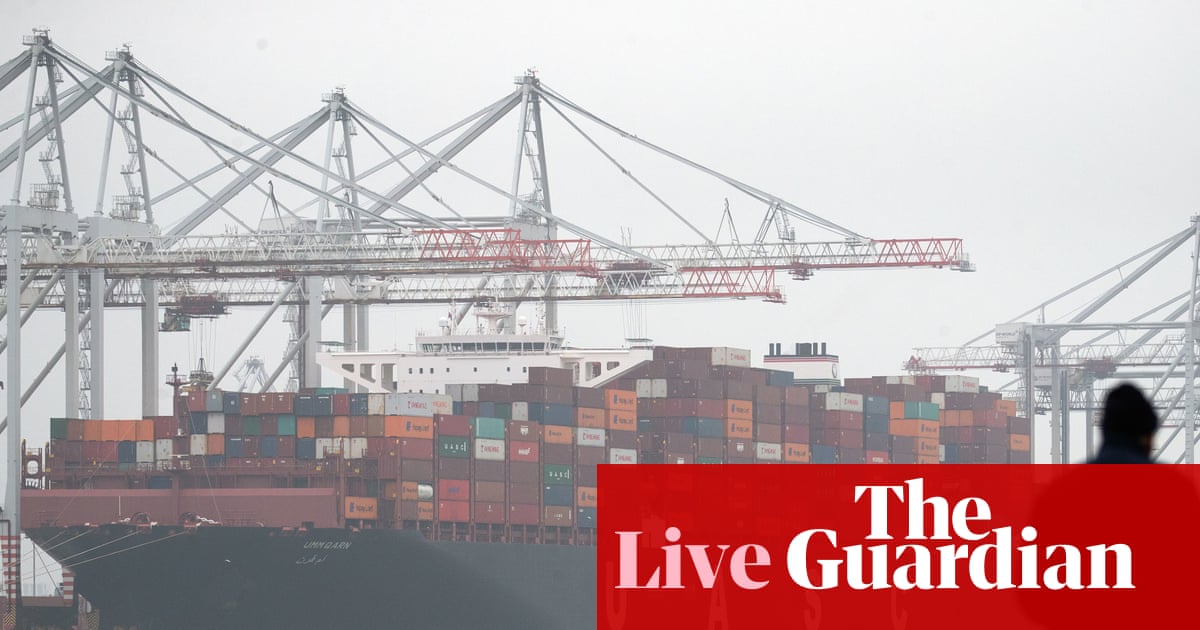
UK food and drink manufacturers are losing ground to global competitors, the industry fears, after exports fell to the lowest in a decade.
The Food and Drink Federation’s (FDF) latest Trade Snapshot report shows that UK food and drink exports fell by 4.8% year-on-year, to £5.7bn, in the first quarter of this year.
In volume terms, exports in January-March were down 8.9% to the lowest level for the period in the last decade (if you exclude 2021 when the Covid pandemic hit shipments), the FDF warns.
Ten years on from the Brexit referendum, it’s notable that EU export volumes fell by 6.9%, which the FDF blames on “the added cost and complexity of trading with our closest trade partner since Brexit”.
The federation hopes that the new sanitary and phytosanitary (SPS) agreement being hammered out by London and Brussels will cut some trade friction, by removing paperwork and reducing border checks.
But the biggest damage has been inflicted on exports to the US, which tumbled by 28% after Donald Trump’s trade wars disrupted transalantic trade.
Karen Betts, chief executive at The Food and Drink Federation (FDF):
“Food and drink businesses are part of the fabric of every community in the UK, and it’s concerning to see them struggling to compete overseas. The UK produces world-class food and drink, drawing on our heritage and our reputation for innovation, but we have to be able to remain competitive overseas against local products. The costs of producing food and drink in the UK are higher than in many competitor economies, from energy to employment, and constantly changing regulation only adds to these.
“There is plenty government can do to improve the competitiveness of our food and drink exporters, many of which are SMEs, from helping companies to access the benefits of trade deals to lowering the cost of doing business in the UK.
The agenda
9am BST: Eurozone consumer inflation expectations report
10am BST: Italian business confidence data
3pm BST: University of Michigan’s US consumer confidence index
Energy news (1): Regulator Ofgem has announced it is giving a “provisional green light” to 16 long-duration energy storage projects that could strengthen domestic power supplies.
The selected projects cover four technologies – pumped storage hydro (PSH), compressed air energy storage (CAES), lithium-ion batteries and vanadium redox flow batteries (VRFB).
Energy minister Michael Shanks, says:
“Forty years after the country’s last pumped storage facility, this government is getting Britain building again.
“The lesson from the conflict in Iran is clear: Britain cannot afford to remain at the mercy of volatile fossil fuel markets and leave families exposed to the next price shock.
“That is why we are further and faster in delivering the clean power mission by rolling out a new generation of pumped hydro storage and state-of-the-art batteries – making more of the clean, homegrown power we already produce, cutting waste, lowering bills and strengthening our energy security.”
Heathrow Airport has warned that passenger numbers could fall this year, due to the Middle East crisis.
In its latest investor report, released this morning, Heathrow says its base case is that it will handle 83.6m passengers this year, a 1.1% fall compared with 2025.
It says the outlook remains uncertain, despite ‘resilient’ demand so far this year, explaining:
In the 5 months to May 2026, passenger numbers reached 32.8 million, a 0.7% increase year on year, driven by larger aircraft and a boost in connecting passengers, although the ongoing conflict in the Middle East is putting notable downward pressure on traffic.
Heathrow says this forecast reflects the risk that continued volatility in the Middle East could dampen global travel demand over the rest of the year.
It has also lowered its earning forecast, predicting that profits on an adjusted EBITDA basis will fall by £147m compared to 2025, and be £60m lower than predicted in December.
The FDF also reports that the UK’s food and drink export surplus with the US has fallen by over 69% – from £359m to £110m in Q1 2026.
This was driven by the 27.9% drop in UK exports to the US, and also by a 11.5% rise in US food and drink exports into Britain.
The FDF fears this trend will continue, warning:
The US are also set to benefit from proposed tariff suspensions announced by the UK government this year, which would make it cheaper for US businesses to export products like chocolate, biscuits, jams and spreads to the UK, while UK manufacturers face higher costs sending products to the US, meaning this trend is likely to persist.
Good morning, and welcome to our rolling coverage of business, the financial markets and the world economy.
UK food and drink manufacturers are losing ground to global competitors, the industry fears, after exports fell to the lowest in a decade.
The Food and Drink Federation’s (FDF) latest Trade Snapshot report shows that UK food and drink exports fell by 4.8% year-on-year, to £5.7bn, in the first quarter of this year.
In volume terms, exports in January-March were down 8.9% to the lowest level for the period in the last decade (if you exclude 2021 when the Covid pandemic hit shipments), the FDF warns.
Ten years on from the Brexit referendum, it’s notable that EU export volumes fell by 6.9%, which the FDF blames on “the added cost and complexity of trading with our closest trade partner since Brexit”.
The federation hopes that the new sanitary and phytosanitary (SPS) agreement being hammered out by London and Brussels will cut some trade friction, by removing paperwork and reducing border checks.
But the biggest damage has been inflicted on exports to the US, which tumbled by 28% after Donald Trump’s trade wars disrupted transalantic trade.
Karen Betts, chief executive at The Food and Drink Federation (FDF):
“Food and drink businesses are part of the fabric of every community in the UK, and it’s concerning to see them struggling to compete overseas. The UK produces world-class food and drink, drawing on our heritage and our reputation for innovation, but we have to be able to remain competitive overseas against local products. The costs of producing food and drink in the UK are higher than in many competitor economies, from energy to employment, and constantly changing regulation only adds to these.
“There is plenty government can do to improve the competitiveness of our food and drink exporters, many of which are SMEs, from helping companies to access the benefits of trade deals to lowering the cost of doing business in the UK.
The agenda
9am BST: Eurozone consumer inflation expectations report
10am BST: Italian business confidence data
3pm BST: University of Michigan’s US consumer confidence index