Paid from German coffers, Jörg Heeskens has been advising Serbia’s Aleksandar Vucic since almost the moment he took power. A mountain of documents obtained by BIRN/Der Spiegel show just how closely Heeskens has worked with Vucic on a deeply unpopular lithium mining project, exposing what critics say is German complicity
 Sasa Dragojlo



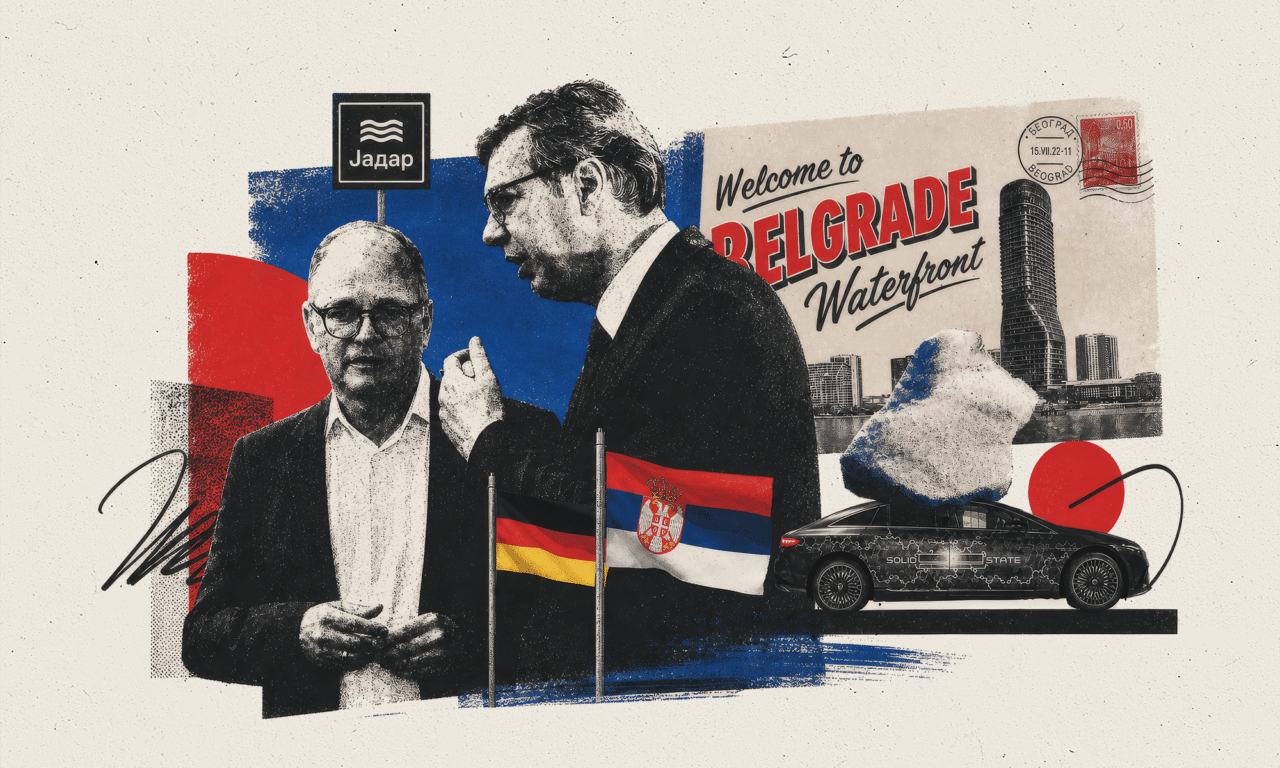
By this point, relations between the EU and Vucic were under severe strain due to the Serbian government’s response to the student-led protests, which included documented cases of policy brutality, claims that police had threatened protesters with death and sexual violence, and the weaponisation of pro-government tabloid media to discredit critics. Vucic had also insulted MEPs and accused neighbouring Croatia, the last ex-Yugoslav republic to join the EU, of stirring up the protests in order to undermine him.
However, the steady churn of activity reports concerning the ‘partnership agreement’ involving Heeskens barely mentioned the upheaval.
One of the rare references came during the June 2025 trip to Serbia by representatives of the German government, when they also sat down with Germany’s ambassador to Serbia, Anke Konrad. In the meeting, it was assessed, according to another readout, that “the current situation between the Serbian government and the protest movement is at an impasse, marked by mutual distrust and a lack of dialogue”.
“The embassy’s relations with the Serbian government are also difficult, and Germany is facing accusations that it supports the protest movement,” it said. That did not stop the cooperation on lithium.
An internal note of the Minister of Economic Affairs and Energy, dated October 6, 2025, noted Germany’s support for “the building of administrative capacity in Serbia for the approval of mining projects, also in the country’s currently politically complex situation”.
In November last year, with Vucic and the SNS on the ropes over the railway canopy collapse and growing calls for snap elections, Rio Tinto announced it was placing the Jadar mine project “under care and maintenance”, corporate speak for reining in spending and, effectively, putting the project on ice. But the company stressed it retained its legal rights to mine.
Opponents of the project are sceptical of the pause, pointing to Brnabic’s 2022 “full stop” to the deal that was actually only a comma.
Indeed, on November 25 last year, just days after Rio Tinto hit pause, the German Ministry of Economic Affairs and Energy signed an agreement with authorities in Saxony providing for the eastern German state to provide Serbia with ‘Green Mining’ expertise; under the deal, experts made two trips to Serbia, in December and then March, even though, in April, the German government told the Bundestag that “no discussions with the Serbian government” on the subject of the proposed Jadar lithium mine occurred after the Rio Tinto announcement of November last year.
Fuelling the scepticism, in April this year, Serbia’s parliament passed a new Strategy for the Management of Mineral and Other Geological Resources which explicitly mentions the project in the Jadar Valley.
Then, on May 22, in an op-ed for US Fox News that was effusive in its praise for President Donald Trump, Vucic touted Serbia’s “mineable” lithium deposits as the European continent’s second-largest.
Such deposits, he wrote, are “a resource vital to Western industrial independence – and we are seeking partners who value efficiency and results”.
Vucic plays on the economy, said Bieber, “because he knows that his partners are far more interested in that than in democracy”.
“Both sides profit at the expense of citizens and democracy.”
Deepening business ties between Germany and Serbia
Business ties between Germany and Serbia have steadily deepened under Vucic and the ruling SNS.
One of the activity reports issued under the ‘institutional partnership’ involving Heeskens cites a 63 per cent increase in bilateral trade between between 2015 and 2019 to a total of 5.16 billion euros.
Growth continued after the disruption of the COVID-19 pandemic and, again according to the activity reports, bilateral trade “has nearly doubled” since the ‘institutional partnership’ was agreed in 2020.
According to the latest figures, German companies in Serbia employ some 80,000 people, though some of the activity reports flag rising wages as a growing concern for German investors, forcing some to leave or cut back.
Nevertheless, the latest survey conducted by the German-Serbian Chamber of Commerce shows that 77 per cent of German companies would again choose Serbia as an investment location.