


Putin is betting on seizing Kostyantynivka to shift attention from Crimea. Intensified Ukrainian strikes on Russia’s energy infrastructure threaten to sap his capacity to sustain a long, attritional push in Donbas.
 Tomáš Vasilko



Every day, the Ukraine Battlefield update newsletter offers a clear look at how the war is unfolding on the ground. Subscribe for free here to get the full text delivered to your inbox.
The situation in Kostyantynivka is much more serious than some Ukrainian commanders say. Why Ukrainians are failing to stop the Russian advance. Ukraine’s campaign against refineries is more successful than in the autumn, an analyst explains why. Chart of the day: Ukrainians are launching twice as many drones at Russia as the other way round. Photo of the day: Russians have started using smoke screens on the Crimean bridge. Videos of the day: Welcoming Russian tourists in Crimea; Bayraktar is back; a new way of launching FPV drones; a Ukrainian strike on vehicles from which Russians launch Gerans.
After reports of attacks on refineries, fuel shortages in Crimea and restrictions in Russian regions, the Kremlin urgently needs to hear some good news. It looks as if it will soon get them from Kostyantynivka.
According to a Ukrainian soldier who goes by the name Officer, this city, together with Dobropillia, is the epicentre of combat operations not only in Donbas, but along the entire front. Russia is also managing to advance south of Kupiansk and near Lyman, but Kostyantynivka is the most important.
Several sources say that the fall of Kostyantynivka is only a matter of time. Nevertheless, some official Ukrainian channels are playing down the situation.
Brigadier general Olexander Bakulin, commander of Ukraine’s 19th Corps, whose units are defending the city, according to the BBC insisted that “the situation remains under control” and that “the enemy has had no success”.
His deputy Yuriy Madyar said, according to NV, that Russian troops had indeed infiltrated buildings, but Ukrainian soldiers knew their positions and were destroying the occupiers.
“They are running away, they are demoralised, but there are still some who try to return fire. South of Kostyantynivka there are now only a minimum number of enemy troops, we have cleared them out there. Now we are starting a sort of offensive aimed at destroying the enemy troops directly in Kostyantynivka – in its central and western parts. There are not many of them, we know where they are,” he wrote.
Such an assessment by a Ukrainian commander was detached from reality, similar to the frequent reports from the other side. Ukrainian soldiers fighting in and around the city said something completely different.
The Ukrainian account Playfra shared information from a soldier in the city. It was not even fresh, but about two weeks old. This soldier wrote that Kostyantynivka was already considered a “lost city”.
“Russia is gaining control over the central, western and northern parts of the city,” he said.
Only one part of the city could be supplied logistically by drones, “but the Russians are monitoring such movements and then strike at the place where the supplies were dropped”.
This was confirmed by soldiers interviewed by a BBC reporter. According to them, virtually the entire city was considered a grey zone.
“Russian forces are getting into areas behind our backs, and in urban conditions it is extremely difficult to push them out,” a Ukrainian drone operator told the BBC.
Russian soldiers were sheltering from drones inside buildings, and the time of year also helped them, as they could hide under trees.
They were advancing slowly, but they were advancing. “Sometimes they move only one hundred metres a day. Sometimes they just crawl into the next building,” another soldier said. Russia’s goal was not so much to fight the Ukrainians as to get as far into the city as possible, create micro-encirclements and gradually push Ukrainian troops out.
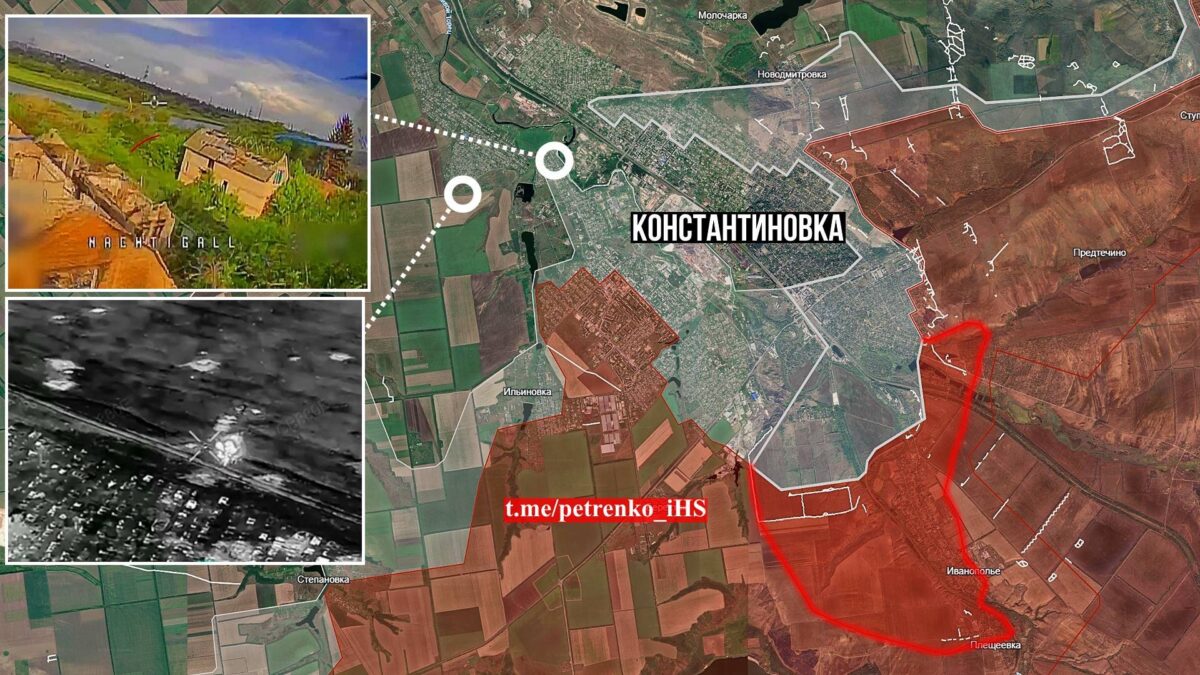
Ukrainian analyst Bohdan Myroshnykov wrote that there were practically no Ukrainian soldiers left in the south of the city and that the heaviest fighting was taking place in the centre of this pre-war city of 60,000 people and in the western districts. From the east, units that had long held the area west of Chasiv Yar were blocking Russia’s advance.
Current map of the city according to the Ukrainian account Petrenko.
Several sources mentioned that Russian troops were advancing in groups of at most two, sometimes one soldier at a time. This dispersed their forces and made it difficult for Ukrainian drone pilots to track all infiltrations. Optimistic Ukrainian commanders said there were around 130 Russian soldiers in the city, but in reality there could be more. Russia was managing to send reinforcements into the city.
What mattered was that Russia was targeting Ukrainian drone operators who, in addition to monitoring the situation in the city, had to watch out for Russian glide bombs, artillery and drones. By contrast, they themselves were more focused on destroying infantry and did not have enough capacity to try to take out Russian operators as well.
“Since we devote little time to finding and targeting enemy pilots, they can operate freely, reveal our positions and we are forced to withdraw. That is how the front line moves,” one operator told the BBC.
This meant Kostyantynivka was probably facing the same fate as Pokrovsk. The Ukrainian account DeepState UA wrote that the fall of the city was only a matter of time. Myroshnykov wrote that “time and the amount of meat the enemy is sending will unfortunately finish the job”. It was said that the city might fall by the end of the summer.
The Russian account Two Majors stated that the assault on Kostyantynivka was approaching a “logical conclusion”.
This shows that Ukrainians still cannot hold a city under siege. And even though they have increased their capabilities and options when it comes to medium- and long-range drones, the protection of the front line with drones in an urban environment has repeatedly proved problematic.
Russia can be stopped in open fields or small villages, where it is currently making almost no progress. But once its forces reach a larger city and begin to besiege it, Ukrainians eventually give way, as they did near Pokrovsk last autumn.
The reason is that assault troops have far more opportunities to hide in a city than in open country. In addition, Russia sees Kostyantynivka as an important trophy and wants to capture it as quickly as possible. “Russia has chosen this axis as one of the main ones and can still afford to do so. This allows it to deploy large numbers of infantry who will suffer considerable losses and it will take a long time, but they will eventually complete the task,” the Playfra account, which focuses on the fighting in this city, wrote.
On Wednesday, it also published satellite images from Sentinel and the NASA FIRMS programme showing Russian bombing on the road leading out of the city towards Druzhkivka and Oleksiievo-Druzhkivka.
Today’s Sentinel-2 and the last 7 days’ FIRMS confirm reports of the start of intense shelling of Oleksiievo-Druzhkivka and Druzhkivka, other than northern Kostyantynivka. pic.twitter.com/ddrEWoYsPT
— Playfra (@Playfra0) June 24, 2026
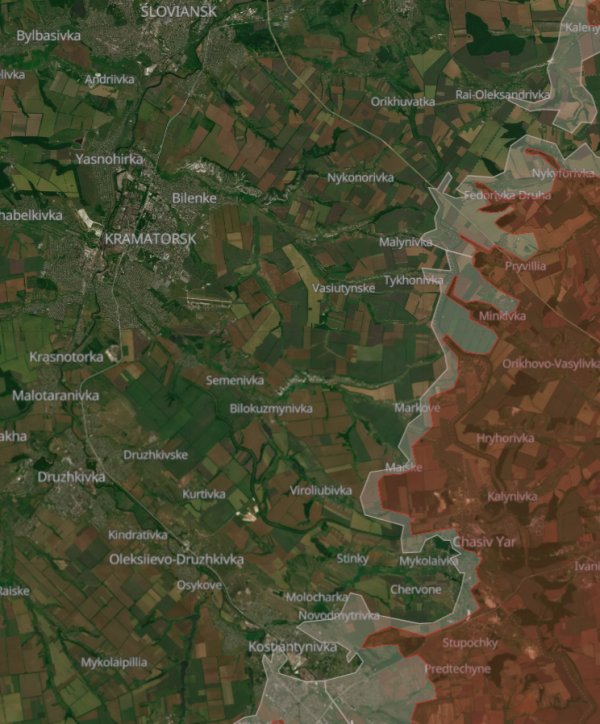
Russia’s advance from the city was expected, in time, to continue in that direction. Russian forces would try to approach Kramatorsk from the south.
And even if, according to Officer, Russia might think that Ukrainian defences on this axis would collapse, this was not expected, as Ukrainians had well-prepared positions there. This war was also a war of time. Ukrainians were slowing and delaying Russia’s advance while inflicting damage on the enemy not only at the front, but – as had been clear in recent months – also in the rear.
Source – DeepState UA
The account Oko Hora published statistics on what targets in Russian territory Ukrainians attacked in May. In as many as 33 cases (67 percent) these were refineries and other oil and gas-related facilities, the highest number so far.
Source – Oko Hora
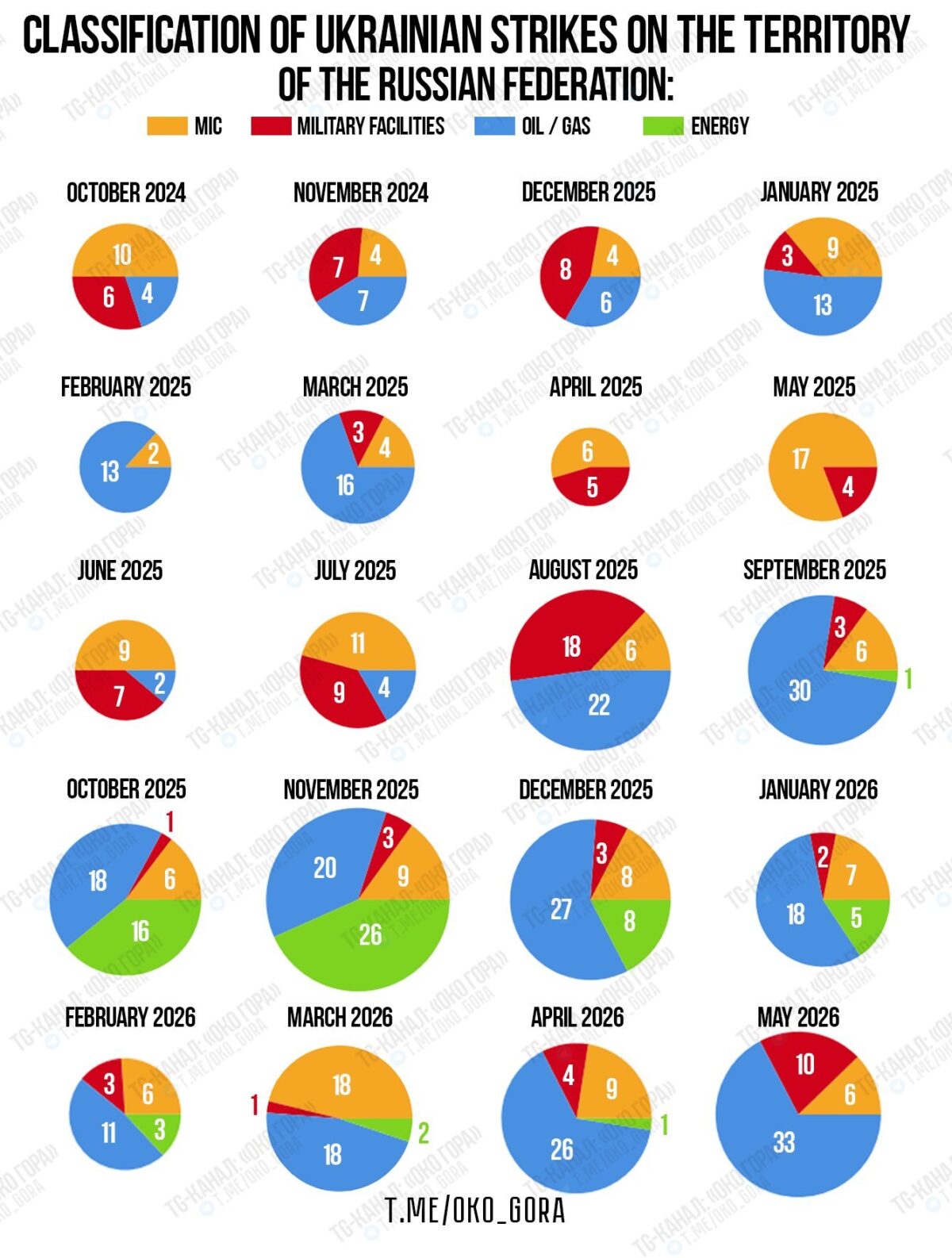
Ukrainians also carried out large-scale attacks on refineries last autumn (they hit 30 targets in September). Nevertheless, this did not cause such fuel shortages in Russia as this time.
Both campaigns were compared by Michael Bohnert, an analyst at the RAND think tank. He said the difference lay in the frequency of the attacks and the size of the warheads with which Ukrainians were managing to hit Russian refineries.
In the autumn, he said, Ukrainians attacked refineries every two to three days. At one point, about a quarter of refineries were offline. The damage, however, was not so severe. “While it is difficult to give precise figures, it appears that most of them were back online within one to two weeks,” Bohnert wrote on X.
This summer, however, Ukrainians were attacking Russian refineries every day, or once every one and a half days.
“They are also using heavier warheads and carrying out multiple strikes in a single raid, causing substantially greater damage. More damage = longer repairs. While high-pressure piping can be sourced relatively quickly, many production processes depend on imported systems that are difficult to repair. Larger warheads mean a higher likelihood that these will be damaged,” the expert wrote.
This was clearly visible during last week’s attack on the Kapotnya refinery in Moscow. While on Tuesday it was hit only once, on Thursday it was reportedly struck by as many as ten drones. On top of that, the Russians inflicted damage on themselves when their air defence damaged one storage tank, and the blown-off roof amused not only the whole of Ukraine.
According to Bohnert, if a refinery is hit once every one and a half days and repairs take an average of four weeks, this means that Russia’s fuel production capacity is reduced by 45 percent, which would mean “a significant burden on industry”.
“If Ukraine can achieve this level of success, it will have a clear impact on prices and industrial production. This would likely be felt at the front,” he wrote.
The president of Rosneft, Igor Sechin, also wrote to president Vladimir Putin back in May that Russian refineries were suffering unprecedented damage.
Moreover, on Wednesday the Reuters agency published a report that the Kapotnya refinery in Moscow, which accounts for only 3 to 4 percent of the country’s overall fuel production but supplies half of Moscow’s needs, would not be back in operation for at least six months, that is, until 2027. It cited two sources.
In the meantime, petrol prices in Russia have already shot up to levels not seen in this season in recent years. This is shown by the A-92 petrol price index graph published by German economist Janis Kluge.
In the current situation, it is worth recalling the Russian propaganda campaign from 2023, which tried to frighten Europe that without Russian gas and oil it would freeze and have no petrol. In this video, for instance, they showed European cars being pulled by horses.
Könnt ihr Euch noch daran erinnern, was uns die ruZZkis 🇷🇺 2023 in Europa 🇪🇺vorausgesagt haben, weil wir kein RU 🇷🇺 Öl & Gas mehr gekauft haben, und alle Vatniks Panik geschoben haben, und das Video überall auf Social Media verbreiteten? Oh diese Ironie 😆 pic.twitter.com/MtACgmF22Q
— @BrennpunktUA 🇩🇪🇺🇦 (@BrennpunktUA) June 25, 2026
In the summer of 2026, videos of people riding horses began to appear in Russian-occupied Crimea.
Occupied Crimea is sinking deeper into a fuel crisis after sustained Ukrainian drone strikes on Russian logistics and fuel infrastructure. Footage from the peninsula shows residents increasingly moving by horse. #Crimea pic.twitter.com/Xcn9km4DVN
— NOELREPORTS 🇪🇺 🇺🇦 (@NOELreports) June 5, 2026
Chart of the day
The pro-Ukrainian account Vitaliy published statistics on long-range drone attacks by Ukraine and Russia, as reported by both sides. It is not the first time that Ukrainians have launched more drones at Russia than vice versa. This month, the ratio has risen to almost two to one.
While Ukrainians were shelling Russian refineries with drones such as Lutyj or FP-1, Russia was attacking with Gerans. This month, the number of drones launched by Ukraine reached a record (more than 300 per day), while Russia has so far deployed fewer than usual. This may be linked to Ukrainians hitting the Kometa antenna factory, whose products are used by Gerans.
Source – Vitaliy
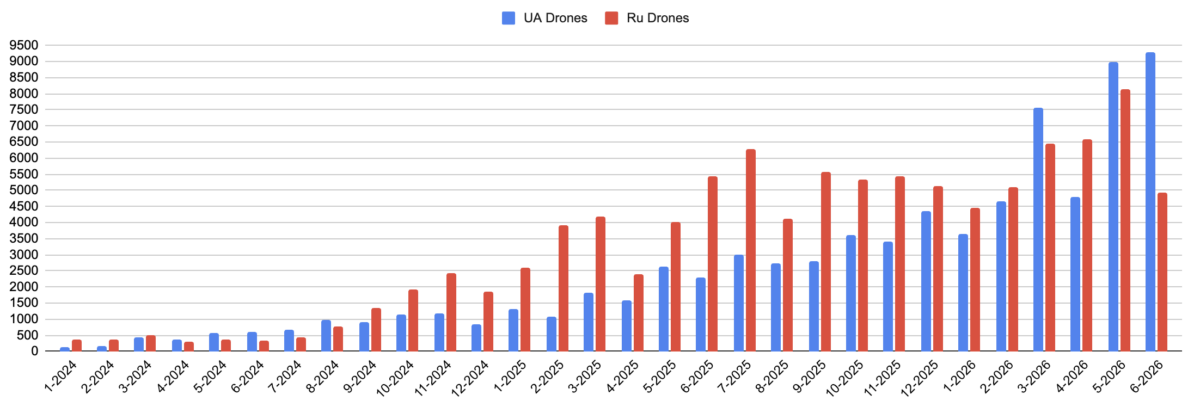
Photo of the day
Russia fears that Ukrainians will attack the Crimean bridge. The Ukrainian account Oko Hora published images suggesting that they have started using smoke screens at some points on the bridge, which could make it harder to guide drones onto it.
Videos of the day
This was what the arrival in Crimea from Russia over the Crimean bridge looked like on Tuesday. Storage tanks at a local power plant were on fire. For Russian tourists heading there on holiday despite the situation, it was a fitting welcome.
Turkish Bayraktar drones flew over the Black Sea for the first time in a long while. In this video they hit a Russian naval kamikaze drone. In total they destroyed three of them. This may be linked to the degraded air defence over Crimea and the Black Sea after Ukrainian attacks. Overall this month, according to data from their general staff, Ukrainians have hit 44 air-defence systems, the highest number in two years. They hit a similar number (42) in May. In this way, Ukrainians are clearing the way for ever larger attacks on Russian positions in Crimea and elsewhere.
WATCH: Ukrainian Bayraktar TB2 UCAV destroys a Russian kamikaze surface drone in the Black Sea.
The strikes destroyed three Russian naval drones. pic.twitter.com/Va7S9Tk4kZ
— Clash Report (@clashreport) June 24, 2026
Ukrainians presented a new way of launching FPV drones. A ground robot protected by a cage brings them into position, from where the drones can then take off. This allows them to keep drones flying longer over important areas.
🤯 WOW: Ukraine is leveling up its drone game.
A new robotic platform can remotely launch multiple FPV drones at once, allowing operators to strike Russian forces from a safe distance. pic.twitter.com/N9ab6DYHDp
— UNITED24 Media (@United24media) June 23, 2026
Ukrainians hit vehicles from which Russians were launching Shaheds.
What the losses are
No update on Thursday.
By Tuesday, Russia had demonstrably lost 23,668 pieces of heavy equipment (on Monday (8 June) it was 23,593). Of these, 18,652 (18,585) pieces were destroyed by Ukrainians, 987 (982) were damaged, 1,199 (1,199) were abandoned by their crews and 2,830 (2,827) were captured by the Ukrainian army. This includes 4,404 (4,397) tanks, of which 3,307 (3,300) were destroyed in combat. Ukraine has lost 11,564 (11,425) pieces of equipment, of which 9,011 (8,888) were destroyed, 687 (680) damaged, 677 (670) abandoned and 1,189 (1,187) captured. This includes 1,433 (1,426) tanks, of which 1,097 (1,091) were destroyed in combat.
Note: Neither side regularly reports its dead or destroyed equipment. Ukraine publishes daily figures on Russian casualties and destroyed equipment, which cannot be independently verified. In this overview we use data from the Oryx project, which since the start of the war has compiled a list of equipment losses documented exclusively by photographic evidence.