Ukrainian drones hammer Russian fuel convoys and frontline towns like Kostyantynivka edge toward collapse while Moscow’s commanders scramble between jamming Elon Musk’s Starlink and rewriting its defeat near Kyiv.
 Roman Pataj



Every day, the Ukraine Battlefield update newsletter offers a clear look at how the war is unfolding on the ground. Subscribe for free here to get the full text delivered to your inbox.
Ukrainian superiority is temporary; Russia is trying to shorten it to a minimum. Why Russia did not capture Kyiv in spring 2022 – a Russian Z-channel debunks the lie about a humanitarian withdrawal. What the road to Kostyantynivka looks like, as its days near the end. Russia advanced in Lyman. Ukraine lost a Su-24 along with its crew. Technical curiosity – work is under way on a rocket launched from balloons. Maps of the day – Kostyantynivka, Lyman Videos of the day – hunting fuel tankers; a Ka-52 helicopter chases a Ukrainian drone; a MiG-29 chases a Russian drone.
Ukrainian superiority is temporary; Russia is trying to shorten it to a minimum with advanced solutions, but also with bizarre decisions. “In the next six months we will have superiority,” Ukrainian defence minister Mykhailo Fedorov said this week.
It is currently most visible in medium-range drone attacks that are decimating Russian logistics. This should also be reflected at the front, where Russia should not be advancing more than it is now and surprises on the Ukrainian side cannot be ruled out.
However, Russia has repeatedly proved that it is able to learn and react to developments that do not suit it. The first signals that it will not sit with its arms crossed and wait until it loses the war are already here.
Some steps would be downright harmful for the country in peacetime (changes in petrol production), others appear absurd (a ban on using motorbikes and quad bikes in Crimea at night), but others open a new battlefield in this front. With a bit of exaggeration, it can be said that the war is moving into space, and this concerns Elon Musk.
We will start with the most technically interesting piece of news. This week, evidence appeared that Ukrainian drones had attacked an unusually shaped concentration of previously unknown devices. There were two cases; in one of them, six trailers were parked in a civilian car park among seemingly innocuous vehicles.
According to Russian military reporter Alexander Kots, for example, who said that these are new electronic warfare systems called Volna Kupol Garant. Their task is to suppress the signal from Starlink satellites, which Ukrainians use to guide their drones onto targets in the Russian rear.
“We cannot shoot down American satellites because that would risk direct military confrontation with the US. What remains is only to ensure that their signal does not reach the terminals,” the Komsomolskaya Pravda journalist explained.
The Russian Telegram channel Bezpilotne bratstvo stated that the system focuses on a specific Starlink satellite flying over the area of its operation and, by irradiating it, causes signal loss on the ground. “One such complex consists of six trailers with satellite dishes, which are hidden under a radio-transparent cover (a dome). It provides protection for approximately 20 km2 and is currently being actively used to cover the ‘Novorossiya’ route (the R-280 road in southern Ukraine) from Ukrainian drones,” the author wrote.
He admitted that its weakness lay in its large size and visibility, but “in the future this problem will be eliminated”.
Kots pointed to another limitation – the threatened route is 410 km long, and dozens of devices are needed for its full coverage; as we can see in the video above, Ukraine has started destroying them.
Starlink also consists of thousands of satellites, which reduces effectiveness. Nevertheless, the system shows that for every weapon there is a counter-weapon – and Russia is actively looking for it.
Until it succeeds, it has to resolve a growing fuel shortage. The problem is spreading across Russia, including Moscow and Saint Petersburg. As Russian business daily Kommersant reported, the government already last autumn allowed refineries to produce lower-quality petrol, and in May it extended the permit for an unknown period.
“According to experts, this could ease local shortages, but they warn of risks for car owners, because, among other things, a higher sulphur content is allowed in this fuel,” the newspaper wrote. In Russia, fuel production also follows the current Euro 5 standard, but refineries have been allowed to produce fuels according to the Euro 3 standard. As Kommersant wrote, in the stricter standard the permitted sulphur content is ten milligrams per kg of fuel; now Russian petrol stations may sell petrol with up to 150 milligrams of sulphur per kg of petrol and diesel with up to 350 milligrams per kg. This is a problem for modern engines adapted to high-quality fuels.
Why Russia did not capture Kyiv in spring 2022 – a Russian Z‑channel debunks the lies about a humanitarian withdrawal. The story that in March 2022 Vladimir Putin was deceived into voluntarily agreeing to withdraw troops from the Ukrainian capital in exchange for an end to the fighting is also used by Russia’s supporters in Slovakia. After all, the Russian president himself has spoken about it publicly.
The fact, however, is that the battle for Kyiv and the whole of northern Ukraine was simply won by the Ukrainian army, which was clear to anyone even slightly familiar with the war. The reason for returning to this well‑known history is a relatively long post by the major Russian Z‑channel Rybar.
Because claims were once again circulating in Russia that “the withdrawal of troops from Kyiv was caused by ‘deception by the Jewish lobby’”, the author decided to explain the real reasons for the defeat, because “explaining military failures by the intrigues of external forces leads to the real causes remaining unnamed. And why actually change anything if there were no problems in the army, but some lobby did not allow everyone to be defeated?”
Rybar explained matter‑of‑factly that the reasons were prosaic – the group of units designated to capture Kyiv from the west became bogged down in fighting in Irpin, Bucha and Moschun. “There could be no talk of cutting Kyiv off from the west, let alone entering it,” he wrote, adding that it was the same from the opposite direction, because troops advancing from Chernihiv failed to break through to Brovary and Boryspil.
“An attack on the Ukrainian capital therefore did not take place because the conditions for such an operation had not been met in mid‑March 2022. The main reason for the failure was mistakes in planning, which assumed a ‘Crimean scenario’. When that failed, it became clear that the size of the grouping and the resources allocated did not physically allow even an approach to encircling Kyiv,” Rybar stated, while seeing similar problems behind Russia’s failures near Kharkiv and Mykolaiv.
“The situation that prevailed at the fronts at that time did not require the intervention of any lobby,” Rybar added.
What the road to Kostyantynivka looks like, as its days near the end. If you have half an hour, it is definitely worth watching a short documentary by Kyiv Independent journalist Francis Farrell. At the end of May he travelled the road between Druzhkivka and Kostyantynivka. Not the entire way, because 3.5 km before the besieged town he judged continuing any further to be an undue risk. Since then, the situation has deteriorated significantly and the town is already on the verge of falling.
Farrell’s journey among the wrecks of cars, ground drones, exhausted soldiers returning from Kostyantynivka during rotations and a handful of civilians is a unique opportunity to get a better idea of what the deadly zone near the front looks like.
Soldiers told him about the hell inside the town itself and explained that since January its logistics have been functioning almost without vehicles. If a vehicle appears, it drives through at high speed and is being used to evacuate the wounded.
Because vehicles are the primary target of drones, which almost always fly overhead above the journalists as they move forward – and sometimes they did not know which army they belonged to – it is safer to go on foot at a distance of five to 10 km from the frontline. In the video, you can also see how the “Chuyka” electronic device works; it not only alerts you to an approaching drone, but can also connect to its camera.
[embedded content]
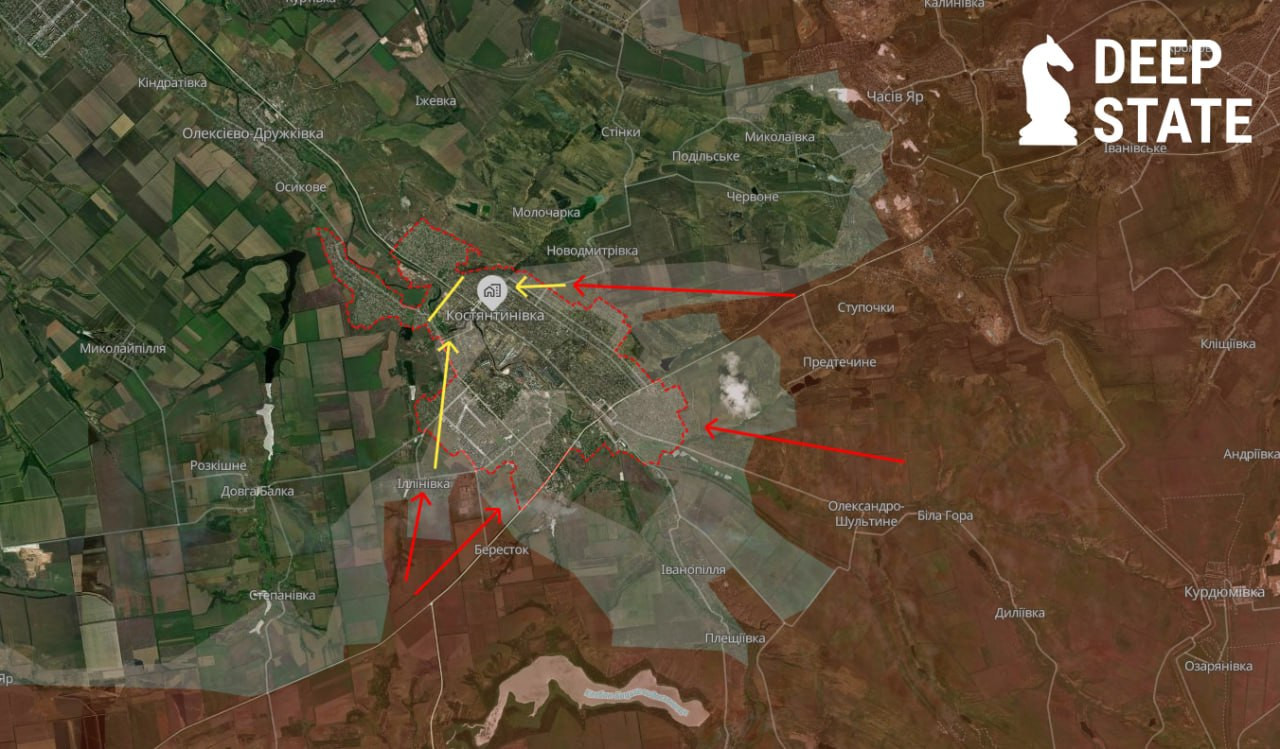
“The situation around Kostyantynivka is developing according to the worst‑case scenario,” DeepStateUA wrote about the town’s current situation.
“The enemy has advanced to the outskirts of the town literally from all sides, is exerting active pressure and penetrating deep into residential areas. The presence of enemy infantry has been recorded from the eastern part from Novodmytrivka, and constant reports are also coming from the direction of Berestok and Illinivka,” the description continued, which, combined with the map (still optimistic compared to others), does not bode well.
Ukrainian analysts are therefore writing that the fall of the town is only a matter of time, and that it already resembles the final stage of the battle for Pokrovsk. Russia is obviously trying to cut off the town’s defenders in the north and Ukrainian troops will therefore start gradually withdrawing from it.
DeepStateUA predicted that the loss of Kostyantynivka would radically change the Ukrainian army’s logistics in the entire area to such an extent that even “simply being in Kramatorsk will become extremely dangerous”.
Kramatorsk lies less than 20 km as the crow flies from the point where the yellow arrows meet on the map. By road, it is somewhat more. Services, including restaurants, are still operating in Kramatorsk today, but that may soon change.
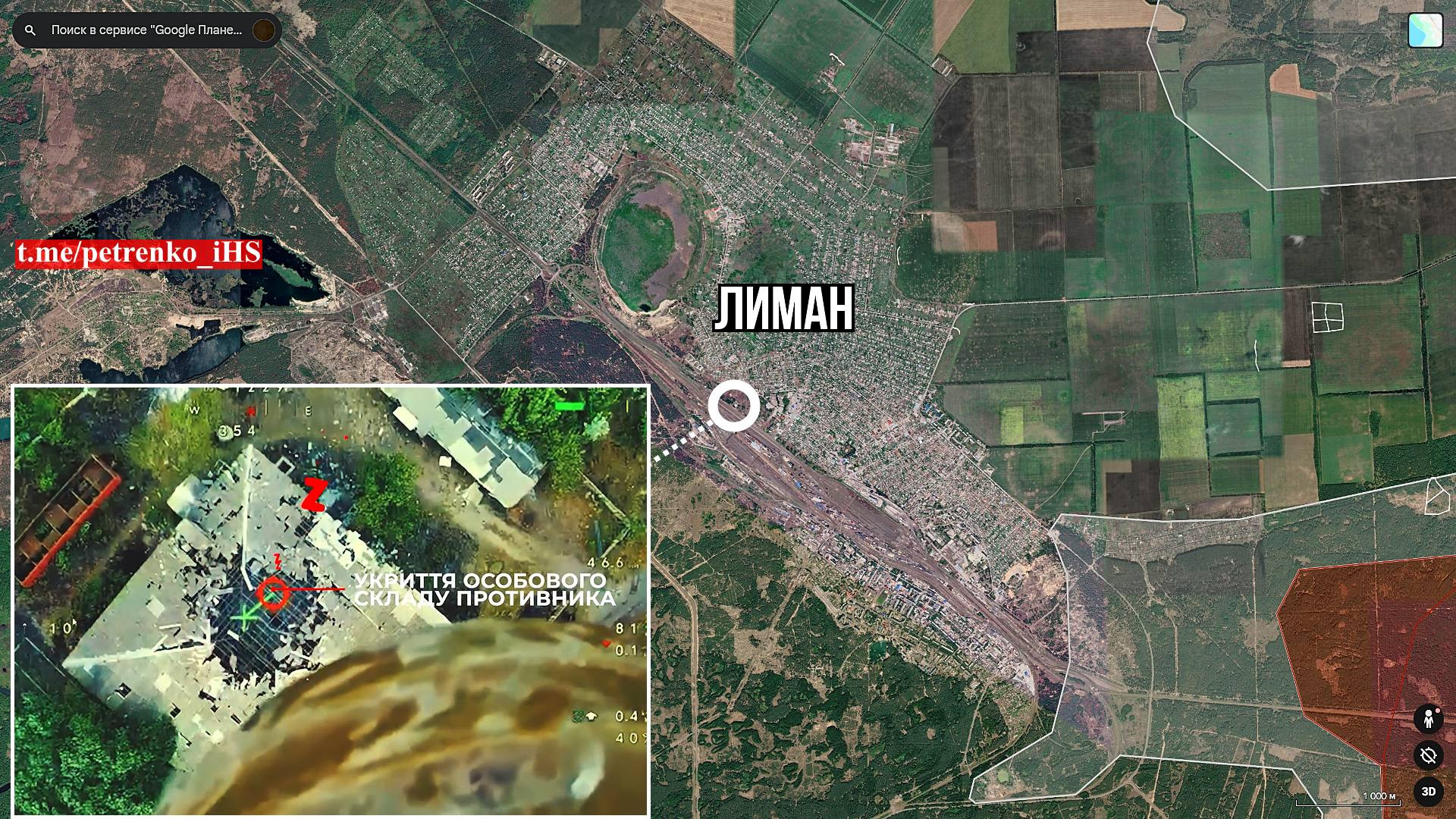
Russia advanced in Lyman. The battlefield in Donbas is complex and Russia is trying to break into its remaining strongholds simultaneously from the south (from around Kostyantynivka), from the east (roughly from Siversk) and from the north from Lyman. From the last of these places came a report on Tuesday that Russian soldiers had managed to penetrate into its centre. This is also shown by videos from Ukrainian drones, which bombed a building where Russians were hiding. According to Ukrainian sources, they were eliminated, but the exact situation is not known.
The Russian Telegram channel Slivochny kapriz (“Creamy Caprice”) drew a map suggesting that this could have been a penetration one km deep, which is a lot in urban fighting.
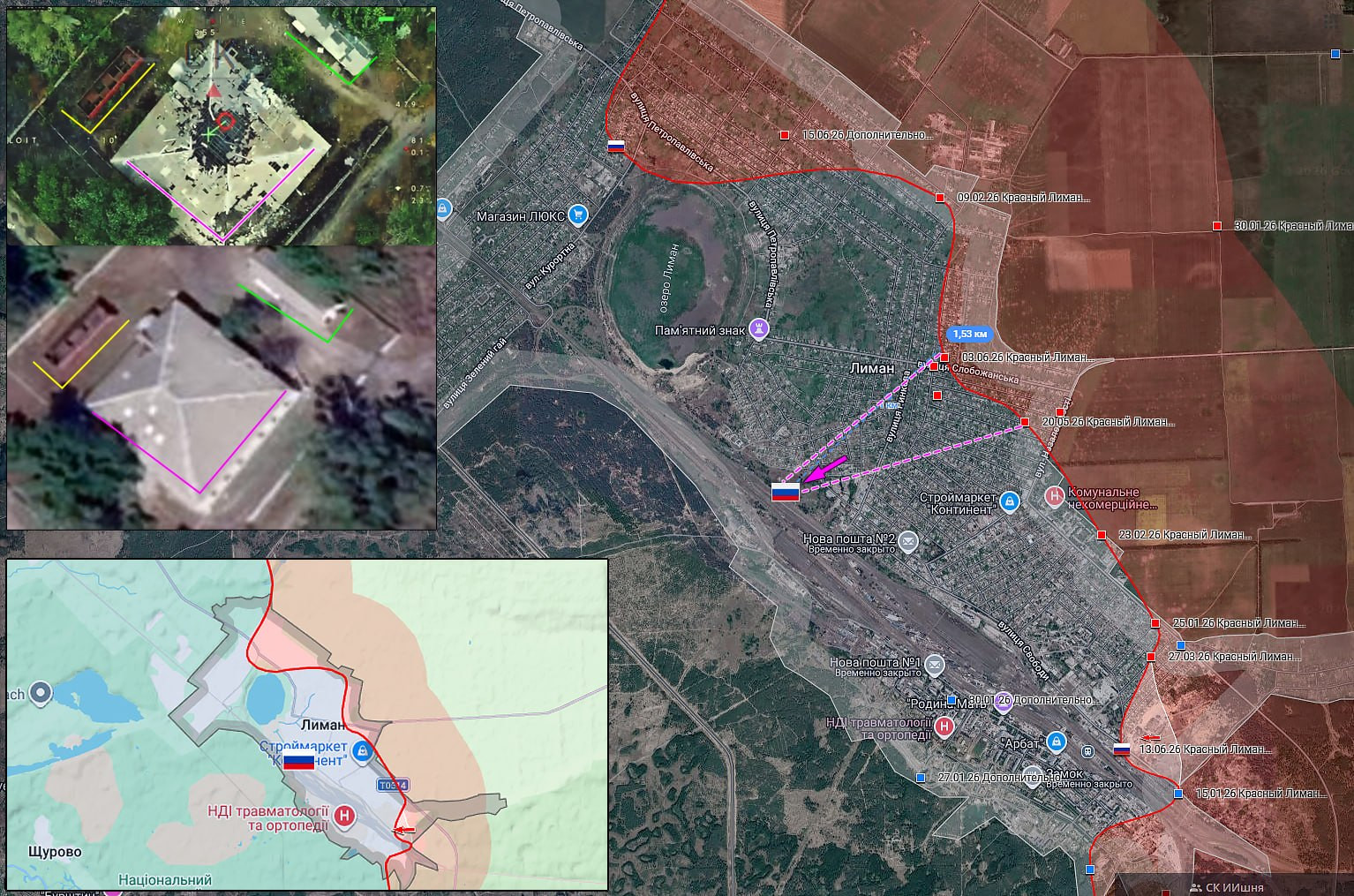
Ukrainian analyst Petrenko geolocated the Russian penetration in the same place. That, however, is the only thing the Russian and Ukrainian maps have in common.
According to the Russians, their troops are firmly on the outskirts of the town, while the rest is a grey zone. Ukrainians draw the town as clearly controlled by their own army, and that applies to its wider surroundings as well, with the exception of the south‑eastern entrance to Lyman. The Ukrainian map is almost certainly more accurate. On the Russian one, you can notice the dates of geolocations and so, for example, you can find one from February. Since then, however, a lot has changed. It is an example of how the authors of Russian maps are satisfied with one several‑months‑old video to keep drawing the frontline based on it for almost another half‑year.
Ukraine lost a Su‑24 along with its crew. A day after the crash of Russia’s Tu‑22M3 strategic bomber, the Ukrainian air force suffered a serious loss. The accident occurred on Wednesday at about 19:00 local time. In a statement, the Ukrainian air force said that the crash had taken place during a mission in Khmelnytskyi region.
The aircraft belonged to the 7th Tactical Aviation Brigade and nothing is yet known about the causes or the type of mission. The Su‑24 is a twin‑seater tactical bomber that in recent years has served in the Ukrainian air force mainly as a carrier for Storm Shadow and SCALP/EG missiles.
This type has been used intensively since the beginning of the war. On the very first day of the invasion, one Ukrainian Su‑24 bombed the runway at Hostomel airfield near Kyiv so Russia could not use it to receive flights of large cargo planes. According to the Oryx website, Ukraine has lost 21 aircraft of this type; including this one, which is not yet in the statistics, the number is already 22.
“We express our sincere condolences to the families of Major Bohdan Hryhorovych Zahorulko and First Lieutenant Bohdan Oleksandrovych Babienko, who defended our country to their last breath,” the Ukrainian air force wrote in farewell to its pilots, which also resonated in Russia.
Of course, Russians rejoiced at Ukraine’s loss, but the aviation Telegram channel Fighterbomber, alongside its satisfaction, also wrote this in a respectful tone: “It must be acknowledged that Ukrainians announce the names of their fallen pilots. Publicly. Officially. And the whole country mourns them. Do you know the surnames of our fallen pilots who recently died in the Mi‑8?”
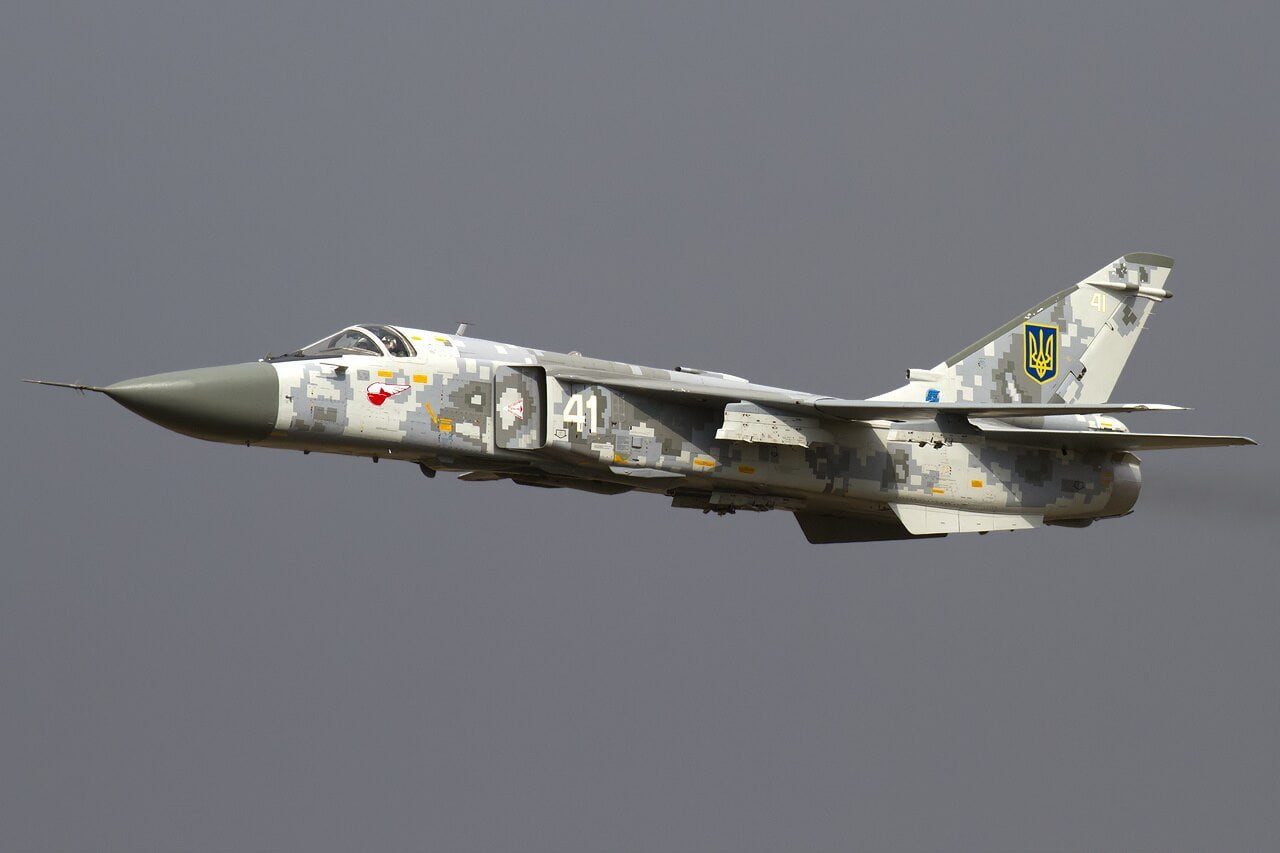 Su‑24 of the Ukrainian air force. Source: Telegram.
Videos of the day
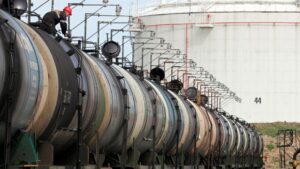
This video explains why Crimea is having fuel problems. It contains a compilation of drone attacks on Russian logistics. The vast majority of targets are fuel tankers.
“Prymary” unit strikes Russian logistics across occupied territories, including Crimea. As the footage shows, fuel tankers remain one of the unit’s highest-priority targets pic.twitter.com/kortAn5tqI
— Special Kherson Cat 🐈🇺🇦 (@bayraktar_1love) June 17, 2026
Helicopters have become a very important part of the defence against drones. In this case, a Russian Ka‑52 is chasing a Ukrainian drone.
A Russian Ka-52 helicopter chases a Ukrainian drone that is likely headed towards Moscow.
Moscow mayor says drone attack on Russia’s capital is in progress. pic.twitter.com/wea9cyD7N7
— Anton Gerashchenko (@Gerashchenko_en) June 17, 2026
A similar situation, but this time the target is a Russian drone and the hunter is a Ukrainian MiG‑29.
🇺🇦✈️ Ukrainian MiG-29 fighter jet uses an R-73 air-to-air missile to shoot down a Russian Shahed on the southern front. pic.twitter.com/kLKGCu4g9Q
— MAKS 26 🇺🇦👀 (@Maks_NAFO_FELLA) June 16, 2026
What are the losses
Last updated on Monday (6 June).
As of Monday (6 June), Russia had demonstrably lost 23,593 pieces of heavy equipment (on Monday 1 June it was 23,556). Of that, 18,585 (18,551) pieces were destroyed by Ukraine, 982 (979) were damaged, 1,199 (1,199) were abandoned by their crews and 2,827 (2,827) were captured by the Ukrainian army. These include 4,397 (4,394) tanks, of which 3,300 (3,293) were destroyed in combat. Ukraine has lost 11,425 (11,397) pieces of equipment, of which 8,888 (8,863) were destroyed, 680 (678) damaged, 670 (669) abandoned and 1,187 (1,187) captured. These include 1,426 (1,424) tanks, of which 1,091 (1,089) were destroyed in combat.
Note: Neither side regularly reports its dead or its destroyed equipment. Ukraine publishes daily figures on Russian casualties and destroyed equipment, which cannot be independently verified. In this overview we use data from the Oryx project, which since the beginning of the war has been compiling a list exclusively of visually documented equipment losses.