“For almost 7 years, nobody cared about UiPath.”
No traction. No funding. No headlines. Merely a petite team in Romania developing in silence while the world looked afield. No hype, no backing; just belief! Then, all of a sudden, everything changed. The same organization once overlooked became unstoppable. So what exactly flipped the story, and why did everyone miss it?
Was UiPath Rejected Multiple Times?
Correct: UiPath struggled for years and had no luck convincing early investors about its robotic process automation (RPA). It almost consumed a decade before the company attained meaningful traction and recognition.
How Did UiPath Actually Start?
UiPath didn’t start as a billion-dollar vision.
Dating back to 2005, Danial Dines initiated a company called DeskOver in Romania. It emphasized outsourcing and automation services instead of building a global product.
It wasn’t backed by any grand ambition to dominate the automation software industry. Rather, it was a humble attempt to develop sustainable revenue via technical expertise.
During that time, Romania could not boast of being a world tech centre. There were funding opportunities, but the Romanian startup ecosystem had yet to evolve.
That’s the story of most Eastern European companies; hard-working but not always acknowledged.
Why Did UiPath Struggle for So Many Years?
Between 2005 and 2012, UiPath encountered what most startups would consider a FAILURE!
- Lack of traction
- Lack of explosive growth
- Lack of investor excitement
The problem was not just funding; it was understanding.
The concept of robotic process automation (RPA) was too early. Businesses failed to witness the value in automating repetitive workflows. Investors failed to envision a giant market opportunity.
This was not a case of a bad product.
It was a case of a market not being ready.
UiPath was not only rejected by investors: it was rejected by the entire ecosystem.
And that’s what made the struggle so ferocious.
What Happened During UiPath’s “Lost Years”?
For almost seven long years, UiPath operated in complete silence.
- No tech blogs featured them
- No conferences highlighted them
- No viral growth stories emerged
Rather, the team started focusing on the most overlooked facets of the UiPath early struggles: the ability to keep moving without validation.
However, other startups pursued visibility; UiPath embraced invisibility.
They were not building for attention
They were building for inevitability
When Did UiPath Finally Get It Right?
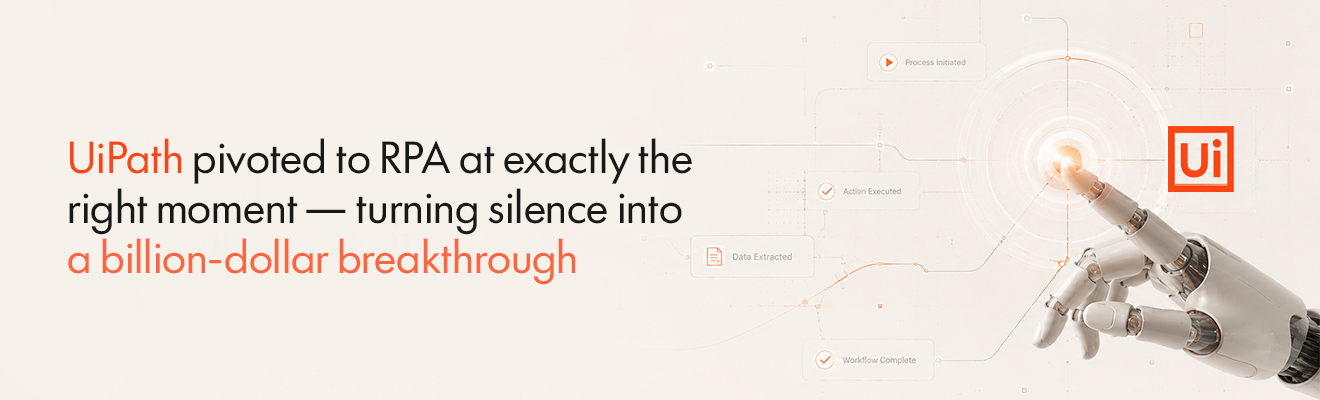
The turning point arrived when UiPath shifted its focus toward automation software, particularly robotic process automation (RPA).
Rather than providing services, they stood firm with product development.
This particular startup pivot strategy changed everything once and for all.
UiPath started developing software that could nearly mimic human actions; clicking, typing, processing data, and automating repetitive business tasks at scale.
And fortunately, the timing aligned.
- Businesses were overwhelming in manual processes.
- Digital transformation was augmenting
- Automation became important, not optional
UiPath didn’t just pivot.
They placed themselves exactly where the future was leading.
How Did UiPath Finally Take Off?
After the market caught up, UiPath’s growth was explosive.
The company began gaining momentum with enterprises seeking to automate workflows. Those investors who once ignored UiPath started competing to invest in the startup.
Several massive funding rounds followed and took UiPath closer to becoming a billion-dollar unicorn.
Expansion to other parts of the world occurred; offices appeared all over the world, from the US to Europe and other parts of the globe. The company transitioned from a quiet Romanian startup into a global automation software company.
The shift was quite dramatic:
Ignored →Funded
Unknown →Industry Leader
Struggling → Scaling Globally
The UiPath growth journey is like a textbook illustration of how timing and perseverance intersect.
How Big Is UiPath Today?
UiPath went public in 2021, transforming into one of the successful tech IPOs recently.
Today, it functions globally, serving thousands of enterprises and leading the robotic process automation (RPA) market.
Right from a small Romanian startup to a billion-dollar company, UiPath re-explained what success from evolving ecosystems looks like.
What Can Founders Learn from UiPath?
UiPath’s journey depicts that success is not always instant: it’s often about staying the course when nothing seems to work in your favor. Founders can take away strong lessons from its long road to success:
- Market timing matters as much as product quality
- Perseverance beats early hype and fast funding
- A silent building can result in powerful, lasting outcomes
- A strong startup pivot strategy can redefine your future
- Being early often seems being wrong
Why UiPath’s Story Matters for Eastern Europe

UiPath’s success is greater than just one company.
It shows the change of attitude of the world towards Eastern Europe startups.
Countries like Romania started being considered centres of producing high-tech and competitive companies. UiPath proved that innovation does not necessarily have to happen in Silicon Valley.
It further demonstrates the emergence of Romania tech companies and the rising influence of the Balkan startup ecosystem.
Thanks to software trends that are emerging, where those regions that have been ignored before now become centres of innovation.
Insights Kolekr is a platform dedicated to such success stories, where underdog ecosystems are making a comeback.
Frequently Asked Questions
1. Why did UiPath take so long to develop?
UiPath entered the market too early when businesses failed to understand RPA. It took years for demand to catch up with the product.
2. Was UiPath rejected by investors?
Yes, early investors demonstrated little interest as the market opportunity was not clear at the time.
3. How did UiPath become successful?
Thanks to persistence, strategic pivot towards automation software and following the emerging demand for RPA.
4. What does UiPath do?
UiPath develops automation software that allows businesses to automate tasks using robotic process automation (RPA).
5. When did UiPath become popular?
UiPath became popular between 2015 and 2017.
UiPath’s history can be described as persistence. After years of rejection and no recognition, the firm pivoted to robotic process automation (RPA). With the evolution of the market, UiPath rapidly developed into a global leader, proving that time, patience, and strategy can transition failure into a billion-dollar success.
The Billion-Dollar Company Nobody Saw Coming
UiPath is a great example of how sometimes silence can be more powerful than loud success. It is often built silently, in times when no one is watching, and no one believes. Years of rejection didn’t break the company; they repolished it. While others chased quick wins, UiPath chose endurance, and that made all the difference.
It showed that the fastest startup is not always the winner. Sometimes success is achieved by those who can withstand criticism and stay committed for years after everyone else quits.