From Mala Tokmachka to Crimea: Russia’s stalled push in Ukraine has triggered fuel rationing.
 Roman Pataj



Every day, the Ukraine Battlefield update newsletter offers a clear look at how the war is unfolding on the ground. Subscribe for free here to get the full text delivered to your inbox.
How Russian forces in Ukraine have ground to a halt, what they fear, and why some are starting to call for a pause in the fighting.
Do not drive on the roads; if you absolutely must, do not stop… and do not count on getting fuel at 100 percent.
The Ukrainian strike in Starobilsk really killed 21 students. Maps of the day – Zaporizhzhia axis according to Russia Videos of the day – attacks in Sjevjerodonetsk offer a reminder of how many km Russia has gained in four years of fighting; a Geran drone lands just tens of metres from farmers working in the field.
How Russian forces in Ukraine have ground to a halt, what they fear, and why some are starting to call for a pause in the fighting. Russia’s creeping advance towards Sloviansk, as well as the equally slow capture of Kostyantynivka, is indeed continuing, but the results in no way meet Russian expectations. Instead of reports of successes, Russian coverage of events at the front repeats endlessly the same village names, which they have failed to capture after weeks or even months of heavy fighting.
The situation has not been changed so far even by the onset of vegetation, the so‑called “greenery”, which Russian forces had hoped would hide their soldiers from ubiquitous drones. Invocations of this “greenery” began to appear regularly from the beginning of March. At the end of May there were no signs that the growing season was changing the nature of the fighting.
Instead of an advance, something quite different was happening. “Some villages have been mentioned in army reports for so long that they have become well known,” the Russian Telegram channel Rybar wrote. It claimed that Russia’s tactic of infiltrations by small groups of infantry had stopped working: “It no longer works as well as it used to. That largely explains why the front in most areas has simply stalled and the Russian offensive has basically ended.”
In the meantime, it described the now‑legendary village of Mala Tokmachka as unfortunate, and the battle for it as bloody.
From a Russian perspective the situation is now so serious that, until recently, unthinkable analyses are beginning to appear. One such piece was published by Alexei Chadayev, one of the public faces of Russia’s drone war. What he wrote could only be interpreted as a call to end the fighting and an admission that Russia had currently reached the end of its tether.
“If the Ukrainian war were to end tomorrow, I would be happy. I do not subscribe to the ‘until victory and the flag over the Reichstag’ approach,” he said. It is important to understand that he was no humanist, but a fanatic of Russian imperialism, who regarded a pause in the fighting only as an opportunity “(for us) to prepare for the inevitable next round”.
Chadayev praised the fact that the war with Ukraine had exposed the weaknesses of the Russian army and that now was the time to learn lessons, and in the same breath he wrote: “The SMO (special military operation) is the best thing that has happened to us in the 21st century. Because war is a great catalyst – without it, we would not have found out about all our shortcomings in time and we would have been fatally unprepared when it became really serious.”
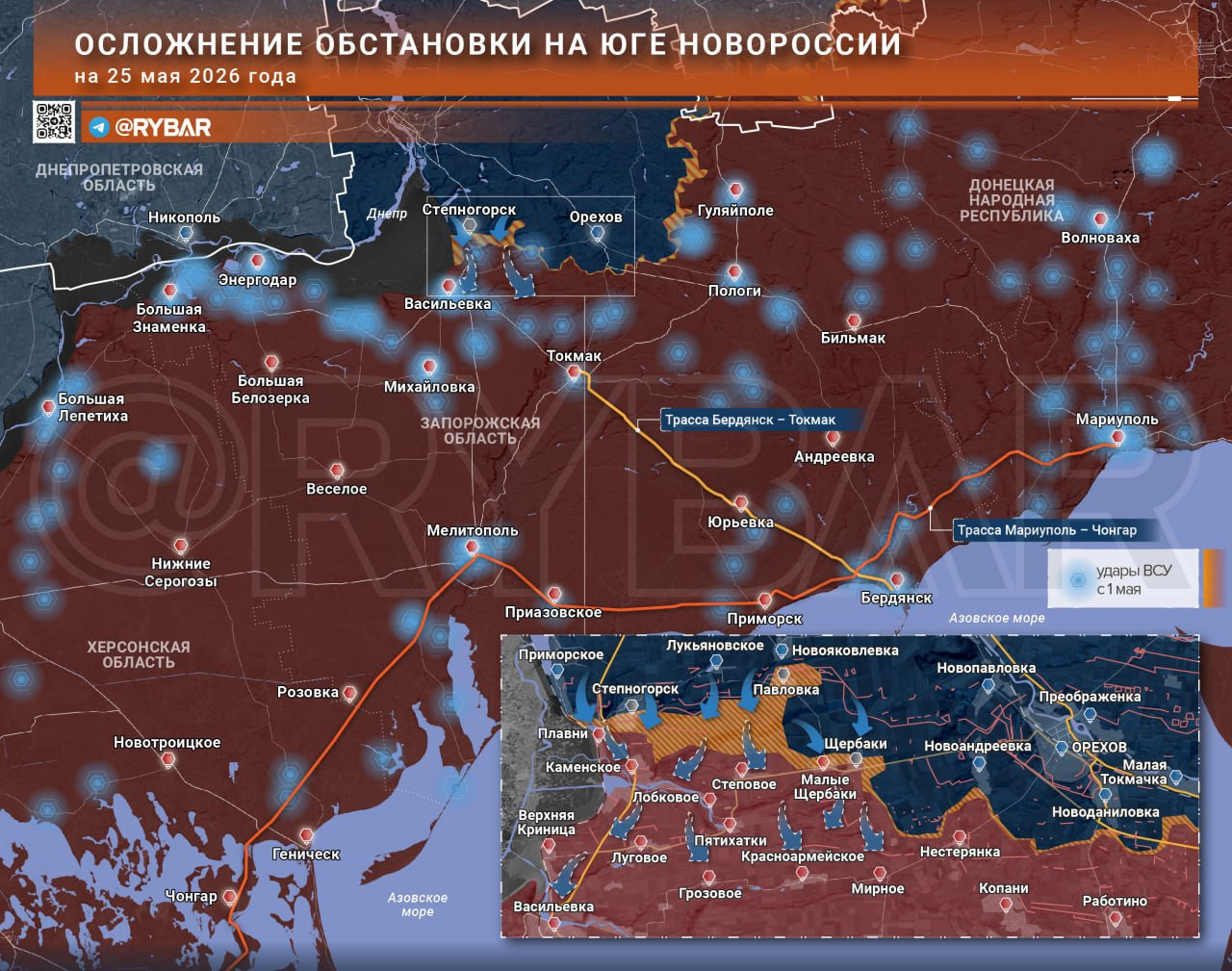
It was already serious enough now. As Rybar admitted, “the situation in the southern regions of Russia (he meant the occupied territories as well) is becoming increasingly ominous.”
In his view, not only was there a looming shortage in Crimea, but the attacks on freight carriers on the peninsula “have a direct impact on the combat capability of the Russian army on the southern front, where the situation is already uncertain as it is”. By this he meant the area south of Stepnohirske, which the Ukrainian army had just managed to liberate.
“Given that Ukrainian forces have already partially paralysed supplies via the land corridor to Crimea, it is not hard to imagine what will happen if the Ukrainian armed forces manage to break through the defence of the Russian armed forces along the Makiyanske–Shcherbaky line,” he wrote, adding his own map, on which there was a flood of blue, that is Ukrainian, arrows pointing south towards Crimea. He feared an attack on Melitopol, and his map combined real and hypothetical Ukrainian attacks with blue markers indicating the locations of drone strikes on logistics.
Do not drive on the roads; if you absolutely must, do not stop … and do not count on getting fuel at 100 percent. The puppet Russian governor of the occupied part of Zaporizhzhia region, Vladimir Saldo, had to issue instructions on road movements in the region over the weekend. Although he prefaced them with a passage about Ukrainian “terrorists” attacking civilian transport, it was in fact a response to the systematic destruction of Russian logistics on the southern front, which was still not letting up and where new cases kept being reported.
Better than videos and maps showing the impact sites, the wording of the official communication itself conveys the atmosphere, so we reproduce a large part of it:
“– Travel during the day; minimise night‑time driving as much as possible, including on route M‑14 Odesa–Melitopol–Novoazovsk from the city of Melitopol to the border between Zaporizhzhia region and the Donetsk People’s Republic, and on route M‑18 Kharkiv–Simferopol–Yalta from the city of Melitopol to the border between Zaporizhzhia and Kherson regions.
– While driving, do not play loud music so that you can hear the characteristic sound of an approaching drone.
If you realise that a drone is flying after your car:
– If it is possible to accelerate sharply, do so.
– If that is not possible, leave the vehicle immediately and move as far away from it as you can. Look for any shelter: a ditch, a ravine, trees.
– If there are passengers in the car, scatter in different directions so as not to allow the enemy to focus on a single target.
– When running for shelter, move in a zigzag pattern – this will make it harder for the drone to home in.”
– During a (drone) attack or when debris is falling, lie down on the ground, cover your head with your hands and do not get up immediately after the first explosion.”
As we have already written, the drone offensive against Russian logistics is aimed, among other things, at cutting Crimea off from the land route from Russia, which runs precisely through the occupied parts of Donetsk and Zaporizhzhia regions. Combined with strikes on Russian refineries, the effects are starting to become very visible.
“Dear residents of Sevastopol! This evening and this morning I held operational meetings on the situation with the city’s fuel supplies,” the Sevastopol governor Mikhail Razvozhayev wrote on Friday.
He did not spell out the causes explicitly, but made it clear that he and all residents knew them well: “At present there are certain logistical difficulties, the causes of which are known.”
The regime’s official then informed residents that ATAN filling stations did in fact have 92‑ and 95‑octane petrol and diesel available, “but not at all of them”.
From his description it followed that the situation was relatively good only with lower‑grade petrol, while for supplies of higher‑quality petrol and diesel “we are working on it” and “they are expected this evening”. Until then, fuel purchases were limited to 20 litres per vehicle or jerrycan.
On Saturday morning Razvozhayev reported that “we are still working on stabilising the situation with fuel supplies”. He claimed that one of the retail networks had indeed received deliveries overnight, but this was not ATAN, which was still waiting for fuel.
The crisis had not been resolved even on Monday (25 May). The governor then repeated that the restrictions remained in force and that “the Sevastopol municipal authorities are working every day on resolving the issue of logistics and fuel supplies”. In the following days he no longer addressed the topic on his personal account, mostly using it to report on repelling Ukrainian drone attacks.
The Ukrainian strike in Starobilsk really killed 21 students. On the basis of its investigation, the Ukrainian newspaper Realna Gazeta claimed this was the case. The article was written because various sources had questioned the identity of the victims, and videos had been widely circulated claiming that Russian forces had been training drone operators in the destroyed building. The Ukrainian General Staff had said it hit a base of Russia’s Rubikon unit.
Realna Gazeta is a reliable source. It was founded in Luhansk in autumn 2013, shortly before the outbreak of war in Ukraine. After the occupation of the city the newsroom moved to Kyiv, from where, thanks to its contacts in Donbas, it reports on the situation in territories occupied by Russia.
The author of the article is Elena Fetisova, who herself graduated from the Luhansk Taras Shevchenko National University. The newspaper she writes for is unequivocally pro‑Ukrainian. There is therefore no reason to look for Russian propaganda behind its findings and conclusions.
“The morning of 22 May, local Telegram groups in occupied Starobilsk were teeming with notices searching for young boys and girls: parents and relatives were looking for those missing after the strike on the dormitory of the faculty of education. They posted photographs, names and identifying features – a tattoo of a small heart on a leg, red pyjamas, a pendant with the letter K. Some of those being sought were found dead,” the article began with this paragraph, and went on to give further details.
Russian authorities published a list of 21 dead (18 young women and 3 equally young men aged 18 to 21). “The dead are real people. Their pages on VKontakte (a Russian social network) are still active, some of them are subscribed to the official group of the Starobilsk faculty of education. They posted photographs, they had friends. Now there are condolence messages there. Their names match the lists of the dead published by the Russians,” Fetisova wrote.
She also gave concrete examples with photographs and the last posts published by some of the victims.
So what actually happened? We know the names of the 21 victims and we know that the strike destroyed the dormitory of the Luhansk State Pedagogical University. The explanation may lie either in an error by Ukrainian intelligence, or in a targeting error, or a combination of both.
Russian authorities brought foreign “journalists” as well as real journalists to the scene of the tragedy. One of them noticed another destroyed building next to the hit dormitory, but the Russians did not let him in despite his request, explaining that no one had died there.
As Fetisova explained, there are two educational institutions at the site of the strike: the aforementioned pedagogical university and also the Starobilsk vocational school. They have different curricula, managements and premises, and both were destroyed. While the leadership of the university regularly reported on life there, the vocational school stopped doing so in September 2025. Realna Gazeta did not state this explicitly, but it is possible that it was in the latter institution that the Russian army was present. So far, however, there is no evidence of this. The videos circulating online that supposedly show classes in the school where 21 people were killed are not from there; they were not filmed at that location.
For now, it appears that the Ukrainian army committed its first failure of this kind. The Russian side immediately launched a huge propaganda machine, during which it ignored the fact that it had itself carried out dozens of similar attacks across Ukraine.
Videos of the day
This video is not included today because it shows something exceptional. It shows what have already become routine strikes on Russian logistics tens of kms deep in the Russian rear. What is interesting is the place from which the footage comes. Many may already have forgotten the city of Syevyerodonetsk in Luhansk region, which Russian forces captured in summer 2022, at the turn of June and July, almost exactly four years ago.
Together with Rubizhne and Lysychansk, it used to form an industrial agglomeration. Today, after years of fierce fighting and hundreds of thousands of Russian casualties, Putin’s army has managed to advance here by just under 40 km to the west. That is the straight‑line distance to the village of Ozerne in the Sloviansk direction.
A disabled Russian Geran drone falls into a field just tens of metres from farmers who were working there at the time.
What are the losses
In May, some categories of equipment were removed from the list, which is why the overall figures dropped significantly compared with previous weeks. No update since Monday (11 May).
By Monday (11 May), Russia had demonstrably lost 23,439 pieces of heavy equipment (on Tuesday (5 May) it was 23,650). Of these, 18,444 (18,618) pieces were destroyed by Ukrainian forces, 971 (976) were damaged, 1,197 (1,206) were abandoned by their crews, and 2,827 (3,182) were captured by the Ukrainian army. This includes 4,390 (4,394) tanks, of which 3,293 (3,292) were destroyed in combat.
Ukraine had lost 11,253 (11,219) pieces of equipment, of which 8,737 (8,708) were destroyed, 666 (661) damaged, 665 (666) abandoned and 1,185 (1,184) captured. This includes 1,422 (1,420) tanks, of which 1,087 (1,085) were destroyed in combat.
Note: Neither side reports regularly on its dead or on destroyed equipment. Ukraine publishes daily figures for Russian casualties and destroyed equipment, which cannot be independently verified. In this overview we use data from the Oryx project, which since the start of the war has compiled a list exclusively of visually confirmed equipment losses.