

His battlefield confession exposes a quiet network of exiled Russians funding and fighting for Ukraine, even as Moscow’s propaganda brands them traitors and insists victory in Donbas is still just months away.
 admin
admin



Every day, the Ukraine Battlefield update newsletter offers a clear look at how the war is unfolding on the ground. Subscribe for free here to get the full text delivered to your inbox.
A Russian journalist serving in the Ukrainian army. The notion that a drone pilot on the Ukrainian front sits somewhere safe, as in stories about American soldiers whose only problem is psychological trauma, is far from the truth.
The former well-known Russian journalist from the opposition television channel Dozhd, who volunteered in 2023 to fight against Russia on the Ukrainian front, knows this very well. Piotr Ruzavin is one of the drone operators whose work largely shapes the nature of the current war and has turned thousands of square kilometres of territory into death zones.
He learned first-hand that it is dangerous. He was hit once.
As he told the independent website The Insider, there was once an explosion near him when a huge half-tonne guided aerial bomb (KAB) fell within one kilometre of him, and his brain switched off his sense of fear. In the end, however, he was wounded by shrapnel from a mine.
Ruzavin’s story, in his own words, deserves a place in the Ukraine Battlefield update. He has no illusions about Russians themselves: he believes it makes more sense to fight them, and offers those living in exile practical advice on how to support his unit financially or in person.
His wife is the Ukrainian and widely known investigative journalist Natalia Humeniuk, whom Denník N has already interviewed. He decided to enlist in the Ukrainian army while on a summer trip with her in the Ukrainian Carpathians.
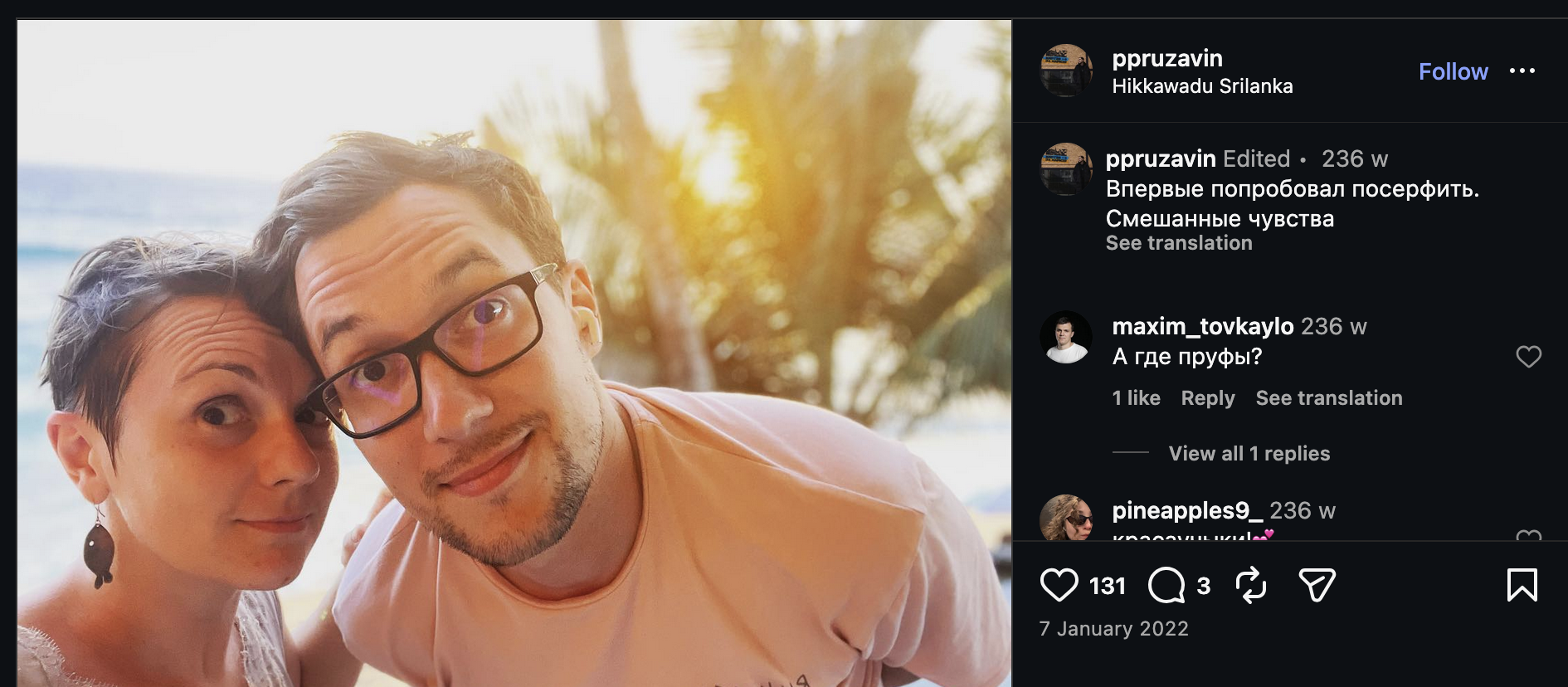 Source: Instagram/ppruzavin
He told his wife that he had several reasons for doing so. On the one hand, he has people close to him here; on the other, he is convinced that the world as it once existed has ceased to exist. And if the world has changed, he must change too, he told Suspilne.
As Masha Gessen wrote in her profile of him for the New York Times, Ruzavin wanted to fight as a resident of Ukraine, rather than as a foreigner. “While he waited for permission to join a Ukrainian brigade, he trained. He learned to shoot. He learned to operate drones. Eventually, he was permitted to join the 13th Brigade of Ukraine’s National Guard, better known as Khartia.”
In 2024, he established himself there as a drone operator on the Kharkiv front. That same summer, he was wounded.
He fell and felt a powerful electric shock in his leg, becoming afraid that it had been torn off. “But I looked — no, everything seemed to be in place. Blood just started flowing, and it was immediately clear that something had gone into it,” Ruzavin wrote.
He did not feel fear; as he said, the emotions always come later. His friend at the neighbouring position was much worse off. He suffered serious injuries, with blood flowing from his ears, but fortunately a rapid evacuation arrived in time and he was saved.
“Thank God, not only did he survive, but his brain was not damaged either; the shrapnel became lodged in his skull. One of his fingers was removed.”
According to Ruzavin, there is no great difference “between pulling the trigger of a machine gun and pressing a button on a drone controller”. It is simply much harder for an infantryman to avoid death during the endlessly long days spent at a position. A modern drone pilot, as he described it, is also on the battlefield and faces constant pursuit. In the grey zone, everyone is a target.
Why there is no point in waiting for anything to change in Russia. After two years in the Ukrainian army and following developments in Russia, he is certain. Trying to change the country through one’s own work or by defending human rights seems futile and fruitless to him. Those who fight for Ukraine, he said, are taking part in something much greater — a struggle against injustice.
Today, Ruzavin cannot imagine doing anything else.
In his “confession” for The Insider, he said that the war had not changed his identity in any way. He still considers himself Russian and sees no contradiction in that. He has accepted that he may never visit Russia again, and considers this a highly likely scenario. Most foreigners in his Khartia unit were already living in Ukraine when Russia launched its full-scale war against it.
In his view, pacifism does not work, because if there is no one to protect you, you have to take matters into your own hands. The other option is to surrender, lose and allow yourself to be killed. “Personally, I do not like violence itself, or killing itself. I take no pleasure in it. But there are no other options. In a war waged against you, there is no option other than to defend yourself.”
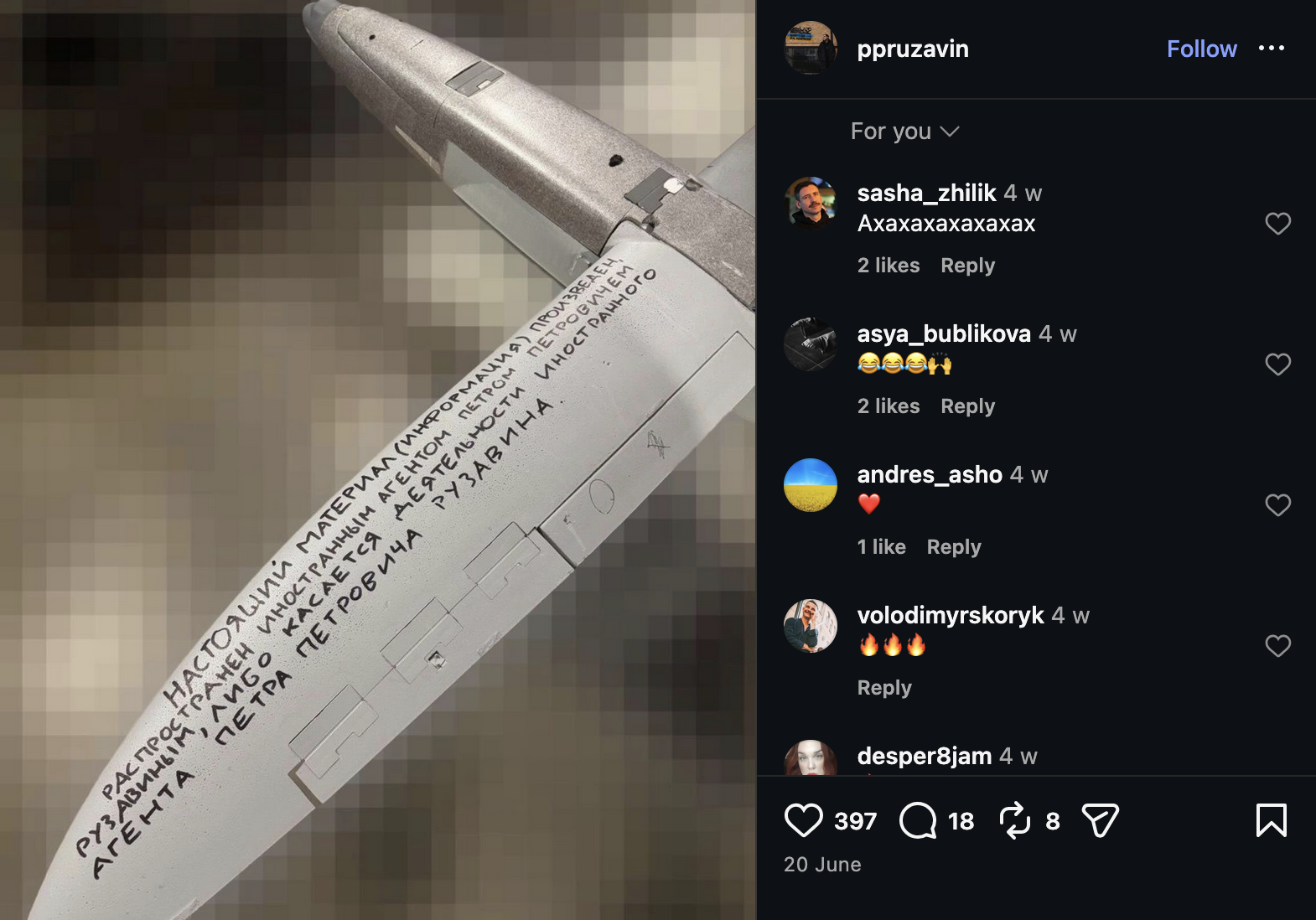
He remained true to both his journalistic profession and his sense of humour when he wrote a message on one of the drones and signed it as a foreign agent (the term Russia uses for independent journalists and non-governmental organisations). Precisely as the Russian state requires people on the list to do.
“This material (information) was produced and disseminated by foreign agent Piotr Petrovich Ruzavin, or concerns the activities of foreign agent Piotr Petrovich Ruzavin.”
Naturally, the Russian journalist sometimes also faces unpleasant reactions from Ukrainians. As he told Suspilne, when it comes to his accent, if he speaks Russian, he cannot fool anyone.
“Every Ukrainian understands from the second word that this is not Ukrainian Russian, but ‘Moscow Russian’. Once, before a church service in 2023, a man approached me in a bar and asked: ‘Where are you from?’ ‘Moscow.’ ‘I’m sorry, but that accent is killing me.’ I replied: ‘I understand.’”
However, he absolutely does not understand those who claim that a Russian cannot fight against the Russian army, even when it is waging an aggressive and unjust war. “This strikes me as a hypocritical position. It is incomprehensible and logically inexplicable,” he wrote for The Insider.
In his words, it is an ethical choice. “Fighting on Ukraine’s side is a godly cause; I had no ethical doubts about it. Unfortunately, when you take part in a defensive war, a war of protection, it does not matter who stands against you,” he told Ukrainian website Suspilne.
He thinks no one still believes Russian victory claims, recalling Kupiansk, which was repeatedly “captured” and ultimately liberated, with the help of his Khartia unit. “In reality, everyone can see that there is no advance by Russian troops, but a Ukrainian counter-advance and an increase in Ukrainian air strikes on Russian territory,” Ruzavin wrote.
And how would he act if he had the opportunity to kill Putin?
“Ah, that is the easiest question! If it were possible to kill Putin with the press of a button, I think there would be a great many such presses. There used to be a game called One Hundred to One, in which you had to guess the most popular answer to a question. I think everyone here would give the same answer,” he concluded his article for the Russian investigative website.
At some point, he internally accepted that the war would be here as long as “Putin is with us”. “And he will be with us for another 10 to 15 years. In those years, I see no opportunity for change for the better — for transforming the country or the regime’s collapse. And that is the basic minimum from which I proceed,” he told Suspilne.
Putin’s unrealistic ideas have not changed. Massive Ukrainian attacks on tankers, refineries and major warehouses of the online retailer Wildberries have so far not prompted the Russian president to reconsider his position on peace talks.
Quite the opposite. According to Bloomberg sources, Russia’s defence ministry has assured him that it can gain control of Donetsk region — and thus all of Donbas — by the end of the year.
Once that happens, the Kremlin would reportedly agree only then to return to the negotiating table. It therefore does not plan to return any occupied territory to Ukraine as part of an agreement, and wants to turn it into buffer zones.
This is another manifestation of Russian propaganda that makes no sense in light of the actual developments at the front. First, the Ukrainians rejected this idea after Putin’s meeting with Trump in Alaska, because Moscow was demanding the entirety of Donbas in exchange for border areas of Sumy or Kharkiv region anyway. That is something unacceptable to them.
Second, Russia is still unable to conquer Donbas militarily — despite the intense fighting for Pokrovsk, which is already in its hands.
According to a new analysis by the Institute for the Study of War, Russian forces have captured a total of only 81.1 km² in 2026.
The think-tank’s experts explain this partly as a consequence of the large-scale Ukrainian counteroffensive in spring and summer. According to the US organisation, Russian officials are therefore continuing to exaggerate their successes on the battlefield “to create a false reality that likely affects Putin’s understanding of the situation and encourages him to continue rejecting all concessions”.
A source close to the Russian military, meanwhile, claimed that several officials consider such statements unrealistic and that, in their view, the complete conquest of the region will not happen before 2027.
According to Bloomberg, Moscow’s new approach has been driven by Ukrainian attacks on Russian territory as well as Trump’s support for a sanctions bill drafted by the late Senator Lindsey Graham, which envisages tariffs of up to 100 percent on the largest buyers of Russian oil and gas.
Map of the day
Ukrainian attacks on shadow fleet tankers have significantly complicated the operation of Russia’s largest Black Sea port. Novorossiysk has introduced a ban on night-time anchoring and on the movement of vessels without air-defence systems.
Novorossiysk is also the main operational base of Russia’s Black Sea Fleet, which Ukrainians drove away from the area around Crimea. However, the problem also affects Kazakhstan, which had to stop oil deliveries to its main export terminal on Russian Federation territory on the Black Sea coast.
The CPC terminal attacks looked like a temporary disruption.
Kazakhstan is now stopping the pipeline to the Black Sea entirely.
CPC carries roughly 80% of Kazakhstan’s crude oil exports, and no alternative comes close to replacing it.
This is not a shipping delay.
It is a… pic.twitter.com/AcP7v8LoU9
— Jack Prandelli (@jackprandelli) July 21, 2026
The Caspian Pipeline Consortium (CPC) terminal is located near the village of Yuzhnaya Ozereevka, close to Novorossiysk. It handles approximately 80 percent of Kazakhstan’s oil exports, with more than one million barrels of oil passing through it daily.
Its 1,511-km pipeline connects the Black Sea with its oilfields in western Kazakhstan, which are operated not only by Kazakh and Russian companies but also by the US firms Chevron and ExxonMobil.
Videos of the day
Foiled Russian attack in the Sumy region. The Telegram channel Sunflower published footage of Ukrainian MiG-29 fighter jets using guided bombs to strike Russian assault groups in the border town of Tyotkino in Kursk region. The strikes were intended to prevent an attempted attack on the village of Ryzhivka.
[embedded content]
New Russian Koschei drone destroyed. In the same direction towards Sumy, Ukrainian units from the 47th Brigade’s Sky Hornets destroyed a new type of Russian Koschei bomber drone, equipped with an electric motor and a camera in the rear section of its fuselage.
Pointless flag operation. French blogger Clément Molin analyses a new video showing a Russian soldier 15 km from the front line. According to him, such cases occur regularly and at much greater distances too — sometimes as far as 80 km — when soldiers lose their way while attempting to infiltrate. Such infiltrations have minimal significance and usually do not end well for the soldiers.
However, they serve Russian propaganda. As Molin said, we should realise that we see less than five percent of what happens at the front every day. No map that depicts such operations even as a grey zone should be taken seriously.
Again, a video of a lone Russian soldier with a flag, more than 15 km from the front.
This happens regularly, especially on some directions. Sometimes, lost russian soldiers are found 20, 50 or even 80 km from the front, after they lost themselves during an infiltration attempt.… pic.twitter.com/Xqn9J3Gmgc
— Clément Molin (@clement_molin) July 22, 2026
One Buk-M3 less. Ukrainian Fenix border units in Donetsk region destroyed a Russian air-defence system that was heading towards the front without camouflage. A system of this kind shot down flight MH17, carrying 298 people, in the summer of 2014, for which an international investigation ultimately blamed Putin himself. The Buk is estimated to cost $50m.
What are the losses
No change on Thursday.
By this morning, Russia had demonstrably lost 23,888 pieces of heavy equipment (23,837 on Friday). Of these, Ukrainians destroyed 18,866 (18,815), 993 (993) were damaged, 1,199 (1,199) were abandoned by their crews, and the Ukrainian army captured 2,830 (2,830). This includes 4,430 (4,427) tanks, of which 3,332 (3,329) were destroyed in combat. Ukraine lost 11,781 (11,690) pieces of equipment, of which 9,205 (9,123) were destroyed, 694 (689) damaged, 689 (687) abandoned, and 1,193 (1,191) captured. This includes 1,450 (1,443) tanks, of which 1,111 (1,104) were destroyed in combat.
Note: Neither side regularly reports on its own fatalities or destroyed equipment. Ukraine publishes daily figures for Russian casualties and destroyed equipment, which cannot be independently verified. This overview uses data from the Oryx project, which has compiled a list of equipment losses documented exclusively by photographs since the start of the war.