Ukrainian drones are quietly mauling Russia’s Azov fleet and missile industry even as a single mis‑sited ammunition depot in Vyshneve shows how one strike can turn a Kyiv neighbourhood into a toxic war zone within minutes.
 Roman Pataj



Every day, the Ukraine Battlefield update newsletter offers a clear look at how the war is unfolding on the ground. Subscribe for free here to get the full text delivered to your inbox.
They cannot be shot down, so they must be eliminated differently – two ways Ukraine is trying to neutralise Iskanders. The story of the Kyiv suburb of Vyshneve – in the capital, Russia really is striking military targets. Drones have already hit almost one third of the Russian fleet in the Sea of Azov. In Lviv, some two hundred people attacked draft officers; Ukrainian mobilisation is stirring anger. Attacks on Ukrainian petrol stations continue; 200 have already been hit since the start of the year. Ukraine claims to have liberated a village on the border of Dnipropetrovsk and Donetsk regions. Russia has unveiled a new T-72 tank with active protection. Maps of the day – the liberated village Videos of the day – unrest in Lviv; attacks on Ukrainian petrol stations; two Russian drones hunt one Ukrainian drone; bloody logistics near the frontline
They cannot be shot down, so they must be eliminated differently – two ways Ukraine is trying to neutralise Iskanders. These ballistic missiles are already a major problem today. If it cannot be solved, Ukrainian cities face an even harsher winter than the last one. After recent raids on the capital, the Ukrainian army reported each time that it had failed to shoot down a single Iskander ballistic missile. The Ukrainians have made it clear that they have run out of interceptor missiles for their Patriot air-defence systems and are desperately trying to obtain new ones.
However, this is not easy because global stocks were sharply depleted after the US war in Iran and the production of new missiles is slow.
The Ukrainian army is therefore working to mitigate the threat ahead of the approaching winter, during which Russia will certainly again bomb power plants. This is happening in two ways: through systematic attacks on the Iskander production chain and through advances in electronic jamming.
As for destroying factories, since March Ukrainian drones have struck and to varying degrees damaged six plants in the cities of Bryansk, Zelenograd, Cheboksary, Voronezh, Volgograd and Penza.
As United24 wrote, each attack followed the same logic: rather than shooting down missiles in flight, limit the ability to produce them. In July alone, Russia fired 50 at Kyiv. The targeted factories produced various components, from launch systems to microelectronics. The plants in Voronezh and Volgograd suffered very serious damage. Given their specialisation, they will not be easy to replace.
The second tool is an electronic jamming system. While you are in Ukraine, your navigation often shows that you are in Lima in South America. The system in question was named precisely after this city. As the website Militarnyj explained, the Lima system simultaneously produces several forms of electronic jamming. It targets the supersonic Kinzhal missiles launched from specially modified MiG-31 aircraft, thanks to which 61 of these weapons have been neutralised.
The story of the Kyiv suburb of Vyshneve – in the capital, Russia really is striking military targets. Any destroyed civilian target and any dead civilians are the consequence of Russian aggression, and therefore responsibility lies with Russia. This applies regardless of whether the tragedy occurs as a result of intent, inaccuracy, falling debris from intercepted missiles, or electronic jamming. Of course, that does not mean Russia has any right to attack even military targets in the country it invaded, but that is beside the point for now.
Even after the latest attacks on Kyiv, claims have appeared that Russia is striking only civilian targets in order to terrorise the population. Immediately after the raid from 6 to 7 July, we published in the Ukraine Battlefield update a video showing a large explosion. It was followed by secondary detonations, a clear sign that a military target had been hit. It is now known that this was the Kyiv suburb of Vyshneve. The Ukrainians confirmed that they had an ammunition depot there and launched an investigation into how this was possible, since it is an unacceptable practice prohibited under the laws of war.
In a video shot near the depot, you can see exploding ammunition landing on surrounding family houses. You can see the consequences in the main photo.
Зеленський заявив, що об’єкт у Вишневому, який уразили під час російського обстрілу, був складом боєприпасів «Укроборонпрому».
Про це він сказав під час спілкування з журналістами
Відео: hromadske pic.twitter.com/EegOd0BzhP
— hromadske (@HromadskeUA) July 9, 2026
The consequences for the neighbourhood are catastrophic. The website Hromadske reported that seven people were killed, 26 were wounded and about 100 buildings were destroyed. Hundreds of residents had to be evacuated, and the air remained acrid for hours after the incident. One resident told reporters that shortly after the explosion no one was extinguishing the fire because shrapnel was flying through the air.
Several residents moved into their basements, but had to flee when smoke penetrated them and they began to suffocate.
Drones have already hit almost one third of the Russian fleet in the Sea of Azov. On Friday morning, the website Defence Express wrote that within 96 hours from the start of the operation, Ukrainian medium-range drones had struck 35 Russian naval vessels of various types in the Sea of Azov. Based on intelligence on the size of the Russian fleet, this represented at that time 27.5 percent of its total strength. On Friday late morning, further reports of attacks followed, after which it was already possible to speak of one third of the vessels having been hit.
Russian sources continue to criticise the passivity of the Black Sea Fleet, which is hiding in the port of Novorossiysk. The Telegram channel Dvaja majori also pointed out that even cargo ships were unprepared for their own defence, and therefore footage from the drones shows no signs of defensive fire.
The author also admitted that the Russian army lacks the personnel needed to protect the ships. Part of the forces that could defend vessels at sea is tied down guarding the Kerch bridge, and it “remains unclear” where the units designated to protect the ports are.
In Lviv, some two hundred people attacked draft officers; Ukrainian mobilisation is stirring anger. First, a video from the incident in the western Ukrainian city, to make it immediately clear that this was not a minor scuffle but a serious event:
An angry crowd attacked a car carrying mobilisation and police officers. According to the Kyiv Independent, there were about 200 people involved. The newspaper quoted the head of the Ukrainian Security Club, Yuriy Honcharenko, who warned of serious consequences. In his view, this may be a sign that the long-running mobilisation crisis may no longer be only a political and social problem, but also a security one.
“Without an adequate response, it could pose a threat to national security. This is a test for the authorities and the police – a test of the state’s ability to respond to such events,” Honcharenko said.
The authorities reported that two mobilisation officers were lightly injured in the attack. It occurred after they asked a 30-year-old man, who was on a wanted list, to show his documents. He agreed to go with the officers, but at that moment the crowd surrounded one of the vehicles and attacked it.
On Telegram, a video is circulating showing the alleged perpetrators, mostly young men and teenagers, who were forced to shout “Slava TCK!” TCK is the abbreviation for mobilisation offices.
Attacks on Ukrainian petrol stations continue; about 200 have already been hit since the start of the year. Most have been struck in Sumy, Kharkiv, Donetsk, Dnipropetrovsk, Zaporizhzhia and Mykolaiv regions. The systematic campaign began in March and in recent weeks has been expanding deeper into the Ukrainian rear. For example, Russia has already destroyed several petrol stations in Kyiv region as well. According to the Ukrainian website United24, they are currently hitting on average 20 per week.
One such attack took place on Thursday in Zaporizhzhia. One person was killed and three were injured. The station was destroyed, as were several cars that were there at the time of the strike.
🚨 BREAKING: Russian drone attack on Zaporizhzhia gas station kills one and wounds three
A Russian drone strike on a gas station in Zaporizhzhia today killed one person, injured three others, and destroyed the facility along with several vehicles, according to regional… pic.twitter.com/ZOWdZioEH1
— UNITED24 Media (@United24media) July 9, 2026
In the second video on the same topic, the location is Sloviansk. The frontline is now only about 10 km away, and the petrol station was protected by an anti-drone net. However, the drone flew under it and likely ignited an LPG tank.
A video showing the moment when a Russian FPV drone struck fuel tank on the territory of a gas station in the city of Slovyansk, Ukraine’s Donetsk Oblast, in the early hours of July 9.
The station can be seen being covered with anti-drone nets, although it didn’t stop a smaller… pic.twitter.com/k8yxqfIEvX
— Status-6 (War & Military News) (@Archer83Able) July 9, 2026
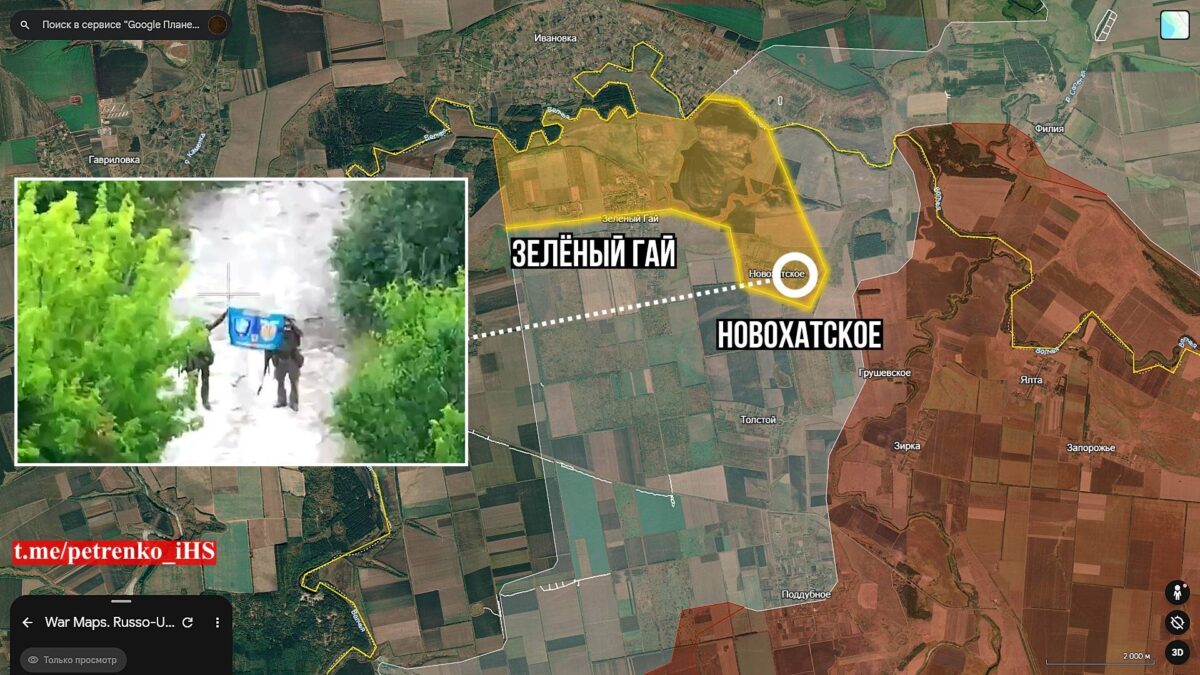
Ukraine claims to have liberated a village on the border of Dnipropetrovsk and Donetsk regions. It is called Novohatske and lies roughly 44 km west of Kurakhove and 24 km north-west of Velyka Novosilka. Both of these towns are known for heavy fighting over the years.
In recent weeks, the Ukrainians have been advancing slowly in the area. On a map by Ukrainian analyst Petrenko there is also a still from a video in which two soldiers hold up a flag as proof that they control the village. Russia has confirmed nothing of the sort, so it cannot be ruled out that this is similar to its own “flag-raising” operations.
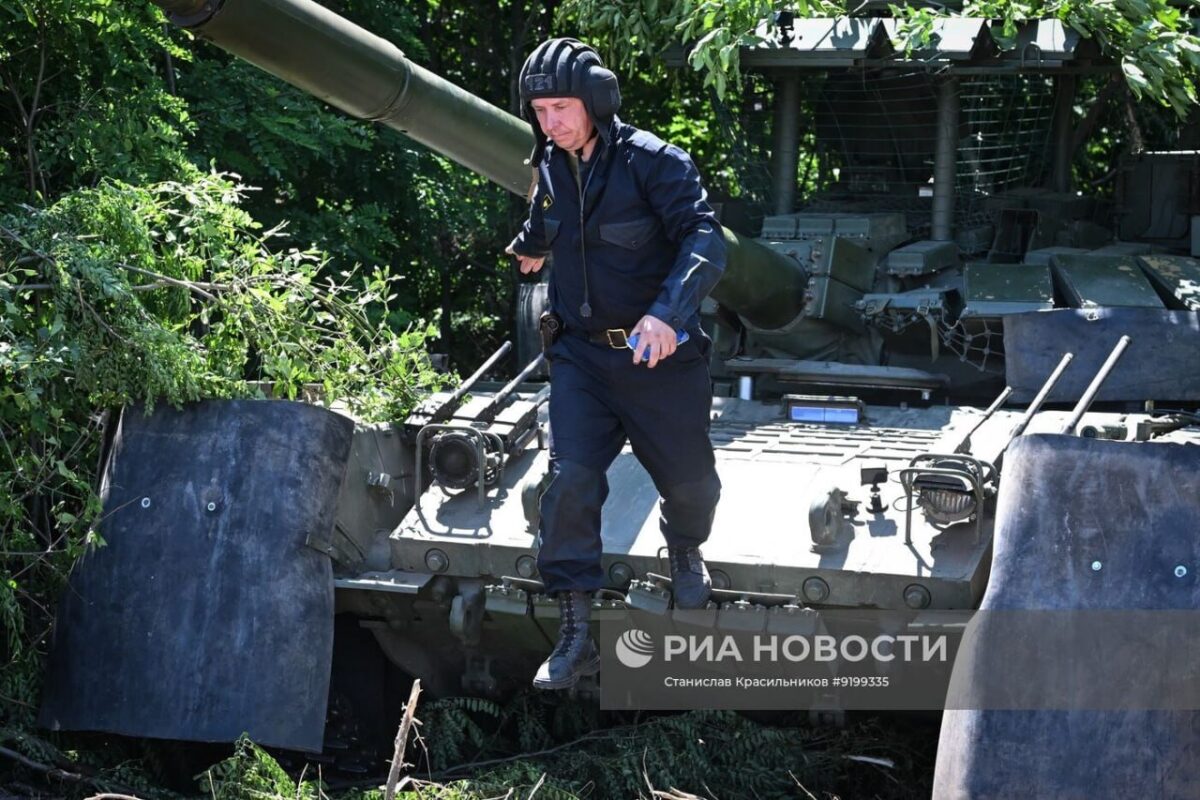
Russia has unveiled a new T-72 tank with active protection. Heavy armour will not return to the frontline until its protection against drones is resolved to an acceptable degree. The so-called “turtles” have turned out to be a dead end – Russia’s answer in the form of tanks wrapped in steel plates resembling barns, later reinforced with rebar rods and bundles of wire.
The Ukrainians have used – and still use – similar improvised solutions, but this is not enough for any army to dare to send this type of equipment to “point zero” in large numbers.
A more promising solution is so-called active protection. It consists of sensors and a counter-weapon that destroys certain types of incoming munitions, and work is under way to make these systems effective also against drones attacking from above.
The newest Western models are being fitted with active protection. The Slovak and Czech armies’ CV-90 combat vehicles will have it as well. Naturally, both Ukraine and Russia had been working on such systems long before February 2022, but neither army reached a stage where it had effective active protection against drones.
Russia has now shown a T-72B3A tank equipped with a modernised system:
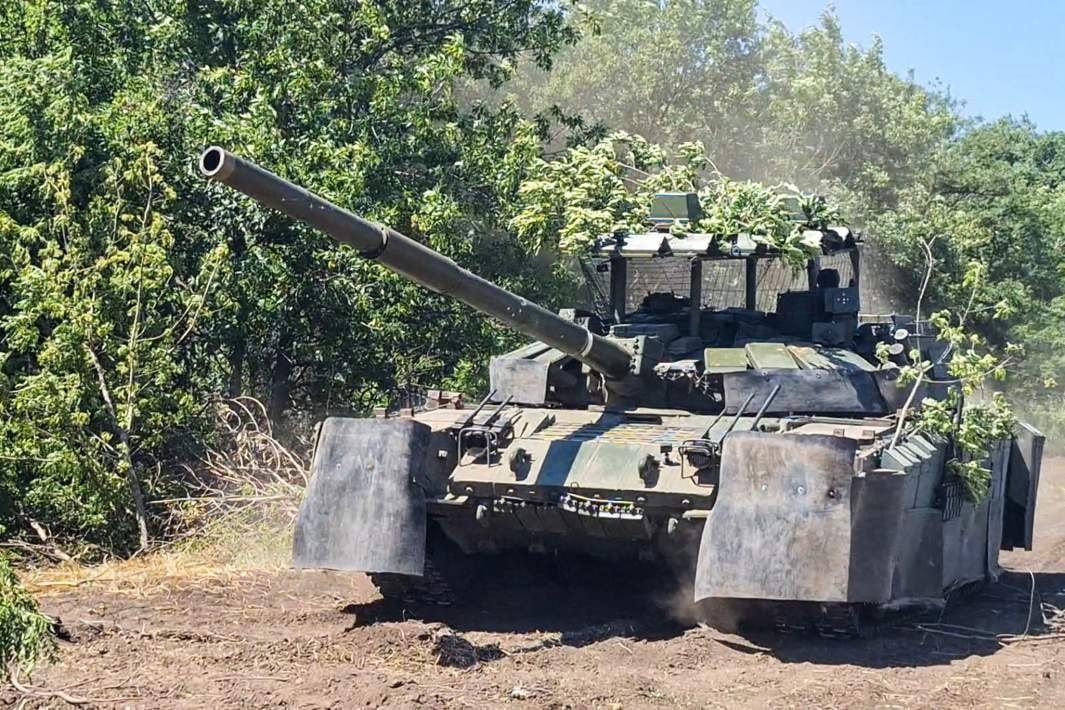
Russia claimed that the tank is already on the battlefield, specifically at an unspecified location in Dnipropetrovsk region.
According to a Russian infographic, the system can be used on the T-72B3A, T-80BVM and T-90M types.
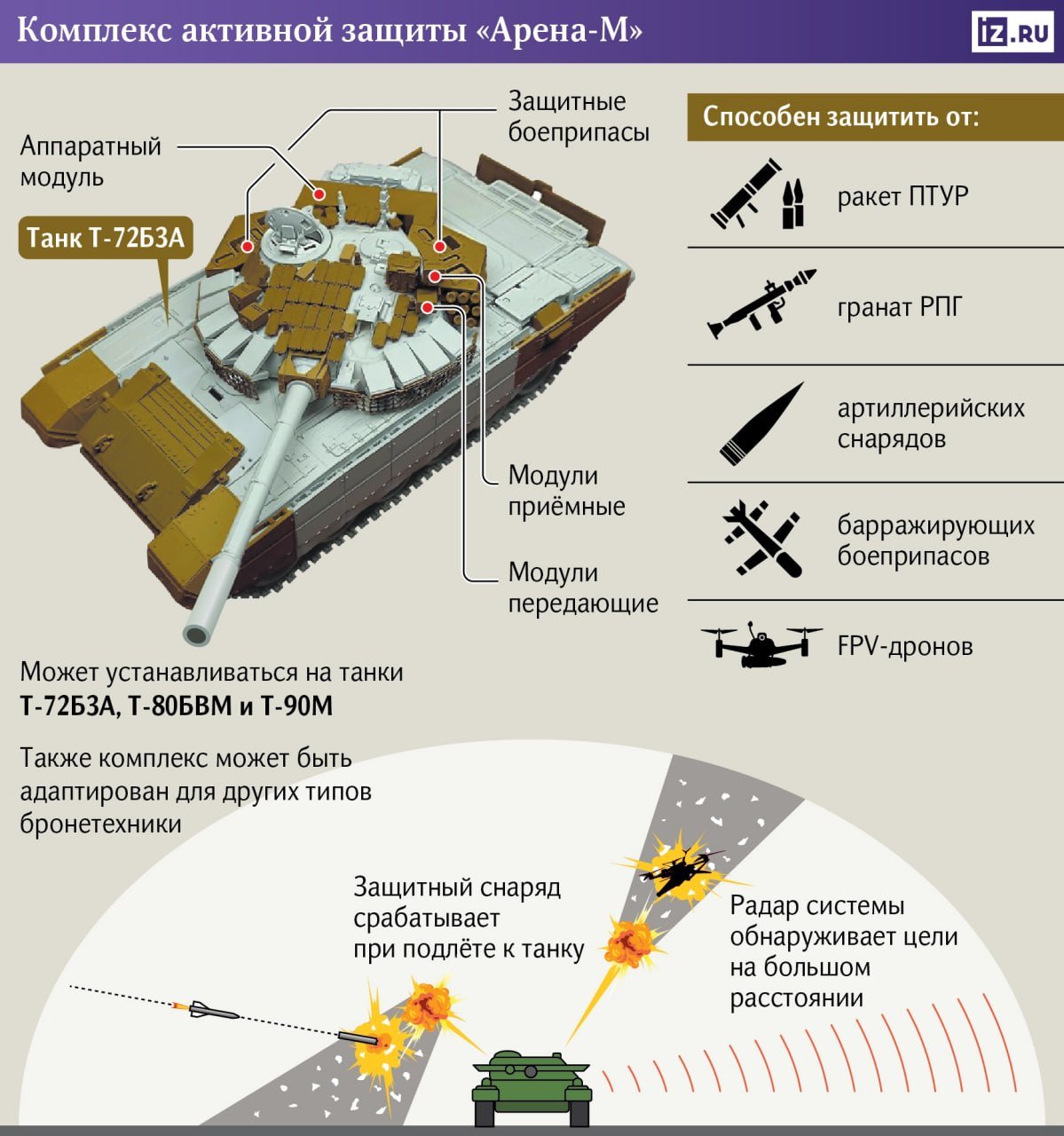
Nothing is yet known about its effectiveness, nor can it be confirmed that it has actually been used in combat.
Videos of the day
An illustration of what countermeasures have been triggered by successful Ukrainian medium-range drone attacks. It is only a three-second clip, but it shows two Russian drones trying to destroy the threat.
🤯 Flash: So that you understand the conditions in which our pilots are currently operating on middle strikes.
The enemy has organized a large-scale hunt, during which one of our UAVs is attacked by at least 2–3 interceptors pic.twitter.com/Csr7KYZxsk
— MAKS 26 🇺🇦👀 (@Maks_NAFO_FELLA) July 9, 2026
Warning – the video contains graphic footage. It shows a wounded Ukrainian soldier being pulled from a pickup destroyed by a drone, while men keep watch in expectation of another incoming threat.
In the Donetsk region, a Ukrainian vehicle came under enemy fire and support came to evacuate and help.
Video ℹ️ U24 pic.twitter.com/uUEocauOCw
— Ukraine War Now ✙ (@uarealitynow) July 9, 2026
What are the losses
No update on Friday.
By Tuesday (7 July), Russia had demonstrably lost 23,806 pieces of heavy equipment (on Tuesday, 23 June, it was 23,668). Of these, 18,785 (18,686) pieces were destroyed by Ukraine, 992 (988) were damaged, 1,199 (1,199) were abandoned by their crews, and 2,830 (2,830) were captured by the Ukrainian army. This includes 4,424 (4,404) tanks, of which 3,327 (3,310) were destroyed in combat.
Ukraine has lost 11,683 (11,546) pieces of equipment, of which 9,068 (9,011) were destroyed, 687 (687) damaged, 683 (677) abandoned and 1,191 (1,189) captured. This includes 1,440 (1,437) tanks, of which 1,101 (1,099) were destroyed in combat.
Note: Neither side regularly reports its dead or its destroyed equipment. Ukraine publishes daily figures for Russian casualties and destroyed equipment, which cannot be independently verified. In this overview we use data from the Oryx project, which since the start of the war has compiled a list of equipment losses documented exclusively by photographic evidence.