Norway is pushing Brussels to rethink its long-standing opposition to oil and gas development in the European Arctic, pushing the EU into reviewing its strategy. But would it meaningfully increase Europe’s energy security? And at what environmental cost?
 admin
admin



The EU is reviewing its Arctic strategy — at a point in time when it is facing the largest oil supply disruption in history.
Almost three months after the US-Israeli attack on Iran, the Strait of Hormuz remains effectively shut, with no clear diplomatic solution in sight.
Against that backdrop, Norway is pushing Brussels to rethink its long-standing opposition to oil and gas development in the European Arctic.
In submissions to the EU’s public consultation on its Arctic policy, which closed in March, Norway’s Equinor and a lobby group backed by Shell, TotalEnergies and ConocoPhillips also urged the EU to drop the effective ban on Arctic drilling.
The commission says that it had “taken note” of these views, but that talks are still at an “early stage” and that “no conclusions” have been drawn.
It also insists it remains committed to its 2021 Arctic strategy, which calls for oil, coal and gas to “remain in the ground” in the region.
But if the Middle East crisis drags on into the autumn review, pressure to shore up new sources of supply may start to count.
The question, however, is whether dropping opposition to Arctic oil would meaningfully increase Europe’s energy security, and at what environmental cost.
‘Symbolic’ only?
“It feels like it would probably be more symbolic than anything else,” said Greg Roddick, upstream analyst at Wood Mackenzie, when asked what a policy reversal would mean in practice for investment and drilling activity.
“No EU member really has any direct Arctic territory to be drilled,” said Lewis Lawrence, also an analyst at Wood Mackenzie.
The countries that do are Norway and Greenland, and they operate outside EU jurisdiction. Norway is not an EU member.
Greenland, though associated with Denmark, holds autonomous mineral rights and does not require Danish or EU permission to drill.
A policy shift might lower the cost of capital, unlock financing, or signal to international oil companies that the region is open for business, but this effect would be small.
“There’s not going to be a rush of companies looking to explore in EU Arctic waters because it’s really up to the Norwegians,” said Roddick.
The companies already operating in the Barents Sea, chiefly Equinor and Aker BP, are state-adjacent Norwegian players and would lead any further exploration, according to the analysts.
“They know the shelf inside out,” Roddick said. Both analysts see little prospect of a wave of international oil majors heading north, even if the EU shifts its stance on Arctic oil and gas.
What is the definition of ‘the Arctic’?
Still, a EU policy reversal could keep Norway’s oil and gas fields open for longer, Norwegian energy think tank Rystad argued in a paper published in February.
Instead of dropping its opposition to Arctic drilling altogether, the group suggests the EU could “narrow” its definition of the Arctic, distinguishing between Norway’s already licensed Barents Sea fields and frontier areas further north.
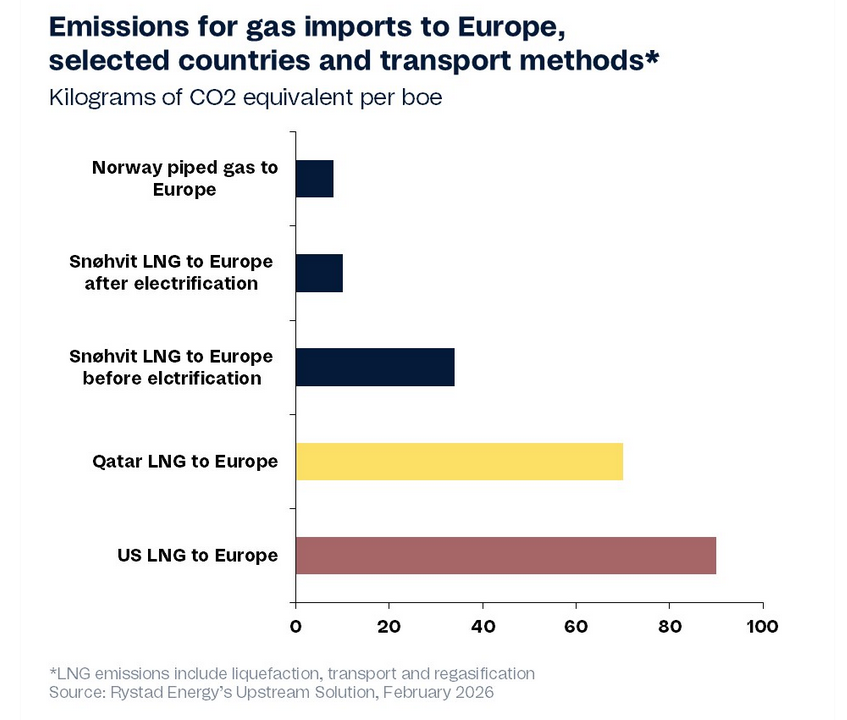
This could keep Norway’s offshore oil and gas “in play” into the 2030s, the think tank says, “offering Europe a nearby, low-emissions supply option”.
Norwegian officials have long argued that the Barents Sea is not “the Arctic” in any meaningful environmental sense.
It is ice-free, warmed by the Gulf Stream, and already hosts three major oil and gas sites, including the Goliat and Johan Castberg oil fields, and the Snøhvit LNG facility at Hammerfest.
“There are no icebergs or polar bears in the Barents Sea,” a senior Norwegian official told the FT last year. “Yes, it’s north of the Arctic Circle but it’s not Arctic as most people consider it. We have pushed the EU for years and years to concede this.”
“If they want to help themselves,” Tore Guldbrandsøy, partner at Rystad, told EUobserver, referring to EU policymakers, “they should incentivise it, then it is up to Norway and oil and gas companies to take the risk.”
“Lead times in the Barents Sea are long, so clear policies matter,” he also said.
Cost estimates ‘out of control’
The biggest obstacle to Arctic oil and gas development are economic and geological, not political. Barents projects typically take five to 10 years to move from discovery to steady output.
That means the EU’s policy decision will not change the current energy picture, but influence what might be coming online in the mid-2030s.
The most significant undeveloped project in the Norwegian Barents Sea is the Wisting oil field, discovered in 2013, and operated by Equinor and located significantly further north than existing fields.
Opening up this field would significantly increase future Norwegian oil supply. But the financial challenges have so far proven too great.
In 2022, Equinor effectively postponed the development after the cost estimate climbed to over 100 billion Norwegian kroner — roughly €9.3bn — which the company concluded was not economic for a field of that size.
“Cost estimates got out of control,” said Roddick.