Shaped by a childhood marked by standing up to bullies and a political career defined by pragmatic shifts, Mette Frederiksen is now using Denmark’s influence to advocate for a more assertive and self-reliant Europe.
 Silvie Lauder



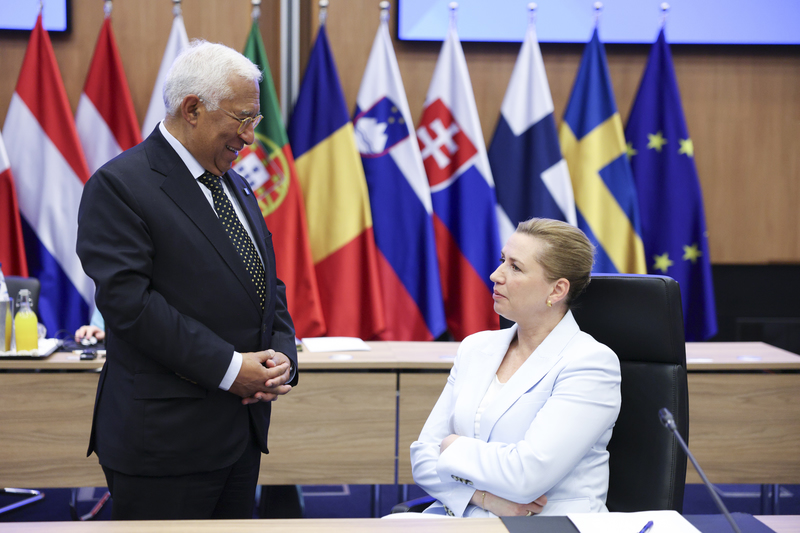
A portrait of the Danish prime minister who has found an unusual recipe for keeping her country on a liberal course.
When, around the turn of the year, Politico drew up a ranking of politicians who would have the greatest impact on events in Europe this year, the podium brought a surprise. Not because American president Donald Trump sat on the very top, but because right behind him came the prime minister of a state with only six million inhabitants, whose weight in international affairs an uninformed observer would probably not bet on.
According to Politico’s editors, it is precisely Danish prime minister Mette Frederiksen who has an effective recipe for the various problems of today, and who also has the combative, bulldog-like nature that is necessary in difficult times.
And that is not only with regard to the ongoing war in Ukraine, but also because it was this 48-year-old Social Democrat who was not intimidated by Trump’s strongman style of politics and who is, together with German chancellor Friedrich Merz, the main driving force behind the changes enabling Europe to stand its ground in the new reality.
The Danish politician is far from a picture-book heroine, but it seems that this year will belong to Mette, as she is known at home.
I won’t be a journalist, I will be a politician
The life story of the woman currently recognised as the most influential European politician sounds as if it had been invented by a political marketer. She was born into a family of a typesetter and a teacher with a long tradition of trade union and Social Democratic membership, which in the end was nothing unusual in her native Aalborg.
Denmark’s fourth-largest city lies in the country’s northernmost region and its nickname, “the city of smoking chimneys”, refers to a long tradition of heavy industry that flourished there in the 19th and 20th centuries. Many people in Aalborg were born into similar families, but few showed such zeal for public affairs as early as little Mette.
While her brother Per, five years older, was playing football with the boys outside, his “annoying little sister” sat in the living room talking about current events with their father and grandfather, both of whom held positions in local politics.
When one of Per’s friends teased the girl that she should become a journalist, since she talked so much and wanted to be everywhere, the little girl reportedly replied firmly that she had other plans – she would become a politician. “She could not have been more than seven at the time,” Per Frederiksen recalled in an interview with the Danish daily Politiken, published last summer. “Her fight against injustice started early, very early.”
She started early and was interested in many causes: she organised petitions for a ban on testing cosmetics on animals, raised money for endangered snow leopards and for the World Wide Fund for Nature. From leopards and whales she then moved on to the South African anti-apartheid fighter Nelson Mandela, who was still in prison in 1989.
Mette Frederiksen did not stop at words, however; at the age of twelve, she joined the international youth organisation of Mandela’s political party, the African National Congress. “In Denmark it was common at the time to support Mandela,” the prime minister recalled in an interview for the August issue of last year’s British edition of fashion magazine Vogue. “But I do not think there were many other twelve-year-old girls from Northern Jutland who joined the African National Congress.”
Nor was it at all common at that time for girls from Northern Jutland to set off alone to Africa, which Mette did at the age of eighteen, when she spent a full year in Kenya and has remained in friendly contact to this day with the family she lived with then.
When she returned home at 19, she headed south towards Copenhagen and, in her brother’s words, “she never came back to Jutland”. Per Frederiksen did not mean it literally, but rather as an expression of his sister’s great ambitions and openly declared goals, which stood out all the more in comparison with his own life.
He himself now leads a quiet life in Aalborg, although his previous twelve-year stint in the army also took him out into the world, on missions in the Balkans or in Iraq. “She was the most persistent and the most stubborn in the whole family, she could argue brilliantly and stand up for her positions,” Frederiksen said of his sister in an interview with Politiken, and he did not hide that these traits sometimes irritated him. “The two of us are like fire and water.”
Commitment to a cause, undisguised political ambition and unsentimental directness and combativeness later brought Mette Frederiksen to the political summit, but they are also qualities that irritated not only her brother.
“Some accuse her of being magtgal — power mad,” wrote the website Politico in a profile accompanying the aforementioned ranking of the most influential movers of European affairs.
But it would be a mistake to think that this makes the Danish politician an arrogant ruler of the pompous, out-of-touch type.
“Mette has a very strong will and is not afraid to show that she is powerful, she is not afraid to make decisions. That makes her a polarising personality, especially when a woman behaves like this,” Elisabet Svane, a political commentator at Politiken, explained to Respekt. “At the same time, however, she is very popular with people. She is close to them, she can talk to anyone.” Svane illustrated this with a scene she once observed as a journalist: when Mette, already as prime minister, visited her native Aalborg, it took her three hours to walk through the town’s famous Jomfru Ane Gade, a street lined exclusively with bars, clubs and pubs, often filled mainly with young people.
And that was because of the number of people who wanted to stop and have a chat with her. The close relationship to the prime minister is also evidenced by the fact that almost no one talks about her as “Madam prime minister” – she is simply Mette.
Mette doesn’t think so any more
When, at 19, the determined young woman with a passion for politics arrived in Copenhagen, she quickly began to turn her big goals into reality. At 24 she took her seat for the first time on the benches of the Danish parliament, as one of the youngest members ever. At the same time, Frederiksen was finishing her university studies and expecting her second child.
Given the family tradition, her involvement in trade unions and in the youth organisation of the Social Democrats, she represented precisely this traditional left-wing party there. Ten years later she entered the government of Denmark’s first-ever woman prime minister and her party leader, Helle Thorning-Schmidt. She first served as minister of labour, later moving to the justice portfolio.
It was precisely during her time in these two ministries that, according to her later explanation, a dramatic change in her positions on certain issues took shape, especially regarding the previously welcoming migration policy of the Social Democrats. Here the dream of the imaginary political marketer ends and a twist begins that complicates the neatly plotted story of a young left-wing politician from a traditionally working-class background.