Telegram posts and satellite images reveal a cat‑and‑mouse war of sabotage and improvisation, with Ukrainian planners timing bridge hits to catch Russian engineers mid‑construction.
 Tomáš Vasilko



Every day, the Ukraine Battlefield update newsletter offers a clear look at how the war is unfolding on the ground. Subscribe for free here to get the full text delivered to your inbox.
Ukrainians recently destroyed two bridges near Mariupol. The Russians are replacing them with pontoon bridges and embankments. Russia has to import petrol from India, Kazakhstan and Belarus, which will cover only part of its consumption. Kyiv experienced one of the heaviest attacks in many months. Maps of the day: Russian gains were only marginal and, if we include non-public information about Ukrainian advances, then negligible. Chart of the day: Sites where Russians attacked Ukrainian petrol stations. Videos of the day: A Hornet drone hits a locomotive; instructions on how Russian soldiers should surrender to Ukrainian drones.
We have already written in this series how difficult it is to destroy bridges. And it is even harder if, like Ukraine, you do not have enough missiles and rely mainly on medium- and long-range drones for your attacks.
In recent days, however, Ukrainians have managed not merely to damage but to outright destroy two bridges in the vicinity of Mariupol. Photographs show that repairs will be demanding, at least in the second case.
First, Ukrainians struck a bridge in Novoazovsk. This is a town between Mariupol and Russia, on route R-280, which is a land corridor from Russia to Crimea through occupied southern Ukraine.
The photographs suggested that the Russians would not repair the bridge any time soon.
Ukrainian attack drones successfully destroyed the E-58 highway bridge in Novoazovsk, dropping the main deck into the Hruzkyi Yelanchyk River.
Ukrainian forces continue their campaign to destroy bridges on Russian rear-area supply routes, knocking down several over the past week pic.twitter.com/tLvIZQGGCd
— OSINTtechnical (@Osinttechnical) June 29, 2026
Footage of even greater destruction arrived on Wednesday and showed a bridge over the river Malyi Kalchyk (Russians call it Kalka). It is a four-lane highway bridge that carried the main road from Mariupol to the city of Donetsk. Photos and videos showed that an entire section of the roughly 90-metre bridge had collapsed in both directions.
As wrote Petro Andriushchenko, former adviser to the Ukrainian mayor of Mariupol and now head of the Centre for the Study of Occupation, these were new bridges that the Russians had built and repaired.
“I would like to send my regards to the fuc… idiot who said it made no sense to attack bridges,” the Russian account Romanov Lajt wrote.
More interesting is how the Ukrainians destroyed the bridge. Although there was initial speculation that they had used a cruise missile, the Russians found debris from FP-2 drones at the site.
Denys Shtilierman, the owner of the company Fire Point, which manufactures these drones, published an image of the bridge with the caption “3FP2”, indicating that the bridge was destroyed by three of his drones.
Back in May, Shtilierman told Ukrainian media that the FP-2 drone, designed mainly for medium-range strikes, had been upgraded to carry up to 200 kilograms of explosives and to fly a distance of 370 km.
“We changed the wing, and now the FP-2 in its largest version can carry 200 kg over a distance of 370 km – it is a kind of cheap replacement for a guided bomb,” Shtilierman said.
Two hundred kilograms already makes the drone a powerful weapon. For comparison, Russian Gerans can usually carry about 40 to 90 kg of explosives. Storm Shadow missiles, which are much more destructive, carry a warhead of about 450 kg, meaning the FP-2 currently has roughly half the destructive power of this expensive British weapon.
By increasing the weight of the warheads on their drones, Ukrainians have increased the effectiveness of their strikes. For example, the long-range FP-1 drones can now carry 105 kg.
As wrote RAND think tank analyst Michael Bohnert, larger warheads are a key factor in why Ukrainian strikes are more effective.
But can drones with a 200 kg warhead destroy a bridge like the one near Mariupol? Probably yes. Petro Andriushchenko wrote that these were not particularly robust bridges in terms of construction.
“Several small and very precise analogues of aerial bombs are hitting the bridges, which is enough either to seriously damage them or to destroy them,” the Russian channel Military Informant stated.
The bridges are, of course, out of service, but for now it seems that the Russians have an alternative route. Military Informant wrote that, as in the case of the bridge in Novoazovsk, there is a bypass route near the destroyed bridge by Mariupol.
“In addition, the watercourse itself is shallow and, in theory, an embankment could be built across it,” it added.
According to Ukrainian analyst Andriushchenko, if Ukrainians also put these alternatives out of action, the remaining detours will lengthen the journey by an hour, and in the case of Novoazovsk by at least an hour and a half. Completely cutting the land route through the occupied territories is not easy, but it can be made more difficult.
Shelling bridges is a game in which Ukrainians try to put a bridge out of operation, and Russians respond by repairing it or building a pontoon bridge or a bypass. Journalist Mark Krutov from Radio Svoboda showed what this looks like when he published satellite images of the bridge near the town of Henichesk, which leads to the Arabat Spit, one of the alternative routes to Crimea.
Ukrainians struck this bridge in June, and it is still out of service. Instead of repairs, the Russians rushed to build alternatives. According to the images, they constructed two bridges next to it – one pontoon bridge and another route built on an embankment.
1/2 Russia constructed two new bridges – an embankment crossing and a pontoon bridge – on the road from Genichesk in Kherson Oblast to the Arabat Spit in Crimea to compensate for damage to the main bridge caused by Ukrainian strikes. Images by @planet, latest taken on June 30. https://t.co/xo4EKshYdD pic.twitter.com/1j9qLeG03u
— Mark Krutov (@kromark) July 1, 2026
According to analyst Andriushchenko, this is another example showing that Ukrainians should strike at the moment when such a bridge or its alternative is being built by the Russians. “Because it is easier to prevent construction than to destroy the replacement later. Even if the bridges look rather flimsy. A dam is a more demanding task,” Andriushchenko wrote.
The first tankers with Indian oil are heading to Russia. Russia is an oil power, the third largest country in oil production and, until recently, also in refining capacity. Nevertheless, at the moment it has to negotiate with other countries for fuel supplies, which the Kremlin now officially admits.
According to Reuters sources, two tankers carrying more than 60,000 tonnes of petrol from India to Russia are already en route. In total, according to the agency’s sources, the Russians want to import 400,000 tonnes per month. In summer, Russia consumes 110,000 tonnes a day, so these deliveries would cover not even four days.
A further 50,000 tonnes of petrol in July and August has been promised by Kazakhstan as “humanitarian aid”. That is half a day’s consumption. Additional deliveries are coming from Belarus.
In the meantime, Ukrainians have hit another refinery, with videos emerging this time of a fire at the refinery in Kstovo in Nizhny Novgorod.
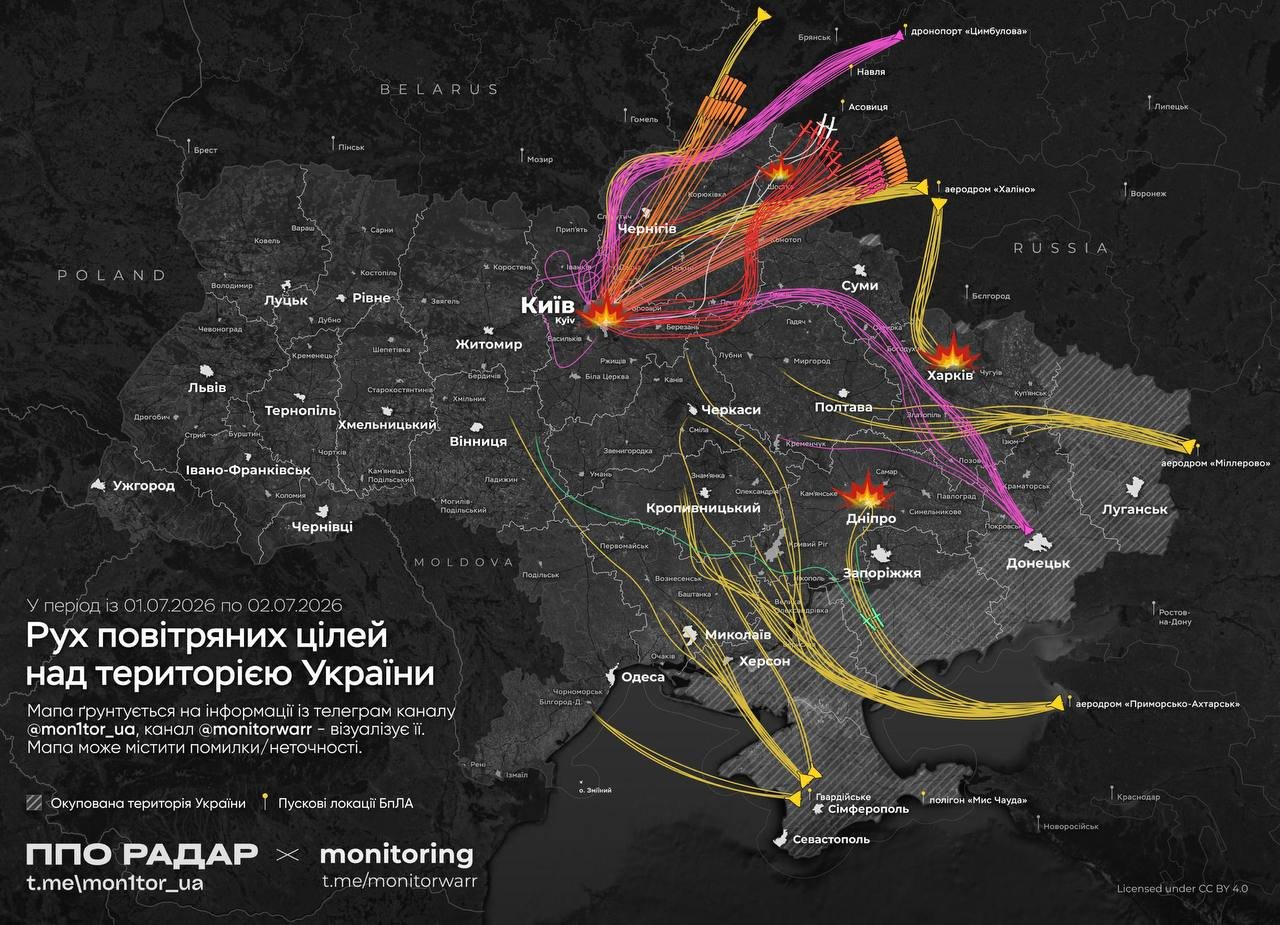
Major attack on Kyiv. For two weeks, Ukraine had relative calm, with Russia not launching any large-scale air attack. Apparently, it was stockpiling missiles and drones, which it then fired at Ukrainian cities on Wednesday night to Thursday.
The main target was Kyiv. Here they hit 30 sites in different parts of the city; at least 17 people were killed in total and more than 80 were injured.
Ukrainian air defence nevertheless performed quite well. It shot down 476 out of 496 drones (a success rate of as much as 96 percent), 32 of 34 Kh-101 cruise missiles, eight of eight Kalibr missiles, and four of four Kh-59 missiles. The only problem was the Iskander-M ballistic missiles (four of 34) and the Zircon missiles (zero of four).
It was precisely these that apparently caused the worst damage. In this video, a large crater can be seen in front of a heavily damaged apartment block.
The attacks also targeted civilian infrastructure; several images showed hit residential buildings and the main warehouse of the MOYO electronics retailer.
❗️Kyiv experienced one of the most massive attacks: the enemy struck residential buildings and civilian infrastructure with drones, ballistic and cruise missiles, as well as hypersonic “Zircon” missiles.
28 locations were damaged in the capital. Currently, there are 25 injured… pic.twitter.com/Gw245TAX1P
— Cloooud |🇺🇦 (@GloOouD) July 2, 2026
російські уйобки знищили головний склад магазину електроніки MOYO у Києві.
Воєнні злочинці навмисно атакують українські цивільні підприємства.
Вони за це боляче заплатять.
Наступний гаджет, який я купуватиму, буде з MOYO. pic.twitter.com/aKdjtpw6CB
— Serhii Sternenko (@sternenko) July 2, 2026
Auch heute Nacht massiver Terror gegen die ukrainische Hauptstadt Kyjiw
Aus Rache für gezielte Angriffe auf Militäreinrichtungen & kritische Infrastruktur hat Russland in den vergangenen Stunden erneut Kyjiws Wohnhäuser bombardiert
11 Tote, 56 Verletzte. pic.twitter.com/x9ihudhHuy
— Julian Röpcke 🇩🇪🤝🇺🇦 (@JulianRoepcke) July 2, 2026
Foreign minister Andriy Sybiha called on partners not to delay decisions on helping Ukraine’s air defence. “This is our main request to our partners after the night of horrors that Kyiv has lived through,” Sybiha said.
As noted by Ukrainian analyst Bohdan Myroshnykov, some of the drones flew along the Belarusian border. According to him, this suggests that Belarus had not switched off the systems that help control these drones. Ukrainians recently gave Belarus an ultimatum to shut them down, otherwise Ukraine would disable them itself. Later, the Ukrainian command claimed they were already out of operation.
Myroshnykov wrote that Russia had fired a very high number of missiles at Ukraine. It might even have been a record in terms of an attack on a single city. He noted that the Russians were firing salvos of missiles from S-400 systems (intended primarily for air defence, but used by Russia also against ground targets) together with Iskanders. They also fired Iskanders and Zircons in salvos.
According to the analyst, this is a tactic against which it is difficult to do anything.
He also said Ukrainians would be able to respond in a similar way once they have their own ballistic missiles, which they are now trying to develop (in particular the FP-9).
“When 25 to 30 ballistic missiles are flying at Kyiv, we cannot do anything about it. And it will be the same with Moscow if an analogous number of our ballistic missiles are flying there,” the Ukrainian analyst wrote.
Charts of the day
Russia advanced only minimally in June – if at all. The Ukrainian analytical account DeepState UA published statistics on territorial changes for June. According to it, Russians occupy 84 square km more than in May. This is the second-slowest Russian advance in the period monitored since June 2024.
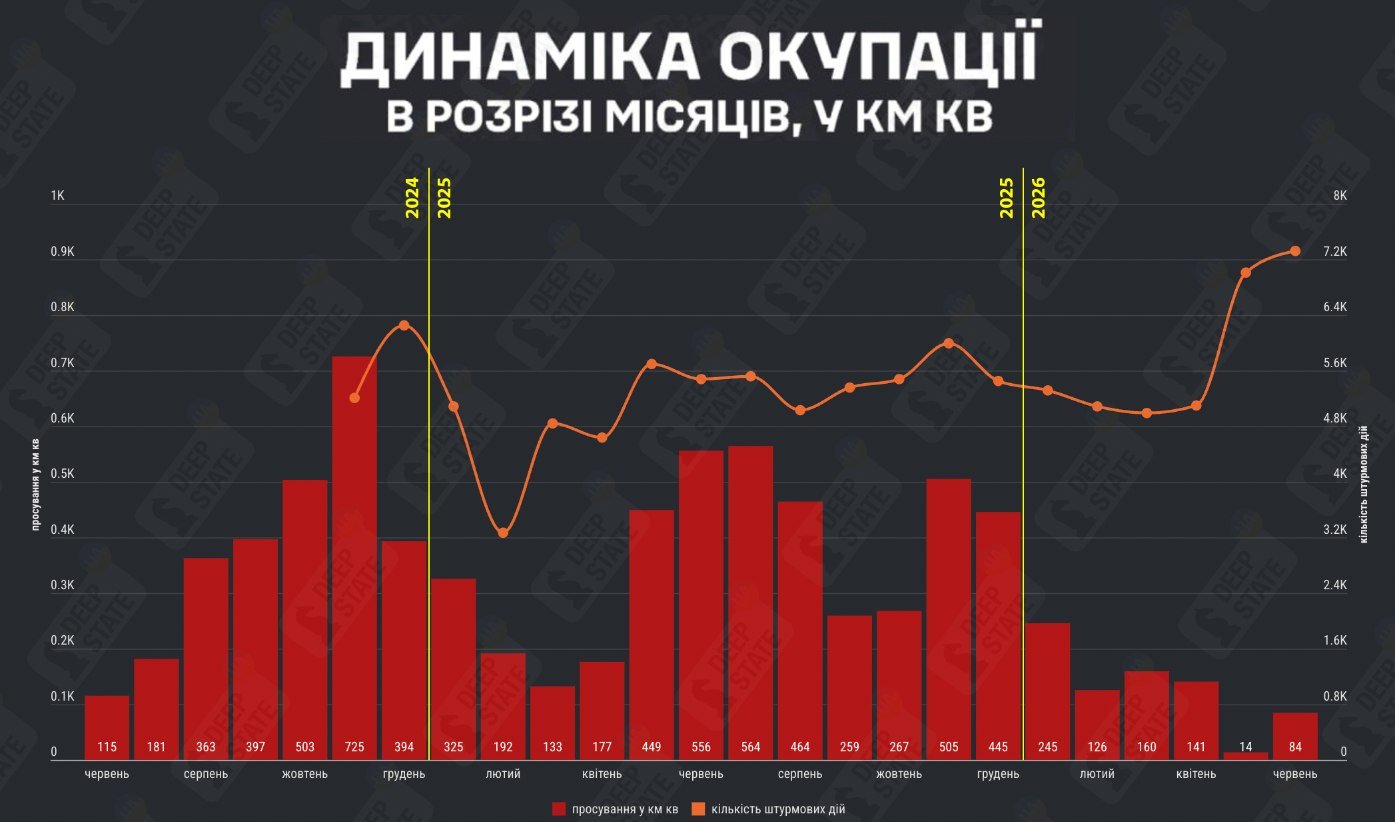
However, as this Ukrainian analytical account writes, in reality the Russians did not advance at all. DeepState UA does not publish up-to-date information on Ukrainian advances, as it does not want to endanger the Ukrainian army or reveal its positions.
It states that in June Ukrainians in fact liberated slightly more territory than they lost. A similar situation occurred in the previous month as well.
“As we have already written, a turning point is now emerging in the war and further developments will depend on the steps taken by the Ukrainian command. If in May we took two steps forward, in June it was one step forward and one step back,” the Ukrainian account wrote.
At the same time, the number of attacks and engagements has increased. This can be explained mainly by the fact that Russians often attack with single soldiers or pairs of soldiers, with each such attack automatically counted as one engagement.
Another Ukrainian account wrote that 70 to 80 percent of the fighting is taking place in four areas: Lyman, Kostyantynivka, Pokrovsk and Huliaipole. French OSINT analyst Clément Molin in turn wrote that the Russians are continuing offensive operations in seven out of a total of 12 directions.
According to him, they advanced by 28 square km in June. A similar figure (30 square km) was published by the Institute for the Study of War.
Source: Clément Molin
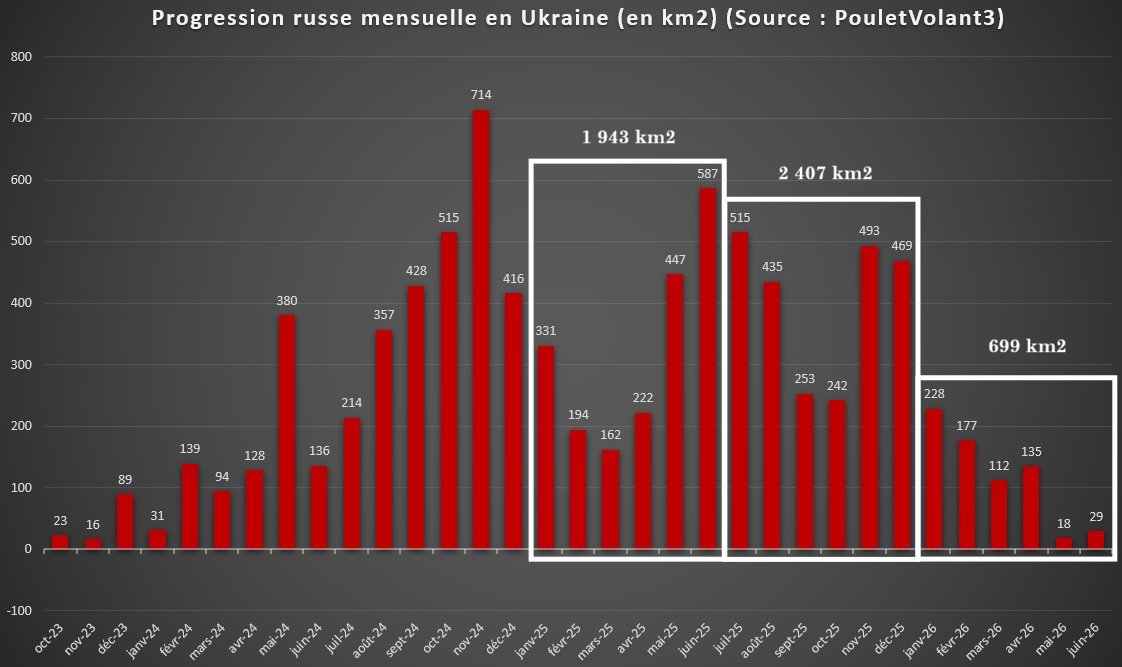
According to DeepState UA, in the first half of 2026 Russians captured 770 square km, which is a significant decrease compared with the same period last year, when they took 1,832 square km.
Map of the day
One of Russia’s responses to Ukrainian strikes on refineries and cargo trucks is attacks on Ukrainian petrol stations in areas near the front. The apparent aim is to cause problems with fuel supplies for the Ukrainian army.
According to the Ukrainian account Oko Hora, 55 strikes on petrol stations were recorded during June. The map shows only those that were attacked in the last 10 days. Ukrainians say this will not cause major problems for the army, because they have several options for supplying the front with fuel.
📍Against the backdrop of Ukrainian strikes on Russian military logistics at the front, Russia has come up with nothing better than targeting gas stations in Ukraine’s frontline regions.
More than 55 strikes on gas stations were recorded in June.
The map shows the approximate… pic.twitter.com/dNR3bcfhCu
— Oko Gora (@oko_gora_tg) July 1, 2026
Videos of the day
Artificial intelligence in a Hornet drone identifies a slowly moving locomotive and then hits it. The video was published by the 1st Azov Brigade.
The Ukrainian project I Want to Live, whose aim is to persuade Russian soldiers that it is better to surrender than to die, has released a video showing how soldiers at the front can surrender to drones. It is not complicated. They need to establish visual contact with the drone, throw away their weapon and raise their hands above their head. The operator gives a signal and then issues instructions on what to do, or drops a sheet of paper with instructions. Most of the time, the soldier has to follow the drone, or wait until another one returns.
What are the losses
No update on Thursday.
By Monday (29 June), Russia had demonstrably lost 23,703 pieces of heavy equipment (on Tuesday (23 June) it was 23,668). Of these, 18,686 (18,652) pieces were destroyed by Ukrainians, 988 (987) were damaged, 1,199 (1,199) were abandoned by their crews, and 2,830 (2,830) were captured by the Ukrainian army. This includes 4,407 (4,404) tanks, of which 3,310 (3,307) were destroyed in combat. Ukraine has lost 11,629 (11,546) pieces of equipment, of which 9,068 (9,011) were destroyed, 687 (687) damaged, 683 (677) abandoned and 1,191 (1,189) captured. This includes 1,437 (1,433) tanks, of which 1,099 (1,097) were destroyed in combat.
Note: Neither side regularly reports its dead or destroyed equipment. Ukraine publishes daily figures on Russian casualties and destroyed equipment, but these cannot be independently verified. In this overview we use data from the Oryx project, which since the beginning of the war has compiled a list of equipment losses documented exclusively by photographic evidence.