With Moscow’s troops close to closing a pincer around Kostiantynivka while Kyiv’s drones gnaw at Russia’s land corridor to Crimea, the war is turning into a test of which side’s supply lines break first.
 Roman Pataj



Every day, the Ukraine Battlefield update newsletter offers a clear look at how the war is unfolding on the ground. Subscribe for free here to get the full text delivered to your inbox.
Russian forces raised their flags in Kostiantynivka, breaking through the positions of a newly formed brigade. The fuel situation in Crimea has slightly improved, but the drone offensive against supply lines continues. Why the arms plant in Cheboksary is so important and how the Russians defended it. The Kremlin has appointed a new Hero of Russia – his name says a lot about today’s Russia. Maps of the day – Kostiantynivka Videos of the day – Russian drones guard the road to Crimea; what the Kinburn Spit looks like from the air
Russian forces raised their flags in Kostiantynivka, breaking through the positions of a newly formed brigade. “The enemy has wedged itself into the city centre. This is no longer infiltration,” said the commander of one of the companies defending Kostiantynivka to Ukrainian journalists from the website Hromadske. Estimates of the number of Russians in the city range from 100 to 250. These figures come from three officers who, on condition of anonymity, spoke about the situation.
“It is quite possible that we will lose Kostiantynivka by the end of the summer. The enemy is pressing very hard,” admitted the commander of one of the brigades fighting for the city.
It is split into two parts by the Kryvyi Torets river, which meanders from the north-west to the south-east. According to one of the soldiers interviewed, Russian forces already had the upper hand on its western bank, that is, in the south-western part of the city, and the defenders are now trying to prevent the same from happening on the opposite side.
Officers mentioned, as one of the reasons for the worsening situation, the presence of one of the newer units – the 156th Mechanised Brigade. Russian troops were reportedly pushing through its assigned sector because unprepared mobilised soldiers were unable to make the right decisions. “The new units are problem number one. It would be better to distribute the mobilised men into the old brigades,” thought a member of one of the “old”, that is, experienced units.
During the ongoing battle, the command replaced the commander of the 156th Brigade. Nevertheless, the soldiers said that at present more Russians were entering the city than they managed to kill before they got there. “Until we cut this route, the situation will not change,” one of them said. He still believed, however, that the city could be saved.
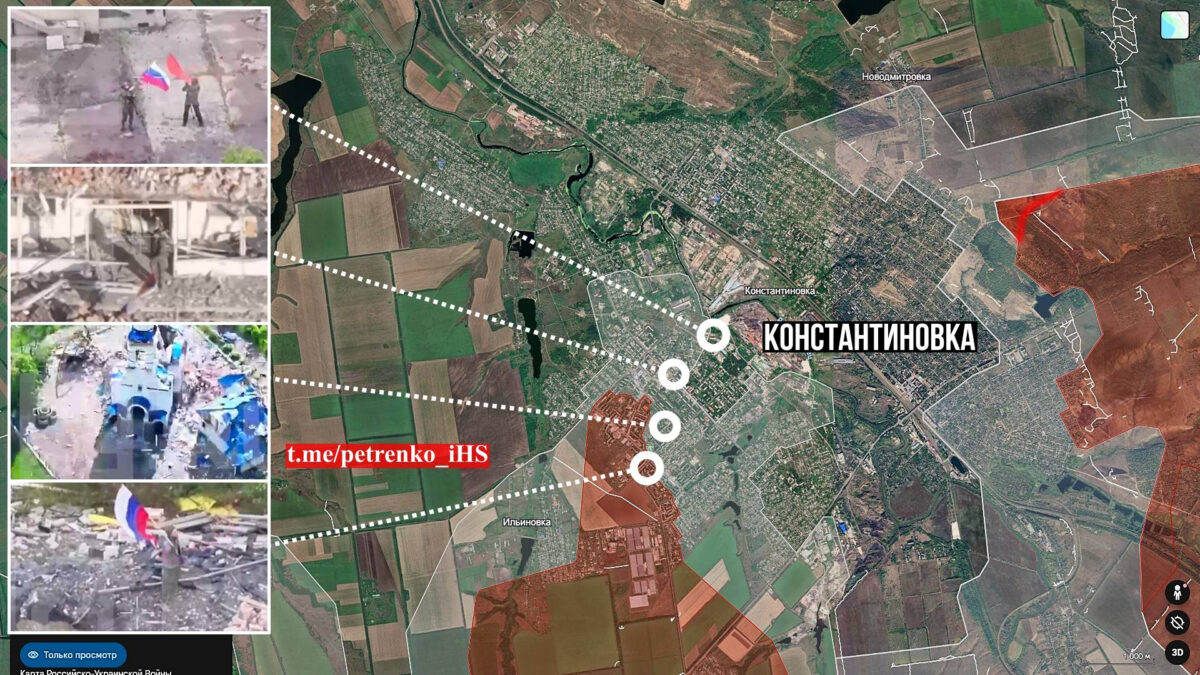
On Thursday, Russian forces displayed several flags in the city. Nevertheless, the Russian Telegram channel claimed that “the complete ‘liberation’ of Kostiantynivka is still a long way off.”
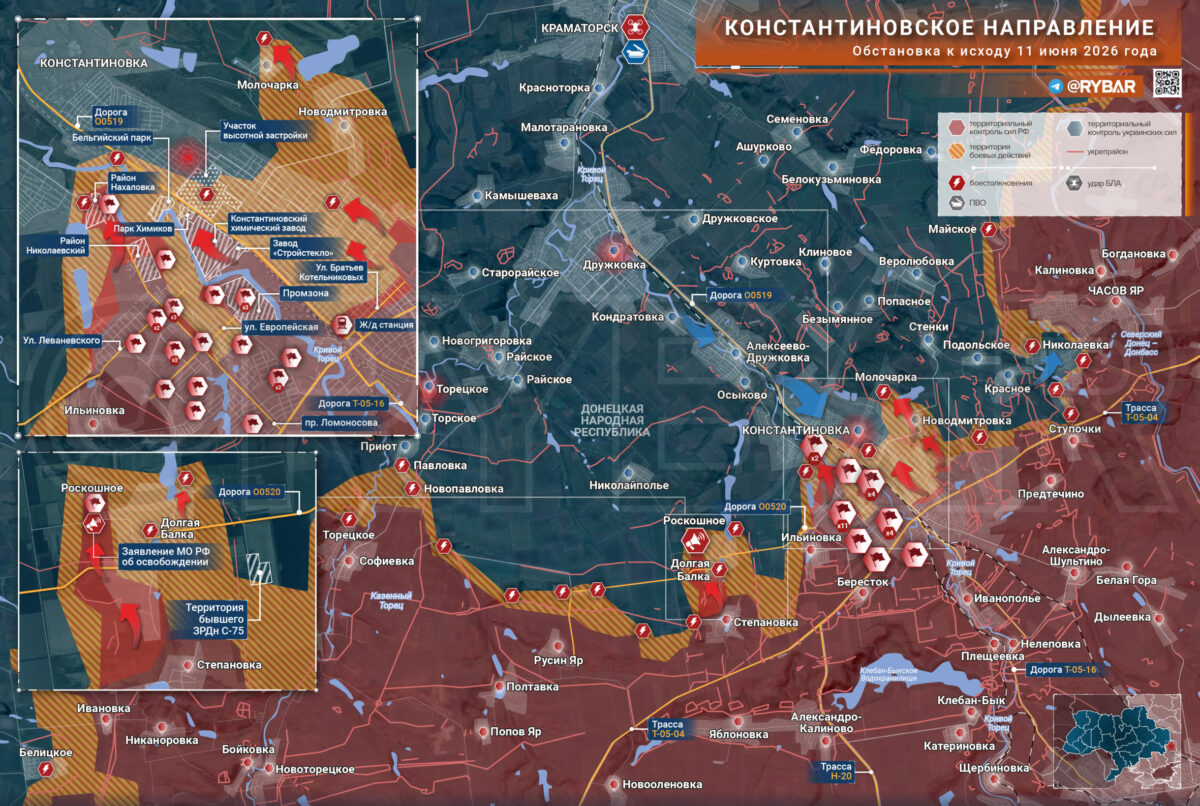
On its map, all the locations where Russian troops raised a flag are marked. All of them are in the south-western part of the city:
Rybar wrote that in the eastern half the situation was much more complicated for the Russians “because the enemy still controls the hills in Chervone and on the edge of Chasiv Yar”.
The author of the Ukrainian military channel Bachmutsky Balu is operating directly on the eastern flank of the Kostiantynivka battlefield. From there he wrote that around Chasiv Yar the Russians were massing reinforcements and trying to get behind the defenders’ backs.
“In our zone of responsibility there are positions we had to abandon in order to save the lives of the soldiers,” the author wrote, adding that there was a very high concentration of Russian FPV (first-person view) drones in this sector.
The Ukrainian analyst Petrenko saw the situation shortly before midnight on Thursday as follows (this was almost certainly an unduly optimistic version of reality):
This time, the interpretation from this Polish OSINT account appears more plausible. It claimed that, faced with the threat of encirclement, both the aforementioned 156th and the 100th Brigades had withdrawn from the western part of the city. It drew the line of contact exactly along the course of the Kryvyi Torets river.
Sytuacja w rejonie Konstantynówki, część VIII. Odwrót resztek ukr oddziałów 100 i 156 BZ z zach części miasta.
Blisko godzinę temu strona rosyjska udostępniła obszerny materiał filmowy z flagowania zachodniej części Konstantynówki. Wskazuje on, że oddziały ukraińskie należące do… pic.twitter.com/gMlo2QQEjN
— Thorkill (@Thorkill65) June 11, 2026
The Ukrainian military analyst Kostyantyn Mashovets saw the prospects for holding on to Kostiantynivka as “very unfavourable”. Only the last two kilometres remained between the forward Russian units on the two arms of the pincer, and the last serious obstacle between them was the river. Once they crossed it, “the situation of all Ukrainian units defending south of the junction of Yemelianova and Oleksa Tykhoho streets would become much worse.”
The fuel situation in Crimea has slightly improved, but the drone offensive against supply lines continues. One Russian account wrote on Wednesday that there were strong winds on the road to Crimea, which made life difficult for Ukrainian drones. It is not clear whether that was the reason why today the mayor of Sevastopol was able to publish a notice that at one of the two fuel-station networks fuel would be on open sale on Friday from 10.00AM. Specifically, this concerned ATAN stations. There are nine of them in the city in total, but none of them has all types of fuel available at every outlet.
At ‘TES’ stations, fuel could still only be bought with an allocated QR code and in limited quantities.
In the meantime, mass attacks in the Russian rear continue. The Magyar Birds published a long compilation. Worth noting is the segment from 2:45, when drones attacked a Russian logistics base in the town of Novoazovsk. It lies more than 150 km from the front line east of Mariupol. Many trucks were hidden behind protective berms, but for many of them this did not help. If you want to deprive the enemy of supplies, these are exactly the kind of targets you want to destroy as a priority.
Magyar’s update:
USF Birds deep inside enemy operational depth. Two SAM systems – a Tor and a Buk – plus a colorful lineup of targets across the TOT.
Among the targets of the night of June 10:
🔥Tor SAM system, Vershyna Druha settlement – 1st USF Separate Center and the 131st… pic.twitter.com/nBzsckDkJn
— 414 Magyar’s Birds (@414magyarbirds) June 11, 2026
Why the arms plant in Cheboksary is so important and how the Russians defended it. It may not seem so at first glance, but this is one of the most interesting videos of the war. It shows part of the VNIIR Progress arms plant in the Russian city of Cheboksary, which this week was hit by a Ukrainian FP-5 Flamingo cruise missile. Ukrainian drones had repeatedly attacked it, but their effect was limited because the Russians wrapped the entire factory in anti-drone netting. That was sufficient against these light weapons, but as can be seen, it was completely ineffective against the Flamingo’s one‑tonne warhead.
An even closer look at the aftermath of the FP-5 Flamingo strike on the VNIIR-Progress facility in Cheboksary.
The footage also offers a detailed view of the massive anti-drone protective structure surrounding the building. https://t.co/bJNSWDugRM pic.twitter.com/eRl22n3EoE
— Special Kherson Cat 🐈🇺🇦 (@bayraktar_1love) June 11, 2026
What makes the factory so special that, even though it is 1,000 km from the front line, they hid it entirely under steel mesh? “The enemy has many companies, but only some of them have a unique, militarily important and technologically advanced production programme,” wrote Serhiy Sternenko, an adviser to the Ukrainian defence minister, explaining the reasons for the attack.
He then listed the weapons for which components are manufactured in Cheboksary. They produce “satellite navigation systems without which the ‘Shaheds’ do not fly, the guided aerial bombs (‘KABs’) and jet-powered drones do not hit their targets, the ‘Iskanders’ lose accuracy and the ‘Orlans’ lose their bearings.”
Sternenko mentioned by name the Kometa satellite antenna. It is typically used by Russian glide bombs that fall on and just behind the front line.
The Russians are well aware of the plant’s importance. That is precisely why they protected it, as can be seen in the videos. However, the Russian Telegram channel Fighterbomber pointed out that despite this, it was hit. It criticised the fact that the FP-5 flew more than 900 km over territory controlled by Russia at the speed of an ordinary passenger aircraft. This is a cruise missile that all types of air defence, with the exception of helicopters, can reliably destroy. Moreover, two separate missiles flew towards Cheboksary, “so there can be no talk of the air defence being overloaded. There can be two reasons: either it failed, or it was not there at all.”
The Kremlin has appointed a new Hero of Russia – his name says a lot about today’s Russia. His name is Ramil Faskhutdinov, he holds the rank of colonel and commands the 5th Separate Motor Rifle Brigade, which was once known as the Oplot battalion. This is a unit originally created by pro-Russian separatists in the Donetsk region. After the invasion began, it was one of the formations where men from the occupied part of the region died in their thousands, without appearing in Russia’s official casualty statistics because formally it was not part of the Russian army.
Russian independent media quickly compiled a summary of whom the Kremlin considers a Russian hero. In October 2025, this officer personally reported to Putin that Myrnohrad had been captured, even though fighting for the city went on for several more months. False reports are one of the reasons for the high Russian losses. On their basis, commanders are often convinced that they control areas which in reality are under Ukrainian control, and then adjust their subsequent moves accordingly.
In addition, soldiers from this brigade testified that wounded troops were forced into further assaults. There is evidence that the brigade commander personally ordered the executions of its members. The unit also has a torture camp for men who in some way “offend”, and at the same time its officers demand money from soldiers in order not to send them to the front line.
Russian president Vladimir Putin considers this commander a war hero.
Videos of the day
From the air you can see the R-280 road in occupied southern Ukraine, which is the land corridor between Russia and occupied Crimea. The footage comes from a Russian drone patrolling above it. It manages to spot a Hornet drone, which Ukrainians are using to decimate logistics to the peninsula, and attacks it. The outcome is unknown; the recording ends before it can be assessed.
Russian FPV interceptor drone chasing a Ukrainian Hornet middle-range strike drone over the R-280 highway in Russia-occupied part of southern Ukraine.
The Russians have begun assigning some of their UAV interceptor detachments for the protection of land arteries along the land… pic.twitter.com/q6Po71jxw9
— Status-6 (War & Military News) (@Archer83Able) June 11, 2026
This Monday, the Ukrainian partisan movement Atesh announced that Russian soldiers had withdrawn from the Kinburn Spit. This is a very narrow strip of land in the Black Sea, about 10 km long, jutting out from the Kinburn Peninsula. It is tiny, but strategically important territory because it separates the mouth of the Dnipro from the sea. Drone footage gives an idea of the character of the whole area. Among other things, Russian trenches can be seen.
🇺🇦🇷🇺 La península de Kinburn se está convirtiendo cada vez más en una posición muy complicada de defender para Rusia
La geografía y las pocas defensas hace que las posiciones rusas sean especialmente vulnerables y difíciles de sostener a largo plazo ante los drones ucranianos… https://t.co/M387JGvqqx pic.twitter.com/IBHqcf9PJF
— Mundo Andriy (@andriy_ht) June 10, 2026
What are the losses
No update on Thursday.
Russia had demonstrably lost 23,593 pieces of heavy equipment by Monday morning (on Monday 1 June it was 23,556). Of these, 18,585 (18,551) pieces were destroyed by the Ukrainians, 982 (979) were damaged, 1,199 (1,199) were abandoned by their crews and 2,827 (2,827) were captured by the Ukrainian army. This includes 4,397 (4,394) tanks, of which 3,300 (3,293) were destroyed in combat.
Ukraine had lost 11,425 (11,397) pieces of equipment, of which 8,888 (8,863) were destroyed, 680 (678) damaged, 670 (669) abandoned and 1,187 (1,187) captured. This includes 1,426 (1,424) tanks, of which 1,091 (1,089) were destroyed in combat.
Note: Neither side regularly reports its own dead or its destroyed equipment. Ukraine publishes daily figures on Russian casualties and destroyed equipment, but these cannot be independently verified. In this overview we use data from the Oryx project, which since the start of the war has compiled a list exclusively of visually documented equipment losses.