

Drapatyi’s rise could decide whether exhausted Ukrainian troops get the training, drones and honest leadership they need to hold back Russia’s latest push on Donbas towns and cross‑border strikes.
 Tomáš Vasilko



Every day, the Ukraine Battlefield update newsletter offers a clear look at how the war is unfolding on the ground. Subscribe for free here to get the full text delivered to your inbox.
Possible priorities of Mykhailo Drapatyi, the new commander-in-chief of the Ukrainian army.
Why Ukrainian commentators praise him and how Russian bloggers view him.
Ukrainians attacked more Wildberries warehouses, while independent Russian analysts debate whether these are legitimate targets.
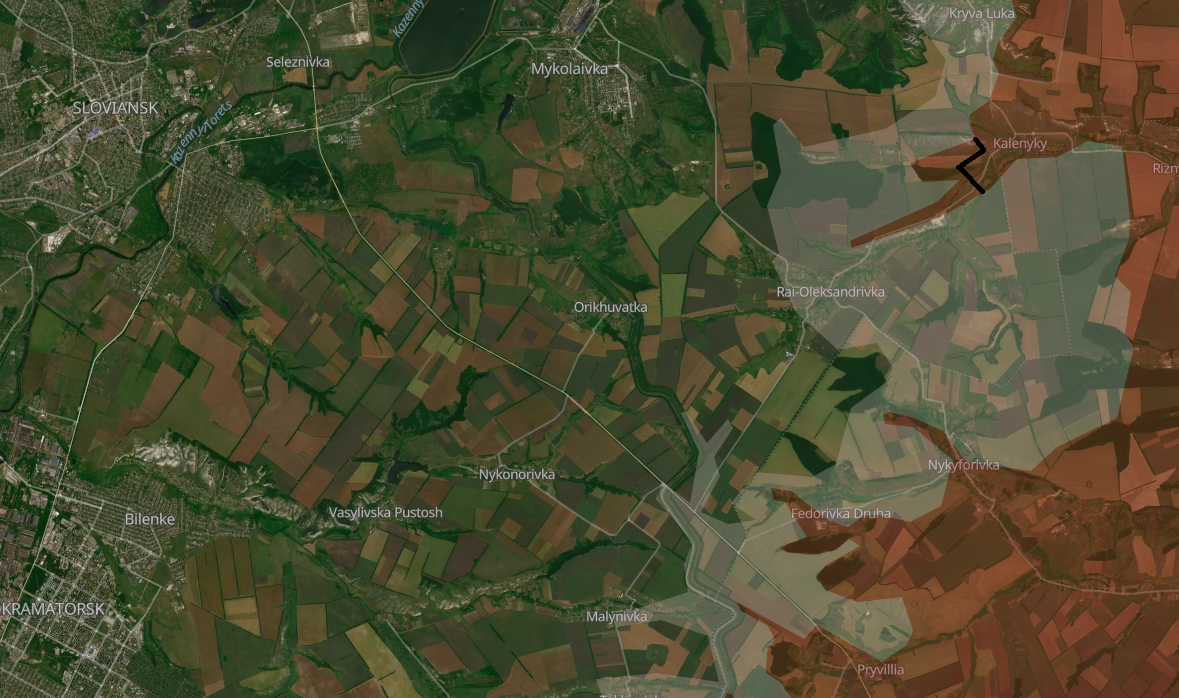
Map of the day: Russian advance in the village of Rai-Oleksandrivka.
Videos of the day: a Russian MiG-29 hit at an airfield, a series of Russian attacks on Ukrainian petrol stations, and a Ukrainian drone striking a military lorry on a motorway.
In Ukraine, it is sometimes necessary to take one step back in order to take two steps forward. The recent departure of defence minister Mykhailo Fedorov was viewed by many in Ukraine as a defeat for reformers in the army, whose face had become the young 35-year-old minister, and a victory for the old leadership embodied by general Oleksandr Syrskyi.
Several days of demonstrations, and apparently pressure from the army, have changed everything. Syrskyi stepped down as commander-in-chief after two and a half years and will be replaced by general Mykhailo Drapatyi, who was the reformers’ preferred candidate and is close to Fedorov. It is not yet clear whether Fedorov will return as defence minister, nor what lies ahead for Syrskyi.
In today’s update, we look at how commentators in Ukraine have welcomed his appointment, why several Russian military bloggers fear him, and what he believes could help Ukraine win its war against Russia.
Mykhailo Drapatyi, who served as commander of the Joint Forces of the Ukrainian Armed Forces, has said little publicly. As the Espreso TV website wrote in a lengthy profile, he avoids interviews and rarely comments on social media. This year, he commented on events only twice, both times when Ukrainian president Volodymyr Zelensky dismissed people whom the general supported.
Most recently, it was Fedorov.
Drapatyi agrees that victory is Ukraine’s only path. Based on what he has said and done publicly, the Espreso TV website identified three things which, in Drapatyi’s view, can lead to achieving this goal. He is likely to pursue them as commander-in-chief of the Ukrainian army as well.
The first is high-quality training for new soldiers. The general has suggested that victory rests on people. Even as commander of the Land Forces, his first interest was in training centres rather than the front. However, Drapatyi was unable to reform the mobilisation system itself — a long-standing problem for the Ukrainian army that will not be easy for him to change even in his new role.
The second element in defeating Russia, in his view, is Ukraine’s technological advantage. “He considers the mass use of FPV drones and the development of artificial-intelligence systems for reconnaissance and target destruction to be an area in which Ukraine currently has an edge over Russia, and one it must retain,” the Espreso TV website wrote.
As US analyst Rob Lee noted, the so-called Drone Line was created when Drapatyi was commander of the Land Forces and Fedorov was minister of digital transformation. “He has long advocated increasing medium-range strike capabilities and supports strengthening the role of unmanned platforms,” Lee wrote.
Drapatyi would also like to change the culture within the Ukrainian army, which is fighting not only an external enemy but also an internal one: an outdated command system, corruption, bureaucracy, and a system in which commanders do not listen to soldiers or take responsibility for mistakes. He had already sought to reform this system as commander of the Land Forces, but was unsuccessful, which was one reason why he left that position. He also accepted responsibility for the deaths of 12 soldiers following a Russian strike on a training centre.
This is also why Drapatyi is among the most popular generals among soldiers, while several brigade commanders have also praised him, according to Rob Lee.
“Rather than merely issuing orders, he listened to their views, welcomed feedback and asked how he could help them. A common criticism from brigades throughout the war has been that the general staff does not provide sufficient support to units defending the front line, or that it does not have a complete overview of the battlefield situation and issues orders without adequately taking the situation into account. I assume that one of the first things he will do is ask the commanders of operational groups what they need and ensure that they receive proper support from the general staff. I think this will have an immediate positive effect,” the analyst said.
According to him, Drapatyi is a critic of Soviet-style thinking and micromanagement. He wants to give individual commanders at the front greater freedom.
Unlike Syrskyi, at 43, he is a general who has “grown up” in the war against Russia, which has effectively lasted for 12 years since the annexation of Crimea.
“Officers who went through the Anti-Terrorist Operation — as Ukrainians called the fighting in Donbas from 2014 onwards — have become generals in recent years and will now take up the highest positions. Meanwhile, those who served in the Soviet era are gradually stepping aside. It will be a genuine смена элит, a changing of the elites,” Ukrainian analyst Bohdan Myroshnykov wrote.
How Ukrainians see it. All this is why many observers praised his appointment. The Ukrainian analytical account Tatarigami wrote that he was “the best possible choice”.
“I would not expect immediate changes and improvements. It will take some time for the changes to become apparent. But I know that many soldiers have regained hope for change, and that is very important for morale,” he wrote.
“Thank you to the president for this difficult but incredibly good decision. The army will change. I believe it,” wrote Serhii Flesh Beskrestnov, a drone expert and former Fedorov adviser.
According to analyst Myroshnykov, Drapatyi will face five main challenges: mobilisation, a potential Russian mobilisation within two to three months, gaining a strategic overview of the front, building communication with everyone from scratch, and ending the provision of false information.
Several people say that expectations of him are high, but that he needs time to make changes — and will not have much of it.
Mykhailo Drapatyi (43)
Mykhailo Drapatyi was the commander of the legendary BMP-2 that broke through Russian-backed barricades in Mariupol on May 9, 2014.
At the time, Russian-backed militants were attempting to seize control of the city. Drapatyi led the armored breakthrough that helped Ukrainian… pic.twitter.com/Tg5mX3mgzJ
— Saint Javelin (@saintjavelin) July 21, 2026
How Russians see it: Russian bloggers have offered mixed reactions to Drapatyi, but it is fair to say that most are not pleased by his appointment.
“He began this war as a combat-unit commander. That is bad for us. A general who rose through the ranks during the war and understands it is a very difficult opponent,” wrote pro-Russian propagandist Yuri Podolyaka. Later, however, he downplayed the choice, saying that the Ukrainian army was “clutching at straws”.
“He is a very capable general, not a butcher. This is bad news for the Russian armed forces,” Maksim Kalashnikov also wrote.
Ukrainian journalist and soldier Yuri Butusov also said that Russian Z-propagandists were “extremely dissatisfied” with his appointment.
The channel Veteran’s Notes wrote that it remained to be seen whether he would be better than Syrskyi, but that, unlike him, he had one advantage: he was very young and energetic.
Attacks on Wildberries. On Wednesday morning, Ukrainians attacked the logistics warehouses of Wildberries, Russia’s largest online retailer, for the third time in the past five days. The attacks were reported in the cities of Krasnodar and Nevinnomyssk.
They have now struck five of the company’s 10 largest warehouses. Given the fire that broke out at the warehouses hit on Wednesday, it was almost certain that they would burn down completely.
Ukrainian forces struck two more logistics centers belonging to Russian e-commerce giant Wildberries in Krasnodar and Nevinnomyssk, Stavropol Krai. At this pace, these retaliatory strikes could soon render Wildberries inoperable. pic.twitter.com/U82uLkgorm
— Giorgi Revishvili (@revishvilig) July 22, 2026
The Russian Wildberries distribution center struck by Ukrainian attack drones in Krasnodar this morning continues to burn out of control. pic.twitter.com/AMSm4TIpSx
— OSINTtechnical (@Osinttechnical) July 22, 2026
Wildberries is something like Russia’s Amazon. Sellers use it to sell their goods, and it was these goods that burned in the logistics warehouses. Ukrainians offer two arguments for attacking these civilian facilities: Russia does the same on a far larger scale — Zelensky has explicitly said these are retaliatory strikes — and Wildberries also sells military goods, such as military clothing, drones and drone components.
It is not widely discussed among Ukrainians, but independent Russian media outlets and analysts living in exile are debating whether these attacks constitute war crimes. Kirill Martynov, editor-in-chief of Novaya Gazeta Europe, believes they are legitimate targets, while Ruslan Leviev, an independent Russian military analyst who heads the Conflict Intelligence Team (CIT) think tank, argues that they amount to war crimes. Eight people were killed in Saturday’s attack.
“Although the Wildberries platform is used to purchase dual-use goods and items related to military activity, this does not mean that all its warehouses are legitimate military targets. This is the same criterion that we have consistently applied in the case of the Ukrainian company Nova Poshta, and we take the same position regarding warehouses in Russia. (…) All such attacks constitute war crimes because they provide no significant military advantage,” CIT wrote.
Russian outlet Meduza also addressed the issue. According to it, the sale of dual-use goods is “clearly not enough” to make attacks on such warehouses legitimate. Only some equipment for soldiers is sold through Wildberries, there is no evidence that the army itself purchases directly through the company, and Russian volunteers, according to CIT, more often buy items directly from China and import them by other means.
“Put simply: if Wildberries or Nova Poshta warehouses were filled with weapons and military equipment, they could become targets for attack. But if weapons make up only a negligible part of the goods stored there, they cannot become targets,” Meduza wrote.
Of course, Russia resorts to similar attacks far more often. According to Meduza, it has attacked 400 Nova Poshta terminals and branches, as well as other civilian warehouses. Ukraine itself is investigating these Russian attacks as war crimes. Moreover, Russia directly targets civilians with drones, for example through the human safari in Kherson or attacks on residential tower blocks in Zaporizhzhia.
At the same time, what German journalist Julian Röpcke wrote also remains true: “Let us not forget: Putin could end this nightmare at any time. Ukraine’s offer of a ceasefire is on his table.”
Map of the day
Ukrainian sources acknowledge that Russian forces have managed to penetrate deeper into the village of Rai-Oleksandrivka, east of Sloviansk. Both the DeepState UA and Petrenko accounts updated their maps.
The village is important for any further Russian advance towards Sloviansk and Kramatorsk, which, together with Kostiantynivka, are the three main unconquered cities in Donbas. “The enemy’s objective is to straighten the front line as far as the canal and then increase pressure in the direction of Mykolaivka,” the Petrenko account wrote.
The black line shows where the front line previously ran. Source: DeepState UA
Videos of the day
Ukrainians released a video showing that they struck a MiG-29 aircraft and a Pantsir-S1 air-defence system at Khalino airfield in Kursk region. The video suggests that the aircraft was indeed damaged, if not destroyed outright. An observation drone shows a fire at the spot where the aircraft had been standing.
🔥 BREAKING: A Russian MiG-29 fighter jet and a Pantsir-S1 air defense system were hit at Khalino airfield in Russia’s Kursk region
The operation was carried out by Ukraine’s 15th Brigade “Black Forest.”
P.S: Follow @15obrar pic.twitter.com/Tz3ojZj8Qc
— Special Kherson Cat 🐈🇺🇦 (@bayraktar_1love) July 21, 2026
Russia has recently been attacking petrol stations in Ukraine close to the front line. This video shows footage from 20 attacks.
In diesem Video zerstört die Russische Armee gezielt 2️⃣0️⃣ zivile ukrainische Tankstellen.
Also kommt mir nicht mit „Mitleid“ für irgendwelche Russen, die 12 Stunden für Benzin warten müssen.
Russland hat den Krieg begonnen & Russland hat ihn in die breite Bevölkerung getragen. pic.twitter.com/UNMJtEyd1I
— Julian Röpcke 🇩🇪🤝🇺🇦 (@JulianRoepcke) July 21, 2026
Although this receives less coverage now, Ukrainians continue to attack Russian cargo vehicles and lorries. According to data from the Ukrainian general staff, they have been destroying Russian vehicles and tankers in July at the same rate as in June.
This video shows a B-2 drone with an eight-kg warhead avoiding a civilian lorry and striking a military one.
A Ukrainian B-2 strike drone, 8kg warhead, hitting a russian logistics vehicle mid-transit – flown fully manually, no auto-lock.
Notice the pilot steering past a civilian car to hit the vehicle with military plates instead. pic.twitter.com/fG8wNkZVUz
— Dimko Zhluktenko 🇺🇦⚔️ (@dim0kq) July 20, 2026
What are the losses
No change on Wednesday.
By Wednesday morning, Russia had verifiably lost 23,888 pieces of heavy equipment (23,837 on Friday). Of these, 18,866 (18,815) were destroyed by Ukrainians, 993 (993) were damaged, 1,199 (1,199) were abandoned by their crews and 2,830 (2,830) were captured by the Ukrainian army. This includes 4,430 (4,427) tanks, of which 3,332 (3,329) were destroyed in combat. Ukraine lost 11,781 (11,690) pieces of equipment, of which 9,205 (9,123) were destroyed, 694 (689) damaged, 689 (687) abandoned and 1,193 (1,191) captured. This includes 1,450 (1,443) tanks, of which 1,111 (1,104) were destroyed in combat.
Note: Neither side regularly reports its own dead or destroyed equipment. Ukraine publishes daily figures on Russian casualties and destroyed equipment, which cannot be independently verified. This overview uses data from the Oryx project, which has compiled a list of equipment losses documented exclusively by photographs since the start of the war.