“If nothing happens by autumn, there will be mobilisation or peace”, an influential Russian blogger wrote.
 admin
admin



Every day, the Ukraine Battlefield update newsletter offers a clear look at how the war is unfolding on the ground, highlighting key developments along the frontline and the shifting dynamics of the conflict.
If nothing happens by autumn, there will be mobilisation or peace, an influential Russian wrote. Losses are intolerable and can no longer be replenished. Olexander Syrskyi is a despot obsessed with micromanagement, disgruntled Ukrainian officers said. Some are leaving the army. The battle for Sloviansk and Kramatorsk is taking place along a front almost 30 km long, Russian forces advanced between Pokrovsk and Rodynske. Russia showed a prototype of the two-seat version of the Su-57. Maps of the day – Sloviansk–Kramatorsk axis; Videos of the day – Su-57D; how cats react to incoming shells; a Russian drone with an R-60 anti-aircraft missile; a duel between an optical reconnaissance drone and an unmanned resupply vehicle.
If nothing happens by autumn, there will be mobilisation or peace, an influential Russian wrote. Losses are intolerable and can no longer be replenished. As you will read below, the Ukrainian army is facing disputes in the command and a shortage of men, which is currently manifesting itself above all on the Sloviansk–Kramatorsk axis. In other words, although Ukraine’s situation these weeks is much better than in winter, its problems have not disappeared anywhere.
On the other side, the situation is quite different. While as recently as half a year ago the Russians exuded confidence, today it has completely disappeared and has been replaced by increasingly open fears about the future.
These were captured precisely by a grim (for Russia) prediction from the well-known pro-Putin Z-channel Notes of a Veteran. Its author is an extreme supporter of the war, which he had backed unreservedly for more than four years. On Sunday evening, however, he wrote this: “The situation on the Ukrainian front is such that in the autumn there will either be mobilisation, or we will end up concluding a peace agreement. A third option simply no longer exists.”
This was nothing less than an admission that the Russian army was not capable of achieving on the battlefield a decisive turn that would lead to Ukraine’s defeat.
However, declaring mobilisation could have unpredictable consequences, and concluding peace in the current situation and without capturing the Donbas region, which is almost certainly unrealistic, would amount to admitting Russia’s defeat.
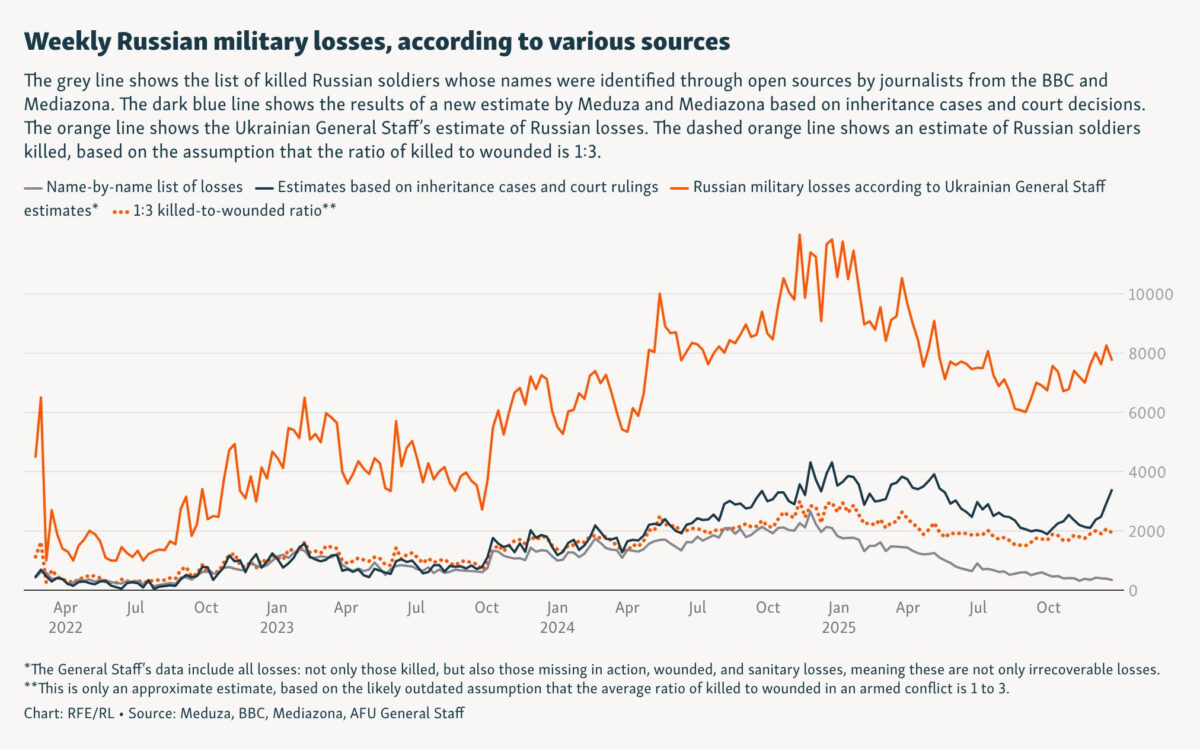
Russian exile Radio Liberty journalists Valentin Baryshnikov and Yevgeny Legalov last Friday published an analysis that confirmed the fears of Notes of a Veteran. It is called The Mathematics of War and, according to it, Russians are currently dying too fast and in numbers that are too large for them to have any chance of achieving victory.
Exactly this situation was defined in January, when the new Ukrainian defence minister, Mykhailo Fedorov, took office. Subsequently, in May, Mediazona and the BBC published new figures on the number of Russians killed. There are at least 352,000 of them.
Remarkably, if one uses the traditional ratio of three wounded to one soldier killed, one gets almost the same figure as that published by the Ukrainian general staff. In that case, the Meduza and BBC data are 0.937 times the claims of the Ukrainian army.
It is necessary to take into account the fact that the figure of 352,000 dead Russian soldiers does not reliably capture this year, because the data can only be confirmed with a time lag. On the other hand, today the ratio of dead to wounded is no longer 1 to 3, but in some places may be 1 to 1.
For the future course of the war, however, another figure is crucial. By cross-checking several sources, the authors arrived at the conclusion that in the first three months of 2026 the Russian army managed to recruit 10,000 to 20,000 fewer new soldiers than the number it lost on the battlefield.
Olexander Syrskyi is a despot obsessed with micromanagement, disgruntled Ukrainian officers said. Some are leaving the army. “Amid an increasingly complex situation in the east, where Russian forces continued their slow but steady advance towards Kramatorsk, and despite local tactical successes in the south, tensions in the Armed Forces of Ukraine are rising,” the Ukrainian website Militaryland, which closely tracks developments in the Ukrainian army, wrote.
The author of the article, Jerome Rendall, said that several experienced officers were leaving the service, citing as the reason the chief of the general staff, Olexander Syrskyi, and his harsh authoritarian methods. One of them is the deputy commander of the 20th Army Corps and Hero of Ukraine, Dmytro Kashchenko. He talked to Ukrainian radio NV about the reasons for his resignation.
He said that after Syrskyi came to the head of the army, an “authoritarian style of command” took hold, under which no dissenting opinions or compromise proposals were accepted. “Any alternative views are perceived with hostility, and you yourself start to be seen as an enemy,” said Kashchenko, who had been fighting since 2014 and had been wounded twice.
He described as the final experience that made him want to quit the three to four days during which he temporarily commanded the 110th Mechanised Brigade, whose commander had been dismissed and which he was supposed to lead until a new one arrived. Kashchenko recounted how the great majority of the new men were not only untrained, but were physically incapable of fighting. Most of them, he said, were “sick guys over 50, with whom it was constantly necessary to work, work and work”. Instead, he was ordered to attack with such people, which he refused.
Kashchenko complained that Syrskyi constantly tried to interfere in operations at the tactical level, even though his role should have been to command the entire army, not a handful of soldiers in a particular village where he decided to launch a counter-attack.
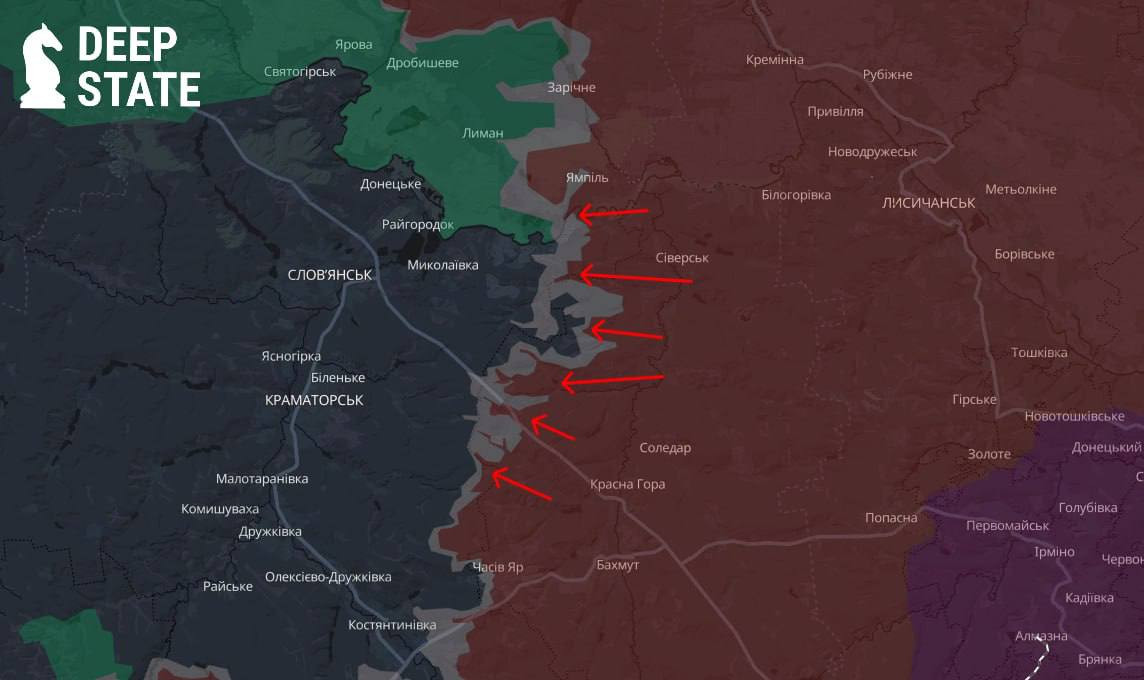
The battle for Sloviansk and Kramatorsk is taking place along a front almost 30 km long. And that is only true if we consider as part of it just the Russian attacks directly from the east, as shown on the current map from DeepStateUA. From a broader perspective, it is an even larger clash between the two armies, because the Russians are also pressing on this agglomeration from the north, roughly from the Sviatohirsk–Lyman line, and from the south towards Kostyantynivka.
“The enemy continued to exert pressure along the entire length of this sector, and it can be said that this is currently one of the most chaotic areas, where problems with gaps in the defence caused by a lack of personnel are manifesting themselves. The adversary is penetrating in depth, trying to hold on, which is causing difficulties for the Armed Forces of Ukraine, as can also be seen on the map,” Ukrainian analysts wrote.
On the map at this scale it is clearly visible that the Russian incursions have the shape of tongues that the Russian army is trying gradually to widen, eliminating Ukrainian positions between them. All this is taking a very long time, but the front is nonetheless gradually approaching both cities. The leading Russian units are today roughly 15 km from the administrative boundary of Kramatorsk and about 2 km further from Sloviansk.
Russian forces advanced between Pokrovsk and Rodynske. In Tuesday’s edition of Ukraine Battlefield update we wrote about the problems of the 7th Rapid Reaction Corps near Pokrovsk. Its command first published and then deleted a post appealing to the command of the Ukrainian army to withdraw the last soldiers from Pokrovsk, because their positions were untenable and attempts at resupply only led to unnecessary losses.
Over the following 24 hours the situation further deteriorated and the Russians captured the ruins of the settlement of Zaporizhzhya, which is so small that you will not even find its name on Google Maps. However, its location was marked on his map by Ukrainian analyst Petrenko. It lies between Pokrovsk and Rodynske, and Russian forces are currently just under 3 km from the south-western edge of the latter.
Rodynske is a very important stronghold that the Russians have not managed to seize, even after months of fierce fighting. Now, however, the Russians are also approaching it from the south, and their plan is certainly to bypass the town from the west and force the Ukrainians to abandon it because it will no longer be possible to supply its defenders.

Russia showed a prototype of the two-seat version of the Su-57. For now, this is not something that would have an impact on the fighting in Ukraine. In Ukraine Battlefield update this news appears only as a technical curiosity.
The single-seat version is slowly reaching the combat units of the Russian air force, but its deployment remains only marginal so far. According to Ukrainian military channels, Su-57s are operating mainly over the Bryansk region, but they are not penetrating Ukrainian airspace.
This type is considered a 5th-generation aircraft and a counterpart to the American F-22 and F-35. This classification is often questioned, because the Su-57’s stealth characteristics – that is, its reduced radar signature – are regarded as significantly worse. The development and deployment of the engine, which also has to meet specific requirements in order for the aircraft to be described as 5th-generation, has likewise been plagued by major problems.
Compared with the American approach, the Russian one appears at first glance to differ in that, while the Americans did not consider it necessary to produce a two-seat version of their most modern fighter aircraft, the Russians are going down another path. So far, they have shown only a video and a few photographs without further details. They have designated the new version of their most advanced aircraft as the Su-57D, which is a departure from the established UB designation for two-seat versions. The abbreviation UB stands for “uchebno-boyevoi”, that is, training and combat.
It is likely that they do not envisage the two-seat version of the Su-57 solely for training, but also as a type intended to work with unmanned aircraft. In that case, this role would be performed by the second crew member.
Russia’s United Aircraft Corporation has flown a two-seat Su-57 prototype for the first time. The variant is designed for pilot training and as a command platform for coordinating manned and unmanned operations. https://t.co/mTtdRvarMo pic.twitter.com/NjPgQzpyTP
— Open Source Intel (@Osint613) May 19, 2026
Videos of the day
Cats are popular among soldiers at the front; they remind them of normal life. They too have learned to distinguish which sounds belong to war and killing.
Cats sharing a trench with Ukrainian soldiers dive for cover at the sound of an incoming munition. pic.twitter.com/87Lud8VV5K
— Special Kherson Cat 🐈🇺🇦 (@bayraktar_1love) May 19, 2026
Such a detailed and high-quality view of a Russian drone armed with an air-to-air missile for its own defence has probably not appeared before. It is an R-60 type, a short-range missile guided towards a heat source. To be dangerous, the target would have to be in front of it; if it approaches from behind, it is defenceless.
Interception of a Russian Shahed fitted with an R-60 air-to-air missile and a rear-facing camera for detecting interceptor drones. pic.twitter.com/CKVBEWfXT6
— Special Kherson Cat 🐈🇺🇦 (@bayraktar_1love) May 19, 2026
For now it looks primitive, but this is the future of war. An optical reconnaissance drone is waiting on the road for a suitable target. In the end, it was a ground drone, whose operator noticed the threat and, through manoeuvring and a good dose of luck, saved it from destruction.
What are the losses
On Monday (4 May), some categories of equipment were removed from the list, so the total figures fell significantly compared to previous weeks. A week later there was a further reduction in total losses on the Russian side. No updates since Monday (11 May).
Russia had demonstrably lost 23,439 pieces of heavy equipment by Monday morning (on Tuesday (5 May) it was 23,650). Of these, 18,444 (18,618) pieces were destroyed by the Ukrainians, 971 (976) were damaged, 1,197 (1,206) were abandoned by their crews, and 2,827 (3,182) were captured by the Ukrainian army. Of this total, 4,390 (4,394) were tanks, of which 3,293 (3,292) were destroyed in combat. Ukraine lost 11,253 (11,219) pieces of equipment, of which 8,737 (8,708) were destroyed, 666 (661) damaged, 665 (666) abandoned and 1,185 (1,184) captured. Of this, 1,422 (1,420) were tanks, of which 1,087 (1,085) were destroyed in combat.
Note: Neither side regularly reports on its dead or on destroyed equipment. Ukraine publishes daily figures for Russian casualties and destroyed equipment, which cannot be independently verified. In this overview we use data from the Oryx project, which since the start of the war has compiled a list exclusively of visually documented equipment losses.