Ukrainian drones and Western missiles methodically shred Russian supply lines from Crimea to Voronezh, forcing Moscow’s generals to scrambling to patch up damaged bridges.
 Roman Pataj



Every day, the Ukraine Battlefield update newsletter offers a clear look at how the war is unfolding on the ground. Subscribe for free here to get the full text delivered to your inbox.
Ukraine’s medium-range campaign is not only increasingly massive, but also highly effective. Is an attack on the Crimean Bridge therefore approaching? On Monday we quoted French analyst Clément Molin and his statistics, according to which on Friday and over the weekend the number of attacks on Russian supply lines in Crimea and southern Ukraine was increasing at a rate of 30 struck targets a day. The same analyst on Tuesday at 21:00 published his observations for Monday and Tuesday. For the first of these days he counted 47 successful drone attacks, for the second as many as 56.
“Russian countermeasures are far too few and ineffective to change anything. We saw numerous mobile teams fleeing and very few cases of successful fire from the ground,” Molin summed up his observations from the published videos. One of the consequences was an almost complete power outage in Sevastopol today.
The Russian Telegram channel Military Informant meanwhile claimed this was how the long-term Ukrainian effort to destroy Russian air defences in Crimea was manifesting itself, an effort that was most discussed during the spring.
“Ukrainian drones feel increasingly unhindered over the peninsula and are delivering ever more palpable blows to its functioning,” the author wrote on Tuesday afternoon.
According to him, the Ukrainians have hit the window of opportunity precisely, at a time when, thanks to their efforts, there is a shortage of classic air-defence systems and the “typically sluggish response” is not enough to build up a so‑called short-range air-defence system, which is made up precisely of mobile teams.
This was Military Informant’s reaction to a specific attack on the railway in Crimea. It is one of the examples of the growing effectiveness of drones over Crimea, which we will describe. Not only are they now systematically hitting military targets, they are subsequently preventing their reconstruction.
The target was a railway bridge over the North Crimean Canal near the village of Rozdolne. It is one of four on this route, along which the Russian army supplies its units in southern Ukraine. Ukrainian special forces published a video together with a map. Ukrainian drones first repeatedly struck the bridge and cut it completely. From the history of wars, however, it is also known that even heavily damaged railway lines can be repaired and reopened relatively quickly. The Americans learned this, for example, during the Korean War.
To delay at least a provisional repair, the Ukrainians returned to the scene of the attack and struck the repair train that was attempting to fix the bridge.
Russia tried to repair the bridge. Ukraine destroyed the repair equipment too.
Ukraine’s Special Operations Forces — in coordination with SSO Resistance Movement underground operatives inside occupied Crimea — have destroyed the railway bridge over the North Crimean Canal near… pic.twitter.com/PAdEdbh4eQ
— Army Media 🇺🇦 (@armyinformcomua) June 23, 2026
On the following map is the location of the four bridges mentioned. The second arrow from the bottom points to the one that was hit:
The attack on the bridge near Rozdolne is not an isolated event, but part of a wider operation. On the map of the OSINT channel Oko Hora, 21 attacks on bridges over just under three weeks are recorded. Several were hit repeatedly – three of them are railway bridges, eight are road bridges.
📍Over the past 17 days, Ukrainian UAVs have carried out 21 strikes on 11 road and railway bridges on the isthmus and in Crimea itself.
Breakdown:
🟢 3 railway bridges — 7 strikes;
🟢 8 road bridges — 14 strikes. pic.twitter.com/3rUDyIVqPW
— Oko Gora (@oko_gora_tg) June 23, 2026
Satellite images reveal the Russian response to the attacks very clearly. At this damaged bridge, a pontoon bridge has been built on the left side, while on the right the Russians are constructing an improvised embankment that will connect both banks.
In turn, in addition to pontoon bridges near some damaged bridges, the Russians are also piling up crushed stone to allow vehicle passage.
These structures will be difficult to destroy; the only advantage is that traffic through such “bottlenecks” will be limited. pic.twitter.com/XcIi5vUojM
— Oko Gora (@oko_gora_tg) June 23, 2026
Such points, however, will slow down traffic and are the most natural locations for drones to target in further attacks. This is already happening; such a situation exists on the pontoon bridge that was built next to the road bridge near Chonhar.
Something I’ve been waiting to see for a long time: drone operators striking Russian logistics at one of the key bottlenecks of the land corridor to Crimea — right in the middle of a pontoon crossing next to the damaged Chonhar Bridge.
If the Kerch Bridge ever stops functioning,… https://t.co/vb4T1Gw4NY pic.twitter.com/2odH02za0R
— Special Kherson Cat 🐈🇺🇦 (@bayraktar_1love) June 23, 2026
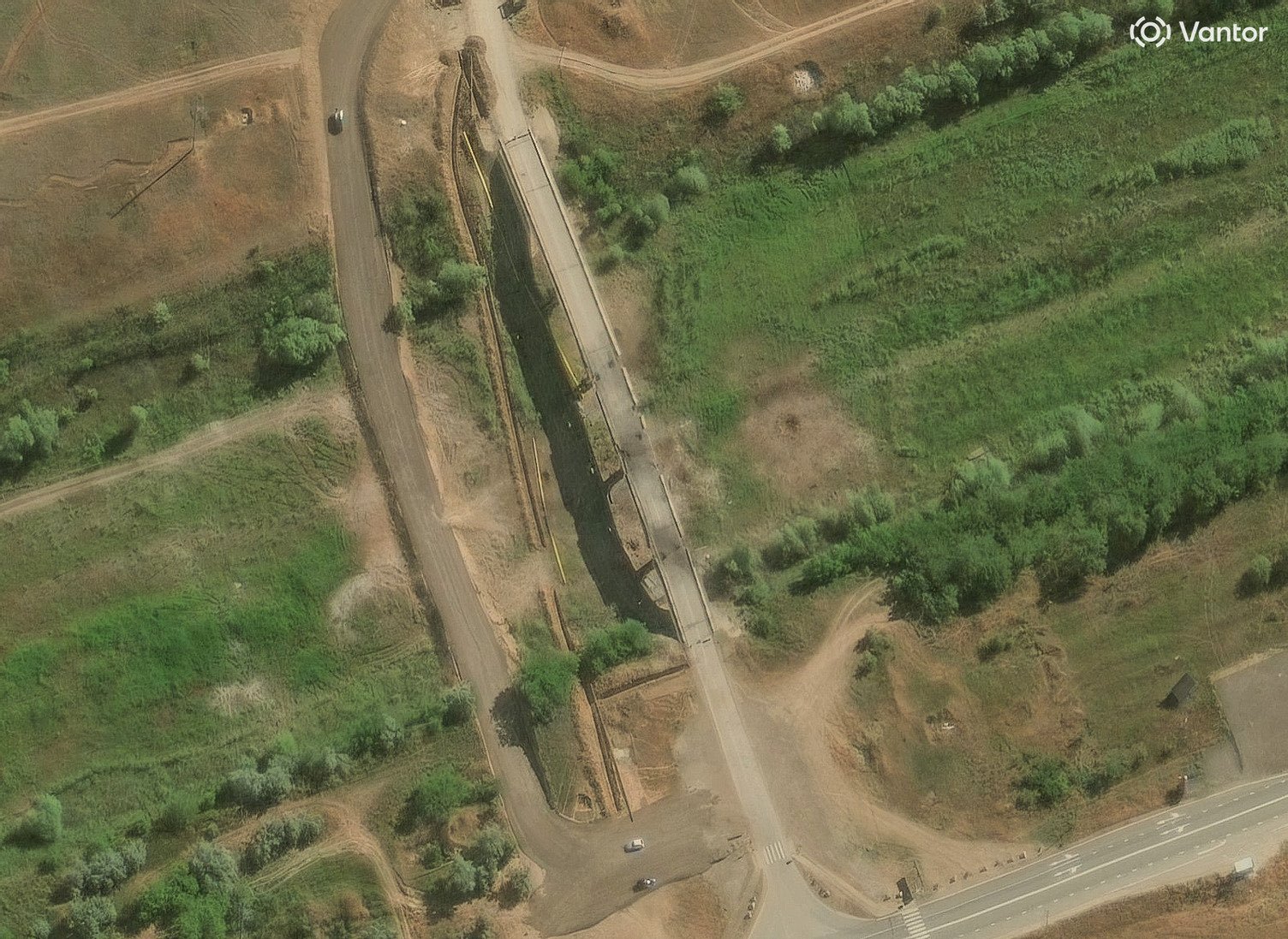
Probably the best idea of how effective the drone strikes on the Russian rear are is provided by a satellite image from the company Vantor, which is circulating online. It shows a road bridge in the Russian hinterland. Note the places where the hits occurred. There are six of them, and all are either directly on the bridge piers or in their immediate vicinity.
This is a level of precision that in the past was achieved only by glide bombs; today drones reliably reach it. They do not carry enough explosives to destroy the bridges, but enough to put them out of service.
Is the moment therefore approaching when Ukraine will attack the Crimean Bridge? The Russians were convinced of it. Oleksiy Yizhak from the Ukrainian National Institute for Strategic Studies said to the NV website that there were two possible lines of thinking: “What is better: for the Russians to flee from there, or for us to isolate them there and destroy what is there?”
He believed that the Russian army in Crimea was still not in a state in which it would be defeated. This was evidenced by the fact that drones, as well as supersonic Zircon missiles, were still flying from there towards Ukraine. “Only when nothing flies from Crimea any more will it mean that a new phase has begun,” he said.
Yizhak believed that after the dramatic restriction of traffic on roads through occupied Ukraine, the Crimean Bridge today provided more than half of the logistics between the occupied peninsula and Russia. “Therefore it is very important to destroy it, but again there is the question of what is better – to let them flee or to destroy it right now?”, he said.
Petrol and diesel are now rationed even in the region that produces 40 percent of Russia’s oil. This concerns the autonomous Khanty-Mansiysk region.
As the Russian independent outlet Meduza wrote, its governor Ruslan Khucharuk wrote as recently as the end of last year that the region planned to increase crude production. He has now told residents that the final product from it is available only in limited quantities. He cited “increased demand” and an effort to prevent “speculation and resale” as the reasons.
Meduza quoted local media, according to which the limits apply to the Gazprom Neft filling-station network – a maximum of 40 litres of petrol and 80 of diesel can be filled up. Restrictions also apply in the Lukoil network. So this is not about small independent sellers, but some of the largest companies in Russia.
The Moscow Times website also reported that on Tuesday, in addition to Khanty-Mansiysk, restrictions began to apply in six other regions: Novosibirsk, Belgorod, Kemerovo, Tyumen, Vologda and Penza.
The 425th assault regiment Skala has a new scandal – its members spoke out about abuse and torture. As we have written before, although it is nominally a regiment, in reality it is one of the largest, if not the largest, units of the Ukrainian army. Estimates say that it sometimes numbers up to 15,000 soldiers. That is a size corresponding to four to five full brigades, formally larger units than a regiment.
Skala reports directly to the army’s highest command. It has high-quality equipment as well as priority in obtaining recruits. This has repeatedly been the target of criticism, because it is favoured over regular brigades that struggle with a lack of personnel. We have repeatedly written about suspicions of unnecessary losses and ill-treatment of soldiers in the 425th regiment. The latest case was reported by the Ukrainian website Babel.
The article is very long, full of personal testimonies and photographic material. For illustration, here are the opening lines:
“An injured head, scratched hands, cuts on the lower back, dirty and broken fingers. In this condition, 35‑year‑old Oleksandr Semenov arrived at a hospital in Kropyvnytskyi in January 2026. He said that he had escaped from the 425th Separate Assault Regiment Skala, where they mocked him, beat him, tied him to a quad bike and dragged him along the ground. In a video recorded by local doctors, the man said that he had witnessed at least nine suicides in the unit, briefly described the circumstances and named one of the dead. The video, which Babel has at its disposal, was recorded on 23 January 2026. A few days later, Oleksandr Semenov died in the hospital. The official cause of death was pneumonia.”
In total, Babel documented 26 cases of deaths of new recruits in Skala between January and June, with pneumonia listed as the cause of death in most of them. For example, 32‑year‑old Volodymyr Tsukanov joined the regiment on 15 January. He died in hospital on 11 February. Although he had multiple rib fractures and blunt chest trauma, the cause of death was recorded as pneumonia.
Eyewitnesses described brutal treatment of new recruits, who were allowed to go even to the toilets only in groups and under armed escort. According to the testimonies, the training camps are surrounded by minefields to stop deserters.
On the effectiveness of Storm Shadow/SCALP-EG missiles – the Voronezh case and the Bryansk case. To begin this section, watch a promotional video from a factory producing electronic components for modern Russian weapons in Voronezh. There are certainly more modern semiconductor plants in the world, but the images show that this was not just any factory, but a modern facility of major importance for the Russian army.
Dieses Video gibt eine Vorstellung davon, wie heftig der gestrige UA 🇺🇦Schlag gegen die Halbleiter Fabrik in Voronezh, die MFK-, Ballistics- und UAV Industrie in RU 🇷🇺 betrifft. Neben der nicht schnell ersetzbaren hochspezialisierten Ausrüstung, ging auch das Personal verloren. pic.twitter.com/YYb3TnrsLR
— @BrennpunktUA 🇩🇪🇺🇦 (@BrennpunktUA) June 23, 2026
This is how this week’s attack on this factory unfolded:
And these were the consequences:
“Ukraine has focused on eliminating Russia’s component base, which, among other things, enables the production of air-defence systems, surface‑to‑air guided missiles, as well as cruise and ballistic missiles,” the Russian Telegram channel Military Informant wrote about the significance of the raid. Despite speculation about the use of a new type of weapon, it stated unequivocally that these were British Storm Shadow missiles or their French equivalent, SCALP‑EG.
In Voronezh, among other things, components for Kh‑101 cruise missiles and Iskander missiles were produced. Five people were killed in the air raid. In connection with it, low‑quality satellite images have also appeared so far, indicating the extent of the damage. On their basis, Military Informant claimed that in addition to the main building, the neighbouring production hall was probably hit as well:
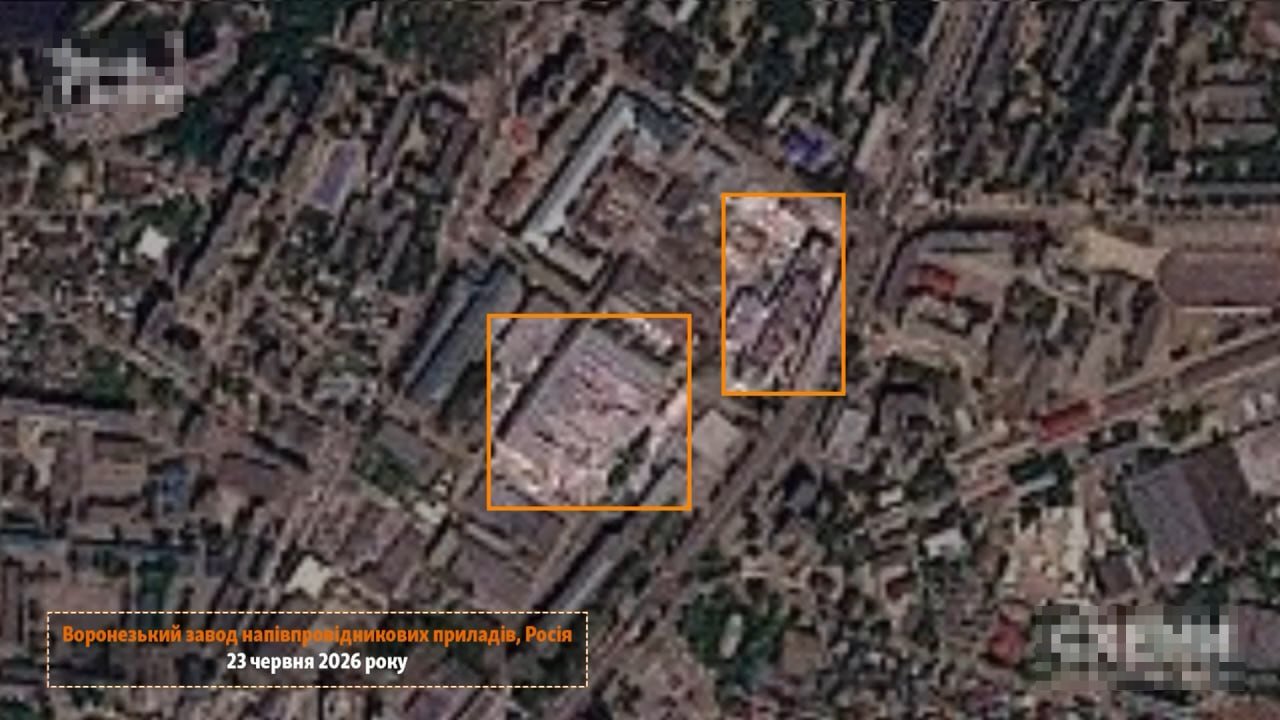
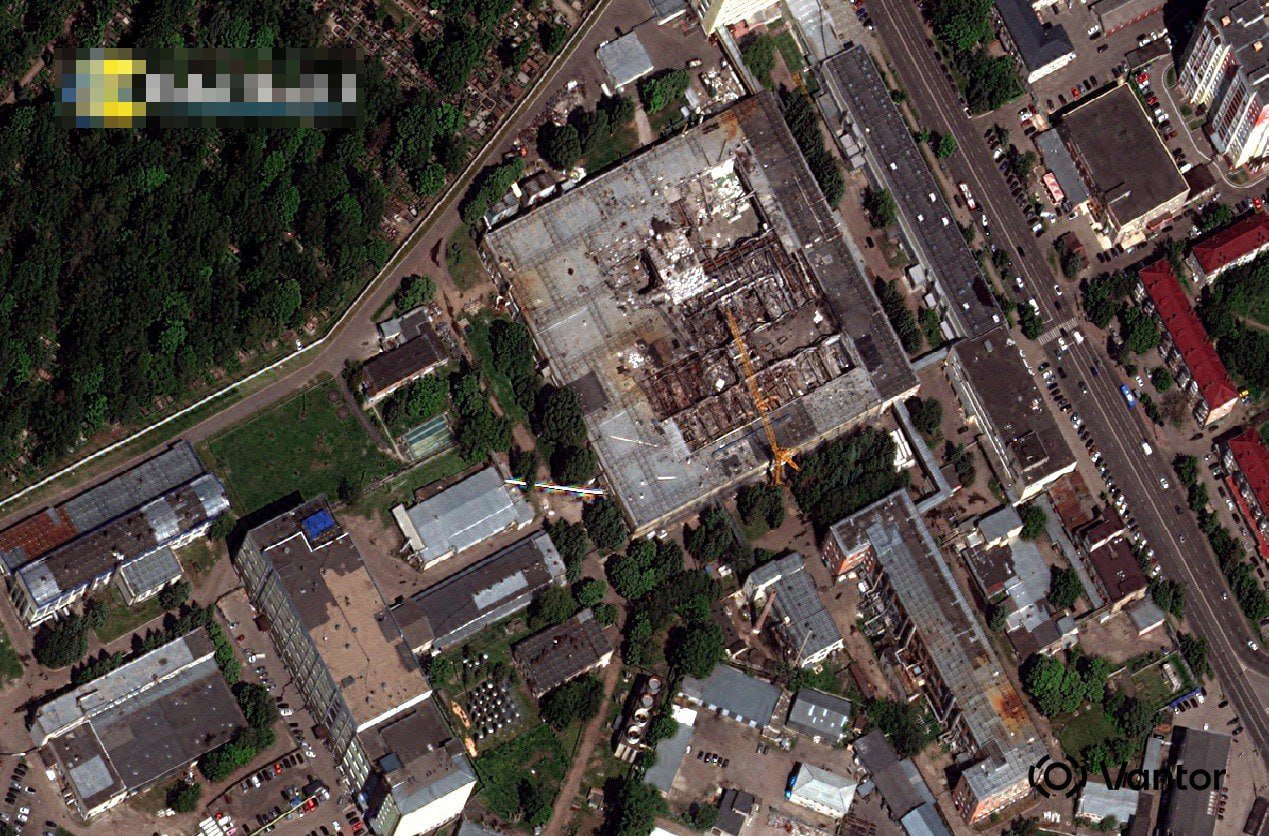
Videos and photographs from space show only a small part of the damage. In this context, the same source on Tuesday published a very interesting and much higher‑quality satellite image showing the wreckage of a microelectronics factory in the Bryansk region, which was hit by several Storm Shadows on 10 March this year.
This is what the moment of the missile impacts looked like in March:
Каждый завод ВПК в России должен выглядеть вот так, как сегодня выглядит завод микроэлектроники для российских ракет «Кремний Эл» в Брянске. Каждый.
Ретвит, если согласны. pic.twitter.com/j77xJFpu7X
— Вестник (@vesstnik) March 10, 2026
This is what the building looked like before the air raid and after the fire was extinguished on 11 March:
It was clear that much of the damage was concealed by the remnants of the roof. We can now assess the overall extent of the destruction of the production facility thanks to Military Informant – the fires almost completely destroyed the interior of the building even in places where the satellite images from March could not prove it. It is virtually certain that although these are different cases (a multi‑storey building in Voronezh, a single‑storey factory hall in Bryansk), the damage is again significantly greater than can be inferred from the imagery published so far.
Videos of the day
Russian trucks were stuck at the “Uspenka“ border crossing between Russia and the Russian-occupied parts of Ukraine, when an Ukrainian drone was attacking.
It is intriguing to see that Russia is still operating this border post, despite claiming the Ukrainian part being Russian,… pic.twitter.com/cd54tHku3U
— (((Tendar))) (@Tendar) June 23, 2026
This video reportedly shows the first combat use of Ukrainian glide bombs dropped from a MiG‑29. In both cases, they hit directly at the locations of bunker entrances.
It is less visible, but the Russians are also attacking Ukrainian logistics. In this case, they targeted a truck in the Kharkiv region.
What are the losses
No update on Wednesday.
Russia had demonstrably lost 23,668 pieces of heavy equipment by Tuesday (on Monday, 8 June, it was 23,593). Of these, 18,652 (18,585) pieces were destroyed by the Ukrainians, 987 (982) were damaged, 1,199 (1,199) were abandoned by their crews and 2,830 (2,827) were captured by the Ukrainian army. This includes 4,404 (4,397) tanks, of which 3,307 (3,300) were destroyed in combat.
Ukraine had lost 11,564 (11,425) pieces of equipment, of which 9,011 (8,888) were destroyed, 687 (680) damaged, 677 (670) abandoned and 1,189 (1,187) captured. This includes 1,433 (1,426) tanks, of which 1,097 (1,091) were destroyed in combat.
Note: Neither side regularly reports on its dead or on destroyed equipment. Ukraine publishes daily figures for Russian casualties and destroyed equipment, which cannot be independently verified. In this overview we use data from the Oryx project, which since the start of the war has compiled a list exclusively of visually confirmed equipment losses.