Since Donald Trump’s return, Europe has consistently failed to get into the rooms where straight answers exist. What Europe has not done is structurally engage enough with the one constituency that can actually give it clear eyes: the opposition.
 Samuel Dempsey




Since Donald Trump’s return, Europe has consistently failed to get into the rooms where straight answers exist.
When EU trade commissioner Maroš Šefčovič travelled to Washington in February 2025 for talks with US commerce secretary Howard Lutnick, National Economic Council director Kevin Hassett, and US trade representative Jamieson Greer, he left with a false sense of “positive momentum.”
When EU foreign affairs chief Kaja Kallas flew to Washington that same month to meet with secretary of state Marco Rubio, she found the meeting cancelled.
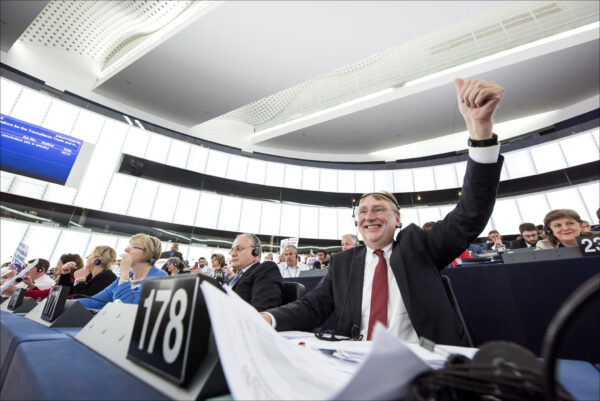
The European Parliament sent its own delegation — foreign affairs chair David McAllister, trade chair Bernd Lange — and did the normal diplomatic rounds, meeting with the Trump administration, MAGA-aligned think tanks, and Congressional leadership.
Yet little, if any, genuine understanding emerged from these encounters. If clarity was gained in Washington, Europe never received it.
The big-ticket visits: Macron in February, Starmer days later, were all Ukraine-driven and assembled under reactive crisis conditions. When Ursula von der Leyen traveled to Trump’s Scottish golf course at Turnberry, she returned with a trade deal built on capitulation.
By January 2026, Washington was threatening to seize Danish territory by force.
Smoke and mirrors
What Europe receives from these engagements is smoke and mirrors: fronted insults written off as political truth-telling, and counterparts unwilling or unable to be constructive, let alone straight with their allies.
The hard pill Europe has not yet swallowed is this — the United States is now, functionally, a government run by one man. In normal times, working Washington meant running all the bases, shifting fluently between Democratic and Republican power centres.
That paradigm is broken. Power today exists only in proximity to Trump himself, and for those around him, the primary objective is climbing the MAGA ladder, not managing allied relationships.
Sub-principal diplomatic contacts are left without substance or influence. An administration staffed by Heritage and America First Policy Institute alumni is far more at home with interlocutors from the MCC than from the Berlaymont.
The one European figure who appears to have cracked the code is Nato secretary general Mark Rutte, whose strategy of public flattery has earned him access.
But don’t confuse access with influence. Strip away the warm optics and what Rutte has actually delivered? A trail of concessions — on Ukraine aid, a war of choice with Iran, and a series of uncoordinated US force-posture withdrawals — and little to show for it beyond a single counterfactual, that the United States remains in Nato.
He has not bent Trump toward Europe. He has bent Europe toward Trump.
What Europe has not done is structurally engage enough with the one constituency that can actually give it clear eyes: the opposition.
And no, not just speaking to Democrats, but speaking to those that recognize the party must no longer be a minority party, but an opposition party.
The progressive Democrats in Congress, progressive think-tanks in Washington, staffed by former officials and analysts who can call a spade a spade and have enough access to see the picture clearly.
While individually, MEPs and European politicians have increased their engagement with the American opposition, it has yet to take a structural form from Brussels, that places it at the forefront of European transatlantic posture.
Back in Brussels, a veneer of normalcy has drained any urgency to build new channels with the organisations and people who will eventually forge a new transatlantic relationship.
MCC and far-right think tanks now dominate the ideological space, hosting American powerbrokers and lobbying on their behalf.
AmCham and major US corporations preserve the appearance of business as usual, unable or unwilling to speak candidly about shifting dynamics in Washington. Without a structured presence that can explain the reality of modern America, the work falls by default to scattered individuals — journalists like Dave Keating — operating without institutional backing to organise this new relationship.
This infrastructure failure is deepened by a generational one.
The European left has, in its own way, already processed the death of the old Washington.
Suspicious of American power long before Trump, shaped by Iraq, Gaza, and a structural critique of liberal hegemony, the MAGA turn registers for them less as rupture than confirmation. But they have never held the keys to the transatlantic relationship.
The problem lies with the centre —the European People’s Party, much of Renew Europe, and the mainstream social democrats who built their foreign policy worldview in the long shadow of the post-Cold War settlement.
The average MEP is 50-years old — and the figures who actually hold foreign policy power across the Commission and European Council skew older still. They insist Brussels and Washington remain natural partners.
‘Old Guard’ collapses
These are the transatlanticists, and they hold the levers of power across the European Council, the Commission, and the major member state governments. They should continue to be transatlanticist, but ones that recognise the relationship as it is, not as it was. This old guard is precisely the least equipped to engage what Washington has become — because doing so would require acknowledging that the world in which their entire political identity was formed has now collapsed.
The basis for transatlanticism in the United States has not merely shifted with Trump. It has broken. And what Europe needs now is not another Alice in Wonderland delegation, or warm diplomatic communiqué — but a new courtship, built with clear eyes — one that engages Americans whose hands are not tied by loyalty oaths, who will not insult Europe’s intelligence with elaborate rationalisations, and who will ultimately bear responsibility for rebuilding what this administration has wilfully damaged.
Unless JD Vance or Tucker Carlson wins the next election, the next administration, regardless of party, will likely prove more transatlanticist than Trump — but that is an exceedingly low bar.
Europeans should therefore identify those interlocutors now, so that when the time comes, both sides can begin to mend — not by restoring what was, but by finding a new way forward.