A new architecture book lifts the lid on Prime Minister Edi Rama’s personal role in bringing world-renowned architects to Albania, inadvertently fuelling discontent over what critics say is an informal form of governance that puts little stock in rules or transparency.
 Vladimir Karaj



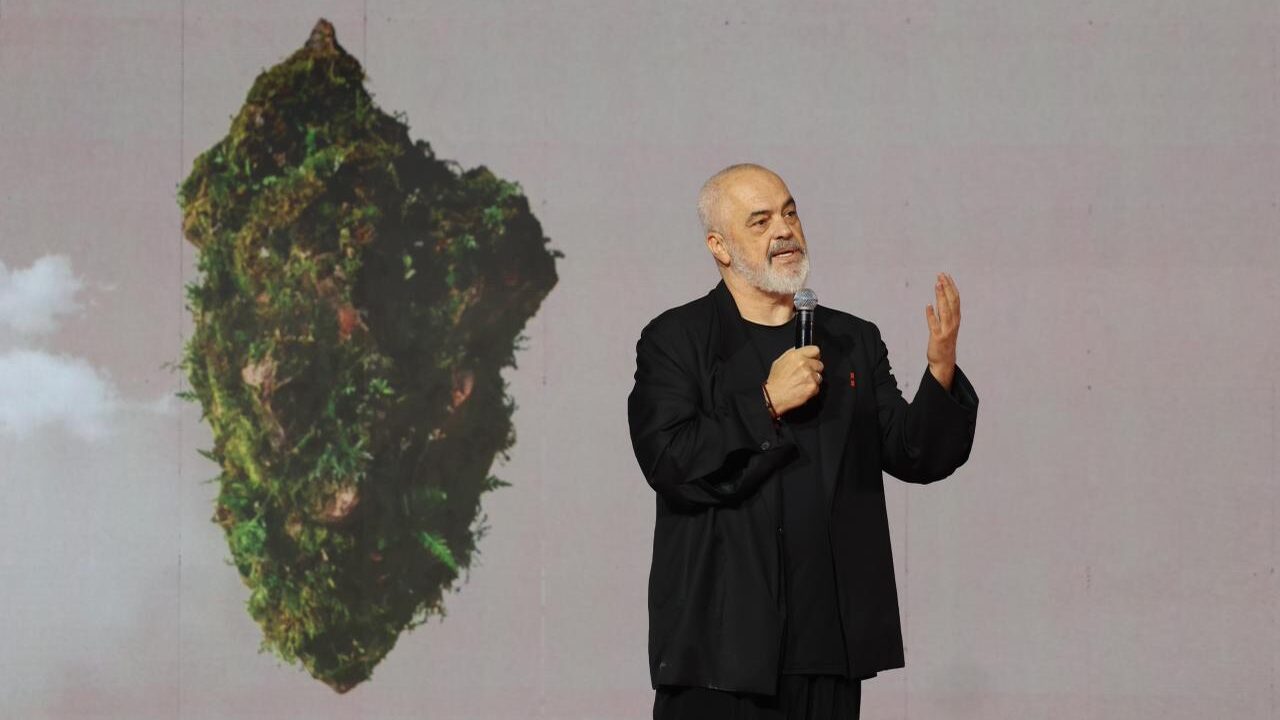
Chermayeff’s story is one of 60 contributions to the recently published The Albanian Files, edited by Anneke Abhelakh and published by Swiss-based Lars Müller Publishers as a look at the “ongoing renewal” of Albania that has placed architecture “at the center of national discourse and created a specific opportunity for architects”.
Featuring a foreword by Albanian Prime Minister Edi Rama, the book offers a rare glimpse into how multi-million-euro development projects were commissioned directly through the prime minister, Roka, and informal networks acting on behalf of private clients.
The book has been seized upon by protesters who have been taking to the streets of Tirana for over a month, spurred at first by anger over a luxury resort development linked to Donald Trump’s son-in-law, Jared Kushner, in a protected lagoon region, but driven on by long-standing grievances over how Albania has been run since the fall of communism in the early 1990s.
Writer and critic Fatos Lubonja, a long-time critic of Rama’s efforts to redraw the Tirana skyline with high-rise developments, said the material contained in The Albanian Files “warrants an investigation”.
Neither Rama, Roka nor the book’s editor, Abhelakh, responded to requests for comment.
‘Five minutes later, the Prime Minister contacted me’
For the past decade, Tirana has been subjected to an aggressive expansion drive, with permits issued for huge towers and sprawling complexes in the name of the 2016 TR030 General Local Plan. Drawn up by the studio of Italian architect Stefano Boeri, the plan envisaged an expansion of the capital’s population by at least 200,000 within 15 years.
Instead, the 2023 census registered a little over 590,000 residents, around 375,000 fewer than the figure cited in the city’s own urban plan for 2013. According to the population count, there were 52,000 unoccupied housing units in the city.
The reality of a shrinking capital has done little to slow the construction boom. In that time, Tirana became a veritable El Dorado for foreign architects. The accounts contained in The Albanian Files suggest many have been directly engaged by Rama, who has hailed Albania’s “architectural renaissance”.
The book features around 520 projects designed by 60 international architecture studios, beginning in the mid-200s, when Rama was mayor of Tirana. The increased exponentially in both scale and volume after 2020, during Rama’s third term as prime minister.
Some of the architects featured in the book describe their experience in Albania with striking candour: Austrian architect Chris Precht, for example, writes about being contacted by Rama on Instagram.
Precht’s studio has designed several large-scale developments in Tirana and elsewhere in the country, including the ‘Eden’ project, a structure built within the courtyard of the prime minister’s office.
Chilean architect Alejandro Aravena also writes about being invited by Rama personally, after a Spanish architecture colleague asked whether she could share Aravena’s contract with the Albanian premier.
“I said: ‘Of course.’ Five minutes later, the Prime Minister contacted me, asking if I could come to Tirana to discuss a potential project,” Aravena writes. His studio, Elemental, is behind a 300-metre tower project that would be the tallest structure in the capital.
German architecture studio BOLLES+WILSON has been working in Tirana since Rama’s tenure as mayor.
According to the book, Rama introduced the studio to an Albanian investor. The project that followed involved the redesign of the façade of an under-construction tower which, according to the studio’s account in the book, “had not met the mayor’s expectations”.
Taken individually, such accounts may be read as proof of Rama’s enthusiasm for high-quality architecture.
Taken together, however, they point to a more problematic pattern, in which foreign architects enter the Albanian market not through open competition but thanks to a network in which Rama and the institutions he holds sway over act as initiators, facilitators or intermediaries.
In this sense, says Lubonja, The Albanian Files is not merely a book about architecture, but a political document and the potential basis for further investigation.
Lubonja argues that Tirana’s construction boom must be looked at in the context of private interests, legal changes introduced on their behalf, and frequent allegations of criminal funding behind the construction.
According to him, the contents of the The Albanian Files suggest that some of these projects – including the proposed five-star resort linked to Kushner – were already planned before changes to legislation on protected areas were introduced.
“These projects were planned before the law was changed; the businessmen knew this, and this is proof of state capture,” he said.
Redi Muci, a member of parliament for the opposition Movement Together party, also read the book as evidence of an informal mode of governance, in which institutions do not control the process but serve to rubberstamp it.
“It is a kind of demonstration of the grandiose delusion of a prime minister who considers himself above the law,” Muci told BIRN.
“Institutions are there to certify informal agreements,” he said, while accusing Rama of acting as a broker and the foreign architecture studios of having found in Albania a place “where they can unleash their imagination, bypassing every urban planning norm”.
‘To bypass the law’