The European Commission will bring forward a proposal on slapping trade bans with Israeli settlers, but will it be trade measure that doesn’t need unanimous agreement, or sanctions, which do.
 Nikolaj Nielsen




Draft EU summit conclusions undergo changes by nature. Some are more significant than others.
The version dated 16 June has removed a line on the Gaza and West Bank, suggesting Germany still won’t budge on trade bans against Israeli settlers, let alone on Israel more broadly.
Although later tweaked and reintroduced, the back and forth pointed to internal political battles on how to deal with Israel.
A previous iteration of a draft dated 8 June demanded that EU states “discuss appropriate measures” in light of the deteriorating situation on the ground.
Those words were axed even as one in six Israeli shipments to the UK and EU contained agricultural goods sourced from illegal settlements in occupied Palestine and the Syrian Golan Heights, according to findings by Global Echo, a non-profit.
Israel has been accelerating settlement expansions and annexation of large parts of the occupied West Bank, including East Jerusalem. The UN says over 36,000 Palestinians have since been displaced, often by violent Israeli security forces and settlers.
This comes on the back of the horrors in Gaza, which is still ruled by Hamas, an EU-designated terrorist group, and where Israeli forces have reportedly killed over 73,000 people since Hamas attacked Israel on 7 October 2023.
As EU leaders gather in Brussels for their summit on Thursday and Friday (18 and 19 June), the back and forth on the Israel line showed German historical sensitivities over the Holocaust, which now saw it give Israel impunity to violate international law.
“We need to go gloves off with the Germans,” says Claudio Francavilla of Human Rights Watch.
“Their sensitivity is not more important than the lives of Palestinian or Lebanese people. Germany is bound by international law to prevent genocide. They can’t allow one to happen because their grandparents committed another,” he added.
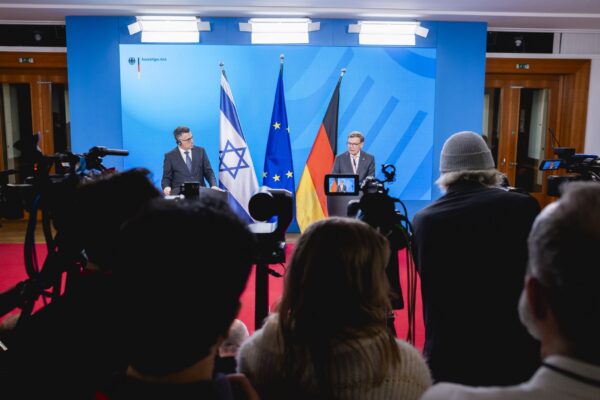
Meanwhile, the EU commission can either hide behind procedural complexities on Israeli settler trade, or it can follow international law and propose a ban.
The commission can still table a proposal regardless of the EU summit conclusions.
Most EU states want action, including Belgium, France, Ireland, the Netherlands, Poland, Spain, and Sweden.
If the commission legal services say banning settler trade is a kind of sanction, it can be vetoed by Germany or smaller Israeli allies, such as the Czech republic.
If they say it is a trade measure, it can be passed by a qualified majority vote (QMV), which requires support from 55 percent of member states representing at least 65 percent of the EU’s population.
Bringing Italy on board could sideline German opposition in such a vote, but Italy is still sitting on the fence, as it awaits the commission’s view.
For his part, Israeli foreign minister Gideon Sa’ar attacked the EU foreign relations chief, Kaja Kallas, on X on Thursday, as part of Israel’s PR campaign to intimidate EU officials.
But even if the commission leans toward Israel and unanimity in the end, or if Italy declines to flip, EU institutions and Israeli settlers could still end up in the EU courts in Luxembourg, as both sides continue to profit from the slow death of the two-state solution.