Next time you hear an EU commissioner say the AI Act needs to be ‘simplified’, the honest translation is: a company asked them to do that, and they said yes.
 Alejandro Tauber



In November 2025, the European Commission unveiled its Digital Omnibus – a package to make digital rules ‘simpler’ for EU businesses.
The AI Act, which is still in the process of being implemented, also made the list. But even before the law has even fully kicked in, the commission is already trimming it back.
That should not come as a surprise to anyone who occasionally reads the news about EU tech regulation. But now, thanks to a new paper from researchers at Trinity College Dublin, Carnegie Mellon, TU Delft, and the University of Edinburgh, we have something of a framework to at least assess what is happening.
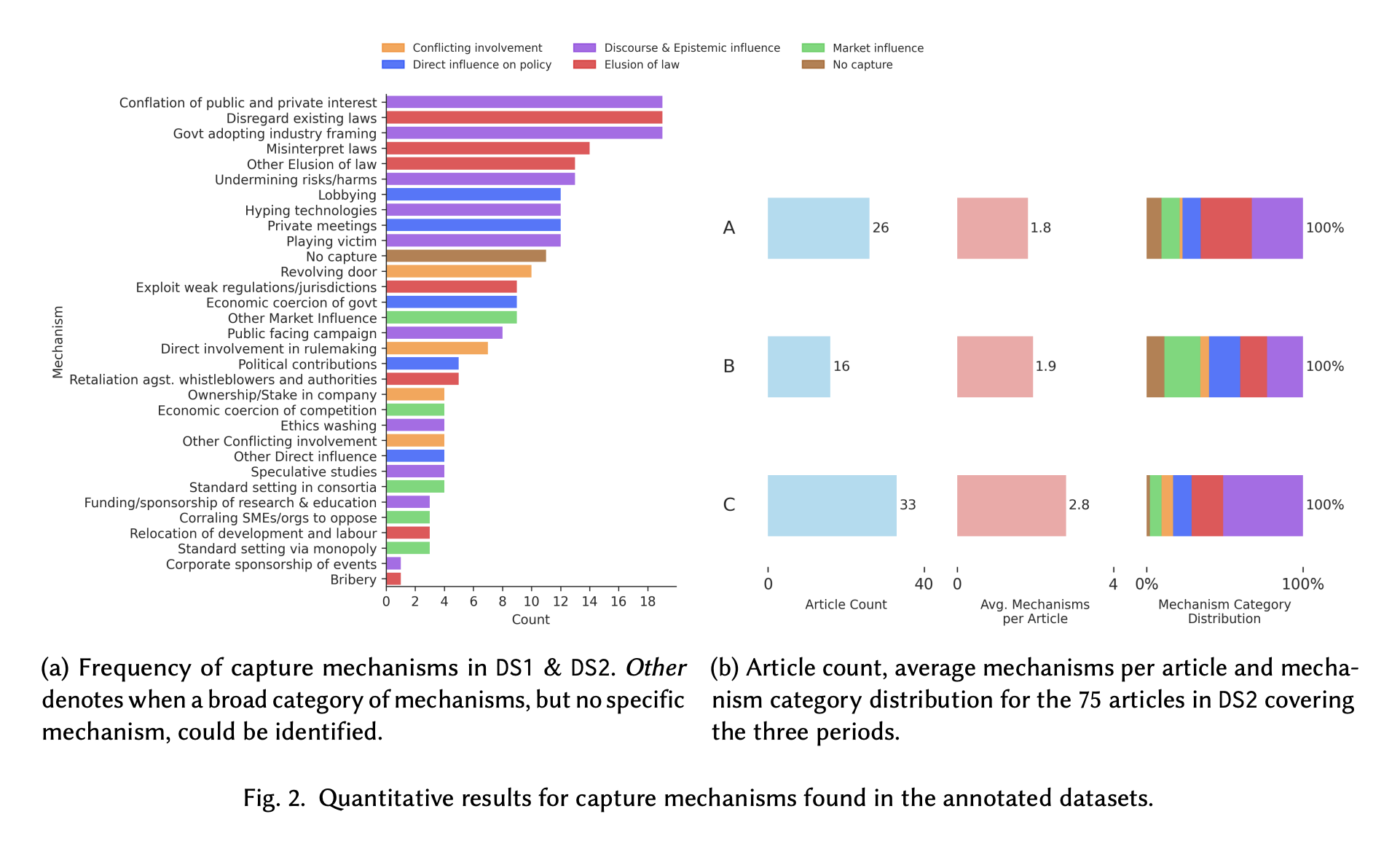
The researchers put together a taxonomy of 27 distinct mechanisms by which Big AI – the handful of companies that build and deploy frontier AI models, plus the Big Tech firms reorganising around them – captures regulators. Or tries to, at least.
The group of researchers, led by Abeba Birhane, annotated 100 Reuters articles spanning three big global AI summits (UK 2023, Korea 2024, Paris 2025) and the AI Act ‘trilogue’ negotiations, between MEPs, EU diplomats, and officials.
Together, they found 249 separate instances of capture mechanisms set out in their taxonomy: lobbying, private meetings, revolving doors, ownership stakes, hyped technology, ‘speculative’ studies, and the catch-all category they call “Discourse & Epistemic Influence” — an unglamorous categorisation of the practice of telling everyone, every day, in every venue, that regulation is killing innovation until everyone believes it.
By the third summit, in Paris, the average article contained nearly three of these mechanisms.
The narratives, oh the narratives
The single most common storyline deployed by Big AI in the paper’s dataset is “regulation stifles innovation.” Number two is “red tape.” Number three is “national interest.” Number four is “competitiveness.”
If those four phrases sound familiar, congratulations, you’ve watched a commission press conference, read a Brussels Playbook by the Politico news website, or sat through any of EU Commission president Ursula von der Leyen’s speeches in the past 18 months.
In her Copenhagen Competitiveness Summit speech in October 2025, von der Leyen karaoke-d industry talking points: “Simplification … deregulation … [cutting] regulatory burden” — language that is interchangeable with the open letter that hundreds of CEOs signed last year demanding Brussels back off.
The paper documents this parroting as a distinct mechanism – ‘Government adopting industry framing’ – and flags von der Leyen’s October 2025 Copenhagen speech as a case in point.
The ‘Code of (watered-down) Practice’
But what about the General Purpose AI Code of Practice, you might ask? — the document that’s supposed to translate the AI Act’s high-level rules into something developers can actually follow for models like GPT, Gemini, Claude, and Mistral.
According to a 2025 analysis, it was continuously diluted. For example, in the final version, protections for human rights were no longer mandatory, but optional.
Documents obtained by Corporate Europe Observatory describe “years of direct pressure, covert groups, tech-funded experts” that “reduced safety obligations, sidelined human rights and anti-discrimination concerns, and secured regulatory carveouts.”

The flagship piece of secondary legislation under the EU’s flagship AI law made human rights (the thing the EU spent the entire ‘Brussels Effect’-era selling itself on) into a tick-box exercise, which firms could choose to ignore.
Go simplification!
France’s ‘plucky start-up’ – that isn’t
The paper also documents 10 high-profile revolving door cases across the US, UK and EU. Nine are outside the EU, but France gets one of them, and it’s a beauty: Cédric O, former secretary of state for digital transition under Frech president Emmanuel Macron, who went from co-shaping French and EU digital policy to becoming a shareholder and adviser at Mistral – the French AI ‘underdog’ that, surprise, has spent the past two years asking Brussels to go easy on general-purpose AI rules.
And let’s be real, Mistral isn’t a startup being crushed by Big Tech.