Unprecedented drone assault on Moscow hit capital’s fuel lifeline and underlined how Ukraine is reshaping the battlefield by striking deep into Russia.
 Tomáš Vasilko



Every day, the Ukraine Battlefield update newsletter offers a clear look at how the war is unfolding on the ground. Subscribe for free here to get the full text delivered to your inbox.
Moscow experienced the worst air raid of the war, with Ukrainian drones hitting the local refinery several times. The lid of an oil storage tank was blown into the air after being hit by Russian air defence. Videos show both successful and unsuccessful Russian air-defence interceptions. Russia – an oil powerhouse – has to import petrol by sea in an effort to ease the fuel crisis. Russians accuse Ukrainians of hitting a bus carrying young Belarusian footballers, which the Ukrainians deny. Map of the day: Russians are pushing Ukrainians back on the left bank of the Oskil river near Kupiansk. Videos of the day: catching drones in nets, a mechanised attack in the Sloviansk direction, Ukrainians hit a truck in Belgorod.
Ukrainian drones flying through the Moscow morning sky. Air defence that tried and failed to stop them. A burning refinery hit at least five times. Smoke from the fire covered the morning sky. And frightened residents, incredulously watching what was happening in the Russian capital four and a half years after the start of Russia’s invasion of Ukraine.
Moscow experienced on Thursday morning the largest Ukrainian attack since the start of the war. Russian official sources said they shot down almost 200 drones directly over the city and its surroundings. In total, they neutralised 555 drones over Russian territory – it was quite likely that a large share of those shot down in other regions had also been heading for Moscow.
They were not able to shoot them all down, however. And the wealth of visual material that Muscovites published despite the ban (one blogger was summoned to a police station for doing so) showed that this was truly something unprecedented.
The main target was the Moscow refinery, located about 15 km south-east of the Kremlin. The Ukrainians had already attacked it on Tuesday, but at that time they managed to hit it with only one drone, although they reportedly struck a key part of the oil-processing operation.
This time, however, the footage showed a greater inferno. According to the independent Russian outlet Astra, the refinery was burning in at least five places because of the drones. Polish analyst Jarosław Wolski wrote that drones hit it at least eight times, and perhaps more than ten times.
Even Moscow mayor Sergei Sobyanin admitted that “several drones reached the refinery”.
This was also confirmed by videos that people filmed and published. They include shots of drones at the very moment they hit the refinery.
The drone dives steeply
This footage shows the „birdcage“ nets Russians have placed around their refineries as protection, but due to weight of the drones, their warheads and, therefore, explosive yield their value is virtually zero. pic.twitter.com/FixIH9zmCK
— (((Tendar))) (@Tendar) June 18, 2026
Two drones hit the refinery a few seconds apart
Fire in the refinery and the burning roof of one building
Absolute devastation inside the Kapotnya refinery in Moscow, Russia. The fires fully engulfed large parts of the Russian refinery, but also objects surrounding this military target have been compromised, whether by Russian air defense action or shrapnel of the exploding refinery. pic.twitter.com/cFLjUBffy4
— (((Tendar))) (@Tendar) June 18, 2026
People also filmed one remarkable incident, when an explosion in an oil storage tank hurled the lid covering it several dozen metres into the air.
Footage of a Ukrainian attack drone hitting a storage tank at the Moscow Oil Refinery this morning, sending the tank lid perfectly soaring hundreds of feet. pic.twitter.com/2GIHEGk52M
— OSINTtechnical (@Osinttechnical) June 18, 2026
Another view of the explosion
Another angle of the explosion of the silo. In Moscow, Russia.
You can see at the end of the footage something crashing on the road. Unclear whether this is shrapnel from the exploding refinery or an Russian air defense missile missing another target. I believe the latter. pic.twitter.com/p08yh90X4J
— (((Tendar))) (@Tendar) June 18, 2026
According to one account, this storage tank was in fact hit by a Russian air-defence missile.
HAHAHAHAHA I think almost everyone has seen the moment when, during the attack on Moscow, the lid of one of the oil tanks was literally blown off.
SO, IT WAS BLOWN OFF AFTER THE IMPACT OF A RUSSIAN AIR DEFENSE MISSILE NOT UKRAINIAN DRONE🤣🤣🤣 pic.twitter.com/p0ZfDIS3jK
— Cloooud |🇺🇦 (@GloOouD) June 18, 2026
Since the refinery was burning in several places, the fire was much more intense than on Tuesday and the black smoke was probably visible from a large part of Moscow.
“This is a fully justified response to Russian attacks on our cities and villages,” Ukrainian president Volodymyr Zelensky commented. The commander of Ukraine’s unmanned-systems forces, Robert Brovdy, alias Magyar, reminded people that Moscow burned down in 1812 during Napoleon’s invasion.
The exact damage to the refinery is not known. However, the Ukrainian OSINT account Kyber Borošno wrote that hits had been recorded on storage tanks, catalytic cracking units, the visbreaking unit area, and the combined unit for producing methyl tert-butyl ether and oligomerate.
Russians invested heavily in the air defence of their capital. According to independent OSINT analysts, they have dozens of Pantsir systems in and around the city. Even so, they failed to completely stop Thursday’s attack.
Russian war reporter Alexander Kots saw it differently. According to him, the 180 drones shot down over the city was something that would have been unthinkable even a month ago. “The air-defence gunners and electronic-warfare crews working in the direction of the capital were operating at the maximum possible intensity,” he said. According to him, drones heading for Moscow included Lutyj, FP-1, Bobr and the Bars rocket drone.
Videos emerged that showed successful air-defence interceptions, but also ones where Russian gunners were not such masters of their craft as the Russian reporter suggested.
Über Moskau hat ein russisches Panzir-S1-System versucht, eine ukrainische FP-1-Drohne mit einer Flugabwehrrakete abzuschießen.
Vergeblich. pic.twitter.com/o3k1zDVrJU
— Julian Röpcke 🇩🇪🤝🇺🇦 (@JulianRoepcke) June 18, 2026
As in Kyiv, shooting down drones in Moscow is also risky, since debris from a hit drone can also cause damage. This is visible in this video, where a downed drone fell onto a roof and caused a fire.
People always mock the ‘falling debris’ claims when countries claim successful interceptions. However it’s why I think proximity fuzes are key. You have to completely blow up the targets in the air pic.twitter.com/1iQBWhsyWb
— Lost Weapons (@LostWeapons) June 18, 2026
In addition, at least two videos appeared showing Ukrainian drones directly hitting residential buildings in Russia. In this case, they hit apartments on the 24th and 25th floors.
It is not clear why these drones hit the apartment blocks; they may have been diverted from their targets by electronic-warfare means.
Another hit apartment block
Drone hit a crane
Moscow really needs to do something about all these cranes. They’re seriously interfering with Ukrainian drone traffic😡 pic.twitter.com/FffGLVLycO
— Special Kherson Cat 🐈🇺🇦 (@bayraktar_1love) June 18, 2026
In any case, Moscow’s residents were shocked by what they saw. The war had largely bypassed Moscow until now. Although similar Ukrainian attacks had been recorded in other Russian cities, they had not yet occurred with such intensity in the capital.
Overall, Russian authorities reported at least 17 people injured. It should be recalled, however, that in the war started by Russia, the residents of Kyiv face attacks of far greater intensity and with far more casualties, and much more often.
Russians in panic, an air-defence missile landed next to a shopping mall
Another instance where the Russian air defense missile not only misses the Ukrainian drone, but also impacts inside a civilian neighborhood. pic.twitter.com/QmvddBIUPT
— (((Tendar))) (@Tendar) June 18, 2026
We were playing and then we saw it, one Muscovite commented.
Moscow is large, however, and one should not think that people everywhere were panicking. As wrote Jiří Just, a Czech journalist living in Moscow, on X, this was “a breaking news story and Muscovites are reading about it.”
“At the moment, Russians are probably angry, it is without doubt the hottest story of the day. We will see, however, how this is reflected in opinion polls and, even better, in the parliamentary elections in September,” he added.
Russians will import petrol. The Moscow refinery normally processes 10 million tonnes of crude oil a year, and petrol from it accounts for roughly half of the capital’s petrol and diesel consumption. After the first attack on Tuesday, it was briefly out of operation, according to Reuters.
The attack comes at a time when there are already fuel shortages not only in Crimea. Some petrol-station chains in Moscow and Saint Petersburg have also introduced refuelling limits.
On Wednesday, a report came out that Russia, an oil powerhouse and until recently one of the largest exporters of crude and oil products, would import petrol by sea. According to a Reuters source, this is to happen in June, when tankers from Asia arrive at western ports. The volume of imported petrol is not known.
This is the first time during the war that Russians will import petrol by sea. Previously, they had imported some supplies from Belarus and Kazakhstan, but these were small volumes, since those countries also need fuel for their own markets.
“One of the sources said that seaborne imports could also be only a temporary measure and were unlikely to bring significant volumes because of logistical problems and high prices,” Reuters wrote.
“The greatest humiliation of an energy superpower,” German economist Janis Kluge commented on the news.
Russia normally produces so much fuel that it exports large volumes worldwide and ranks among the biggest exporters. Last year, it exported an average of 117,000 barrels of petrol per day. For comparison, the United States, the largest exporter, ships about 900,000 barrels of motor petrol per day.
This is changing, however, after the attacks on refineries. Russia has introduced a ban on petrol exports abroad, which is to remain in force until the end of July.
And this is happening just as summer is approaching, the peak period of fuel consumption for travel and agricultural work.
This summer, however, there may be less travel in Crimea. As the Russian channel Rybar wrote, because of the fuel crisis on the occupied peninsula, 79 percent of bookings have been cancelled over the past two weeks.
Russians again accuse Ukrainians of attacking a bus full of civilians. This time they accuse them of a drone hitting a bus in Russia’s Bryansk region, carrying members of a youth football team from Homyel in Belarus.
According to them, one adult woman was killed in the attack and six other people ended up in hospital, including four children. They also published footage of the damaged bus.
A week earlier, Russians had likewise accused Ukrainians of hitting a bus with a drone near Donetsk. At that time, a video also leaked out clearly showing a drone strike that looked like a Hornet drone used by Ukrainians.
Whereas then the Ukrainians did not comment on the attack, which suggests that they probably did hit the bus, this time they unequivocally rejected responsibility. The General Staff of the Ukrainian army said that at that time they had not conducted any drone attacks in the Bryansk region.
“Since the Russian Federation is failing to achieve its stated objectives on the battlefield and has suffered significant losses, it is increasingly resorting to manipulating information and fabricating accusations against Ukraine,” the General Staff declared.
The Ukrainian human-rights ombudsman announced that he had contacted the Belarusian side.
The Russian channel Rybar asked whether Ukrainians were trying to drag Belarus into the war. How would that suit the Ukrainians?
“The armed forces of this country in themselves do not represent a major threat to the Ukrainian armed forces, but this situation would force the Russian leadership to move forces to protect its ally,” Rybar wrote.
Maps of the day
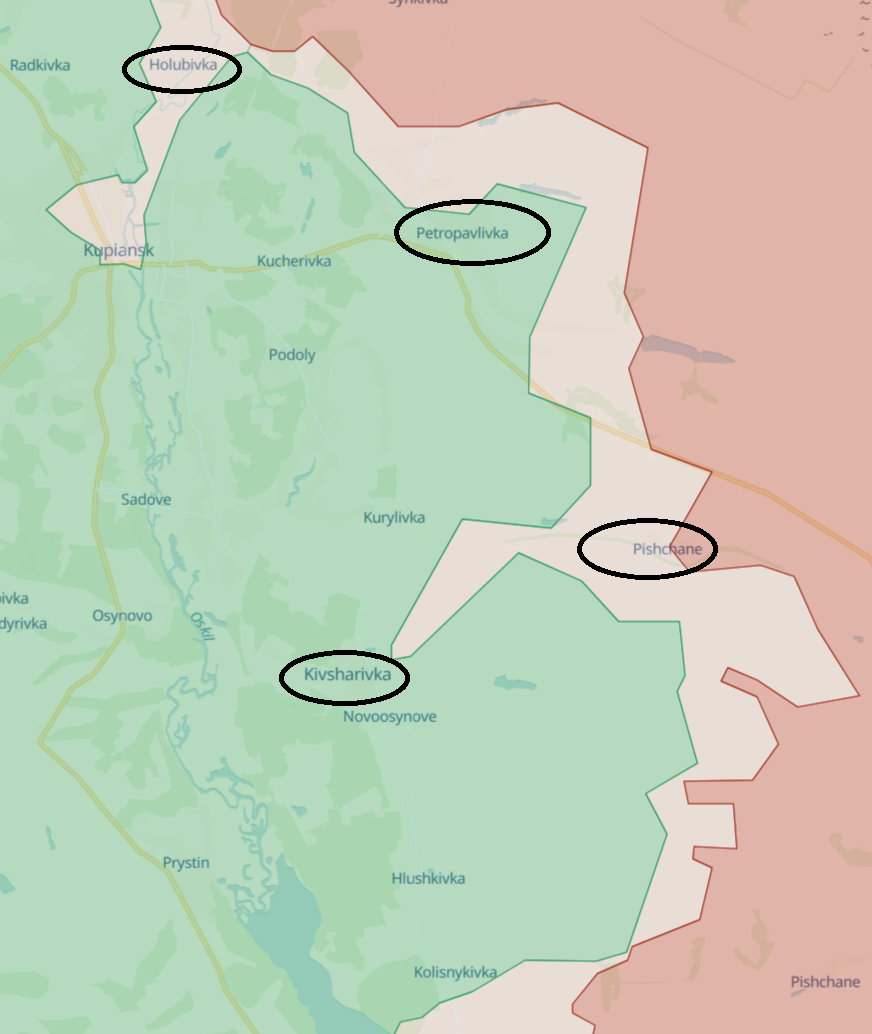
The situation for Ukrainians around Kupiansk is deteriorating. This is not visible on the DeepState UA map, because that account has lately been updating its map only at long intervals. However, Russians are pushing Ukrainian troops in the area around the town of Kupiansk. Ukrainians hold a bridgehead on the Oskil river here, specifically on its left bank. The Russians are trying to drive them out.
As wrote Ukrainian military analyst Bohdan Myroshnykov, the situation there is very difficult, and on the left bank of the Oskil even “critical”.
“The enemy constantly penetrates into Kivsharivka, where it then concentrates,” he wrote, adding that this is the key village for the entire Ukrainian bridgehead.
In the area of Petropavlivka and Pishchane the situation is “catastrophic”. “Logistical support there almost does not exist, because supplies dropped by drones are a dubious option under conditions of enemy electronic warfare. I have no idea how long we will still be able to hold this bridgehead, but it looks bad,” he wrote.
The mentioned villages are circled. Source – DeepState UA
On the right bank of the Oskil north of Kupiansk the situation is better; at least ground resupply drones get through from time to time. According to him, fighting is under way in Holubivka and Kindrashivka.
“Perhaps it would be easier to list the areas where there is no active fighting. Because such areas simply do not exist. The Kupiansk axis has unjustly slipped out of public attention,” Myroshnykov wrote.
The area around Kupiansk according to the Black Bird Group map
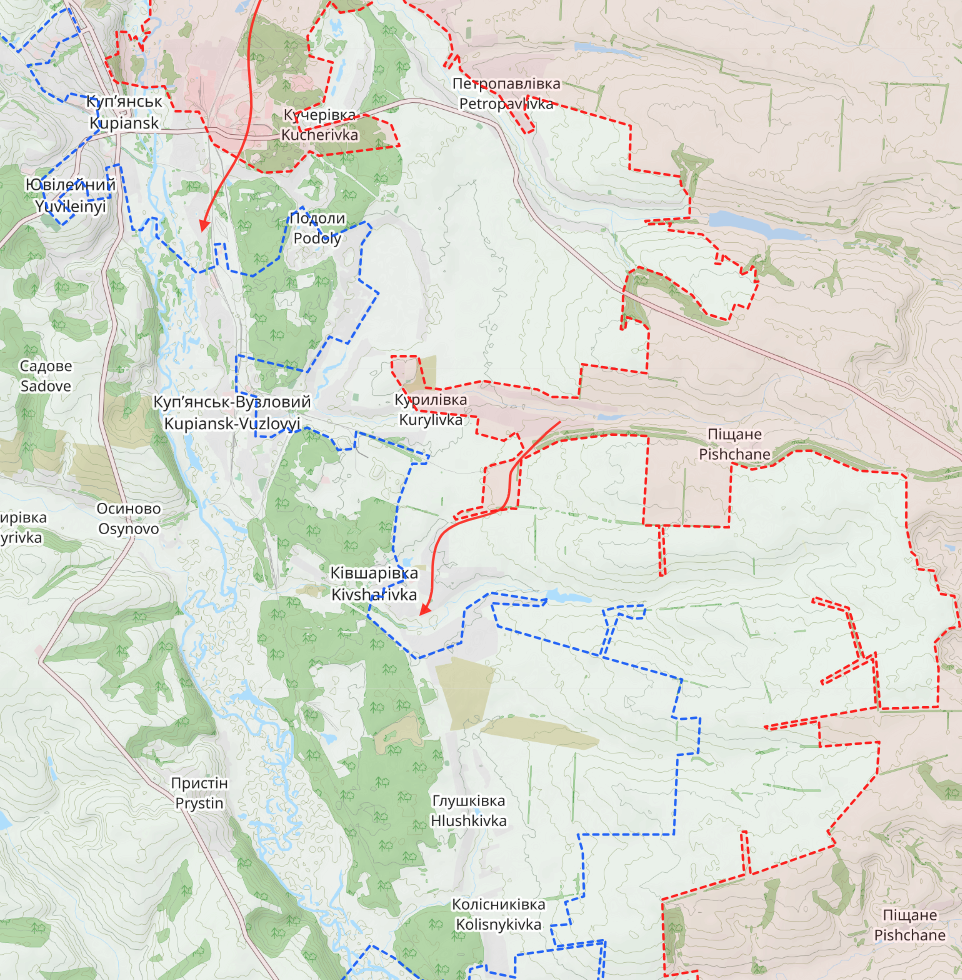
Chart of the day
According to the Oko Hora account, Russians advanced by 17 square kms last week. This is a similar figure to the week before. The account is based on data from DeepState UA.
Russian progress by weeks
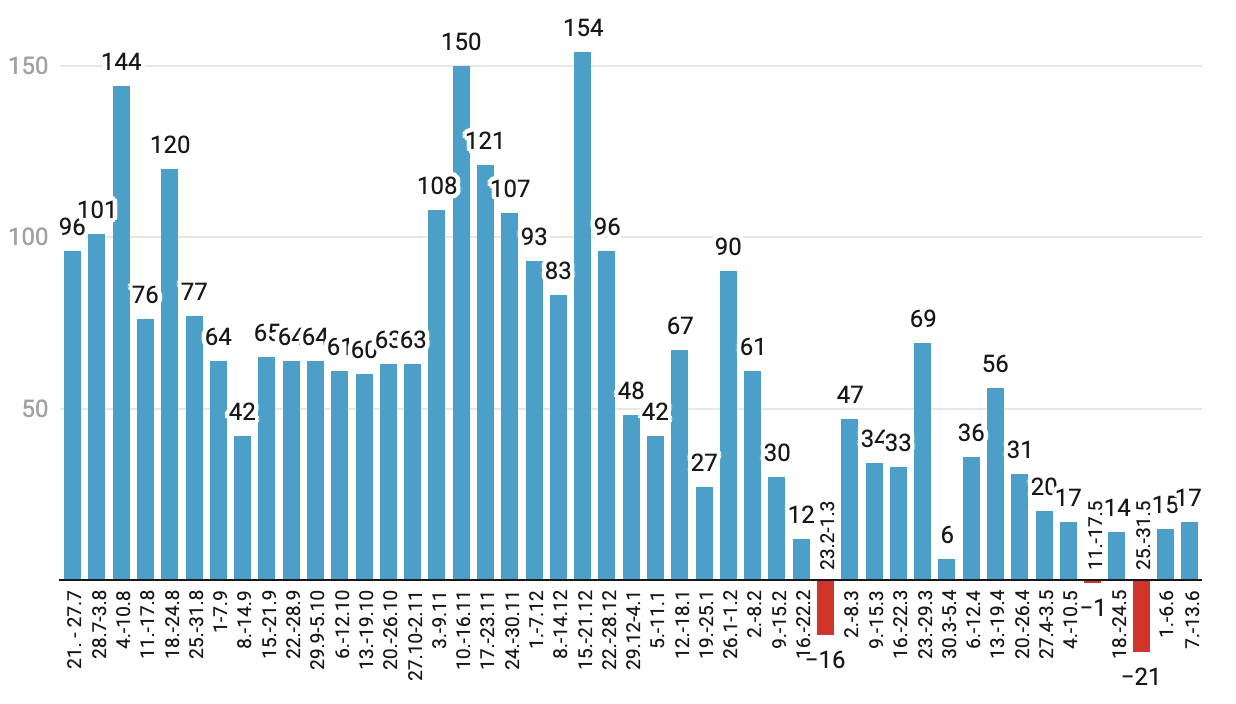 The amount of territory occupied by Russia per week. The figures are in square kilometres. Source: Oko Hora account/Data Wrapper.
 Videos of the day
Videos from training and from the frontline showing Ukrainian soldiers trying to neutralise drones with a net.
Although motorised assaults are currently rare on the frontline, both sides occasionally try them. According to Ukrainian defence ministry adviser Serhiy Sternenko, this video shows footage from one such attack in the Sloviansk direction that took place on Friday.
He said it involved 28 motorbikes, one tank, three BMP infantry fighting vehicles and five cars, and a total of 50 infantry soldiers. Despite this, they failed to reach even the first line of defence.
‼️Один із наймасштабніших штурмів на Слов’янському напрямку влаштували окупанти на «день росії».
ББпС Apachi разом із суміжними підрозділами зірвали спробу. Жодна з механізованих груп не змогла досягти навіть першої лінії оборони
Для цього штурму противник залучив:
28… https://t.co/cGBZ3LErX3 pic.twitter.com/86ysHtEM7h
— Serhii Sternenko (@sternenko) June 17, 2026
Ukrainians are now striking logistics targets on Russian territory as well. In this video from Belgorod, you can see a drone hitting the cab of a truck at a junction in the Russian city. The driver died in the attack and the vehicle is probably a write-off. Russian sources claim that Ukrainians are targeting civilian drivers of civilian trucks. We do not know whether this was truly a civilian truck (there have previously been reports of military materiel being transported in civilian vehicles).
What are the losses
Last updated on Monday (6 June).
By Monday (6 June), Russia had demonstrably lost 23,593 pieces of heavy equipment (on Monday (1 June) it was 23,556). Of these, 18,585 (18,551) pieces were destroyed by Ukrainians, 982 (979) were damaged, 1,199 (1,199) were abandoned by their crews, and 2,827 (2,827) were captured by the Ukrainian army. This includes 4,397 (4,394) tanks, of which 3,300 (3,293) were destroyed in combat. Ukraine has lost 11,425 (11,397) pieces of equipment, of which 8,888 (8,863) were destroyed, 680 (678) damaged, 670 (669) abandoned and 1,187 (1,187) captured. This includes 1,426 (1,424) tanks, of which 1,091 (1,089) were destroyed in combat.
Note: Neither side regularly reports its dead or destroyed equipment. Ukraine publishes daily figures for Russian casualties and destroyed equipment, which cannot be independently verified. In this overview, we use data from the Oryx project which, since the start of the war, has compiled a list of equipment losses documented exclusively by photographic evidence.