Human rights NGO’s report says routine denial of war crimes and glorification of convicted war criminals form part of deliberate strategy to sow division and undermine democratic values.
 Ivana Jeremic



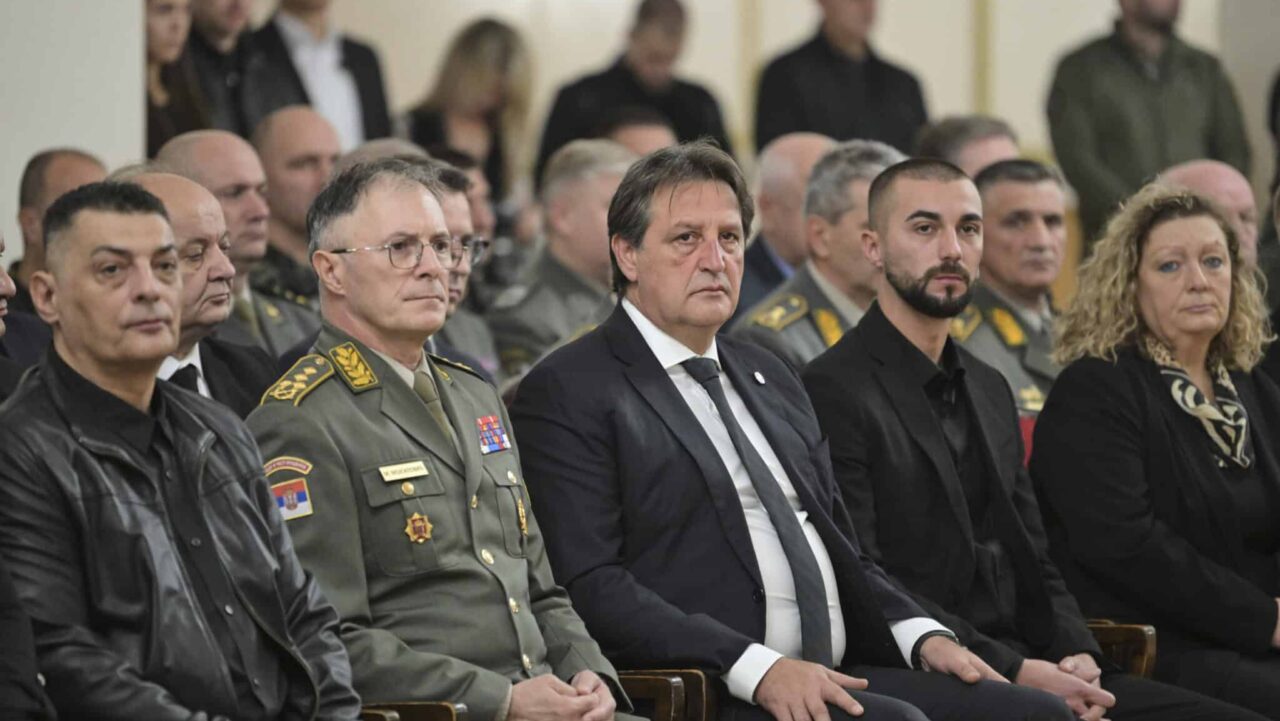
Serbian Defence Minister Bratislav Gasic (centre) Chief of General Staff Milan Mojsilovic (second left) at a commemoration for Nebojsa Pavkovic in Belgrade, October 2025. Photo: mod.gov.rs
A new report published on Monday says denial of the war crimes committed during the Yugoslav wars is routinely used by those in power in Serbia to discredit opponents, civil society organisations and independent media, particularly during periods of political tension and public dissent.
The report by the Youth Initiative for Human Rights Serbia, covering 2025, documents widespread denial of the war crimes committed during the 1990s both by officials and institutions in Serbia.
The report, titled “State of Denial – Serbia 2025: War Criminals as Distinguished Citizens”, identified at least 110 instances of denial of war crimes committed during the 1990s and around 60 cases of glorification involving 10 convicted war criminals, as well as 50 cases of various forms of war-crimes denial.
They include denial of the crimes committed in 1999 at Racak, Kosovo, when Serb forces killed dozens of Kosovo Albanians, the 1992-5 Bosnian Serb siege of Sarajevo, the existence of Bosnian Serb-run detention camps in Prijedor, north-west Bosnia, during the Bosnian war, and the existence of mass graves of Kosovo war victims in Batajnica, Serbia.
The report notes that, like in previous years, denial of the 1995 Srebrenica genocide committed by Bosnian Serb forces remained the single most frequently denied crime in 2025, with 30 documented cases of denial.
It says that as in previous years, representatives of the executive branch, from the President through to the Prime Minister and ministers and various institutions, are at the forefront of denying and relativising war crimes.
“We knew that the denial and relativisation of war crimes had become one of the central pillars of politics in Serbia. It is a primary tool for fomenting hatred … The past year was a clear example that the goal of denial and the misuse of the wartime past is, in fact, the destruction of our society’s democratic capacities,” said Sofija Todorovic, director of the Youth Initiative for Human Rights Serbia.
“During the past year, the highest-ranking government officials repeatedly and falsely accused representatives of the opposition and the student movement of claiming that Serbs are ‘genocidal people’,” she added.
Todorovic highlighted the obstruction of cooperation with the International Residual Mechanism for Criminal Tribunals in cases involving several officials of the Serbian Radical Party, the refusal to recognise a judgment of the Court of Bosnia and Herzegovina concerning the 1995 massacre at Tuzla Gate, where a Bosnian Serb shell killed 71 people, as well as the appointment of Dragoslav Bokan, founder of the Serbian paramilitary unit White Eagles, as chairman of the board of the National Theatre in Belgrade, as examples of the institutional blockage of efforts to confront Serbia’s wartime past.
The report identifies the death of convicted war criminal Nebojsa Pavkovic as the most significant example of war-crimes denial and glorification in Serbia last year. State institutions and pro-government media used his illness and death to portray him as a distinguished military officer while downplaying or denying the crimes for which he was convicted. Pavkovic became the first war criminal from the 1990s to be buried in the Alley of Distinguished Citizens, with full military honours, which the report describes as a “dangerous precedent”.
Chauvinistic rhetoric against Croatian citizens, as well as Serbian citizens with dual citizenship, intensified in 2025. The report mapped five of the most indicative cases of rights violations and analysed more than 20 discriminatory statements made by high-ranking officials in Serbia and pro-government media that labelled Croatian citizens and Serbian citizens belonging to the Croatian minority as “Ustasha”, referencing the Croatian fascist organisation of the 1940s.
In his reaction to accusations against the government that it had used a sonic weapon at the opposition protest on 15 March, former Prime Minister Milos Vucevic stated that this was a lie “just as the crimes in Markale and Racak are lies.”
Among the most important actors are the media, which give space and glorify convicted war criminals and often encourage topics and discussions that deny or relativise the crimes committed. These denial practices often include hate speech and discrimination based on national, religious and political affiliation, the report says.