The Serbian government has agreed to return and bury in Belgrade the remains of Blagoje Jovovic, who claimed he shot and wounded Croatian World War II fascist leader Ante Pavelic in 1957 in Argentina.
 Gordana Andric



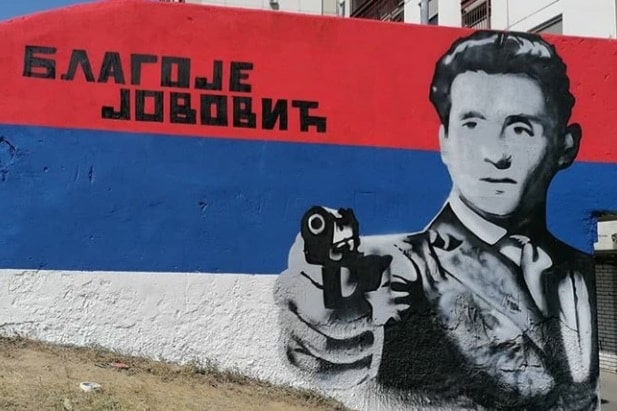
The Serbian government said on Thursday that it has agreed to bring back the remains of Blagoje Jovovic from Argentina to Belgrade for burial, as “a tribute to the man who, in 1957, carried out an assassination attempt on the Ustasha leader Ante Pavelic in Lomas del Palomar, Argentina”.
Following Thursday’s government session, the government said that “Jovovic was a fighter of the Yugoslav Army”, and that the initiative to return his remains to Serbia was launched on April 10 – the day of the alleged assassination attempt and the day that the Nazi-allied Independent State of Croatia, NDH was established in 1941.
Between 1941 and 1945, Pavelic’s NDH adopted Nazi-style racist laws and persecuted Serbs, Jews, Roma and Croatian anti-Fascists; according to an official name-by-name list, 83,145 victims of the regime perished at the main Ustasha-run concentration camp at Jasenovac in central Croatia.
After fleeing in 1945, Pavelic reached safety in Argentina, where he continued his political activities. Jovovic allegedly shot him in Buenos Aires in 1957, but Pavelic survived.
Pavelic then moved to fascist-ruled Spain – due to his good relations with General Francisco Franco’s regime – where he died in 1959, aged 70.
The BBC’s Serbian service reported in April that there is little proof, besides Jovovic’s own statements and the testimonies of his family, that he indeed shoot Pavelic.
His daughter Marija has previously told media that after World War II, Jovovic emigrated to Argentina where he opened a hotel. After learning that Pavelic fled to Buenos Aires, he prepared for months for to kill the Croatian fascist leader.
“The only evidence we have that Jovovic actually carried out this act is what he told his priest,” Rory Yeomans, a British historian and author of the book Visions of Annihilation: The Ustasha Regime and the Cultural Politics of Fascism, 1941-1945 told BBC Serbian.
“I do not dismiss the possibility that he did it; there is simply very little evidence,” Yeomans said,
BBC Serbian also quoted Nikolina Zidek, a professor of international relations at IE University in Spain, who said there is “no firm and indisputable evidence” that Jovovic carried out the assassination attempt, “although it is regarded as the most likely theory”.
“In a dispatch from the Embassy of the Socialist Federal Republic of Yugoslavia (SFRY) in April 1957, it is mentioned that Pavelic withdrew his accusation that an official of the SFRY Embassy had been the assassin, and that newspapers were besieging the embassy for statements concerning Pavelic,” Zidek said.
Serbia’s Minister for Veterans’ Affairs Milica Djurdjevic Stamenkovski announced that the government will launch the initiative to return Jovovic’s remains on her Instagram account in April, stating that this reflected the wishes of his family and daughter.