With Ukraine knocking Moscow’s key refinery offline for days, Russians are watching their own infrastructure burn, as hardliners fantasise about wiping Kyiv off the map in revenge.
 Roman Pataj



Every day, the Ukraine Battlefield update newsletter offers a clear look at how the war is unfolding on the ground. Subscribe for free here to get the full text delivered to your inbox.
Welcome to the Russian world – nuclear bombs in every other sentence, inability to distinguish cause from effect, and other mental crashes. The Moscow refinery has been knocked out of operation for at least several days. The most photogenic part of the attack on Moscow was caused by an inaccurate Russian missile. The Russians claim they have captured Rai-Oleksandrivka. They are probably celebrating prematurely again. A risky dance is underway near Lyman. The Russians are pushing into the town, while further north the Ukrainians are trying to get into their rear. Maps of the day – Lyman; Rai-Oleksandrivka. Videos of the day – a new attack on Moscow, aftermath of the previous attack from multiple angles.
Welcome to the Russian world – nuclear bombs in every other sentence, inability to distinguish cause from effect, and other mental crashes. “In Moscow, many people finally realised that there was a war going on,” the Russian Telegram channel Notes of a Veteran wrote about Thursday’s air raid on Moscow.
At the time of writing this part of the Ukraine Battlefield update, another attack on the capital was already under way, with the outcome still unknown. The very fact that for the second day in a row Ukrainian drones were flying over Moscow did nothing to improve Russians’ mood.
❗️🇷🇺Moscow is under attack again. Drones are approaching the Russian capital from different directions — a massive attack is beginning. pic.twitter.com/CmFtGMb3lo
— 🪖MilitaryNewsUA🇺🇦 (@front_ukrainian) June 19, 2026
The reactions to the successful strike on the Moscow refinery say everything essential about the state of mind of the pro-war segment of Russian society. Since another segment certainly exists but remains silent, we are left to observe only this one, because it forms the backbone of Putin’s regime.
The first thing to note is the use of the “forbidden” word war, which is now becoming the norm, even though in the past merely uttering it was enough to trigger criminal prosecution. It was used by Notes of a Veteran and also by an evidently disgruntled prominent propagandist, Vladimir Solovyov, who is already preparing Russians for a long war, although he once promised them one that would not even last weeks.
Following the strike on the Moscow oil refinery, Solovyov began calling on Russians to prepare for hard times and self-sacrifice. pic.twitter.com/XlD4dYeZhx
— WarTranslated (@wartranslated) June 18, 2026
It is no exaggeration to say that pro-war Russians have succumbed to madness. One of the worst examples is a post by Konstantin Malofeyev. He is a Russian oligarch and ultra-Orthodox fanatic who financed the start of the war in Donbas in 2014, as well as pro-Russian forces in Europe, including Slovakia.
Malofeyev, who has 1.3m Russian readers, claimed that war meant “victory at any cost” and openly called for nuclear apocalypse: “Why do we not use the nuclear weapons that our forefathers, with the exertion of the entire country, produced and stockpiled for precisely this purpose? So that we would win. So that no one would even dare to think of war with a nuclear superpower. So that our people, our civilians, would not suffer. When choosing between our own and outsiders, we must choose our own. Pity them, not outsiders. What else has to happen? What are we waiting for?”.
The same author also deployed another favourite narrative of the hard-core pro-war camp, which claims that “we have a special military operation, therefore we are not fighting with all our strength and means, but at half throttle, like gentlemen, with the same weapons as the enemy.”
Malofeyev personifies the regime’s view that while it could bomb and destroy Ukrainian cities with impunity for four and a half years, an attack on the Moscow refinery was “terrorism”.
The Komsomolskaya Pravda reporter Aleksandr Kots may not be calling for the use of nuclear weapons, but he also has a recipe for how to destroy Kyiv: “The khokhols (a derogatory term for Ukrainians) are celebrating today, all channels are running videos of the Moscow refinery on fire. Realistically, the only thing that could trump this would be blowing up the dam above Kyiv – the water would wash away that filth as well as the bridges across the Dnipro.”
Again – after every major air raid on Ukraine, people like him revel in the scale of destruction and damage; now they feel that some injustice is being done to them which deserves the bloodiest retaliation.
Yuriy Kotenok, in calling for a nuclear strike, relied on quoting one of his readers, who sent him the following message: “Why do we not use tactical nuclear weapons? They dropped one on Hiroshima and nobody cared, and besides, our constitution says we can use them!”.
This author, however, came up with his own innovation, this time aimed inside Russia. In addition to calling for de facto total war, like the Nazis in 1943, he proposed in another post that the regime should be radicalised against its own citizens.
“It is obvious that we will not manage without introducing a strict counterintelligence regime and tightening punishments for treason,” Kotenok proposed, who, like every supporter of totalitarian regimes, constantly looks for ever new enemies that must be destroyed, even at the cost of them being his own fellow citizens.
Nor does the former Russian ambassador to Nato, former head of Roscosmos and Duma deputy Dmitry Rogozin distinguish between cause and effect, and he joined those who think that Kyiv can be bombed every night, but if it happens to Moscow, then terrible evil is being done: “The enemy has opted for a sharp escalation, and it is no secret that this encourages its sponsors, including the USA, to give it more drones and more money. The suffering of our civilian population and the blood of our people only excites these vampires even more. That is obvious …”.
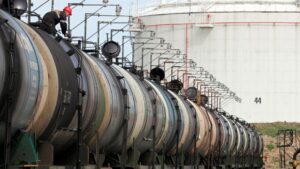
The Moscow refinery has been knocked out of operation for at least several days. Drones hit one of the two refining units, having damaged the first one in the air raid on 16 June. The Russian opposition outlet Meduza reported this on the basis of a Reuters dispatch.
Less important service facilities, oil tanks (the flying cover), pipelines and the like were also damaged. As Meduza wrote, the AVT-6 refining unit that was hit has a capacity of 140,000 barrels of oil per day, which it processes in such a way that commercial fuels can subsequently be produced from it.
The most photogenic part of the attack on Moscow was caused by an inaccurate Russian missile. On Thursday, videos and photographs circled the world showing, after a large explosion, a massive cover being blown off the top of an oil storage tank in the Russian capital. They immediately became the source of numerous jokes.
The incident also became a symbol of a successful Ukrainian air raid and, conversely, of failed Russian air defence. That still holds, but the “perpetrator” has now definitively changed. We already wrote yesterday that it was probably a Russian missile. Only later did a video emerge that, beyond any doubt, shows that the large tank was hit and destroyed by a malfunctioning Russian surface-to-air missile. It may have been from a Pantsir air-defence system, or from a man-portable system in the MANPADS category, but that is irrelevant.
In footage shot from the opposite side to that shown in yesterday’s videos, you can see an incoming drone approaching the already smoking refinery, when at the 29th second a missile launches towards it. It harmlessly passes under the unmanned aircraft and immediately afterwards hits the tank. It was probably not the first missile. In the sky, roughly along the drone’s flight path, you can see the trail of another missile. If it was not aimed at a different target, that would mean that two guided missiles failed to destroy a single low- and slow-flying drone.
A clearer view of the Russian air defence missile that caused the now famous UFO incident in Moscow earlier today, starting at 0:26 pic.twitter.com/3NKkCiyNho
— Ukraine Control Map (@UAControlMap) June 18, 2026
The Russians claim they have captured Rai-Oleksandrivka. They are probably celebrating prematurely again. This is a very important location on the Sloviansk axis. From its western edge to the eastern edge of Sloviansk is less than 10 km as the crow flies. The village lies on high ground and, according to maps, has another advantage for Russian plans. Between it and the city runs the Siverskyi Donets–Donbas canal, which is an obstacle for an attacker, but at this point there are two sections that run underground. Together they are almost 2 km long. To their north-east, however, stands the large and important settlement of Mykolaivka (marked as Nikolayevka in Russian transcription on the map), which the Russians must inevitably seize if they want to begin the battle for Sloviansk itself.
We are not there yet. So far it is only the Russian defence ministry that claims Rai-Oleksandrivka has fallen. On Rybar’s map below you can find it right in the middle. The Russian Telegram account assessed the change cautiously:
“At this stage, the liberation of Rai-Oleksandrivka should be regarded as an important tactical success that has improved the situation of Russian units on the Sloviansk axis, but not as an event that automatically opens the way to a rapid offensive towards the Sloviansk–Kramatorsk agglomeration.”
Traditionally triumphalist is the largest Z-channel, run by Yuriy Podolyaka. This prominent supporter of the war has lately turned into a herald of often non-existent good news, and he described the report of the alleged capture of Rai-Oleksandrivka as “extraordinarily significant”.
He called the village a base for an attack on Mykolaivka and Sloviansk. In that he is unquestionably right. Once villages are captured, drone operators move into them. In addition, Podolyaka already sees Russian artillery positions in Rai-Oleksandrivka for shelling Sloviansk and Kramatorsk. And as a third advantage, he sees the provision of support for neighbouring Russian units that are advancing further north towards Lyman directly from the east.
The Russian advance in Rai-Oleksandrivka was also confirmed by the Ukrainian analyst Petrenko. He likewise confirmed the presence of Russian soldiers in the westernmost part of the village. He marked the exact locations of their presence on this map of his.
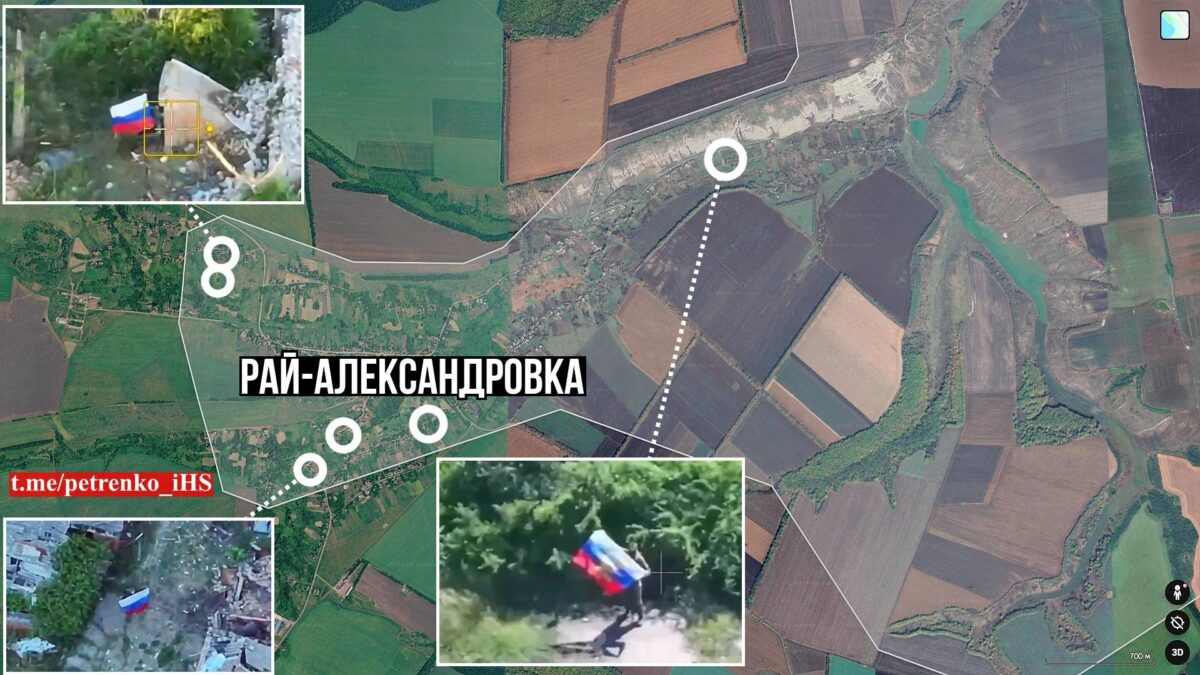
Petrenko also suggested, however, that this was another wave of fake flag raisings. In the videos he published alongside his map, it really looks as if Putin’s foot soldiers were simply ordered to run somewhere quickly and show flags so that the defence ministry could announce a victory. Nothing resembled a situation in which they actually had firm control of the area.
“Over the past year and a half, the wave of flag raisings, premature declarations about the capture of settlements and other information hoaxes has three times coincided with preparations for negotiations. If this pattern repeats, August to September will again become a period of revived diplomatic talks,” Petrenko said.
The Polish OSINT account Thorkill has some very interesting observations about the situation in the village. He argued that even if the Russians really had occupied most of the settlement, or if it were at least a grey zone, “it would not be of fundamental significance, because units of the 10th Mountain Assault Brigade (Ukrainian) continue to hold positions on all the heights around the village – including Hill 202, which is located to the east of the village.”
Sytuacja w rejonie Rai-Oleksandriwki (Słowiańsk), część II.
W rejonie Raj-Ołeksandriwki trwają ciężkie walki pozycyjne pomiędzy rosyjską 88 i 123 Brygadą Strzelców Zmotoryzowanych ze składu 3 Armii a ukraińską 10 Górską Brygadą Szturmową wchodzącą w skład Grupy Taktycznej… pic.twitter.com/TiZMo3gSmj
— Thorkill (@Thorkill65) June 18, 2026
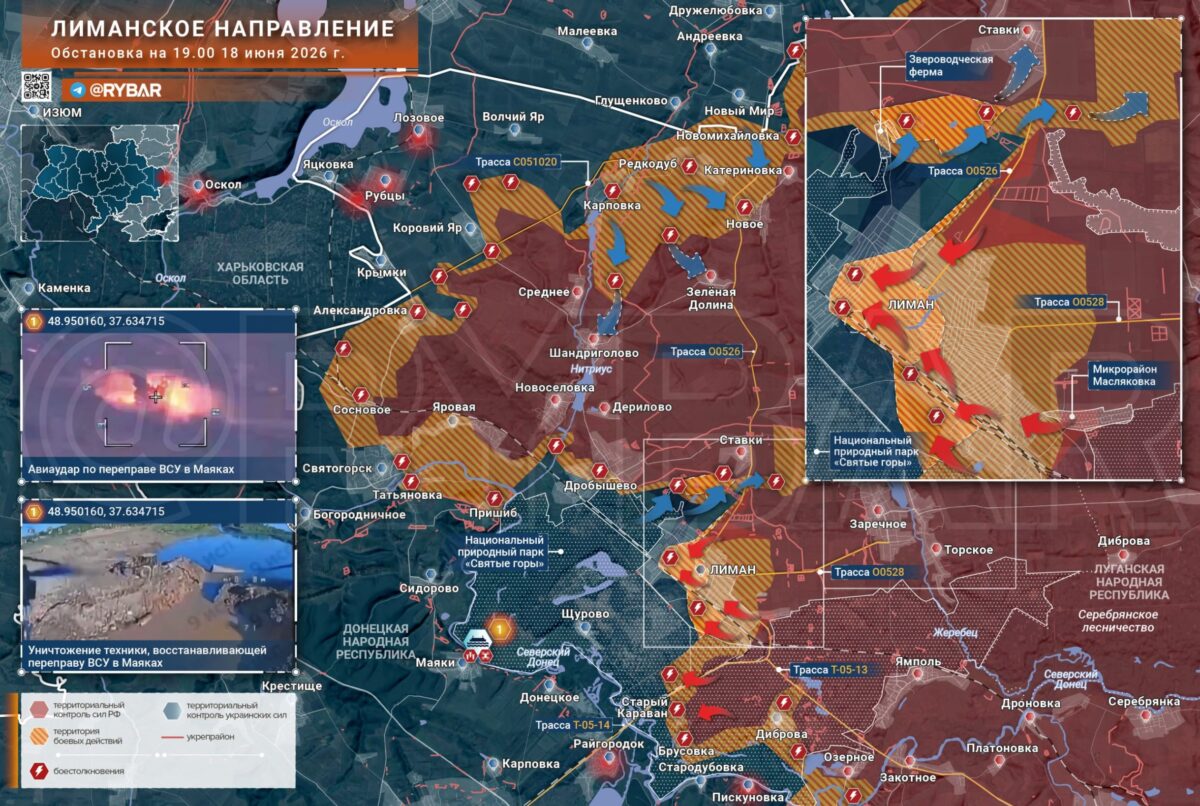
A risky dance is underway near Lyman. The Russians are pushing into the town, while further north the Ukrainians are trying to get into their rear. Less than 20 km as the crow flies separates this town from Rai-Oleksandrivka. They are therefore part of the larger battle for Sloviansk and Kramatorsk, as well as being the main theatres of the Russian summer offensive. Developments at one location inevitably affect both armies’ prospects at the other, even though in one place the Russians are attacking from the east and in the other from the north. After all, Podolyaka above wrote precisely about this in connection with the claim of capturing Rai-Oleksandrivka.
In the case of Lyman as well, the Russian Rybar drew a map and added an assessment that is again cautious and sober: “On the Lyman axis, units of the Western Group of Forces have improved their tactical position on the approaches to Lyman itself, which has allowed soldiers to operate in almost the entire area of the town. However, it is too early to speak of full control, because the Russian armed forces are fighting in small groups. And, as we have repeatedly reported, taking the town in this way is a very difficult and time-consuming task.”
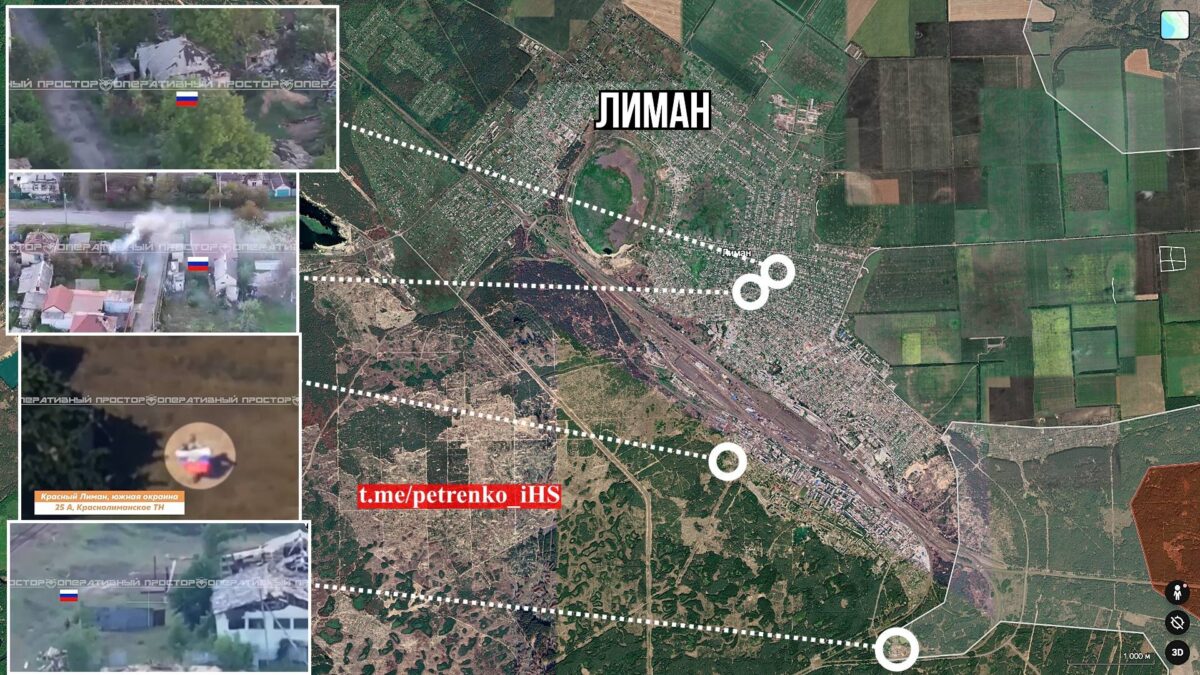
Petrenko’s map takes precedence over Rybar’s, as he did indeed confirm that Russian soldiers had been recorded in a large part of the town, but at the same time he said that the Russian defence ministry’s reports resembled the situation in Kupiansk, which the Kremlin claimed it had captured, even though the state of the battlefield did not correspond to that at all.
Now it is the Rybar map’s turn, because unlike the Ukrainian ones it shows something more – specifically, the Ukrainian effort to cut off the large Russian salient above Lyman and Sloviansk. In the central upper part of the map, note the number of blue arrows.
This time, unlike in other places where Rybar in the past reported on Ukrainian counterattacks, he draws the initial situation very similarly to Ukrainian and independent maps. In this case, that means the original front line somewhere near Kaprivka and Ridkodub. On the southern side of the salient, Rybar also reports a Ukrainian attack near the village of Stavky.
“North of the town, Ukrainian forces carried out a series of counterattacks towards Stavky, which led to one of the Russian armed forces’ access roads to the town once again coming under the control of Ukrainian forces,” Rybar wrote, adding that the situation in the entire salient “is extremely tense, because the enemy is clearly trying to cut off this ‘wedge’ near Shandryholove.”
Videos of the day
Firefighting in Moscow was to a large extent carried out by helicopters. In a short video there are five of them in different locations, including two Kamov firefighting helicopters. What you cannot see is the world’s largest helicopter, the Mi-26, which was also deployed.
Russia’s Ministry of Emergency Situations has dispatched numerous firefighting helicopters to fight the massive blaze at the Moscow Oil Refinery. pic.twitter.com/xJCiZu1a3v
— OSINTtechnical (@Osinttechnical) June 18, 2026
When, in the spring, a Ukrainian soldier fired a man-portable air-defence system in Zaporizhzhia directly from a street, some Russian accounts claimed that he was making the street and civilians a legitimate target, that this was a violation of the laws of war, and so on. Cut to a few weeks later, and Russian soldiers are firing in Moscow’s streets in the middle of full traffic.
A variation on the same theme. You only get a chance to see the launched missile at the beginning of the video. Its target is also clearly visible, but it probably failed. Just before launch you can hear the audio signal for the gunner that the target has been locked.
Moscow, a Russian soldier attempts to engage, and misses, an incoming Ukrainian attack drone with a MANPADS at near point blank range. pic.twitter.com/8IgLfiM6Ec
— OSINTtechnical (@Osinttechnical) June 19, 2026
What are the losses
Last updated on Monday (6 June).
By Monday (6 June), Russia had demonstrably lost 23,593 pieces of heavy equipment (on Monday (1 June) it was 23,556). Of this, 18,585 (18,551) pieces were destroyed by the Ukrainians, 982 (979) were damaged, 1,199 (1,199) were abandoned by their crews, and 2,827 (2,827) were captured by the Ukrainian army. This includes 4,397 (4,394) tanks, of which 3,300 (3,293) were destroyed in combat.
Ukraine has lost 11,425 (11,397) pieces of equipment, of which 8,888 (8,863) were destroyed, 680 (678) damaged, 670 (669) abandoned and 1,187 (1,187) captured. This includes 1,426 (1,424) tanks, of which 1,091 (1,089) were destroyed in combat.
Note: Neither side regularly reports on its dead or on destroyed equipment. Ukraine publishes daily figures for Russian casualties and destroyed equipment, which cannot be independently verified. In this overview we use data from the Oryx project, which since the start of the war has been compiling a list of equipment losses documented exclusively by photographic evidence.