Ukraine’s drone and missile campaign on oil infrastructure has brought impact of war to citizens of Moscow and elsewhereFive hours into the queue, tempers were already fraying at the gas station. Then a black Audi Q7 swept past dozens of waiting cars and pulled straight up to the pumps. Within
 Pjotr Sauer



Five hours into the queue, tempers were already fraying at the gas station. Then a black Audi Q7 swept past dozens of waiting cars and pulled straight up to the pumps. Within minutes, motorists were shouting, mobile phones were recording and a police officer had drawn his pistol to calm the crowds.
The confrontation, filmed on Saturday night at a petrol station in the Siberian town of Ust-Ordynsky, captured the growing frustration over Russia’s worsening fuel shortages, which have spread across a country that remains one of the world’s largest oil producers.
More than four years into the war, Ukraine’s campaign of long-range drone strikes on Russia’s oil infrastructure is increasingly being felt far from the frontlines.
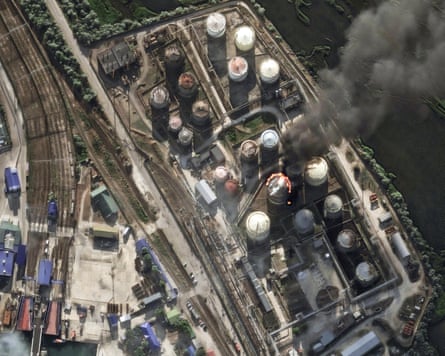
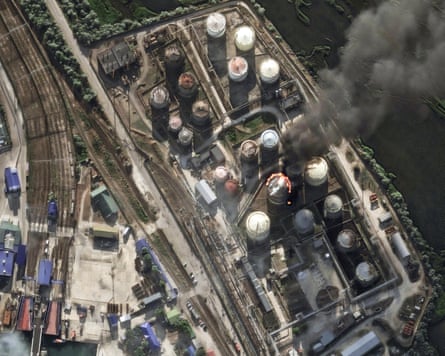
After repeated attacks on some of the country’s largest refineries in recent months that have damaged roughly a third of the country’s oil refining capacity, Russia’s gasoline production has fallen by about 25% year on year, leaving filling stations struggling to meet demand during the summer holiday season and the agricultural harvest.
The shortages first emerged in Russian-occupied Crimea in May but have since spread across almost the entire country, with only two Russian regions reportedly unaffected. The fuel crisis has become one of the most visible disruptions to everyday life for many Russians since the full-scale invasion of Ukraine, challenging the Kremlin’s efforts to shield the public from the war’s economic consequences.
For Putin, images of motorists waiting hours to fill their tanks are difficult to reconcile with his longstanding message that life has remained largely normal despite western sanctions and the war.
“Mass fatigue with the war is turning into mass irritation,” said Andrei Kolesnikov, a Moscow-based political analyst. Even so, he said the shortages were unlikely to trigger widespread protests in Russia’s tightly controlled political system. “There is certainly shock, but the lack of any real means of influencing the situation – and the risks associated with trying to do so – make protests unlikely.”
The disruption has become so severe that Russian officials acknowledged last week they were exploring fuel imports from Belarus, Kazakhstan and India – an extraordinary step for a country that is normally one of the world’s largest exporters of refined petroleum products. The government is also considering temporarily relaxing fuel-quality standards to allow companies to produce lower-grade gasoline and diesel.
Analysts say the longer-term impact of the shortages will largely depend on whether Ukraine can sustain its campaign against Russia’s oil infrastructure. On Monday, Ukrainian drones struck the Omsk refinery in western Siberia, roughly 1,800 miles (2,900km) from Kyiv, in what appears to be Ukraine’s deepest strike yet against Russia’s energy infrastructure.
For now, the fuel crisis is already reshaping daily life and beginning to ripple through the wider economy. “I could never have imagined we would be rationing fuel,” said Anastasiya, an employee at a logistics company in Irkutsk, one of the Siberian cities worst affected by the shortages. She requested her last name be withheld for security reasons.
She said that several of the company’s lorries carrying cargo had been stranded outside the eastern city of Chita for five days because drivers had been unable to find fuel. “It’s like the stories I heard about the Soviet Union, when people had to queue for food,” Anastasiya added.
Taxi drivers are increasingly staying off the road. Industry representatives told the Russian business daily Kommersant that the fuel crisis had reduced journeys by about 20%, with ride-hailing drivers increasingly unwilling to accept longer trips for fear they would be unable to find fuel afterwards.
In southern Russia, one of the areas hardest hit by the shortages alongside eastern Siberia, authorities have deployed Cossack patrols to help maintain order at petrol stations in Black Sea resorts as public frustration mounts during the peak tourist season.
The shortages have given rise to a grey market last seen shortly after the fall of the Soviet Union. According to Novaya Gazeta Europe, petrol is now openly advertised on Telegram and the marketplace website Avito, with sellers in Russian-occupied Crimea offering to deliver fuel by taxi within four hours at heavily inflated prices.
Some motorists have started to find their luck abroad, crossing into Kazakhstan and China to fill their tanks, a practice that has become common enough to earn its own nickname: “fuel tourism”.
Even Moscow, the political and economic heart of the country that has largely been protected from the consequences of the war, has begun to feel the effects. Many petrol stations across the capital have temporarily closed after disruption at one of the city’s largest refineries after a Ukrainian drone strike in June.
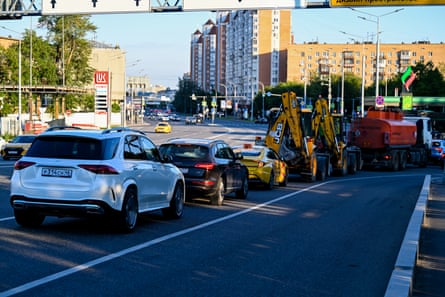
“One positive is that I’ve started walking more instead of constantly driving everywhere,” one Muscovite said, estimating that waiting times for petrol had risen to between one and two hours.
The shortages are starting to take a toll on the Kremlin’s standing. According to polling by the independent Levada Center, Putin’s approval rating fell five percentage points in June to 74% – its lowest level in four years – while the share of Russians who said the country was moving in the right direction dropped from 61% in May to 52%.
Senior Russian officials have begun speaking more openly about the costs of the war. “I don’t believe there is anyone in this country whose primary concern is anything other than an end to military hostilities as soon as possible,” German Gref, the powerful head of Sberbank, said recently.
There is little indication, however, that the Kremlin is preparing to change course. Over the weekend, Putin made a rare visit to the army’s headquarters, wearing military fatigues as he hailed what he described as Russian battlefield successes and dismissed Ukraine’s claims of recent successes as an “information and propaganda operation”.
Putin, who rarely addresses domestic problems before they become unavoidable, was forced last month to acknowledge the shortages, telling state television that Russia was experiencing “a certain deficit” of fuel, “but not a critical one”. On state TV, the message to Russians has been blunter: endure.
“Let’s remember what we’ve already survived. There’s no petrol now? Well, my generation remembers when food was rationed,” Margarita Simonyan, the editor-in-chief of RT and one of the Kremlin’s most prominent propagandists, said on her weekly programme on Rossiya 1 on Sunday.
“I call on everyone to stay calm. Yes, it’s hard. Very hard … But we’ll get through this too. I have absolutely no doubt.”