A month after the fall of Romania’s coalition government, President Dan has still not named a new prime minister, leaving the country in political limbo.
 Marian Chiriac



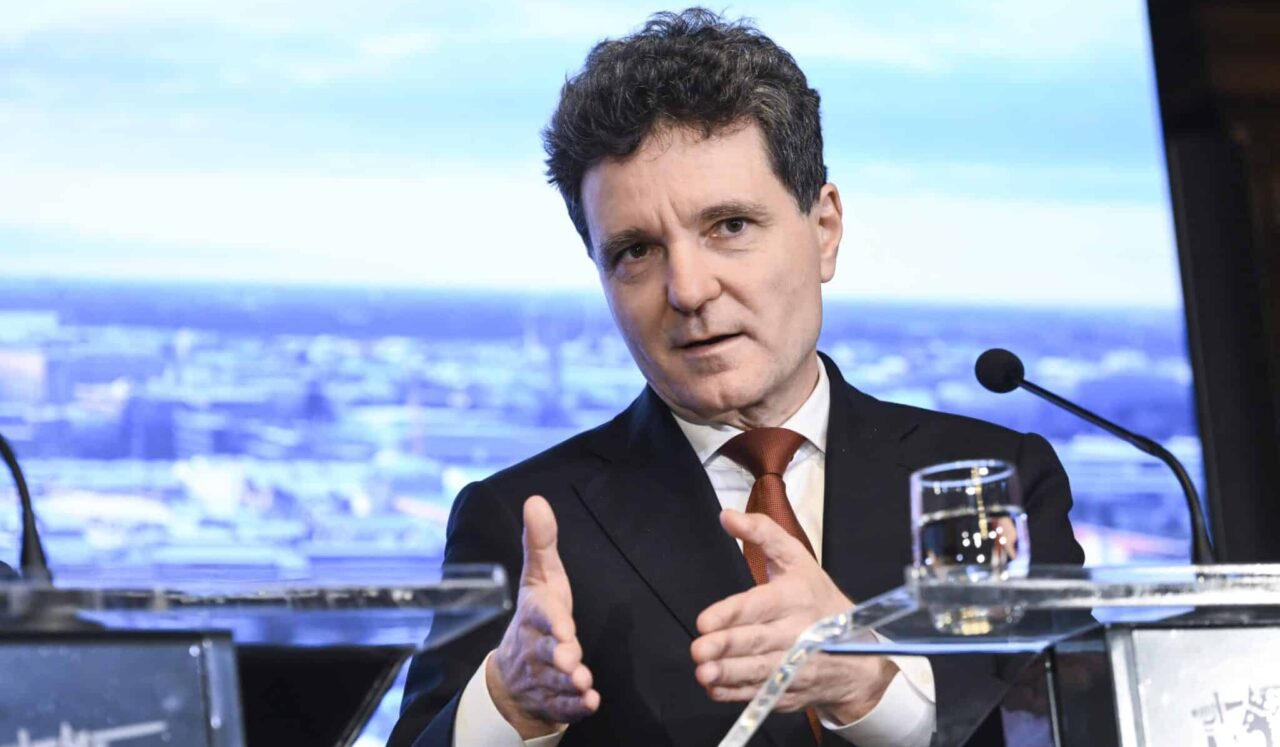
Romanian’s President Nicusor Dan attends the press conference of the Eastern Flank Summit in Helsinki, Finland, 16 December 2025. Photo: EPA/KIMMO BRANDT
After several rounds of consultations, President Nicusor Dan on Wednesday again invited the leaders of Romania’s main parliamentary parties to the Cotroceni Palace in a renewed effort to identify a candidate capable of leading a stable governing coalition.
The task remains challenging, however, as no single party commands enough votes in parliament to form a government on its own, while tensions among the members of the former pro-European governing coalition have risen.
The coalition, formed in June 2025, brought together the centre-left Social Democratic Party, PSD, the centre-right National Liberal Party, PNL, and two smaller centre-right parties. One of its main objectives was to curb the rise of the far-right Alliance for the Union of Romanians, AUR, led by George Simion.
Its mandate included stabilising the economy, which is burdened by the largest budget deficit in the European Union, securing access to €11 billion in EU recovery funds and safeguarding Romania’s investment-grade credit rating.
But a series of unpopular austerity measures introduced to reduce the budget deficit placed growing strain on the coalition, particularly with the Social Democrats, who withdrew their support on May 5. Prime Minister Ilie Bolojan accused PSD leaders of seeking his removal to “protect their own interests”.
President Dan then launched consultations with party leaders, expressing confidence about nominating a new prime minister “within days”. The process, however, has proved complicated.
“First of all, Dan’s original plan, to appoint a PSD-backed candidate who would also receive support from part of the PNL, failed,” journalist Cristian Pantazi told BIRN.
Pantazi, said the President then mulled appointing a politically independent technocrat to form a government.
“None of the names proposed to the parties gained sufficient backing,” he explained. “Moreover, few were willing to associate themselves with a future administration which, lacking a clear parliamentary majority, would have limited chances of surviving for long”.
The prolonged deadlock has raised concerns among investors and Romania’s European partners at a time of mounting economic and regional security challenges. Political uncertainty has complicated efforts to adopt measures required to reduce the budget deficit and unlock the European funding.
Interim officials have also been confronted with unforeseen security challenges. On 29 May, a Russian drone entered Romanian airspace and exploded in a town near the border with Ukraine, injuring two people.
The incident was the most serious cross-border spillover since the start of the Ukraine war, prompting renewed calls for stronger air defence coordination with NATO allies. It also exposed the constraints of a caretaker administration operating amid regional instability and domestic political uncertainty.
Analysts warn that a prolonged period without a stable government could weaken confidence in Romania’s ability to implement reforms and maintain fiscal discipline.
The situation has also fuelled speculation about early elections, although most major parties remain reluctant to embrace such a scenario. Romania’s next parliamentary election is not due until 2028. It has never held an early election.
For now, Dan appears determined to continue the negotiations, hoping that mounting pressure will eventually persuade rival political forces to reach a compromise.
Regardless of who forms the new government, Romania must continue to shrink its deficit as well as implement reforms to tap the EU recovery and resilience funds before an August cut-off date. The deficit is expected to narrow to 6.2 per cent of economic output this year from more than 9 per cent in 2024.