




Western city of Oradea again says no to Pride Parade for fourth consecutive year – adding to concerns about backsliding on LGBTQ+ rights in the EU-member country.
 Marian Chiriac



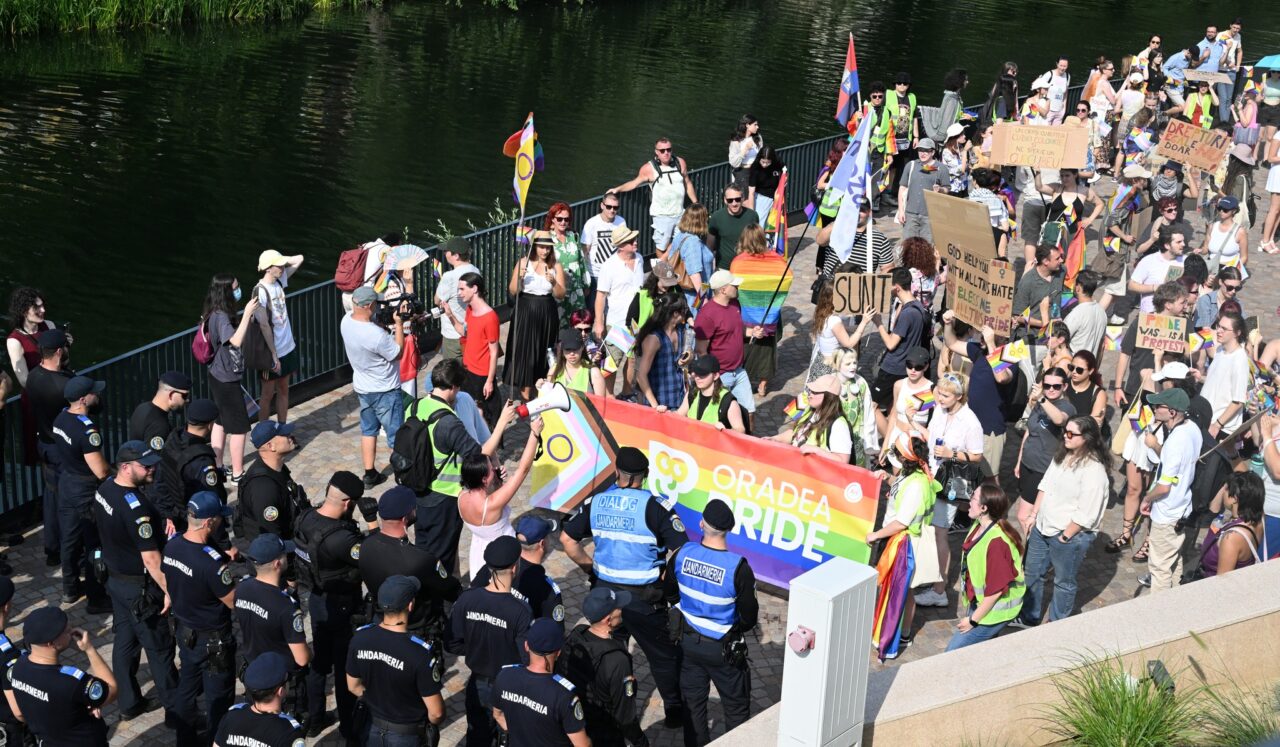
Oradea’s unauthorised Pride March in 2025. Photo: Photo: Ovi D. Pop/Oradea Pride.
Just over 250 kilometres separate Romania’s western city of Oradea from Budapest in Hungary, but until recently the two cities shared another distinction: both had refused to allow Pride marches.
Hungary’s capital hosted a Pride event this year despite government opposition. Oradea is now the only major city in the European Union where local authorities continue to deny permission for a Pride march, after refusing to authorise the 2026 event on Wednesday.
“The City Hall has decided not to approve the event. All 115 possible routes proposed by the organisers are concentrated in the city’s central area … These routes are unavailable because they overlap with other authorised events, or are affected by major public infrastructure works,” municipal spokesperson Octavian Haragoș said, as quoted by the local news outlet ebihoreanul.ro.
The municipality did not explain why alternative routes outside the city centre could not be considered. The decision followed weeks of delays by the city council in ruling on the organisers’ request, where conservative councillors and religious groups dominated the debate.
Human rights groups condemned the decision, arguing that it violates the constitutional right to peaceful assembly.
“We consider this decision completely unacceptable because it effectively blocks people’s constitutional right to peaceful assembly,” Victor Ciobotaru, director of ACCEPT, Romania’s leading LGBTQ+ rights organisation, told BIRN.
“Under Romanian law, local authorities cannot ban a public march. Their role is to identify practical solutions to ensure that such events can take place safely and under appropriate conditions, not to prevent them altogether,” Ciobotaru added.
Citing the same legal argument, ARK Oradea, the organisation behind the city’s Pride Parade, said the march would go ahead on July 25 despite the municipality’s refusal to authorise it.
“Our march will take place … As a sign of solidarity and concern for the situation in Oradea, representatives of nine diplomatic missions accredited to Romania, as well as representatives of the Ombudsman Institution, will be present in Oradea to monitor the unfolding of events,” ARK said, adding that the presence of diplomats reflects growing international concern over restrictions on freedom of assembly and LGBTQ+ rights in Romania.
This marks the fourth consecutive year that Oradea’s authorities have refused to authorise the Pride Parade.
Last year, however, an unauthorised march was still held through the city centre, attended by several hundred mostly young people. There were brief scuffles between some participants and the police but the situation did not escalate.
Authorities later imposed fines totalling 19,800 lei (about 3,900 euros) on organisers and participants in the unauthorised march
Romania has made progress on LGBTQ+ rights since joining the European Union in 2007 but continues to rank among the bloc’s weakest performers in terms of legal protections and social acceptance.
Consensual same-sex relations have been legal since 2001, but same-sex marriage and civil partnerships are not recognised, despite a 2023 ruling by the European Court of Human Rights requiring Romania to provide legal recognition and protection for same-sex couples.
Public attitudes toward LGBTQ+ people remain largely conservative, particularly outside major cities. Pride marches have been held annually in Bucharest for two decades, however, and in several other cities, generally under police protection and without major incidents.
Human rights organisations have urged Romania to strengthen anti-discrimination protections and fully implement European human rights standards, arguing that it is lagging behind in terms of the country’s commitments as an EU member.