
The Azerbaijani regime has arrested investigative journalists and dismantled independent media, leaving virtually no one on the ground to report on corruption and trade violations. And yet the EU Commission and German government are placing their trust in the authoritarian petro-state.
 Jeanne Cavelier



On Tuesday (21 July), Germany and Azerbaijan deepened ties through an extensive bilateral partnership as EU countries seek to wean themselves off Russian energy.
The agreement comes after European Commission president Ursula von der Leyen’s visit to Baku three weeks ago, where she declared: “Few countries are as well placed as yours to drive regional cooperation and stability.” She did not mention a single one of the Azerbaijani journalists behind bars.
European politicians are placing their hopes for smooth geopolitical waters in a state controlled by president Ilham Aliyev, the man who, this past February, announced “there is no independent media in the world” at the Munich Security Conference after refusing to answer questions from outlets that weren’t aligned with his government.
Aliyev’s prisons tell a different story.
They harbour at least 25 independent news professionals, according to Reporters Without Borders, most of them prosecuted after exposing corruption involving Azerbaijan’s political elite.
However, their reporting has not stopped. From inside squalid detention centres, they’ve been documenting the torture, medical neglect and sexual harassment inflicted on prisoners. Thanks to their reports, we have more proof of how Baku’s governance relies on systematically violating human rights. Were they not in jail, they would likely be exposing scandals on how Aliyev’s regime is, in fact, sabotaging “regional cooperation and stability.”
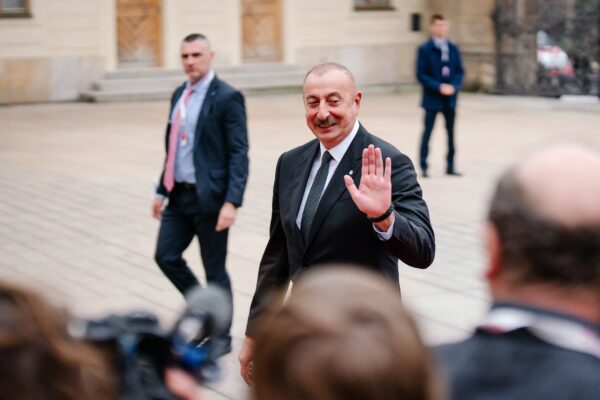
Azerbaijan is an authoritarian petro-state ranked among the ten countries with the lowest recorded levels of press freedom globally in our World Press Freedom Index.
Nonetheless, the country has deepened its strategic partnership with the European Union as Russia’s 2022 full-scale invasion of Ukraine and the 2026 Strait of Hormuz blockade intensified energy insecurity for states in western Europe.
‘Candid dialogue’ from Kallas?
High-level visits to Baku have followed in quick succession: in May, EU foreign policy chief Kaja Kallas described Azerbaijan as a “valuable energy partner” while vaguely mentioning there should be a “candid dialogue on human rights.” No meaningful engagement with imprisoned journalists’ families or independent civil society accompanied these visits.
This is not just a human rights failure, but a strategic one. The EU’s “valuable energy partner” is home to dozens of companies managing tankers that belong to Russia’s shadow fleet – vessels used to circumvent EU sanctions in response to the war in Ukraine.
The EU has consistently condemned press freedom violations in countries with comparable situations to Azerbaijan, such as neighbouring Russia, which ranks 172nd out of the 180 countries and territories surveyed in the 2026 World Press Freedom Index, and Iran, which holds 177th, place and has 26 imprisoned journalists.
Yet, officials remain peculiarly quiet on Azerbaijan, which ranks 171st. The difference is not the severity of the abuses — it’s the strategic interest in energy.
Meanwhile, in Azerbaijan, independent outlets have been systematically shuttered, their staff prosecuted on charges even members of the European Parliament describe as “politically motivated.”
Among them is Sevinj Vagifgizi, editor-in-chief of the investigative outlet Abzas Media, which published investigations into corruption networks linked to the Aliyev family – revealing systematic rent distribution to family members and loyal officials.
In November 2023, she was arrested at Baku airport, triggering a broader crackdown on independent media.
In June 2025, following a trial marked by fabricated evidence and disputed testimonies, Vagifgizi and six colleagues were sentenced to up to nine years in prison, recently upheld by the Supreme Court. The journalist is currently held in Lankaran prison near the Iranian border, where she was transferred last September in an attempt to further isolate her from lawyers, family and the public.
In parallel, journalists linked to the independent outlets Meydan TV and Toplum TV are currently on trial under nearly identical currency smuggling accusations, in cases observers say rely on bogus evidence recycled from previous unjust trials, intimidated witnesses and flawed investigations.
Now they’re being funnelled behind bars, Azerbaijan’s journalists have taken on a new beat.
The reports they’ve managed to smuggle out of detention describe severe mistreatment. Abzas Media’s imprisoned director Ulvi Hasanli has described routine torture in detention centers, writing that he could “set the clock” when violence starts between 9 and 10 a.m. Abzas Media reporter Nargiz Absalamova documented severe medical neglect, such as the case of an imprisoned woman who was falsely diagnosed as pregnant using outdated medical equipment – even though she had a hysterectomy years prior.
Women journalists have reported rape threats and sexist humiliation by prison staff.
Independent journalism exists within Azerbaijan, but it’s fighting for its life.
The question is whether European governments are willing to act as if it matters – publicly, and on the record. Private diplomacy and “candid dialogue” have not freed any of these news professionals. The names of those imprisoned must be spoken out loud, by EU leaders, in Baku.