
Rolling coverage of the latest economic and financial newsEurope faces a squeeze on its diesel supply this year, according to analysts at the bank Morgan Stanley, with stockpiles expected to decline over the coming months.Analysts including Martijn Rats wrote in a note yesterday:The picture is genuinely tight. Our supply/demand modeling
 Lauren Almeida




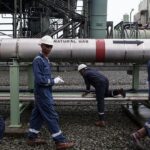
Europe faces a squeeze on its diesel supply this year, according to analysts at the bank Morgan Stanley, with stockpiles expected to decline over the coming months.
Analysts including Martijn Rats wrote in a note yesterday:
The picture is genuinely tight. Our supply/demand modeling points toward European diesel inventories falling to multi-year lows toward year-end.
…The real bottleneck in the oil system right now is refining, more so than crude…The epicenter of all this is the diesel market, and Europe in particular.
It comes as global energy markets grapple with the impact of renewed conflict in the Middle East.
Morgan Stanley now expects that European stockpiles will fall steadily from August, reaching a low of about 299m barrels in November. That would be the lowest level for that time of year since at least 2015, according to their analysis, which was first reported by Bloomberg.
Jim Reid of Deutsche Bank says the rapid rise in the oil price and fresh waves of strikes underscores “how quickly the situation is deteriorating”.
Three US service members were killed in separate incidents in Jordan and Iraq, while US strikes hit targets including Qeshm Island and multiple locations in southern Iran. At the same time, Iran broadened its retaliation beyond military sites, targeting critical infrastructure across the Gulf, including power and desalination facilities in Kuwait, as well as launching drone and missile attacks towards US bases and regional allies. And prospects for any diplomatic breakthrough remained dim, with Iran’s Foreign Minister Araghchi suggesting that some nuclear issues may ‘remain unresolvable’.
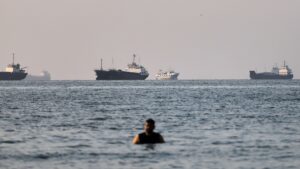
Tensions also escalated further in the strait of Hormuz, with Iran signalling a far more assertive stance over shipping flows and claiming to have intercepted vessels attempting to transit the waterway.
Oil prices have hit their highest level in more than a month as the US carries out its ninth consecutive night of strikes against Iran.
Brent crude, the international benchmark for oil, is now up by 2.7% to $90.49 a barrel, shortly after hitting as high as $91.41 – its highest level since June.
The jump in oil prices comes as the US carries out another fresh wave of attacks against Iran, after a fragile ceasefire agreement signed a month ago unravels and deepens a struggle for control over the strait of Hormuz.
The US announced the death of a third American service member over the weekend, after two people were killed in an Iranian attack on a Jordanian base on Friday, with another missing in action.
US president Donald Trump said “we hit them very hard again tonight” as he returned to Washington after the World Cup final, adding “we did that in honour of the, probably three, it’s probably three great patriots.”
The British military has also reported that a ship caught fire in the strait of Hormuz near the coastline of Oman, though it is unclear what triggered the blaze. Iran’s Revolutionary Guard (IRGC) later claimed two oil tankers were blown up after attempting to transit through the southern route of the strait, but there was no independent confirmation.
It also claimed on Monday that two oil tankers had exploded and been immobilised after attempting to transit the southern route through the strait of Hormuz.
The IRGC said the strait would remain unsafe as long as what it called US “aggression” in the region continued, warning that “this passage will not be safe for the transit of petrochemical products, nor even a single drop of oil and gas”.
Elsehwere this morning, uncertainty around the Middle East war has meant Ryanair has had to cut fares during the peak summer travel season.
The budget airline has said this morning that its first quarter average fares were 6% lower than last year.
Chief executive Michael O’Leary said in a statement:
The Middle East conflict led to consumer hesitancy, concerns about EU jet-fuel shortages, economic uncertainty and later bookings.
…Despite a recent, slight, uptick in volumes, and less price stimulation, Q2 pricing is trending modestly down (y-o-y) and the final H1 fare outcome is heavily dependent on the strength of close-in bookings in Aug. and Sept.
The company said its first quarter profit after tax fell 34% to €538m (£457m), down from €820m at the same point last year and compared with a forecast of €579m in a company poll of analysts.
The agenda